

There are two distinct classes of software engineering in a growth-stage B2B SaaS architecture, and failing to separate them through a dedicated enterprise readiness sprint is the primary reason technical founders miss their revenue targets. The first class is product domain logic: probabilistic, user-facing, feature-driven code designed to find product-market fit and differentiate your platform from incumbents. The second class is procurement compliance infrastructure: deterministic, binary, audit-driven plumbing designed to survive a Chief Information Security Officer’s (CISO) interrogation. When an engineering organization forces the same team to build both, the system hits a kill condition. Senior product developers are pulled off core roadmaps to decipher malformed identity metadata, retrofit database schemas for enterprise governance, and manually answer 47-question security assessments. Executing an enterprise readiness sprint—a time-boxed, architectural engineering cycle dedicated exclusively to procurement-mandatory infrastructure—is the structural solution to this bottleneck. It works not by bypassing the compliance requirements, but by ensuring that the engineers building your security controls are not the exact same engineers responsible for shipping your next core release.
The operational cost of handling enterprise readiness incorrectly rarely shows up on an invoice. It manifests as silent roadmap erosion. When your core product team is tasked with building secure B2B SaaS on a startup budget, assigning them to infrastructure plumbing creates an opportunity cost that compounds monthly. The developer time spent debugging federation edge cases directly subtracts from the capacity required to build the features your end-users actually pay for.
If you are evaluating whether your current engineering structure is absorbing too much compliance overhead, tracking your team’s throughput against enterprise onboarding frameworks will reveal the divergence immediately. The economic case for isolating this work is demonstrable: it protects product velocity, shortens sales cycles, and eliminates the cognitive friction that burns out senior developers.
Why Enterprise Requirements in an Enterprise Readiness Sprint Destroy Product Team Velocity
Context switching is not a soft human-resources complaint; it is a measurable structural degradation of engineering capacity. Research on human cognition in software development indicates that the recovery time from a major analytical interruption averages over 23 minutes. In a standard operational environment, a software engineer experiences between 12 and 15 significant context switches per day. When you calculate the arithmetic of cognitive reset, an engineer who is nominally allocated for an eight-hour workday is actively delivering fewer than four hours of focused, complex problem-solving output.
When you inject enterprise compliance tasks into a core product team’s sprint, you are not simply adding ticket volume; you are introducing a completely different domain of cognitive work. A developer deep in the headspace of user experience design or asynchronous data ingestion cannot seamlessly transition to debugging cryptographic certificate chains without a severe spike in error rates. Interruptions as brief as five seconds have been shown to triple error rates in complex logic tasks. Multitasking across domain boundaries—such as shifting from core algorithmic optimization to enterprise audit trail formatting—increases bug introduction rates by up to 50%.
In financial terms, this context-switching tax represents an ongoing loss of $50,000 to $78,000 per developer annually in wasted capacity, according to published developer productivity benchmarks from organizations like Stack Overflow’s engineering research division. However, if you are building a financial model for your board, do not rely on industry averages; audit your own fully loaded engineering costs against your delivery velocity. The real loss is not the salary expenditure itself—it is the enterprise contracts that stall in procurement because your team was trying to implement custom identity federation while simultaneously trying to ship a major version release.
The True Price of “Just One More Feature” Before an Enterprise Readiness Sprint
There is a persistent, dangerous optimism among technical founders that standard enterprise compliance features represent “a couple of sprints of work.” Because protocol specifications like RFCs exist and public API documentation is accessible, product teams routinely underestimate the surface area of enterprise plumbing. They assume the build is straightforward until they encounter the operational reality of enterprise IT environments.
If you examine the actual engineering footprint required to build enterprise infrastructure from scratch, the architecture breaks down into five distinct, labor-intensive domains:
SAML 2.0 (Security Assertion Markup Language) and OIDC (OpenID Connect) Integration: These are the industry-standard identity federation protocols that allow enterprise organizations to authenticate users through centralized identity providers (IdPs) such as Okta, Microsoft Entra ID, and Google Workspace. Constructing a production-grade federation layer requires between 350 and 500 engineering hours. The time is not spent on the basic authentication handshake; it evaporates in the edge cases. Your team must handle XML metadata parsing anomalies, implement automated X.509 certificate rotation without dropping active user sessions, engineer Single Logout (SLO) flows that behave inconsistently across different identity providers, and build the self-service administrative console that enterprise IT managers demand before signing a contract.
SCIM (System for Cross-domain Identity Management) Directory Synchronization: SCIM is the open standard protocol for automating user provisioning and deprovisioning between an enterprise identity directory and your application. Implementing reliable SCIM endpoints consumes 200 to 300 engineering hours per directory provider. When an enterprise IT administrator deactivates a terminated employee in Okta, their legal compliance mandate requires that user’s access to your application to terminate instantaneously. If your architecture relies on manual CSV uploads or nightly batch syncs, you will fail the vendor security assessment.
Hierarchical RBAC (Role-Based Access Control): Standard RBAC assigns permissions to flat user roles or isolated team workspaces. Hierarchical RBAC maps permissions to complex organizational structures—encompassing parent-child subsidiary relationships, geographic divisions, departmental branches, and granular project-level overrides. Retrofitting hierarchical RBAC into an existing application is not a surface-level feature addition; it is a fundamental database schema refactor requiring recursive common table expressions (CTEs) or materialized path trees to prevent query read times from degrading under load.
SIEM (Security Information and Event Management) Audit Logging: Enterprises require immutable, append-only audit logs that capture every authenticated action, structural change, and data access event within the platform. Formatting and streaming these logs to external SIEM ingestion engines—such as Splunk, Datadog, or AWS CloudWatch—requires 80 to 120 engineering hours. The complexity lies in guaranteeing tamper-resistance, enforcing strict schema formatting, and ensuring that high-frequency logging does not introduce latency into core application transaction paths.
SOC 2 Compliance Infrastructure: Preparing an application architecture for SOC 2 Type I and Type II compliance for SaaS involves exhaustive technical control mapping, automated evidence collection pipelines, encryption-in-transit and at-rest verification, and access anomaly alerting. Achieving an audit-ready baseline demands 640 to 900 engineering hours before the external auditor even begins their formal observation window.
When you sum these requirements, an in-house enterprise readiness build consumes between 1,200 and 1,800 hours of senior engineering capacity. Furthermore, custom-built authentication stacks carry a permanent maintenance overhead. Maintaining homegrown federation protocols, tracking IdP API deprecations, and answering security questionnaires consumes 15% to 20% of a senior engineer’s capacity indefinitely. Over a three-year operating window, the Total Cost of Ownership (TCO) for a custom-built enterprise infrastructure stack reaches approximately $900,000 when factoring in salaries, ongoing maintenance, bug remediation, and the opportunity cost of delayed product features.
The historical failure rate of internal builds confirms this structural risk. According to cloud infrastructure benchmarks from organizations like Bessemer Venture Partners, custom-engineered authentication and access systems experience three times more security incidents and compliance vulnerabilities than purpose-built, isolated identity architectures. Fewer than 25% of internal engineering teams successfully meet all enterprise procurement requirements on their first attempt, typically failing due to unhandled multi-IdP edge cases or incomplete SCIM deprovisioning logic.
Measuring DORA Metrics: Product Engineers vs. Enterprise Readiness Sprint Teams
To evaluate engineering efficiency objectively, technical leadership must rely on standardized, empirical frameworks rather than subjective progress reports. The DORA (DevOps Research and Assessment) metrics—comprising Deployment Frequency, Lead Time for Changes, Change Failure Rate, and Mean Time to Recovery (MTTR)—serve as the industry standard for measuring software delivery throughput and operational stability.
When a core product team is forced to absorb enterprise compliance development into their standard workflows, their DORA performance metrics degrade systematically across all four vectors:
Deployment Frequency collapses because the continuous integration and continuous deployment (CI/CD) pipeline becomes congested with massive, high-risk compliance pull requests. Refactoring core database schemas for hierarchical RBAC or modifying authentication state machines requires extensive security reviews, blocking routine product updates from merging into production.
Lead Time for Changes stretches from hours to weeks. A feature that would normally move from commit to deployment in two days is held in staging while engineers manually test SAML assertion parsing against multiple external identity providers or verify encryption control mappings for compliance documentation.
Change Failure Rate spikes significantly. Product engineers are domain experts in user workflows, business logic, and data visualization; they are rarely domain experts in cryptographic key rotation or directory federation protocols. Forcing developers to operate outside their primary competence results in configuration errors that trigger production outages or security vulnerabilities.
Mean Time to Recovery (MTTR) extends from minutes to days. When an identity federation outage occurs or a SCIM provisioning pipeline fails, core product teams lack the specialized runbooks, automated diagnostic tooling, and operational intuition required to isolate and resolve infrastructure-level authentication failures rapidly.
Conversely, isolating this work within a specialized enterprise readiness sprint team preserves the product team’s operational velocity. A specialized engineering unit operates within its native domain. They have solved XML signature wrapping vulnerabilities before; they maintain pre-built Terraform modules for audit logging; they understand the undocumented behavioral quirks of enterprise identity providers. A scope of work that consumes six months of a core product team’s roadmap is routinely executed by a specialized pod in eight weeks, with zero degradation to the company’s baseline DORA metrics.
Case Study: The $500K Opportunity Cost of Skipping a Specialized Enterprise Readiness Sprint
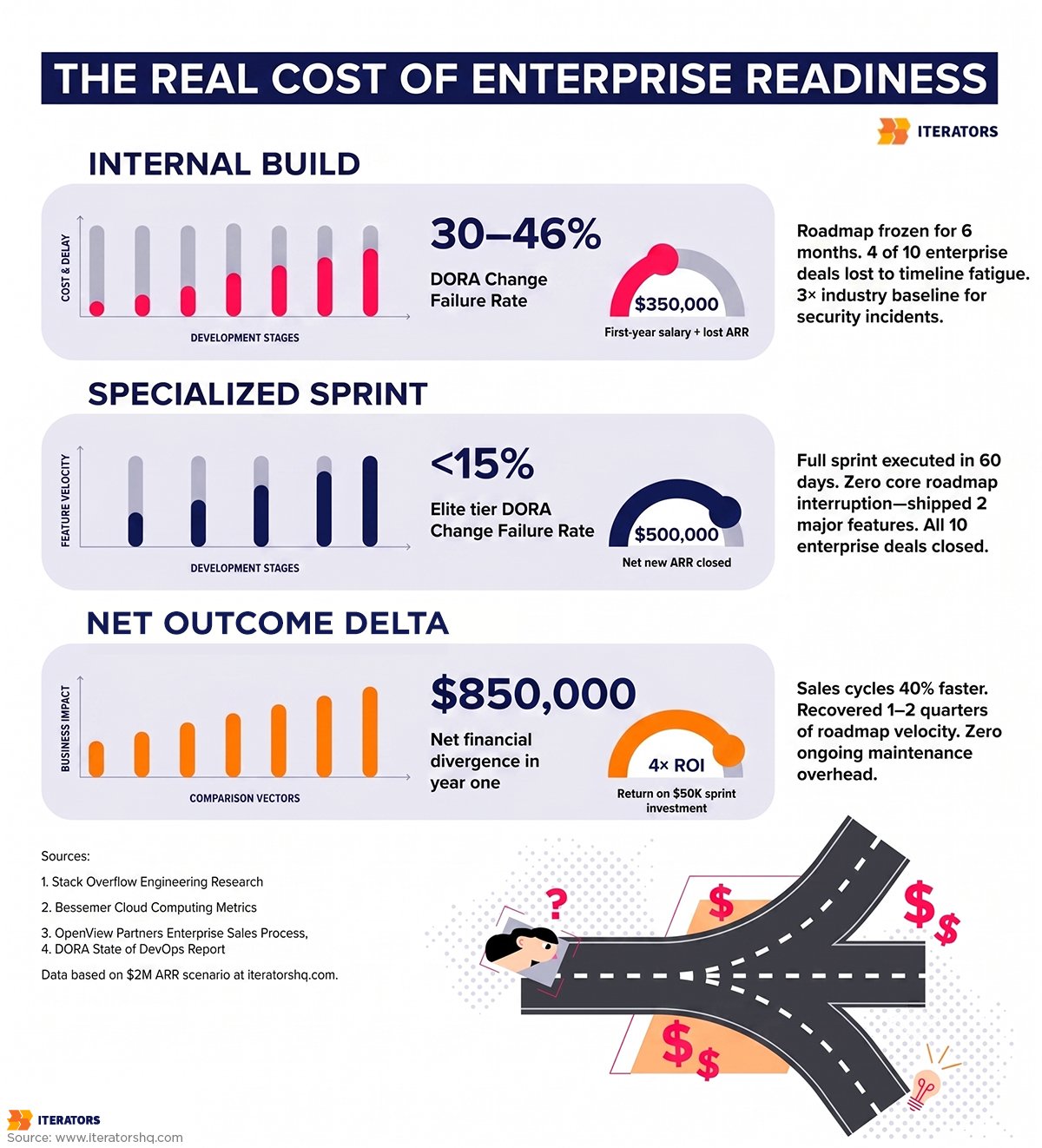
To examine the economic reality of this architectural choice, consider a B2B SaaS software startup operating at $2,000,000 in Annual Recurring Revenue (ARR) with ten enterprise contracts in its active sales pipeline, each valued at $50,000 in ARR.
Approach A (Internal Build): The Chief Technology Officer decides to build the necessary enterprise compliance infrastructure—SAML SSO, SCIM, and SOC 2 controls—using the internal product engineering team. Three senior developers are allocated full-time to the project for six months. The direct salary expenditure is approximately $150,000. However, during this six-month window, the core product roadmap is completely frozen. Because the company cannot demonstrate compliance on day one, procurement cycles stretch from 60 days to 180 days. Four of the ten enterprise prospects abandon the deal due to timeline fatigue or defect to a competitor whose platform is already enterprise-ready. The startup loses $200,000 in net new ARR. The combined first-year financial impact of the internal build—salary expenditure plus lost revenue—is $350,000, alongside a six-month stagnation in product evolution.
Approach B (Specialized Enterprise Readiness Sprint): The CTO retains a specialized software engineering partner to execute an external enterprise readiness sprint. The specialized team deploys the required authentication gateway, tenant isolation enforcement, and audit logging pipelines in 60 days. The direct engagement cost is $50,000. Because the platform achieves procurement readiness within the first quarter, all ten enterprise sales cycles proceed without technical friction, closing $500,000 in net new ARR. Meanwhile, the core product team ships two major differentiating features during the exact same timeframe, strengthening the company’s competitive market position.
The comparative performance of these two operational models is summarized below:
| Performance Metric | Product Team Handling Enterprise | Specialized Enterprise Readiness Sprint Team |
| Feature completion time | 5 to 6 months | 8 weeks |
| Context switches per sprint | 12 to 15 major interruptions daily | Single-domain focused execution |
| Product roadmap delays | 1 to 2 quarters frozen | Zero roadmap interruption |
| Enterprise deal closure time | Extended by ~36% due to review friction | Standard sales cycle maintained |
| DORA Change Failure Rate | High (30% to 46% error rate) | Elite (<15% error rate) |
| Mean Time to Recovery (MTTR) | Days to weeks for auth failures | Under 1 hour via specialized runbooks |
| Security vulnerability incidence | 3x industry average for identity | Industry baseline standard maintained |
Enterprise procurement teams do not evaluate software purely on feature merit; they evaluate institutional risk. According to enterprise software acquisition research from venture capital firms like OpenView Partners, complex B2B software transactions now require alignment across an average of 6.8 enterprise decision-makers and span 12 to 18 months from initial demo to contract execution. The most vulnerable phase of this cycle is the “procurement quiet zone”—the critical window between internal executive sponsorship and final CISO authorization.
When a SaaS vendor responds to a CISO’s security questionnaire within two hours by providing an automated trust center, pre-compiled SOC 2 Type II audit reports, and verified architectural documentation, they establish an epistemic advantage. They prove operational maturity. A vendor that requires three weeks to respond while their engineering team frantically attempts to build missing encryption or RBAC controls signals deep structural risk, causing enterprise risk committees to terminate the acquisition.
Calculate Your Internal Enterprise Readiness Overhead
Estimate the hidden P&L impact and roadmap lag of pulling your core product developers away from user-facing features to build procurement plumbing (SAML, SCIM, RBAC, SOC 2).
How the Enterprise Readiness Sprint Model Accelerates Deals Without Killing Product Velocity
An enterprise readiness sprint is a time-boxed, 60-day engineering methodology executed by a specialized team, dedicated strictly to implementing the infrastructure required to pass enterprise procurement security reviews. The core product team does not write code, manage infrastructure, or debug protocols for this initiative; they remain entirely focused on their product feature roadmap.
The 60-Day Enterprise Readiness Sprint Architecture
The sprint is structured into four sequential, deterministic phases designed to eliminate compliance gaps systematically:
Days 1–15: Architectural Assessment and Data Isolation Enforcement: The specialized team performs a comprehensive gap analysis against real-world enterprise procurement standards. They establish an Infrastructure as Code (IaC) baseline using Terraform, ensuring that all cloud networking, database instances, and security groups are defined in version-controlled configuration files to prevent manual environmental drift. They implement **Row-Level Security (RLS)** at the database tier—a relational database policy mechanism that enforces strict tenant isolation directly within SQL execution engines. By embedding tenant IDs into SQL table security policies, cross-tenant data leakage becomes programmatically impossible at the storage layer, satisfying a foundational SOC 2 security control.
Days 16–30: Identity Federation Gateway Deployment: Rather than modifying core application controllers to handle authentication parsing, the team deploys an edge identity gateway. This gateway intercepts SAML 2.0 and OIDC authentication payloads, validates cryptographic signatures, handles X.509 certificate exchange, and manages Single Logout (SLO) execution across providers like Okta, Entra ID, and Google Workspace. Once authentication is verified at the edge, the gateway issues a clean, standardized JSON Web Token (JWT) to the core application, isolating the product codebase from identity federation complexity.
Days 31–45: Automated Provisioning and Hierarchical Access Control: The team builds and verifies RFC 7644-compliant SCIM endpoints to enable automated user lifecycle management. When an enterprise IT administrator provisions or deactivates an employee in their central directory, the SCIM pipeline updates user records and immediately invalidates active session tokens upon deactivation. Simultaneously, the team deploys the necessary database schema refactor to support Hierarchical RBAC, enabling nested organizational permissions, multi-subsidiary governance, and inheritance-based role mapping without requiring product developers to rewrite core business logic.
Days 46–60: Compliance Evidence Engineering and Procurement Enablement: In the final phase, the team constructs append-only, tamper-resistant audit logging pipelines that format events to RFC 5424 syslog standards, streaming directly into enterprise SIEM platforms. They formulate disaster recovery runbooks, conduct verified backup restoration drills, and compile an exhaustive security questionnaire playbook backed by architectural evidence. Finally, they deploy a public-facing automated trust center that allows enterprise prospects to execute NDAs and download compliance documentation on demand.
The deliverable at the conclusion of day 60 is not merely abstract code; it is an audit-ready, procurement-verified operational posture. For a comprehensive technical breakdown of how to structure your internal systems for CISO evaluations, reviewing guide frameworks on preparing your product architecture for enterprise vendor assessment success demonstrates why clean documentation and architectural boundaries are just as load-bearing as the underlying code.
Which Enterprise Features Belong in an Enterprise Readiness Sprint Architecture
Deciding which engineering tasks belong in an enterprise readiness sprint versus the core product roadmap requires analyzing two variables: *skill domain specialization* and *long-term maintenance ownership*.
The following categorization matrix illustrates how to partition engineering responsibilities to prevent architectural entropy:
| Feature Domain | Responsible Team | Architectural Justification |
| Core Business Logic & UX | Core Product Team | Directly drives user adoption, competitive differentiation, and product-market fit. |
| SAML 2.0 / OIDC Identity Federation | Enterprise Readiness Team | Requires low-level protocol expertise, cryptographic handling, and multi-IdP edge case management. |
| SCIM Automated Provisioning | Enterprise Readiness Team | Infrastructure-level lifecycle automation that must strictly adhere to RFC directory specs. |
| Hierarchical RBAC Schemas | Enterprise Readiness Team | Requires specialized relational database refactoring (recursive CTEs) to prevent query degradation. |
| SIEM Audit Logging Pipelines | Enterprise Readiness Team | Requires tamper-resistant, append-only storage and high-throughput streaming integration. |
| SOC 2 Control & Evidence Mapping | Enterprise Readiness Team | Audit-driven operational documentation and infrastructure verification, not feature coding. |
| Database Row-Level Security (RLS) | Enterprise Readiness Team | Enforces tenant isolation at the storage engine layer, eliminating application-level leakage risk. |
| Trust Center & Security Playbooks | Enterprise Readiness Team | Procurement enablement assets required to satisfy CISO vendor assessment workflows. |
The dividing line is structural: if an engineering requirement exists primarily to satisfy an enterprise procurement compliance checkbox rather than to deliver direct workflows to an end-user, it belongs within the enterprise readiness sprint. Core developers must remain focused on proprietary algorithms, application performance, and user interface innovation.
The Enterprise Readiness Sprint Handoff Framework: Maintaining Product Cohesion
The primary technical risk of utilizing a specialized external engineering pod is the potential creation of knowledge silos or architectural drift. To ensure seamless continuity once the sprint concludes, the technical architecture must enforce strict decoupling through the **Gateway Pattern**—an architectural design pattern that places an abstraction layer between external integration endpoints and internal application services.
By terminating SAML 2.0, OIDC, and SCIM protocols at an isolated edge gateway, the complex mechanics of XML parsing, certificate validation, and directory token exchange never penetrate the core application codebase. The gateway translates verified external identities into standardized internal JWTs containing immutable user and tenant claims. Core product developers continue writing standard feature code, interacting solely with clean, predictable internal authorization tokens.
To prevent operational entropy during the transition back to internal ownership, the handoff framework mandates four verifiable deliverables:
1. Version-Controlled Infrastructure as Code (IaC): Every database schema modification, IAM permission policy, cloud gateway route, and security group rule must be authored in declarative Terraform or OpenTofu scripts. Manual configuration changes within web cloud consoles are strictly prohibited, ensuring that the entire enterprise compliance infrastructure can be programmatically reconstructed or audited from version control.
2. Automated Security Test Suites: The specialized team must deliver an automated test harness integrated directly into the company’s CI/CD pipeline. This suite continuously executes regression tests against SAML signature verification, token expiration bounds, SCIM deprovisioning execution, and tenant RLS boundary enforcement. If a future product feature accidentally violates an enterprise security constraint, the automated test suite blocks the deployment pipeline immediately.
3. Live Pair-Programming Walkthroughs: Static documentation is insufficient for transferring operational intuition. During the final week of the sprint, the specialized engineering pod conducts mandatory, structured pair-programming sessions with internal engineering leads on live staging environments. These sessions focus specifically on debugging failure modes: simulating certificate expiration, forcing IdP synchronization timeouts, and executing database point-in-time recovery.
4. Definitive Incident Response Runbooks: The team delivers exhaustive, step-by-step operational runbooks covering identity provider outages, cryptographic key rotation procedures, SIEM pipeline congestion, and SCIM sync conflicts. The first time an internal engineering lead encounters an enterprise authentication anomaly must not be the time they attempt to improvise a recovery strategy.
Decision Criteria: Is Your Company Ready for an Enterprise Readiness Sprint?
When an Enterprise Readiness Sprint Makes Sense
Separating enterprise feature development from core product delivery is a strategic architectural decision that must be timed correctly. Deploying an enterprise readiness sprint too early wastes capital on infrastructure before achieving product-market fit; deploying it too late results in stalled enterprise contracts and severe roadmap disruption.
The following operational indicators confirm that a company has reached the structural threshold requiring an independent enterprise readiness sprint:
| Operational Vector | Actionable Threshold Signal | Structural Implication |
| Annual Recurring Revenue (ARR) | Crossing $1,000,000 to $5,000,000 ARR with target ACVs exceeding $100,000. | The economic value of closing single enterprise deals now justifies dedicated infrastructure investment. |
| Sales Pipeline Composition | Enterprise prospects represent ≥20% of active pipeline opportunities. | Standard product growth is becoming constrained by upmarket compliance requirements. |
| Procurement Friction | Two or more consecutive deals stalled in CISO security review for >60 days. | Absence of SSO, SCIM, or SOC 2 is actively causing revenue leakage and deal abandonment. |
| Roadmap Erosion | Compliance requests consume >20% of core sprint capacity or delay features by >1 quarter. | Context switching is actively destroying core product team velocity and DORA metrics. |
| Developer Sentiment | Senior engineers express vocal frustration regarding security questionnaires and plumbing. | High risk of engineering burnout and developer attrition due to domain mismatch. |
Three Approaches to Enterprise Readiness Teams
Once technical leadership acknowledges the necessity of separating enterprise infrastructure from core product development, they must evaluate three distinct organizational execution models:
| Execution Model | Target Company Stage | Primary Advantages | Structural Disadvantages |
| Full-Time Internal Team | >$10M ARR with large, continuous enterprise feature backlog. | Total institutional ownership; tight alignment with internal product architecture. | Prohibitive headcount cost; 4-to-6 month hiring ramp; severe overhead for early-stage SaaS. |
| Specialized Team Extension (Enterprise Readiness Sprint) | $1M to $10M ARR requiring immediate procurement maturity. | Immediate domain expertise; 60-day execution; zero permanent headcount overhead post-sprint. | Requires strict API boundary enforcement and disciplined, structured handoff protocols. |
| Hybrid Platform Model | $5M to $15M ARR scaling across international enterprise markets. | Combines internal strategic ownership with rapid external engineering execution. | Requires sophisticated governance and architectural coordination between teams. |
For growth-stage B2B SaaS organizations operating between $1M and $10M ARR, the specialized team extension model—executing a time-boxed enterprise readiness sprint—delivers the highest return on capital. It resolves the immediate CISO procurement bottleneck in 60 days without burdening the P&L with permanent, specialized compliance engineering headcount that would sit underutilized once the foundational infrastructure is operational. When evaluating specialized external partners, examining platforms that specialize in enterprise-ready HR tech platforms and essential compliance architectures provides valuable insight into the domain expertise required to navigate complex B2B security requirements.
Addressing “But What About…” Concerns in an Enterprise Readiness Sprint

“Won’t Using External Engineers Create Knowledge Silos?”
This is a legitimate technical concern, but the root cause of knowledge silos is architectural, not organizational. When external or internal teams build undocumented, highly coupled software that weaves complex compliance logic directly into core product controllers, knowledge silos are inevitable. The solution is enforcing clean architectural decoupling through the Gateway Pattern and declarative Infrastructure as Code.
When identity federation, SCIM provisioning, and SIEM audit streaming are encapsulated within an edge gateway managed by version-controlled Terraform scripts, there is no mysterious codebase woven through your business logic. Your core engineering team inherits well-documented infrastructure modules governed by explicit API contracts and automated regression test suites. The risk of organizational entropy is eliminated by treating the structural handoff as a first-class engineering deliverable.
“How Do We Ensure Quality and Architectural Integration?”
Quality and seamless integration are guaranteed through three deterministic engineering mechanisms:
Strict API Contract Enforcement: Before sprint execution begins, internal and external engineering leads define immutable API schemas and JSON Web Token (JWT) data structures. The enterprise infrastructure operates strictly within these boundaries, ensuring that external engineering work cannot alter core product data models.
Continuous CI/CD Security Regression Harness: Automated end-to-end integration tests validate SAML assertion parsing, token expiration boundaries, SCIM lifecycle events, and RLS database policies on every pull request. Architectural drift surfaces immediately as a failed pipeline build rather than an undetected production bug.
Feature Flag Isolation: All enterprise compliance capabilities are wrapped in dynamic feature flags. This allows enterprise infrastructure to deploy independently of core product release cycles, mitigating deployment risk and enabling instantaneous rollback if an identity provider API experiences instability.
“What If Enterprise Requirements Conflict with Our Core Product Vision?”
This is a governance challenge, not an engineering problem. Enterprise procurement requirements—such as custom SAML attribute mapping, specialized RBAC hierarchy rules, or unique SIEM log formatting—must never be treated as standard product feature requests. When enterprise compliance tasks are dumped into the general product backlog, they compete directly with user-facing innovation, causing roadmap paralysis.
By enforcing architectural separation between core product logic and enterprise infrastructure, compliance requirements cannot contaminate the user experience by default. If an enterprise prospect demands a custom workflow that violates core product boundaries, that request is elevated to the CTO or VP of Product as a formal business trade-off, rather than being silently absorbed by developers attempting to close a Jira ticket. Specialized development team extensions operate strictly within the technical governance boundaries defined by your engineering leadership.
Getting Started: 30/60/90-Day Milestones for Your First Enterprise Readiness Sprint
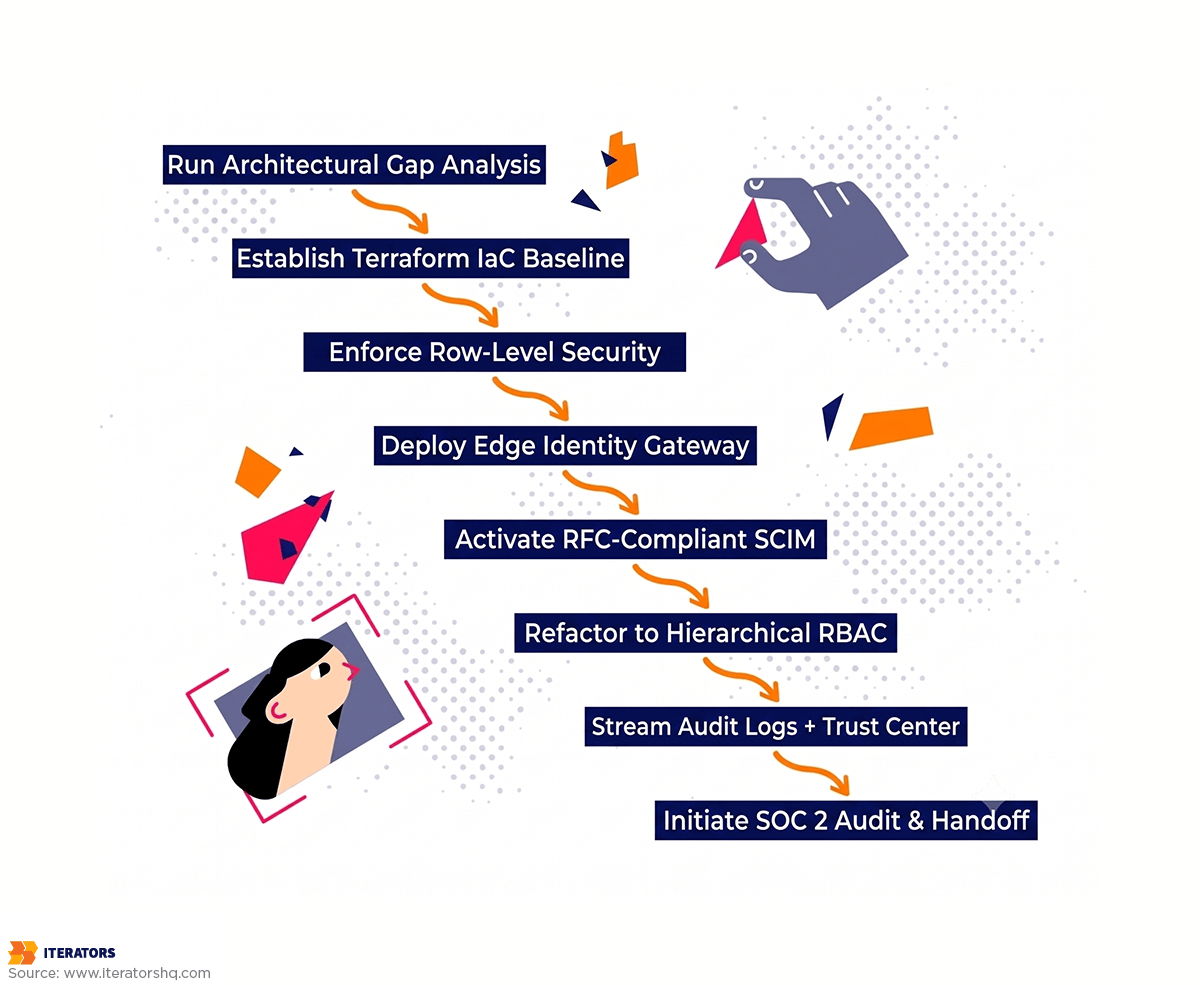
Before initiating an enterprise readiness sprint, engineering leadership must conduct an objective, witness-driven audit of their current architectural posture. Do not rely on assumptions; verify your systems against the following binary procurement baseline:
The CISO Procurement Baseline Checklist:
- SAML 2.0 or OIDC single sign-on operational in production with at least one major enterprise IdP (Okta, Entra ID, Google Workspace).
- SCIM automated user provisioning and instantaneous deprovisioning endpoint operational.
- Database permission schema supports hierarchical RBAC (nested organizational divisions, subsidiaries, and departments).
- Immutable, append-only audit logging streaming natively to external SIEM ingestion engines (RFC 5424 compliant).
- Tenant data isolation enforced at the storage engine layer via database Row-Level Security (RLS), not merely application logic.
- SOC 2 Type I audit completed or Type II observation window actively running with automated evidence tracking.
- Security questionnaire playbook containing verified, evidence-backed architecture responses ready for same-day delivery.
- Automated, public-facing trust center live for instant NDA execution and compliance document distribution.
If your architecture currently fails more than three of these baseline criteria, your next enterprise sales opportunity will inevitably stall during CISO security review. To systematically eliminate these technical deficits without disrupting core product delivery, execute the sprint across the following structured milestone schedule:
30/60/90-Day Enterprise Readiness Sprint Execution Roadmap
Days 1–30 (Foundation, Infrastructure as Code, and Identity Gateway): Complete exhaustive architectural gap analysis against target enterprise customer requirements. Stand up version-controlled Terraform infrastructure modules for all cloud environments. Implement database-level Row-Level Security (RLS) to guarantee tenant isolation. Deploy the edge identity authentication gateway, configuring and verifying SAML 2.0 and OIDC integrations with Okta and Entra ID. Automate X.509 certificate rotation pipelines.
Days 31–60 (Lifecycle Automation, RBAC, and Compliance Streaming): Deploy RFC 7644-compliant SCIM endpoints, verifying automated user provisioning and immediate session termination upon directory deactivation. Execute the database schema refactor required for Hierarchical RBAC without altering core application controllers. Implement RFC 5424-compliant append-only audit logging, streaming events natively into Datadog and Splunk. Deploy the automated trust center and finalize the evidence-backed security questionnaire playbook.
Days 61–90 (Audit Verification, Team Handoff, and Product Continuity): Execute verified disaster recovery and point-in-time database restoration drills. Initiate formal SOC 2 Type I audit observation with an external auditing firm. Deliver same-day, evidence-backed security responses to all active enterprise sales prospects. Conduct structured pair-programming walkthroughs and review operational runbooks with internal engineering leads. Confirm zero degradation to baseline DORA metrics, verifying that the core product engineering team has successfully shipped two major roadmap features uninterrupted during the 90-day window.
Conclusion
The economic reality of B2B SaaS scaling is absolute: when you force your core product engineering team to build enterprise compliance infrastructure, you pay a compounding financial penalty across three distinct vectors. You pay the direct salary expenditure of senior developers writing low-level protocol plumbing; you pay the opportunity cost of product differentiation features that never get shipped; and you pay the catastrophic P&L cost of enterprise contracts that stall or abandon during lengthy CISO security reviews. For a software company operating at $2M ARR with a $500K enterprise sales pipeline, the net financial divergence between an internal engineering build and a specialized enterprise readiness sprint exceeds $850,000 in first-year revenue impact.
An enterprise readiness sprint is not a superficial development shortcut; it is a fundamental architectural decision regarding organizational boundaries and domain specialization. Your core product developers are highly compensated because they possess the unique probabilistic intuition required to solve user workflows and drive product-market fit. A specialized engineering unit—whether structured as an isolated internal pod or retained through specialized development team extension services—possesses the rigorous, deterministic engineering discipline required to satisfy enterprise security auditors and make your software safe to procure. These represent entirely different engineering competencies. Treating them as interchangeable commodities is the precise operational error that destroys product velocity.
If your organization needs to evaluate its current architectural posture against CISO procurement standards, scheduling a technical review with our team will help identify where your compliance plumbing risks derailing your product roadmap. Through our enterprise readiness consulting and engineering extension teams, we work alongside technical founders to isolate compliance plumbing, secure SOC 2 postures, and accelerate enterprise sales cycles without taking a single core developer away from their primary features.
Yet, as you evaluate your engineering roadmap for the coming two quarters, there is a foundational operational question you must answer before writing a single line of compliance code: when an enterprise customer’s identity provider unexpectedly updates its signing algorithm or deprecates a core SCIM API endpoint six months from today, which specific engineer on your team owns the degradation path, and what core product feature will you cancel so they have the bandwidth to fix it?
Frequently Asked Questions

What is an enterprise readiness sprint?
An enterprise readiness sprint is a time-boxed, 60-day architectural engineering cycle dedicated exclusively to building the technical infrastructure required to pass enterprise CISO procurement reviews—specifically SAML 2.0/OIDC single sign-on, SCIM automated user provisioning, database row-level security (RLS), hierarchical RBAC, and SIEM-compliant audit logging. A specialized engineering pod executes the sprint using an isolated Edge Gateway Pattern and declarative Infrastructure as Code (Terraform), allowing the company’s core product developers to continue shipping roadmap features without interruption or cognitive context switching. The primary deliverable is an audit-ready, procurement-verified operational posture that allows sales teams to pass security questionnaires on day one of an enterprise transaction.
How much does enterprise feature development typically cost?
Custom-building enterprise compliance infrastructure in-house consumes between 1,200 and 1,800 senior engineering hours, representing an upfront fully loaded personnel expenditure of $100,000 to $150,000. However, when factoring in permanent ongoing maintenance, IdP protocol deprecations, automated certificate rotations, and security questionnaire remediation, the Total Cost of Ownership (TCO) for a homegrown enterprise auth stack reaches approximately $900,000 over a three-year operating window. Conversely, utilizing a specialized development team extension to execute an external enterprise readiness sprint typically requires a direct expenditure of $40,000 to $60,000, eliminating permanent headcount overhead while protecting internal product roadmap velocity.
When should startups start building enterprise features?
A startup should initiate an enterprise readiness sprint as soon as target Annual Contract Values (ACVs) exceed $100,000, or when enterprise sales prospects represent 20% or more of the total active sales pipeline. Attempting to build compliance infrastructure reactively after an enterprise champion has already signed an internal proposal is an operational failure mode; building complex identity federation and database isolation under a ticking procurement clock inevitably results in architectural shortcuts, severe security vulnerabilities, and deal abandonment.
Can product engineers ever work on enterprise features?
Product engineers can technically write compliance code, but forcing them to do so inflicts catastrophic opportunity costs on the business. Core product developers are domain experts optimized for probabilistic user workflows, UI/UX performance, and proprietary business logic; they are rarely domain experts in cryptographic key rotation, X.509 certificate parsing, or RFC directory federation specs. Forcing developers across these distinct cognitive domains generates severe context-switching penalties, degrades DORA deployment frequency, and results in custom authentication systems that suffer three times more security incidents than purpose-built, isolated architectures.
How long does SOC 2 compliance take with a specialized team?
A specialized engineering pod can establish an audit-ready SOC 2 Type I infrastructure baseline within a 60-day enterprise readiness sprint. The specialized team deploys version-controlled cloud networking, configures database Row-Level Security (RLS), implements encryption-in-transit and at-rest verifications, and automates evidence collection pipelines without requiring core product developers to divert bandwidth from feature development. SOC 2 Type II certification—which mandates an auditor observation window of three to six months—follows directly from this architectural foundation and runs seamlessly in the background during the post-sprint operating period.
What is the ROI of using external enterprise readiness teams?
The empirical return on investment for an external enterprise readiness sprint manifests across three measurable vectors: a 40% compression in enterprise sales cycle duration, an 80% to 90% reduction in engineering hours wasted on manual security questionnaires, and the complete elimination of product roadmap delays. In direct financial terms, if a $50,000 specialized engineering sprint prevents two $100,000 enterprise contracts from stalling or abandoning in procurement, the direct first-year revenue ROI is 4x—before accounting for the hundreds of thousands of dollars in preserved engineering capacity and competitive feature velocity gained by keeping core developers focused on their primary product roadmap.