

Every team I’ve worked with that underestimated travel app development made the same mistake: they scoped it like e-commerce with a map view. They looked at Booking.com or Kayak and saw a search bar, some filters, a hotel card, a booking button. They thought: we need a backend, a mobile app, some API connections, maybe a nice itinerary screen. Six months later they were debugging XML envelope structures at 11 PM, arguing with a GDS certification team in a different timezone, and explaining to their investors why “integrate booking API” was apparently not a single Jira ticket.
Most travel app development challenges are invisible to users. They don’t happen in the search results, the map, or the “Book Now” button. They happen in the integration layer behind that button. That layer orchestrates inventory that expires, prices that change without warning, APIs you don’t control, and bookings that can fail after payment has already cleared.
A travel app is not a storefront. It is a coordination system for perishable inventory, dynamic pricing, external supplier availability, payment authorization, and third-party API reliability. All of that runs at the same time, dependent on systems you didn’t build and can’t fully control.
That’s the thesis. The rest of this article explains what it means in practice.
Travel App Development Challenges Are Mostly Invisible to Users
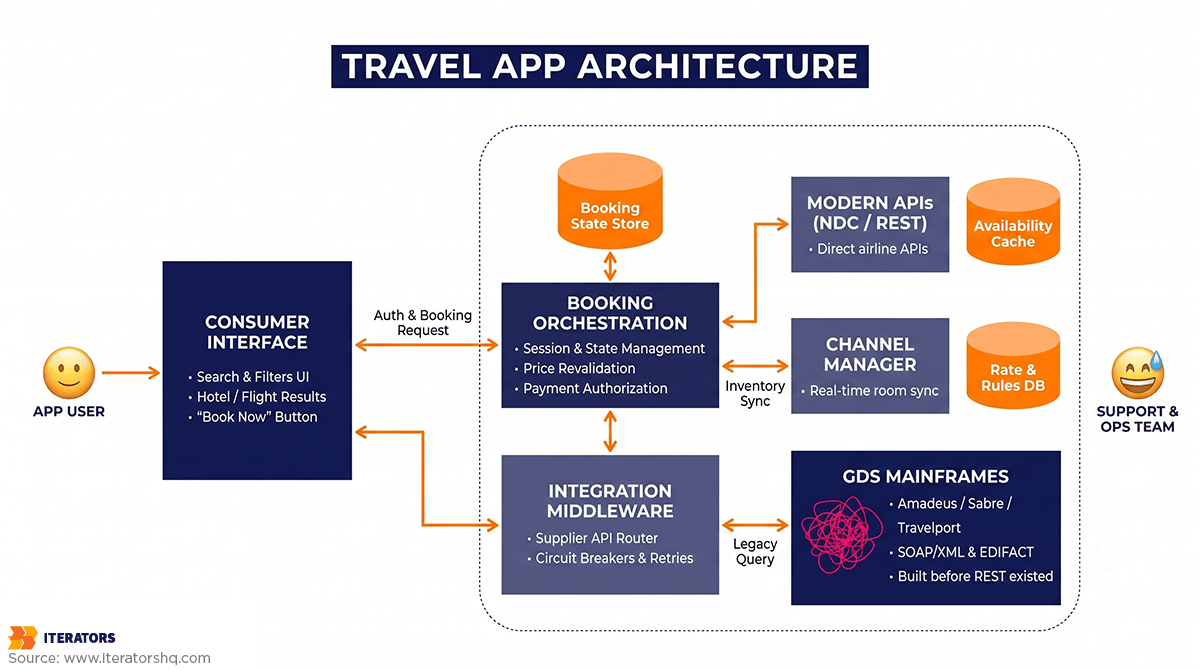
Users interact with a clean interface. Developers deal with fragmented supplier systems that were built decades before REST APIs existed. Founders scope the project by looking at the consumer surface.
This gap between what users see and what engineers must build is the source of most failed timelines and blown budgets in travel software.
Standard e-commerce is relatively predictable. You own your inventory. Your database says whether a product is in stock. Your price doesn’t change between the time a user adds something to their cart and the time they check out. If a payment fails, you retry. If a product runs out, you restock.
None of that is true in travel.
The inventory is owned by airlines, hotels, tour operators, and car rental companies. The price is determined by yield management algorithms that update constantly. Availability is not the same as bookability. A hotel room might appear available in one system and already sold in another. And if a payment succeeds but the booking fails, you have a real operational problem, not just a code error.
That’s the structural difference. Travel is not normal e-commerce because inventory expires and depends on external systems you don’t own or control.
Why Travel Inventory Breaks Normal E-Commerce Logic
A hotel room that isn’t sold tonight disappears forever. It doesn’t go back to the warehouse. A flight seat at a specific fare class is available for minutes, not days. A tour slot depends on weather, local operator capacity, guide availability, and seasonal demand, all at once.
This is what “perishable inventory” means in practice. And it changes the entire architecture of how your app must handle data.
In standard e-commerce, you can cache product availability aggressively. The product exists until someone buys it. In travel, cached data has a shelf life measured in minutes. Travel search produces far more lookup traffic than completed bookings because users compare calendars, destinations, routes, and room combinations before committing.
You cannot query a live supplier API for every top-of-funnel lookup. The rate limits alone would hurt you. The compute costs would be high. The latency would make your app unusable.
So you need smart caching. You serve indicative, directional pricing from a local cache, for example Redis, for the overwhelming majority of top-of-funnel queries. You reserve live supplier API calls for the moment a user signals genuine booking intent: the price revalidation step, right before checkout.
Getting that bifurcation right is one of the first real architecture decisions in travel app development. Most teams don’t think about it until they’ve already built the wrong thing.
One more thing worth naming: availability is not the same as bookability. A room appearing in a channel manager feed might be under a minimum stay restriction, a closed-to-arrival rule, or a specific rate plan that doesn’t apply to the user’s dates. Your app has to handle the difference between “this exists” and “this can actually be booked right now.”
GDS Integration Is One of the Biggest Travel App Development Challenges

If your travel platform involves flights, whether you’re building an OTA, a corporate travel management tool, or a full itinerary aggregator, you will eventually need to deal with Global Distribution Systems.
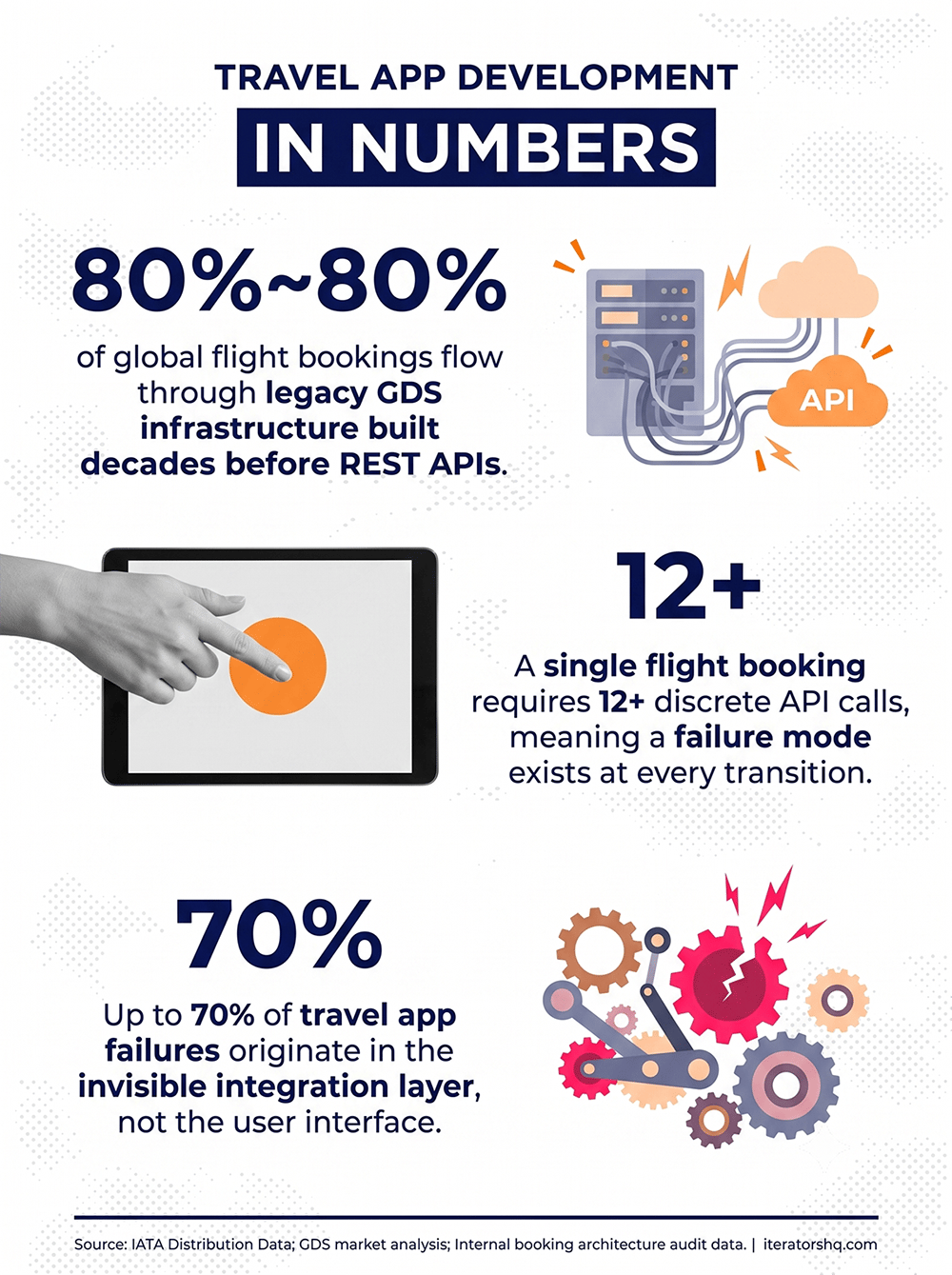
A GDS is the infrastructure layer that connects travel agents, OTAs, and booking platforms to airline inventory, fares, seat availability, and ticketing. The three major systems are Amadeus, Sabre, and Travelport. They’ve been the backbone of global air distribution for decades, and they are not going to be replaced by a clean REST API anytime soon.
What GDS integration actually does: When your app connects to a GDS, you get access to flight search, fare rules, seat availability by class, PNR (Passenger Name Record) creation, ticketing, post-booking modifications, and cancellations. That’s the full lifecycle of a flight booking, from search to issued e-ticket.
Why plugging in an API is the wrong mental model: The first thing that surprises most development teams is the data format. Sabre, for example, still exposes a large set of legacy SOAP APIs alongside REST APIs. Deep integrations often force developers to work with verbose XML payloads wrapped in WS-Security headers that require cryptographic signing. If your team is primarily working in modern JavaScript or TypeScript, you’ll need to build custom middleware to handle this. Java and .NET have native libraries that manage SOAP envelopes more gracefully. That is one reason a lot of travel tech still runs on older stacks.
The second surprise is the certification requirement. Even after your team has built, tested, and validated every API call in the GDS sandbox environment, you cannot access live production data until the GDS provider’s internal specialists have audited your implementation. They access your test environment directly, verify every request and response sequence against their network standards, and confirm the end-to-end booking flow works without straining their mainframes.
This process often takes weeks. It is not something you can accelerate by assigning more engineers to it. As Fred Brooks observed in The Mythical Man-Month: “Adding manpower to a late software project makes it later.” The certification bottleneck is a third-party process. Throwing developers at it doesn’t help.
If your product roadmap has “GDS integration” as a two-week task, that’s where your launch date starts slipping.
A few other things that catch teams off guard: GDS shopping requests require heavy configuration to filter airlines, set origin-destination pairs, process fare rules, and handle multiple specialized fields. Hotel content distributed through a GDS is often low-resolution and outdated. You’ll frequently need secondary content mapping services like GIATA to normalize property descriptions and deduplicate room types before you can show anything useful to a user.
Not every travel app needs direct GDS integration. Some apps can use aggregator APIs that sit on top of GDS content and normalize it. But if you’re building a flight-heavy OTA or a corporate travel platform, you will encounter GDS complexity directly or indirectly. The question is whether you’ve budgeted for it.
NDC Adds a New Layer to Travel App Development Challenges

IATA’s New Distribution Capability (NDC) was introduced to give airlines more control over how they sell. Instead of distributing through GDS EDIFACT formats built in the 1980s, NDC uses a modern XML-based standard that allows airlines to offer rich content, bundled ancillaries (baggage, Wi-Fi, lounge access), and dynamic pricing directly through OTAs and aggregators.
The intent is good. The reality is messier.
Because airlines vary enormously in their internal IT capabilities, individual NDC implementations vary dramatically. A major carrier might offer dozens of verified NDC features including rich media and continuous pricing. A smaller carrier might offer an NDC API that lacks basic functionality, creating gaps in the booking flow. An OTA building direct NDC connections has to build bespoke integrations, normalize distinct data models, and manage separate authentication protocols for each airline.
NDC also operates differently from traditional GDS workflows. It’s a shopping-led environment: inventory and pricing are not guaranteed until the booking order is created by the airline. Offer time limits are short and enforced by the airline. That puts pressure on your architecture to handle tight windows without losing the user’s session or their selected fare.
IATA’s Airline Retailing Maturity (ARM) index now governs NDC certification, evaluating entities across capabilities verification, partnership deployment, and overall merchandising maturity. Even modern NDC connections require compliance checks.
The practical result: many travel platforms route NDC content back through GDS intermediaries or use third-party NDC aggregators to avoid building dozens of direct connections. That introduces passive PNR synchronization workflows that are technically complex to maintain. NDC doesn’t simplify travel app architecture. It adds a new dimension to an already fragmented supplier landscape.
Channel Manager Travel Integrations Are Where Hotel Booking Gets Messy
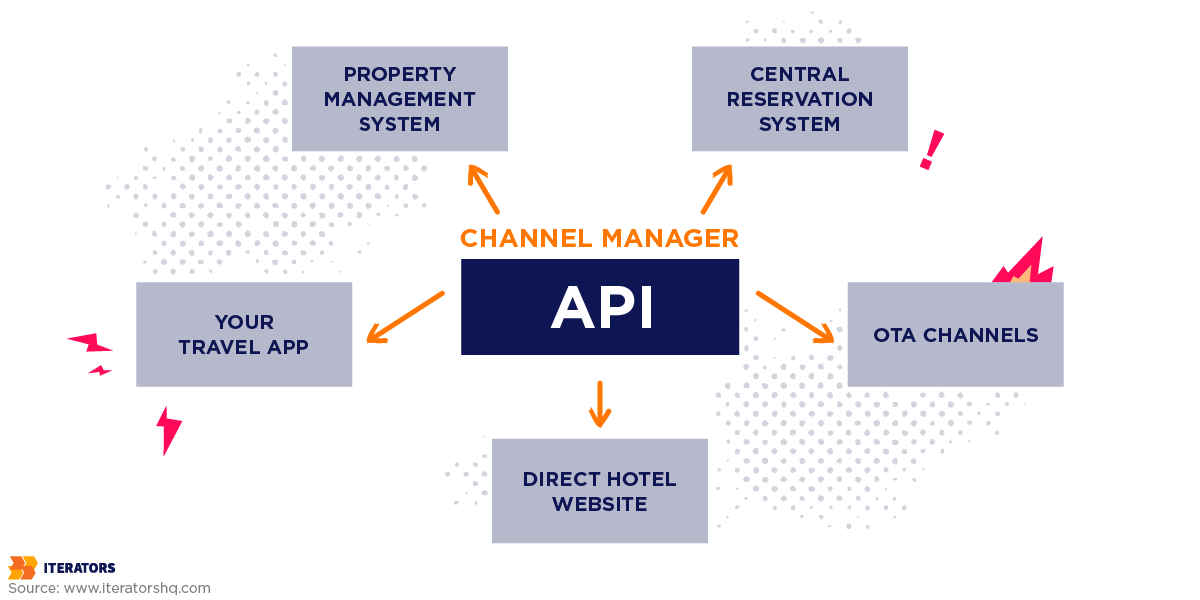
Hotels don’t sell through one channel. They sell through their own website, Booking.com, Expedia, Agoda, wholesalers, corporate travel programs, and OTAs simultaneously. Managing that distribution without creating overbooking chaos requires a channel manager.
A channel manager is cloud-based software that synchronizes room availability, rates, and restrictions across all connected sales channels in real-time. When a room is booked through one channel, the channel manager removes it from all others instantly. When a hotel updates its rates, the channel manager pushes the update everywhere.
For your travel app, this means you’re not just connecting to a hotel’s database. You’re connecting to a channel manager API, which itself connects to the hotel’s Property Management System (PMS) and Central Reservation System (CRS). The PMS handles day-to-day property operations: check-ins, housekeeping, billing. The CRS centralizes booking data for distribution to GDS platforms and corporate networks. The channel manager sits between all of these and the outside world.
Without automated synchronization, hotels update their extranets manually. Manual updates introduce variance between displayed and true availability. That variance causes overbooking. Overbooking causes displaced guests, negative reviews, and financial penalties for the OTA. This is why your app cannot simply scrape hotel data. It needs to connect to authoritative, real-time inventory through the channel manager API.
Why Hotel Availability Is a Moving Target
Hotel inventory is not a simple count of available rooms. Each property manages multiple room types (standard, deluxe, suite), multiple rate plans (rack rate, member rate, non-refundable, breakfast included), occupancy rules, seasonal pricing, promotional discounts, allotments for specific partners, minimum stay requirements, and closed-to-arrival restrictions.
All of these dimensions can change simultaneously. A hotel might release allotted rooms back into the general pool at a specific cutoff time. A rate plan might be available on some channels but not others due to rate parity agreements. A minimum stay rule might apply on weekends but not weekdays.
Your app has to handle all of this correctly, or it will show users options they can’t actually book.
Channel Manager Travel Mistakes That Break Booking Platforms
The most common mistake: assuming availability data is always fresh. If your caching layer doesn’t account for the volatility of hotel inventory, users will select rooms that are no longer available, triggering failures at the booking confirmation step.
The second mistake: not revalidating price before payment. Hotel rates change. The price shown in search results may not match the price returned by the live channel manager API at checkout. If you don’t revalidate, you either absorb the difference or you charge the user incorrectly. Neither is acceptable.
The third mistake: ignoring rate parity rules. Rate parity agreements require hotels to maintain uniform public pricing across distribution channels. If your app applies discounts in a way that undercuts the hotel’s rate parity commitments, you risk having your API access revoked.
The fourth mistake: treating hotel content as clean data. It isn’t. Room type names are inconsistent across properties and systems. Descriptions are duplicated, outdated, or missing. Images are low-resolution or mismatched. Content normalization is a real engineering task, not a cosmetic afterthought.
Booking Platform Architecture Needs State Machines, Not Hope
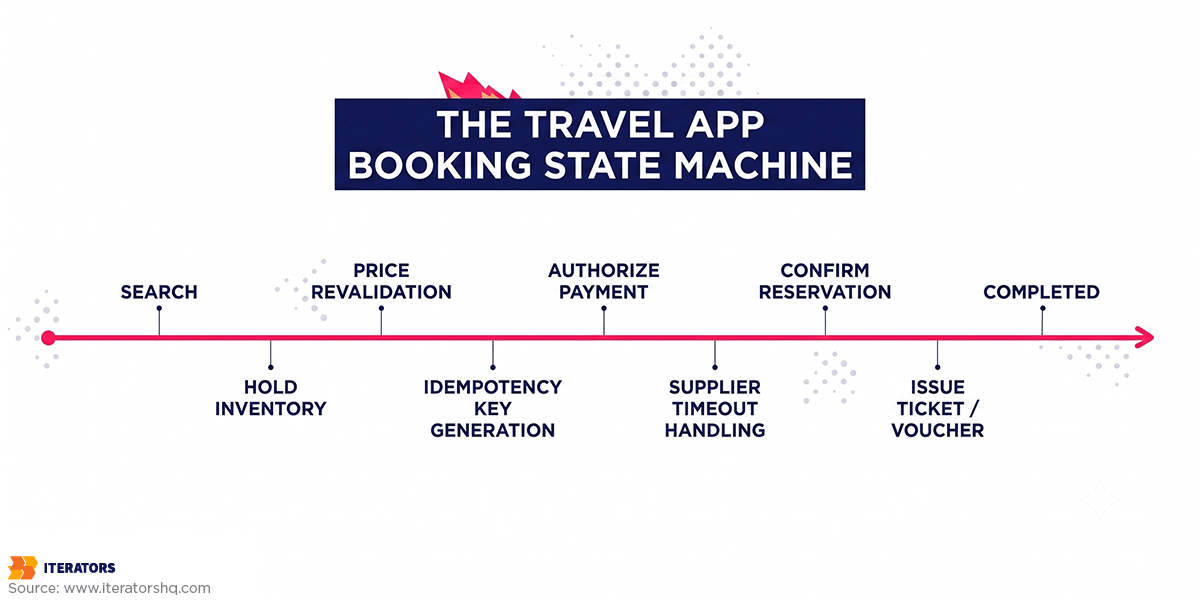
The “Book Now” button implies a single action. The backend reality is a chain of fragile operations that must either complete cleanly or fail safely. The failure modes matter as much as the happy path. If you don’t understand what will happen when it breaks, you’re not done.
“A booking is not a database record. It is a sequence of state transitions, each of which can fail independently.”
Here’s what that sequence actually looks like:
- Search: serve from cache
- Select: user chooses an option
- Price Revalidation: live supplier API call to confirm price and availability
- Hold Inventory: temporarily remove the asset from the supplier’s pool
- Authorize Payment: secure the customer’s funds via the payment gateway
- Confirm Reservation: execute the booking with the supplier
- Issue Ticket or Voucher: generate the e-ticket, hotel voucher, or confirmation document
- Send Confirmation: deliver to the user
- Completed: or trigger modification/cancellation workflow
Every transition between these states can fail. The architecture has to handle each failure mode explicitly.
Payment succeeds but the supplier API times out during confirmation: the system must either trigger an automated rollback of the funds or queue the transaction for priority manual review. For GDS bookings, if an e-ticket isn’t issued within the supplier’s ticketing window, a human agent needs to intervene before the reservation drops. The booking succeeds but the confirmation email fails: the user has a confirmed booking with no record of it, which generates support tickets. The user refreshes during payment: the system must handle duplicate booking attempts with idempotency keys to prevent double-charging.
This is why real-time marketplace and booking systems require state machine architecture, not optimistic API calls. You need to know exactly what state a booking is in at every moment, what transitions are valid from that state, and what happens when a transition fails.
Teams that treat booking as one API call discover the failure modes in production. By then, they’ve already shipped features that depend on latency and supplier behavior assumptions nobody wrote down.
OTA Development Means Orchestrating APIs You Don’t Control

Building an OTA means accepting a fundamental operational dependency: your platform’s reliability is bounded by the reliability of your worst critical supplier API.
Supplier APIs have downtime. Documentation quality varies from excellent to actively misleading. Sandbox behavior frequently differs from production behavior. You won’t discover that until you’ve completed certification and gone live. Rate limits can break your platform during peak traffic. Different suppliers use different data formats, different authentication mechanisms, different error codes, and different timeout behaviors.
When tackling travel app development, this creates a specific engineering requirement: your system integration strategy has to treat every supplier API as an unreliable external dependency, not as a stable internal service. That means circuit breakers to stop cascading failures when a supplier goes down. Retry logic with exponential backoff for transient errors. Graceful degradation: showing users what’s available from functioning suppliers rather than returning a blank results page because one API is timing out. Separate observability per supplier so you can see which one is causing problems without having to guess.
On Obi, a real-time ride aggregation platform we worked on at Iterators, the user saw one result list. The backend had to normalize provider-specific pricing, availability, and booking semantics, then recover when one provider timed out while another returned stale data. The operational cost of getting that wrong was a failed transaction and a support case, not a broken card layout. The pattern is consistent: the complexity isn’t in any single integration. It’s in managing the interactions between integrations when things go wrong simultaneously.
The practical implication for founders: when you’re evaluating supplier APIs before building, test failure behavior, not just happy-path behavior. How does the API behave when it’s under load? What does it return when inventory is unavailable: a clean error or a timeout? Does the sandbox accurately reflect production rate limits? These questions determine your architecture more than the API’s feature list does.
Payments, Refunds, and Cancellations Are Core Travel App Development Challenges

Travel payment logic is not standard e-commerce checkout with a different product category.
When a consumer books through an OTA, the OTA collects payment from the consumer and then pays the airline, the hotel, and the transfer operator separately. Passing the consumer’s personal card details to each supplier would create enormous PCI DSS compliance exposure and fraud liability.
Modern travel platforms solve this with Virtual Credit Cards (VCCs). When a booking is confirmed, the platform generates a single-use virtual card with a specific value and currency, issued to the exact supplier for the exact transaction amount. Some platforms use Just-In-Time funding: rather than pre-loading funds onto virtual cards and locking up working capital, the monetary value stays centralized until the supplier’s acquirer attempts to charge the card, at which point the system ringfences the exact balance in real-time.
This architecture requires deep fintech integration, not a standard Stripe checkout. You need PCI DSS compliance across the payment flow. You need multi-currency support with automated FX routing to avoid conversion spreads on cross-border supplier payments. You need idempotency keys throughout the payment and booking flow to prevent duplicate charges. You need audit logs that can reconstruct exactly what happened in any transaction.
Refunds are harder than payments. Refund logic depends entirely on supplier cancellation policies, which vary by fare class, booking window, rate plan, and operator. A non-refundable hotel rate might allow a full refund within 24 hours of booking. A flexible airline fare might allow changes with a fee. A tour operator might have a sliding scale of penalties based on days before departure. Your cancellation policy engine has to model all of these correctly and apply them consistently.
Chargebacks are expensive and operationally disruptive. Fraud prevention matters. These are core features to consider during travel app development.
Mobile Travel App Development Challenges Go Beyond Responsive UX
The mobile-specific challenges in travel are real, but they’re downstream of architecture decisions, not upstream of them.
Offline access to tickets and itineraries is not a nice-to-have. Airports, train stations, and hotels are notoriously unreliable connectivity environments. A user who can’t pull up their boarding pass because the app requires a live API call to render it is going to have a bad experience and a worse review. Offline mode requires thoughtful local storage architecture and synchronization logic, not just caching the last screen.
Push notifications for gate changes, flight delays, hotel check-in reminders, and booking modifications require a reliable event pipeline from supplier systems to your notification service. That pipeline depends on the same supplier APIs discussed above, which means notification reliability is bounded by supplier reliability.
Passport and document scanning, mobile wallet integration, and location-triggered recommendations add complexity that compounds with the backend dependencies. A beautiful boarding pass screen is useless if the app can’t load it offline. A smart location-triggered recommendation is useless if the booking flow behind it can’t handle the state machine correctly.
Your mobile app development approach, whether React Native or native, affects how you handle offline storage, push notification delivery, and device-specific capabilities like NFC for mobile wallets. That decision should be informed by your specific feature requirements, not by a default assumption.
Travel App Development Challenges Get Worse During Peak Demand
Your servers can scale. Your supplier APIs may not.
During holiday booking surges, flash sales, airline fare drops, and weather disruption events, consumer demand spikes simultaneously across every travel platform. Your infrastructure needs to handle the load. But your suppliers’ legacy systems, including GDS mainframes, hotel channel managers, and airline inventory APIs, are also receiving that same spike from every OTA and aggregator simultaneously.
Legacy supplier APIs frequently rate-limit or go down under peak load. When that happens, your platform has a choice: fail completely, or degrade gracefully.
Graceful degradation means serving cached data when live data is unavailable, clearly indicating to users when results may not be fully current, and routing requests to alternative suppliers when a primary supplier is unavailable. It means circuit breakers that stop your system from hammering a failing API. It means queues that absorb booking requests and process them when the supplier recovers.
SLA planning for critical platforms has to account for third-party dependencies, not just your own infrastructure. Your SLA with users is only as strong as your weakest critical dependency. That needs to be explicit in your architecture and your operational planning, not discovered during the first Black Friday sale.
Observability per supplier is essential. When your platform is slow or failing, you need to know immediately whether the problem is in your code, your infrastructure, or a specific supplier API. Generic application monitoring won’t tell you that. You need supplier-specific latency tracking, error rate dashboards, and alerting thresholds that distinguish between your system’s problems and your suppliers’ problems.
The Back Office Is the Part Founders Forget

Users see the app. Operators need the admin system.
If your travel platform launches without back-office tooling, your support team becomes the back office. They’ll be writing SQL queries to look up bookings, emailing suppliers to resolve failed confirmations, manually processing refunds, and reconstructing transaction histories from scattered logs.
That’s not a sustainable operational model. And it doesn’t scale.
The back office needs: manual booking review tools for transactions that fall into edge cases the automation doesn’t handle. Failed booking recovery workflows with clear escalation paths. Refund processing interfaces that apply cancellation policies correctly without requiring an engineer. Supplier error logs surfaced in a readable dashboard. User identity and payment lookup for fraud investigation. Booking modification tools that allow agents to cancel, rebook, or issue vouchers without touching the database directly. Voucher and invoice generation. Reporting and reconciliation for accounting.
Build the back office early. The cost of building it after launch, when your support team is already underwater, is much higher than the cost of building it alongside the core booking flow.
How to Plan Travel App Development Without Drowning in Integrations
Travel App Reality Check
Select the features you want for your launch to see what it actually does to your architecture and timeline.
Select Launch Features:
Awaiting Selection
Select features from the left to populate your architectural roadmap.
Phase 1: MVP Core
Phase 2: Production Scaling
Phase 3: State-of-the-Art
The biggest risk in travel app development is trying to build everything before validating anything. Here’s a framework that works.
PoC: Validate the Travel Model Before the Full Build
One supplier integration, or a unified aggregator API. One booking flow. Limited geography or inventory type. Manual support fallbacks are acceptable at this stage. The goal is proving user demand and basic payment functionality before investing in scalable architecture. Don’t integrate ten APIs before you know which one matters most to your users.
MVP: Build the Core Booking Flow and Operational Tools
This is where the formal state machine goes in. Search with caching, availability, price revalidation, payment authorization, booking confirmation, ticket or voucher issuance. Alongside this: the foundational admin dashboard and error monitoring. If you launch an MVP without observability and back-office tools, you’re flying blind into the first real customer problems.
Production: Harden the Platform for Real Customers
Multiple supplier integrations. SLA monitoring per supplier. Automated refund and cancellation workflows. Performance testing under realistic load. Fraud handling. Cloud infrastructure that scales automatically under peak demand. This is where you transition from a functional product to a reliable one.
State-of-the-Art: Add AI, Personalization, and Predictive Intelligence
AI-driven itinerary recommendations, dynamic packaging, demand prediction, predictive pricing, and automated disruption management belong here, after the architecture underneath them is solid. Building personalization on top of an unreliable booking flow produces a polished experience that fails at the moment of truth.
Travel App Development Challenges Checklist for Founders
Before you commit to a build timeline or a supplier list, work through these:
- Have you identified which supplier systems you need: GDS, NDC, direct airline APIs, OTA aggregator APIs, channel managers, PMS, or CRS?
- Do you know how stale your availability data will be, and have you designed caching and revalidation accordingly?
- Will price be revalidated against a live supplier API before payment is authorized?
- What happens if payment succeeds but the booking confirmation fails?
- What happens if the supplier confirms the booking hours after the user’s session ended?
- Who handles refunds and cancellations, and is the logic automated or manual?
- Do you have offline access to confirmed tickets and itineraries in the mobile app?
- Do you have back-office tooling for support, refunds, and failed booking recovery?
- Do you have observability per supplier, not just aggregate application monitoring?
- Do you have a support workflow for failed bookings that doesn’t require an engineer?
| Do | Don’t |
|---|---|
| Revalidate price before payment | Assume search price is final |
| Build booking as a state machine | Treat booking as one API call |
| Add admin tools early | Make support fix issues in the database |
| Monitor supplier APIs separately | Only monitor your own servers |
| Start with one focused supplier flow | Integrate ten APIs before validating demand |
The UX Is the Tip of the Travel App Iceberg
Travel inventory is real-time risk assessment disguised as e-commerce. The platform coordinates rooms, seats, unstable availability, supplier systems, pricing rules, payments, and customer expectations at the same time.
The map view, the hotel cards, the date picker, the itinerary screen. These are real and they matter. Users judge your product on what they can see. But those surfaces are only as good as the architecture underneath them.
Travel apps fail when the architecture is underestimated. GDS certification timelines break launch dates. Channel manager synchronization failures cause overbooking incidents. Missing price revalidation creates payment disputes. Absent back-office tooling makes operational problems unmanageable. Supplier API downtime during peak demand takes down the whole platform.
The teams that build travel platforms successfully plan the architecture around real travel workflows before obsessing over UI polish. They treat booking as a state machine, not a button. They build the back office alongside the front end. They monitor supplier health separately from their own infrastructure. They scope the MVP to one supplier flow and validate demand before building the aggregation layer.
The hard part of travel app development isn’t the UX. It’s everything the user never sees.