

If you want to shorten B2B sales cycle length before it drains your runway, you are not alone—and this guide will show you exactly how to do it.
You’ve built something amazing. Your product solves a real problem. Your demos are fire. Enterprise prospects are nodding enthusiastically.
Then comes the procurement process.
Six months later, you’re still waiting. Your runway is burning. Your investors are getting nervous. And that “enthusiastic” champion? They’ve gone dark.
Welcome to the hidden tax on your startup runway—the enterprise sales cycle that’s quietly draining your bank account while you wait for procurement to “circle back.”
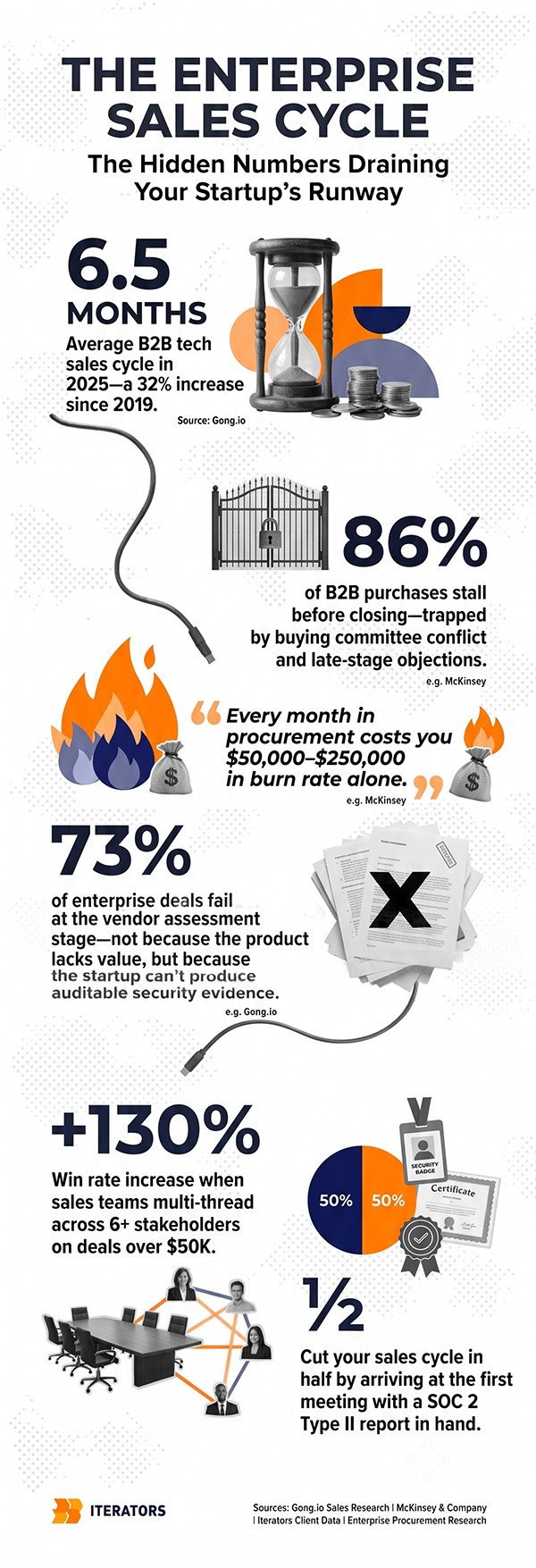
Here’s the brutal truth about trying to shorten B2B sales cycle length: the average has ballooned to 6.5 months in 2025—a 32% increase since 2019. For large enterprise deals? You’re looking at 12-18 months. That’s not a sales cycle. That’s a survival test.
And it’s getting worse.
While you’re stuck in month seven of security reviews, your competitors are closing deals. While you’re waiting for legal to finish redlining your MSA, your runway is shrinking. While you’re hoping that champion will finally get budget approval, you’re burning $50,000 to $250,000 per month just keeping the lights on.
The math is simple and terrifying: Every month in procurement costs you real money—not just in sales expenses, but in runway consumed, opportunities missed, and valuation destroyed when you’re forced to raise at the wrong time.
But here’s what most founders don’t realize: The problem isn’t your product. It’s that you’re not enterprise-ready. Read our complete guide to enterprise readiness for B2B SaaS to understand exactly what that means.
This article will show you how to shorten B2B sales cycle length by up to 3x—not by cutting corners, but by building the infrastructure that makes you “pre-approved” in the eyes of enterprise buyers. We’ll break down exactly where deals stall, what it’s costing you, and how to accelerate velocity without sacrificing deal quality.
Because the difference between startups that survive and those that don’t often comes down to one thing: how fast you can turn pipeline into revenue before your cash hits zero.
Free Consultation
Every Month in Procurement
Is Runway You Don’t Get Back
Our engineers will assess your enterprise readiness gaps — SOC 2, SSO, audit logs, the works — and build the infrastructure that makes you pre-approved before the CISO ever opens your questionnaire.
Stop the Runway Burn →The Brutal Math: What Failing to Shorten B2B Sales Cycle Is Costing You
Let’s talk about the real cost of that enterprise deal sitting in your pipeline.
Most founders who want to shorten B2B sales cycle think about costs in terms of commissions and travel expenses. That’s cute. The actual cost is your entire monthly burn rate multiplied by the length of the sales cycle.
Here’s what I mean.
Direct Costs: Sales Team, Travel, and Tools
Your enterprise sales motion isn’t cheap. Between salaries, tech stack, travel, and sales engineering support, you’re looking at some serious monthly overhead:
| Direct Expense Category | Monthly Estimate (Per Rep) | Annualized Impact |
|---|---|---|
| AE/SDR Salary & Commission | $12,000 – $25,000 | $144,000 – $300,000 |
| Sales Tech Stack (CRM, AI, Data) | $1,500 – $3,000 | $18,000 – $36,000 |
| Travel & Client Hospitality | $2,000 – $5,000 | $24,000 – $60,000 |
| Sales Engineering Support | $5,000 – $10,000 | $60,000 – $120,000 |
When a single enterprise account executive manages a deal that stretches to 12 months, the direct cost of acquisition can easily exceed $250,000 before you even factor in overhead. If the deal closes, your CAC often exceeds the first-year contract value. If it doesn’t close? That’s $250,000 you’ll never see again.
But wait—it gets worse.
Opportunity Costs: The Deals You Didn’t Pursue
While your AE is stuck in month seven of procurement hell with that “strategic enterprise logo,” they’re not prospecting new accounts. They’re not closing smaller deals that could actually hit this quarter. They’re not multi-threading other opportunities.
The typical enterprise buying decision involves 13 internal stakeholders and 9 external influencers. That’s 22 people your rep needs to coordinate with. When deals drag on for months, your sales team becomes anchored to single accounts, creating a high-stakes environment where one executive departure or budget freeze can collapse months of effort.
Research by Gong shows that successful deals involve twice as many buyer contacts as unsuccessful ones. Yet most sellers still engage fewer than six contacts per deal. This gap in “multi-threading” is where pipeline goes to die.
Every week your AE spends chasing a champion who’s gone “dark” is a week they’re not working to shorten B2B sales cycle length on deals that are actually ready to close.
Runway Burn: Why You Must Shorten B2B Sales Cycle Now
Now we get to the existential threat.
Your runway is simple math:
Runway (Months) = Cash on Hand ÷ Net Burn Rate
In 2025, VCs are advising portfolio companies to maintain 12-18 months of runway as a baseline, with many recommending 24-30 months for seed-stage companies due to lengthening fundraising cycles.
This is why you must shorten B2B sales cycle length—a 12-month cycle for a critical enterprise account can consume 100% of your remaining cash before revenue is realized.
Let’s look at what this actually means:
| Burn Scenario | Monthly Net Burn | 12-Month Sales Cycle Cost | Survival Impact |
|---|---|---|---|
| Seed Stage SaaS | $75,000 | $900,000 | Often exceeds total initial funding |
| Series A Growth | $250,000 | $3,000,000 | Consumes 60% of a standard $5M raise |
| Scaling Enterprise | $500,000+ | $6,000,000+ | Requires constant bridge funding |
Here’s the “Pipeline Paradox”: Pipeline generation has increased by 23% in recent years, but win rates have dropped by 18%. Translation? Startups are burning more cash to generate more noise, without a corresponding increase in closed deals.
The difference between survival and shutdown often comes down to identifying your “lights out” date—the day your cash hits zero—and accelerating revenue to push that date further into the future.
Dilution Cost: Raising at the Wrong Time
The final hidden tax? Forced fundraising at terrible valuations.
Startups that enter a fundraising round with less than six months of runway typically accept valuations 35% to 50% lower than those with healthy cash buffers. When you’re stuck in month seven of a procurement negotiation, you can’t credibly demonstrate the “revenue traction” required to command a premium valuation.
This is another reason to shorten B2B sales cycle—the resulting dilution for founders and early employees is a permanent tax that persists long after the enterprise deal eventually closes. You gave away 20% more of your company because you couldn’t close deals fast enough to maintain negotiating leverage.
So when we talk about the “cost” of a long sales cycle, we’re not talking about commission checks. We’re talking about:
- Direct sales expenses: $250,000+
- Opportunity costs: Multiple lost deals
- Runway burn: Potentially your entire Series A
- Dilution: Permanent equity loss
The hidden tax on your runway isn’t just expensive—it’s existential.
Why It’s So Hard to Shorten B2B Sales Cycle in 2025 (And Why It’s Getting Worse)
The expansion of the tech sales cycle from 4.9 months to 6.5 months isn’t an anomaly. It’s a reflection of fundamental shifts in how enterprises buy software.
Understanding these shifts is the first step to beating them and learning how to shorten B2B sales cycle in a modern buying environment.
The Modern Enterprise Buying Committee
Remember when you could sell to one decision-maker? Yeah, those days are dead.
A typical B2B purchase now involves 6-10 core stakeholders, while complex strategic deals frequently reach 17 or even 25+ cross-functional decision-makers. This “mega-committee” creates a consensus-based decision model where any single stakeholder—from IT security to legal or finance—possesses a de facto veto.
Here’s who you’re really dealing with:
| Stakeholder Function | Core Priority | Typical Delay Mechanism |
|---|---|---|
| Economic Buyer | ROI & Budget Preservation | Demands extensive business case modeling |
| Technical Evaluator | Integration & Feasibility | Requires deep-dive API and architecture reviews |
| Security/CISO | Data Protection & Risk | Issues 200+ question security questionnaires |
| Procurement | Terms & Pricing Optimization | Engages in aggressive legal redlining |
| End User | Workflow Impact & UX | Requests prolonged pilot programs |
Gartner research highlights that 74% of these buying teams experience “unhealthy conflict” during the decision process, leading to “analysis paralysis” as members deconflict disparate information they’ve gathered independently.
Translation? Even when everyone likes your product, they can’t agree on whether to buy it.
Security and Compliance Requirements Have Exploded
Security is no longer a checkbox—it’s the architecture of the deal itself and one of the biggest barriers to shorten B2B sales cycle in 2025.
In 2025, SOC 2 Type II certification has become table stakes for any vendor managing enterprise data. Here’s the kicker: 73% of enterprise sales for startups now fail during the vendor assessment stage—not because the product lacks utility, but because the startup cannot provide auditable evidence of its security controls. Learn how to prepare in our guide to enterprise vendor assessment success.
The complexity is further intensified by a regional and sectoral regulatory landscape that includes GDPR, HIPAA, the EU AI Act, and CCPA. Each of these frameworks requires specialized infrastructure:
- Vault-backed secrets management
- Encrypted backups with audit trails
- Immutable logging systems
- Data residency controls
- Automated compliance reporting
Most early-stage engineering teams aren’t prepared to deliver this on a standard product roadmap, which is why so few manage to shorten B2B sales cycle without outside help. So when the CISO asks for your SOC 2 report and you don’t have one, the deal enters a death spiral where you’re suddenly spending three months retrofitting compliance features you should have built from day one.
Economic Uncertainty = More Scrutiny
Economic volatility has transformed the procurement process into an “interoperability war” where every solution must justify its place in a crowded tech stack.
85% of sales leaders struggle to obtain a budget for new hires or software, and 78% of buyers are more careful with spending than in previous cycles. CFO involvement in software purchases has increased by 40%, leading to what I call the “Mid-Market Squeeze”—deals in the $50,000 to $100,000 range that used to close in 90 days are now taking an average of 9 months.
You’re not competing against other vendors anymore. You’re competing against the status quo, budget freezes, and the CFO’s mandate to “do more with less.”
Your Competitors Are Getting Faster
While you’re stuck in procurement hell, your competitors are closing deals. How?
They built enterprise readiness before they needed it.
The companies that manage to shorten B2B sales cycle and win enterprise deals in 2025 aren’t the ones with the best product. They’re the ones who show up to the first security review with a complete SOC 2 report, pre-built SSO integration, and a library of pre-answered vendor assessment questionnaires.
When a prospect’s CISO asks for security documentation and you respond with “we’re working on that,” you’ve just added 3-6 months to your sales cycle. When your competitor responds with “here’s our SOC 2 Type II report,” they’ve just moved to the front of the procurement queue.
The ability to shorten B2B sales cycle doesn’t happen by accident. It happens by design.
The 5 Major Bottlenecks Stopping You From Shortening B2B Sales Cycle
To shorten your sales cycle, you need to surgically address the specific points where momentum evaporates. While many founders blame “slow customers,” most delays are systemic results of vendor unreadiness.
Let’s break down exactly where deals die.
Bottleneck #1: Stakeholder Alignment Paralysis
Your champion loves the product. The end users are excited. But when IT, Legal, and Finance enter the room, everything grinds to a halt.
Why? Because each stakeholder brings different success metrics and different anxieties.
The IT team cares about integration complexity. Legal worries about liability and data protection. Finance wants to see ROI models. Your champion just wants to solve their immediate problem.
When sales teams focus on “individual relevance”—helping a manager save 10 hours a week—they actually increase internal conflict by 59%, as other stakeholders view that benefit as a threat to their own budget or headcount.
The solution to shorten B2B sales cycle here? Focus on “buying group relevance”—goals that serve the organization’s overarching strategic mandate. But most sales reps don’t discover what those goals are until month four of the sales cycle, after they’ve already lost control of the narrative.
Bottleneck #2: Security Review Delays
The technical review stage typically adds 2-6 weeks to an enterprise cycle. For an unprepared startup, it creates a 5-month blockade.
Here’s what happens: The prospect’s CISO sends over a 200-question security questionnaire. Questions like:
- “Do you have SOC 2 Type II certification?”
- “Do you support SAML SSO and SCIM provisioning?”
- “Where is our data stored and who has access?”
- “What is your incident response plan?”
- “Do you have cyber insurance?”
If you don’t have immediate, documented answers to these questions, the deal enters procurement purgatory while your engineering team scrambles to:
- Build the features you should have had from day one
- Document your security controls
- Pass a SOC 2 audit (which takes 3-6 months minimum)
- Re-engage with a CISO who has now moved on to other priorities
73% of enterprise deals fail at this stage, making it impossible to shorten B2B sales cycle. Not because of product quality. Because of vendor unreadiness. Our guide to SOC 2 compliance for SaaS shows you exactly how to fix this.
Bottleneck #3: Legal Contract Negotiation
The legal queue is where momentum goes to die.
Your MSA (Master Service Agreement) sits for weeks in the general counsel’s inbox. When it finally gets reviewed, you receive a redlined document with 47 changes to liability caps, data residency requirements, and indemnification clauses.
Most startups that want to shorten B2B sales cycle lack a “redline playbook”—a set of pre-approved standard modifications for common objections. Without this, every minor change requires a two-week round-trip to your outside counsel, bleeding cash and patience.
Meanwhile, your champion is getting frustrated. The economic buyer is losing confidence. And your AE is watching the quarter close without the deal.
Bottleneck #4: Technical Proof-of-Concept (POC) Drag
A pilot or POC is intended to validate the product and help shorten B2B sales cycle. Without strict success criteria, it becomes an indefinite drain on engineering resources.
Here’s the problem: 35% of demos are unqualified or underqualified, wasting 2-10 hours of sales engineering time each. When you agree to a POC without defining:
- Specific success metrics
- Timeline with hard deadlines
- Who will evaluate the results
- What happens after success
…you’ve just committed your engineering team to an open-ended science project that may never convert to revenue.
A “successful” pilot that doesn’t lead to a close is actually a massive net loss for your runway. You spent weeks of engineering time, pulled developers off the roadmap, and got nothing in return.
Bottleneck #5: Budget Approval Bureaucracy
Final approval often stalls not because of product quality, but because of fiscal cycles and shifting corporate priorities.
86% of B2B purchases stall during the buying process, often because a single stakeholder raises a late-stage objection about ROI. McKinsey research shows that knowledge workers waste 30-40% of their time simply waiting for decisions, a friction that translates to $750,000 in lost productivity annually for a mid-sized organization.
Your deal gets caught in this bureaucracy. The budget was “approved” in Q2, but now it’s Q3 and there’s a hiring freeze. Or the CFO wants to see three more vendor comparisons. Or the original champion left the company and their replacement wants to “evaluate all options.”
Each of these bottlenecks compounds the others. A security review delay pushes the legal review into next quarter. The POC drags on because stakeholders can’t agree on success criteria. Budget approval gets delayed because Finance wants to see the completed POC results.
The result? A 12-month sales cycle that burns through your runway while you helplessly watch deals stall at every stage.
How to Shorten B2B Sales Cycle: Strategic Solutions That Actually Work
Enough about problems. Let’s talk about solutions.
Shortening your sales cycle requires moving from reactive selling to proactive buyer enablement. The goal is to remove friction before the buyer even realizes it exists.
Strategy #1: Build Enterprise Readiness Before You Need It
If you want to shorten B2B sales cycle, waiting for an enterprise customer to request security features is 3-5x more expensive than building them upfront.
Here’s the ROI breakdown:
| Readiness Tier | Technical Requirements | ROI Impact |
|---|---|---|
| Tier 1: Deal Killers | SOC 2 Type II, SSO/SAML Integration, Data Encryption | Prevents automatic disqualification; cuts cycle in half |
| Tier 2: Infrastructure | High Availability, 10x-100x Load Testing, Automated Scalability | Reassures technical buyers; avoids lengthy “scalability drills” |
| Tier 3: Governance | SCIM Provisioning, Immutable Audit Logs, Disaster Recovery Runbooks | Shortens IT review by months; automates onboarding |
| Tier 4: Legal | Pre-approved Redline Playbook, Standard MSA Templates | Compresses contract negotiations from weeks to days |
At Iterators, we’ve seen this transformation firsthand. When we helped Imperative build SOC 2 compliance into their HR platform from day one, they were able to close enterprise deals with companies like Zillow, Hasbro, and Boston Scientific without the typical 3-6 month security review delay.
Why? Because when prospects asked for security documentation, Imperative could immediately provide:
- A complete SOC 2 Type II report
- Pre-built security questionnaire responses
- Documented disaster recovery procedures
- Audit logs and compliance dashboards
The result? The ability to shorten B2B sales cycle to 3x faster than competitors who were scrambling to retrofit compliance after the fact.
Strategy #2: Multi-Thread Your Enterprise Deals
Relying on a single champion is the most common cause of deal failure and one of the biggest obstacles to shorten B2B sales cycle.
Multi-threading means engaging at least 6-17 contacts within an account simultaneously. Research shows that successful deals involve twice as many buyer contacts as those that don’t close, and multi-threading boosts win rates by 130% for deals over $50,000.
Here’s the framework:
Track One: The Champion
- Product evangelist
- End user advocate
- Internal seller
Track Two: The Technical Buyer
- IT/Engineering lead
- Integration requirements
- Security concerns
Track Three: The Economic Buyer
- Budget owner
- ROI requirements
- Strategic alignment
Track Four: The Legal/Procurement
- Contract terms
- Compliance requirements
- Vendor assessment
Most startups wait until Track One (the champion) introduces them to the other tracks. By then, it’s too late. You need to engage procurement, legal, and IT security teams “on day one,” rather than waiting for them to surface at the end of the process.
This proactive engagement allows you to navigate the “Track Two” (legal/security) requirements while the champion manages “Track One” (the product value).
Strategy #3: Create Standardized POC Playbooks
A standardized POC playbook is essential to shorten B2B sales cycle—it defines success metrics upfront, limiting the pilot’s duration and engineering cost.
Every POC should include:
1. Defined Success Criteria
- Specific, measurable outcomes
- Not “let’s see if it works” but “we’ll measure X metric and achieve Y improvement”
2. Hard Timeline
- 2-4 weeks maximum
- Clear start and end dates
- No extensions without re-negotiation
3. Named Evaluators
- Who will judge success?
- What are their evaluation criteria?
- Who makes the final decision?
4. Mutual Action Plan
- What happens after success?
- Timeline to contract signature
- Implementation schedule
Without these elements, your POC becomes an indefinite science project that drains engineering resources without ever converting to revenue.
Pro tip: Interactive demos—shareable, sandbox-style environments where buyers can click through workflows—can replace live POCs entirely. Reaching 9 or more demo views leads to an 8-10x higher close rate, as it allows stakeholders to self-educate without waiting for scheduled meetings.
Strategy #4: Implement Mutual Action Plans (MAPs)
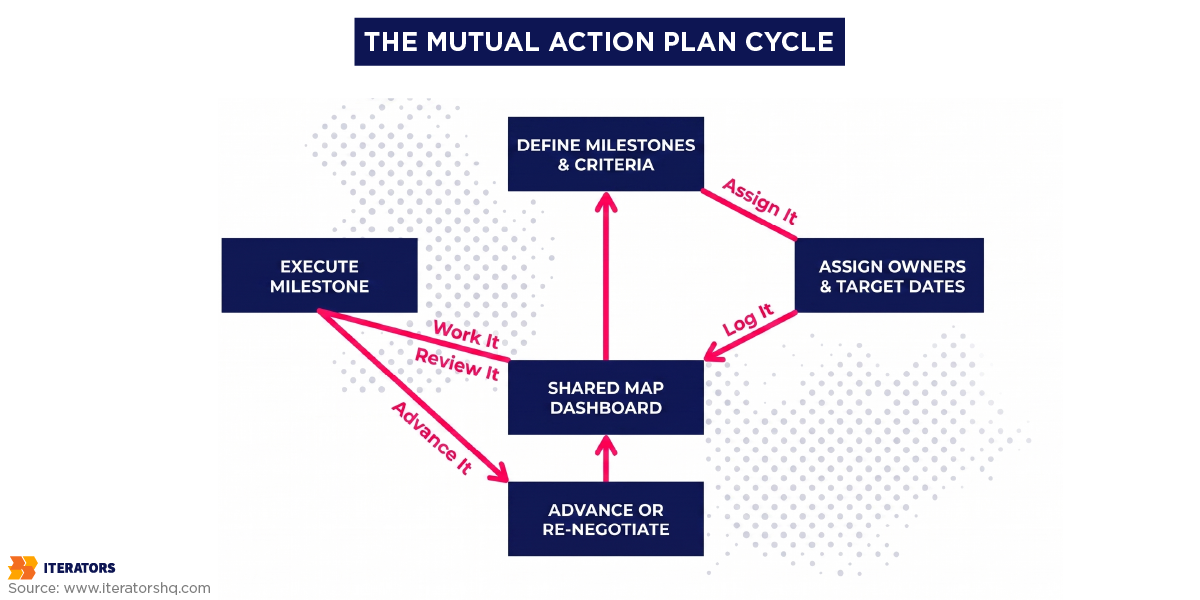
A Mutual Action Plan is one of the most effective tools to shorten B2B sales cycle—a collaborative project management tool shared between you and the buyer. It outlines every step required to reach the “go-live” date, from technical review milestones to final legal signature.
Here’s what a MAP looks like:
| Milestone | Owner | Target Date | Status |
|---|---|---|---|
| Technical Review Complete | Buyer IT Team | Week 2 | ✓ |
| Security Questionnaire Submitted | Vendor | Week 3 | ✓ |
| POC Success Criteria Met | Both | Week 6 | In Progress |
| Legal Review Complete | Buyer Legal | Week 8 | Pending |
| Budget Approval | Economic Buyer | Week 10 | Pending |
| Contract Signature | Both | Week 12 | Target |
This transforms the buyer from a passive reviewer into a project partner, creating urgency and accountability on both sides. When the buyer misses a milestone, they’re not just delaying your deal—they’re missing their own internal deadline.
Strategy #5: Automate Vendor Assessment Responses
Sales reps spend enormous amounts of time on repetitive administrative work. 80% of sales take five or more follow-up calls, yet 44% of reps give up after just one attempt.
Automation tools can:
- Automatically log all sales activity in your CRM
- Generate audit-ready security questionnaire responses using AI trained on your SOC 2 data
- Free up 20% of a seller’s capacity, improving overall productivity by 30%
At Iterators, we help clients shorten B2B sales cycle by building “security documentation libraries”—centralized repositories of pre-answered vendor assessment questions. that can be instantly retrieved when a prospect sends over their 200-question questionnaire.
Instead of spending 40 hours manually answering questions, your team spends 2 hours reviewing and customizing pre-built responses. That’s a 95% time savings that directly accelerates your sales velocity.
The Enterprise Readiness Sprint: How to Shorten B2B Sales Cycle Without Cutting Corners

Most startups view compliance and readiness as a burden to be delayed until the Series B round. The data proves otherwise.
Smart founders build for enterprise readiness on a Series A budget to avoid a Series B panic.
What is Enterprise Readiness?
Enterprise readiness is the fastest way to shorten B2B sales cycle—the systematic implementation of features that allow your software to fit into the governance, security, and identity frameworks of a Fortune 500 company.
Identity Management Moving from simple email/password to Federated SSO (SAML 2.0/OIDC). Our guide to web authentication and secure access covers exactly how to implement this correctly. This ensures the corporation owns the user account, not the individual, allowing for instant deprovisioning when an employee leaves.
Auditability Creating immutable logs of every action within the system. These logs must be exportable to the client’s own SIEM (Security Information and Event Management) tools for their internal monitoring.
Governance Implementing RBAC (Role-Based Access Control) that mirrors the complex organizational hierarchies of global firms—countries, divisions, departments, teams, and individual roles.
Compliance Achieving SOC 2 Type II certification, GDPR compliance, and HIPAA compliance (if handling health data). This requires documented security policies, regular audits, and automated compliance reporting.
The ROI of Proactive Compliance to Shorten B2B Sales Cycle
Let’s compare two scenarios:
Scenario A: Retrofit (Reactive)
- Upfront Investment: $0
- Engineering Cost of Rework: $300,000+ (Rushed, Overtime)
- Sales Cycle Length: 12-18 Months
- Lost Deal Revenue: $6M-$8M ARR (3-4 deals)
- Valuation Growth: Minimal (Slow Growth)
- Net ROI: Negative
Scenario B: Enterprise Readiness Sprint (Proactive)
- Upfront Investment: $150,000-$300,000
- Engineering Cost of Rework: $0
- Sales Cycle Length: 3-4 Months
- Lost Deal Revenue: $0
- Valuation Growth: +$40M-$60M (at 10x Multiple)
- Net ROI: 13,000%-20,000%
In Scenario A, you enter a “death spiral” where you lose 3-4 deals per year because you can’t clear procurement. In Scenario B, the investment in a 6-month “Enterprise Readiness Sprint” enables you to win those same deals 3x faster, fundamentally protecting your runway and accelerating valuation.
How to Build SOC 2 Compliance on a Startup Budget
SOC 2 certification used to take 12-18 months and cost $100,000+. In 2025, automation tools like Vanta and Drata have cut that timeline to 3-6 months and $30,000-$50,000.
Here’s the roadmap:
Month 1: Gap Assessment
- Audit current security controls
- Identify missing requirements
- Prioritize implementation
Month 2-3: Implementation
- Deploy required security tools
- Document security policies
- Implement access controls and monitoring
Month 4-5: Audit Preparation
- Collect evidence
- Run internal assessments
- Fix identified gaps
Month 6: SOC 2 Audit
- Engage auditor
- Complete Type I audit
- Begin Type II observation period
The key is to start this process before your first enterprise deal, not after. When you can hand a prospect your SOC 2 report in the first meeting, you’ve just eliminated 3-6 months from your sales cycle.
Real-World Results: How These Companies Managed to Shorten B2B Sales Cycle

Theory is great. Let’s talk about real results.
Case Study: Imperative’s $7M Revenue Acceleration
The Challenge Imperative, a peer coaching platform, needed to serve major corporations like Zillow, Hasbro, and Boston Scientific. The problem? Passing the stringent security requirements of Fortune 500 HR departments.
The Solution Iterators took full technology ownership, embedding SOC 2 Trust Services Criteria—security, processing integrity, and privacy—directly into the platform architecture from day one.
By integrating enterprise-grade compliance and scalable infrastructure, the platform generated over $7 million in revenue. The readiness investment meant that when prospects like Airbnb asked for security evidence, Imperative was “pre-approved” rather than being sent to the back of the procurement queue.
As Aaron Hurst, CEO of Imperative, put it:
“One of the keys to our success was finding Iterators. We’ve been in touch almost on a daily basis, collaborating on both a large and small scale. I’ve always had an authentic sense that they’re in it for our success first.”
Case Study: KLIX’s Enterprise Shared Services Excellence
A multinational professional services firm with 5,500 employees across 50 countries faced an operational crisis in unified time-tracking and profitability analysis. Managing diverse service lines across multiple legal and tax jurisdictions created “interoperability hell” that hindered growth.
The Solution Iterators developed KLIX, an enterprise-grade platform utilizing Scala and React. Rather than enforcing rigid automation, the team performed an “operational modeling” exercise to align the software with the day-to-day workflows of accountants.
The focus on user-centric enterprise readiness—multi-tenant architecture, multi-timezone support, and real-time custom dashboards—resulted in a technology partnership that has persisted since 2016, supporting thousands of daily transactions across global offices.
Case Study: QUICO.IO’s Frontline Performance Transformation
The Challenge QUICO.IO needed to roll out microlearning training to large, scattered frontline teams. Their existing mobile app suffered from stability and performance issues that alienated enterprise clients.
By restructuring the app on React Native and implementing a comprehensive UX/UI redesign, Iterators delivered four major releases in four months.
The resulting stability and “enterprise-ready” reporting features enabled a successful rollout to the majority of QUICO.IO’s client base, with users reporting faster response times and consistent experience across all devices.
The pattern is clear: Companies that invest in enterprise readiness early close deals 3x faster and achieve higher valuations.
Your Action Plan: How to Shorten B2B Sales Cycle Starting Today
Shortening your sales cycle is an iterative process that begins with understanding the gaps in your current motion.
Week 1: Audit Your Current Sales Cycle
Perform a “post-mortem” on your last five closed-lost deals. Create a Sankey diagram to visualize where leads are dropping out of your funnel.
Key questions:
- Where are deals stalling? Discovery? Proposal? Security review?
- What’s your average first response time? (Industry standard: 47 hours)
- How many stakeholders are you engaging per deal?
- What percentage of deals are failing due to security/compliance issues?
Pro tip: Only 27% of leads currently receive any response at all. If you’re not responding within 48 hours, you’re already losing deals before they start.
Month 1: Implement Quick Wins
Ruthless Qualification Stop trying to make “square pegs fit into round holes.” Use a framework like MEDDIC to disqualify low-intent buyers within the first 45 minutes of engagement.
Multi-thread Early Enforces a rule that no deal is forecasted unless at least three contacts are engaged, including one technical and one economic buyer.
Pricing Transparency Discuss pricing early to weed out prospects who lack budget, avoiding three months of pointless negotiation.
Automate Follow-ups Use CRM workflows to ensure no lead goes 48 hours without a touchpoint.
Quarter 1: Build Enterprise Readiness Foundation
SOC 2 Audit Prep Begin your readiness assessment. Using automation tools like Vanta or Drata can cut audit prep time by 80%.
Identity Infrastructure Move your IAM (Identity and Access Management) to a provider like WorkOS or Auth0 to enable SAML SSO and SCIM deprovisioning. For a deeper look at what enterprise-ready HR tech requires, read our guide to enterprise-ready HR tech platform features.
Technical Documentation Library Build a self-service portal for prospects containing:
- Technical architecture diagrams
- Data flow documentation
- Pre-completed security questionnaires
- Integration guides
- API documentation
Ongoing: Measure and Optimize
Track your “Sales Efficiency Score”:
Efficiency Score = (Win Rate × Avg Deal Size × Sales Velocity) ÷ (Sales Cycle Length × Cost of Sale)
The goal is to increase the numerator while decreasing the denominator.
Use call intelligence tools (Gong/Chorus) to monitor talk-to-listen ratios. High performers consistently maintain a 43:57 ratio, while underperformers tend to over-talk in losing deals.
FAQ: How to Shorten B2B Sales Cycle
How much does it cost when you fail to shorten B2B sales cycle?
Every month a deal remains in procurement costs a startup between $50,000 and $250,000 in burn rate, plus the opportunity cost of deals not pursued. A 12-month cycle can consume up to 60% of a Series A runway.
What is a “normal” enterprise sales cycle length in 2025?
The median B2B tech sales cycle is 6.5 months. Deals over $100,000 ACV commonly take 6-9+ months, while strategic deals over $500,000 can exceed 18 months.
Why do deals stall in procurement?
86% of purchases stall because of buying committee complexity (averaging 10+ stakeholders), lack of internal consensus, and unready vendor compliance (SOC 2, SSO).
What is “enterprise readiness”?
It’s the suite of technical and administrative features—Federated SSO, SCIM provisioning, immutable audit logs, and SOC 2 certification—that allows your product to be approved by corporate IT and security teams.
Does multi-threading really help?
Yes. Multi-threading (engaging multiple stakeholders) increases win rates by 130% for deals over $50,000. Successful deals typically have twice as many buyer contacts as unsuccessful ones.
Should we offer a free pilot or POC?
Only if success criteria are defined upfront in a Mutual Action Plan. Otherwise, pilots become a “POC drag” that consumes engineering time without a path to closure.
How does SOC 2 impact the sales cycle?
Having a SOC 2 Type II report can cut a sales cycle in half. It removes the need for individual 200-question questionnaires and establishes instant operational trust with CISOs.
What is a Mutual Action Plan (MAP)?
A MAP is a shared timeline between buyer and seller that maps out every milestone required for a successful close, from technical evaluation to legal signature.
Conclusion: Protect Your Runway by Accelerating Enterprise Sales
The traditional 12-month enterprise sales cycle isn’t a sustainable baseline—learning how to shorten B2B sales cycle is no longer optional, it’s a financial imperative.
In an era of “mega-committees” and extreme budget scrutiny, the startups that survive will be those that treat “sales velocity” as a core engineering and product priority, not just a sales quota.
By investing in proactive enterprise readiness—building the security, identity, and governance infrastructure that Fortune 500 buyers demand—you can eliminate the deal-killers that cause 73% of enterprise sales to fail.
Simultaneously, optimizing your sales process through multi-threading, interactive demos, and automated enablement allows you to build consensus across the 17+ stakeholders who now hold the keys to your next funding round.
Every week a deal sits in procurement costs you tens of thousands in burn rate and millions in potential valuation.
The ability to shorten B2B sales cycle isn’t merely an optimization—it’s the most effective way to protect your runway and transform enterprise sales from a “hidden tax” into a high-octane growth engine.
Ready to Build Enterprise-Ready Products That Close Deals 3x Faster?
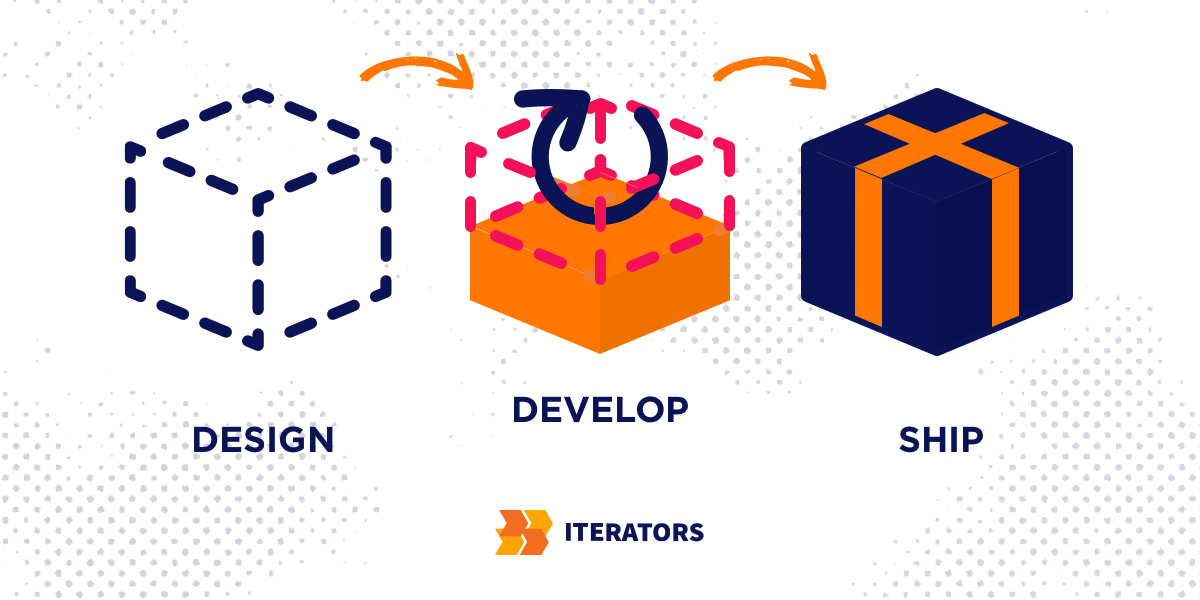
At Iterators, we’ve helped companies like Imperative, KLIX, and QUICO.IO build the enterprise readiness infrastructure that accelerates sales cycles and protects runway.
We don’t just consult—we build. From SOC 2 compliance to SSO integration to complete security documentation libraries, we provide the full-spectrum development services that turn your product into an enterprise-ready platform.
Schedule a free consultation to discuss how we can help you shorten your B2B sales cycle and protect your startup’s runway.
Because the difference between startups that survive and those that don’t often comes down to one thing: how fast you can turn pipeline into revenue before your cash hits zero.