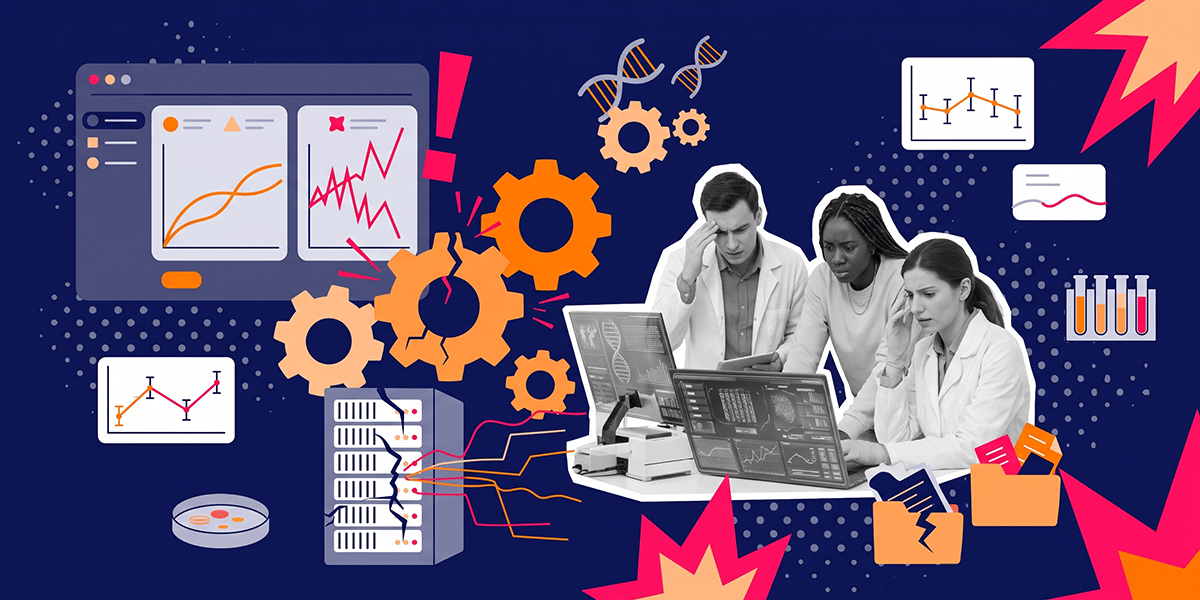

Biotech software development fails at a specific moment. It does not fail when the science is wrong. It fails when the science is right, and someone asks if customers can use it tomorrow. The algorithm runs. The notebook produces results. The model looks promising. Then, the system built to test a hypothesis gets handed to an engineering team. Now, they must turn it into a product.
That handoff is where most biotech software development projects break. It is not because the science was weak. It is not because the team lacked talent. Research code and production software are simply two different things. They serve two distinct purposes, and the gap between them is much larger than it looks.
This is not just a staffing problem. Hiring more engineers into a system never designed for production does not fix the issue. It just adds more people to a weak foundation. The actual problem is structural. There is no translation layer between scientific research and building a software product. Building that layer requires skills that most teams doing biotech software development have not yet gathered.
The Real Problem in Biotech Software Development: Research Is Not Product
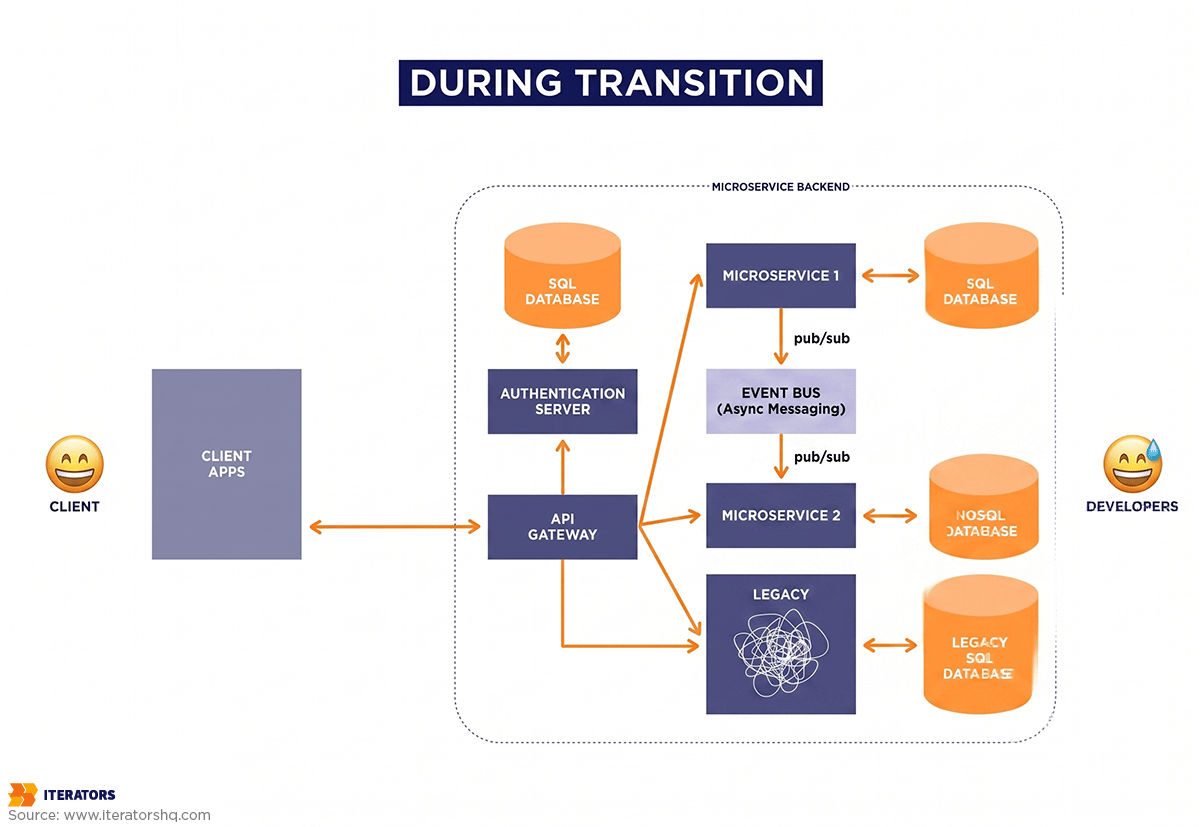
Research code is built for discovery. It must be quick to write, easy to change, and open to uncertainty. A scientist using a Jupyter notebook makes dozens of hidden choices. They decide which cleaning steps to use. They pick the parameters. They rely on specific library versions on their computer. They choose which data rows to skip and why. Those decisions live only in the scientist’s head. The code runs. The result looks valid. The experiment is done.
Production software is built for something entirely different. It must be repeatable under conditions the original author did not control. A production system must run correctly when a new person submits different data on a new server, six months after the original scientist left the company. When something goes wrong, it must fail visibly, not silently. It must produce results that users can track, audit, and reproduce on demand.
A notebook proves something can work once. A production system proves it can work repeatedly, safely, and under real-world pressure.
The mismatch between these two modes is the root cause of most biotech software development failures. Teams often fall into a specific trap. They keep patching the research prototype. They add features around the edges. The system grows more complex and more fragile at the same time. The technical debt piles up. The scientist who built the original notebook becomes the single point of failure. Soon, the platform meant to generate revenue only generates support tickets.
Algorithm Deployment in Biotech Software Development
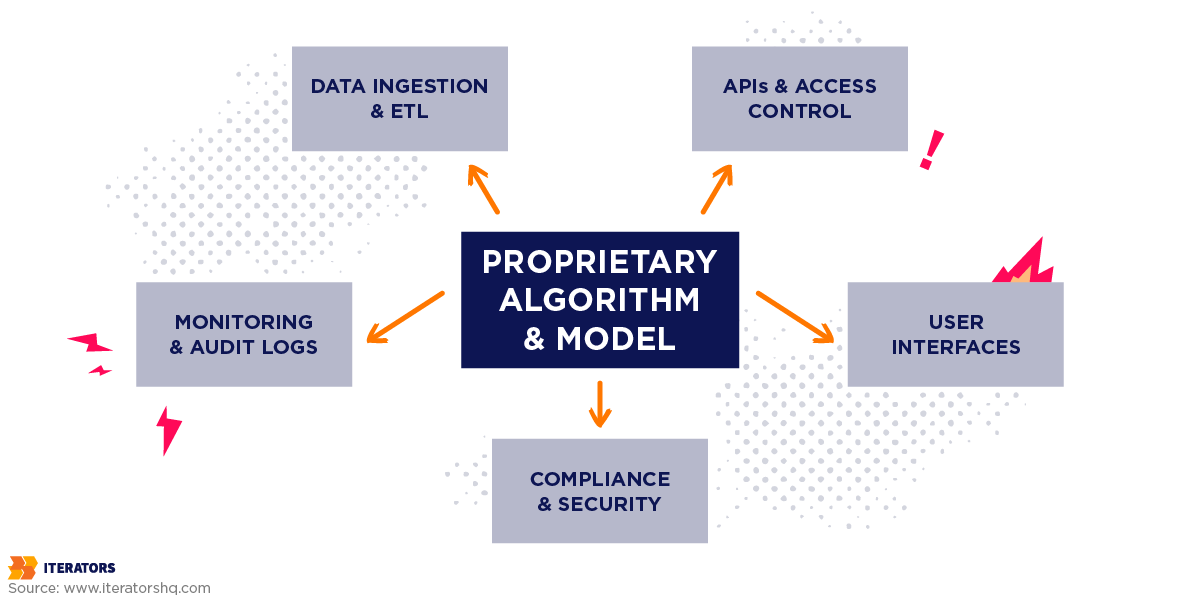
In biotech software development, productionizing a scientific algorithm means building the entire system around it. Exposing the model through an API is only a small part of the work. The algorithm itself is usually the smallest fraction of the total system. D. Sculley and colleagues at Google documented this precisely in their NeurIPS paper on machine learning technical debt:
“Machine learning offers a fantastically powerful toolkit for building complex systems quickly. This paper argues it is dangerous to think of these quick wins as coming for free.”
A production system requires much more than the algorithm. It includes data ingestion and validation. It needs automated cleaning pipelines, model packaging, and API design. It requires a user interface, access controls, and report generation. It must have monitoring, audit logs, and security controls. Each of these is a major engineering problem. If any are missing, the system will eventually fail.
What Biotech Software Development Actually Means for Algorithms
Scientific algorithm production is a process. It turns experimental research code into reliable software systems. These systems can be used, monitored, updated, secured, and audited in real-world business or clinical settings.
The difference between a research algorithm and a production algorithm is not about code quality. It is a matter of system design:
| Characteristic | Research Algorithm | Production Algorithm |
|---|---|---|
| Execution environment | Local machine or Jupyter notebook | Cloud, on-prem, or hybrid infrastructure |
| Data processing | Manual inputs, hardcoded paths | Validated, automated ETL pipelines |
| Who operates it | The scientist who built it | Any authorized user |
| Assumptions | Hidden in the scientist’s head | Documented business rules |
| Outputs | One-off results | Repeatable, auditable workflows |
| Error handling | Script fails or gives wrong results silently | Observable failures with alerts and logs |
| Model versioning | “I think I used v3 of the model” | Tracked, reproducible, linked to data version |
| Compliance | Not designed for it | Audit trails, access controls, data tracking |
The business risk of ignoring these rules is high. A system that cannot tell you which model version produced a result will fail an enterprise review. A system that relies on manual data cleaning cannot scale without hiring more analysts. A system with no monitoring will fail in ways that take days to fix.
Where Biotech Software Development Breaks: 7 Common Failures
These failure modes appear in almost every biotech software development project that struggles to move from research to production.
Failure #1: Hidden Notebook Assumptions in Biotech Software Development
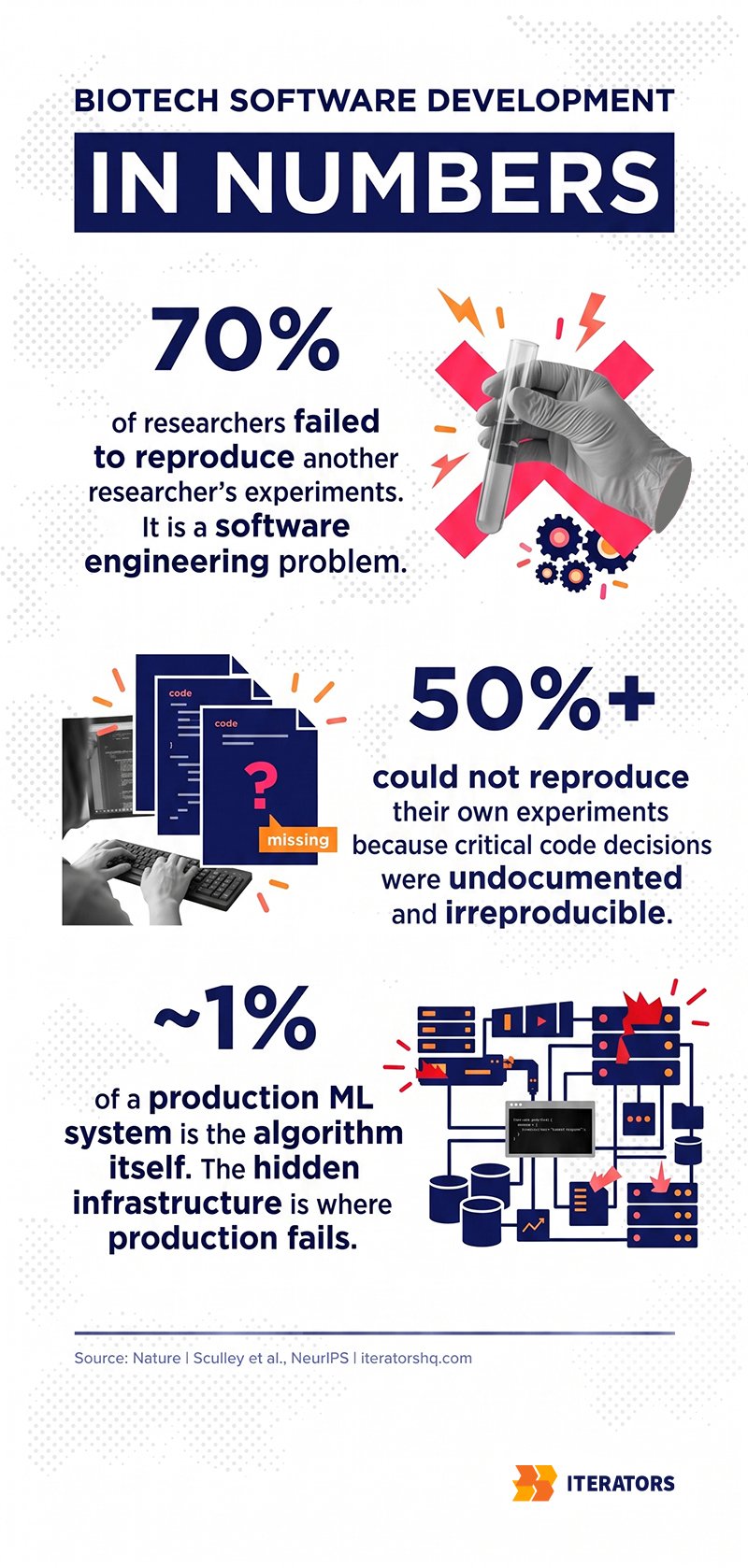
This failure is the most common and the hardest to spot from inside the lab. Jupyter notebooks gather hidden assumptions. They use file paths that only exist on one machine. They use parameter values set manually for a demo. They use library versions tied to the original computer.
When engineers get this code, they quickly find it does not run. This happens because the execution environment is undocumented. Guessing those assumptions takes time. Guessing wrong produces results that look valid but are false.
The reproducibility crisis in science comes directly from this pattern. A Nature survey of 1,576 researchers showed that over 70% failed to reproduce another scientist’s experiments. Over half failed to reproduce their own. In computing, this is almost always a software engineering problem, not a scientific one.
Failure #2: Data Provenance Is Treated as an Afterthought
Production systems must answer specific questions about every result. Where did the input data come from? Who changed it, and when? What cleaning steps were applied? Which model version made this output? Can we rebuild the entire workflow six months from now?
Research workflows rarely answer these questions. The scientist already knows the answers. But the scientist will not always be there, and a memory is not a legal audit record.
Data tracking is not just a documentation problem. It is an architecture problem. A biotech software development project that fails to track data will fail regulatory audits, no matter how good the algorithm is.
Failure #3: Manual Preprocessing Becomes a Silent Bottleneck
“Just clean the data first” is a dangerous phrase. When data cleaning is manual, analysts export CSVs, apply quick fixes, and make personal judgment calls. The system begins to rely on undocumented human choices. These choices are not consistent across different days or different people.
When preprocessing is manual, bad data enters the system through unrecorded human decisions. The algorithm gives a wrong result. To fix it, the team must figure out what one specific person did to one dataset on a specific day. Automated pipelines with clear rules and version control are essential infrastructure.
Failure #4: The Algorithm Has No Product Interface
Raw model outputs are not a product. A biologist can read a probability chart. A doctor, lab tech, or software buyer cannot—and they should not have to.
In biotech software development, users need clear dashboards. They need search, filter, and compare tools. They need PDF exports for reports. They need admin controls to manage users without calling support.
Missing a product interface is a major sales problem. Enterprise buyers will not buy a platform they cannot easily test. Doctors will not use a tool that requires a training course. The algorithm’s science does not matter if the target audience cannot use the software.
Failure #5: Compliance Is Added Too Late
Adding compliance rules to an existing system is incredibly expensive. Audit trails require database changes. Access controls require major code rewrites. If you do not plan for data security early, you might have to rebuild the entire platform.
Rules like 21 CFR Part 11, GxP, SOC 2, and HIPAA are not just paperwork. They are architecture requirements. The software must be built to make compliance possible from day one.
The FDA’s shift toward Computer Software Assurance (CSA) actually supports agile biotech software development when applied correctly. High-risk functions get strict testing. Lower-risk features get standard attention. The goal is to apply effort where the real risk lives, not to slow development down.
Failure #6: Nobody Owns the Translation Layer
Scientists know the algorithm. Engineers know the servers. Product managers know the users. In most biotech software development projects, these groups only see part of the whole picture.
The missing role is the translation layer. This cross-functional team turns scientific logic into product rules. It maps compliance needs to specific software features. It owns the system from end to end.
Without this team, the system breaks at the boundaries. The algorithm works alone but fails with real data. The UI looks good in demos but crashes under real use.
Failure #7: The Prototype Is Mistaken for the Product
A prototype is a learning tool. It asks: Can this science work in software? A production system asks a different question: Can this software work reliably at scale for real users?
The failure mode is treating the prototype as the final foundation. Teams patch it and add features on top. This creates a “pipeline jungle” of glue code that nobody understands.
This is technical debt in its most expensive form. It slows development down exponentially. A Proof of Concept (PoC) exists to validate risks before building real infrastructure. Once the PoC finishes its job, the production system should be built using its lessons, not on top of its code.
Biotech Software Development Architecture: From Notebook to Production
The Lab Bench vs. The Factory
Research code proves the science works. Production architecture proves your business can scale it safely and pass compliance audits. Toggle to reveal the missing translation layer.
Manual CSV Exports
Data is pulled manually, cleaned locally, and lacks version history.
Jupyter Notebook
Algorithm runs locally. Environment dependencies are undocumented.
Static Results Output
Results are emailed or saved as PDFs. Cannot be audited or reproduced reliably.
Automated ETL
Validated ingestion and schema normalization.
Feature Store
Centralized, versioned data for model execution.
Data Provenance
Every input is tracked back to its original source.
Containerized Model Execution
The algorithm is packaged, versioned, and runs securely in the cloud. It can process high-volume data reliably and scale automatically under pressure.
Secure API Gateway
Handles authentication, rate limiting, and integrations.
Clinical / Client Portal
Role-based UX for end users to view reports securely.
Observability
Monitoring for system health, data drift, and errors.
Continuous Compliance Layer
Immutable Audit Logs • 21 CFR Part 11 Readiness • Access Controls • Secure SDLC
A proper biotech software development pipeline has layers. Each layer has a job. Each layer supports the one above it. The order matters highly.
Data Sources (genomic outputs, LIMS, EHRs, external datasets):
- ETL / Validation (ingestion, schema normalization, FAIR compliance)
- Data Store / Feature Store (versioned, auditable)
- Algorithm / Model Execution (containerized, versioned)
- API Layer (documented, authenticated)
- Web Platform / Client Portal (role-based, user-tested)
- Reports / Dashboards (actionable, exportable)
- Monitoring + Audit Logs (observable, immutable)
Data Pipelines Come Before Dashboards
The UI is what users see, but it should be built last. Without stable data ingestion and cleaning, the dashboard is just a pretty face on bad data.
Biological data is messy. It comes from many sources in different formats. An algorithm trained on clean data will fail when fed messy real-world data. Data quality is the foundation that everything else rests upon.
Model Versioning Is Not Optional
In a production environment built through biotech software development, every result must trace back to an exact model version, dataset, and setting. This is an operational requirement. When a result changes, the system must explain why. When a client questions a result, the system must recreate it exactly.
Observability Makes It a Managed System
A production system without monitoring will fail in mysterious ways. Logs, metrics, and alerts are the bare minimum. You must monitor data drift to see if real-world data is changing compared to your training data. You must track user behavior to see how the platform is actually used. Observability is the difference between a system you manage and a system that manages you.
The Build-vs-Buy Question in Biotech Software Development
Not every biotech software development problem requires custom coding. The choice depends on where your true advantage lies.
| Situation | Better Fit |
|---|---|
| Standard lab operations, inventory, ELN | Buy or integrate existing tools |
| Proprietary AI/ML algorithm or model | Custom build |
| Internal PoC only | Lightweight prototype |
| External customer-facing platform | Productized custom software |
| Regulated enterprise buyers | Enterprise-ready architecture |
| Research team lacks product engineers | Partner with a software consultancy |
| Standard clinical trial management | Evaluate existing CTMS platforms |
The rule is simple. If your algorithm is your main advantage, the software around it cannot be generic. Standard platforms are made for standard workflows. If you force a unique scientific approach into a generic platform, it will be hard to maintain.
A Practical Roadmap for Biotech Software Development
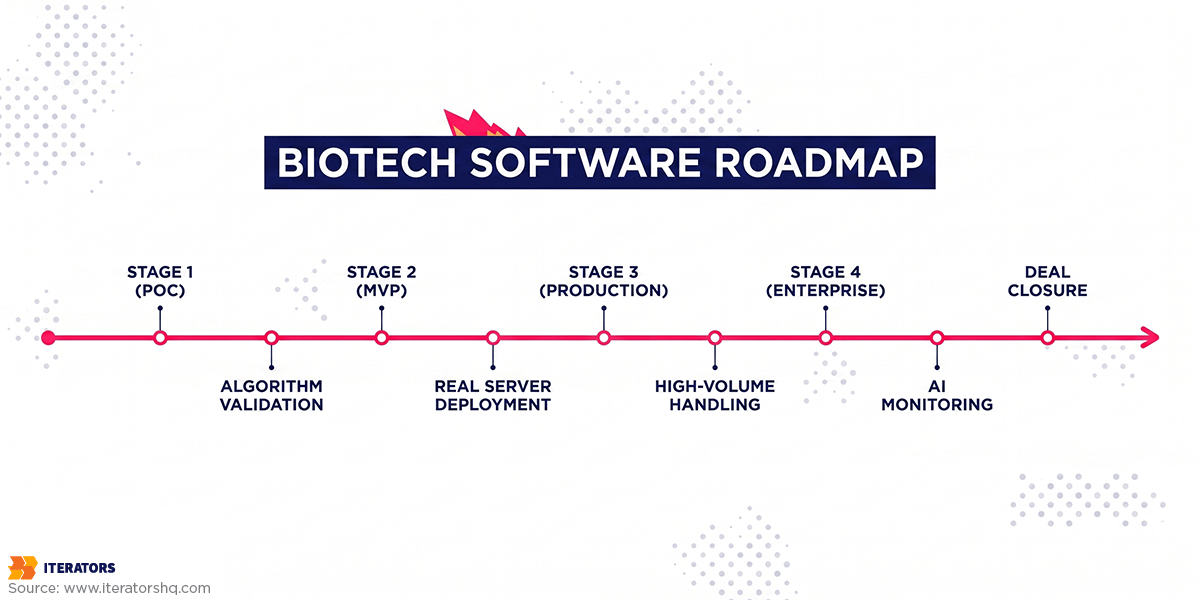
There are four standard stages in biotech software development. Skipping a stage does not save time. It just moves the cost to a later stage where fixes are more expensive.
Stage 1: PoC — Validate Scientific and Technical Risk
The PoC answers one question: Can this work? It proves the algorithm can function as software. It checks data quality and maps technical risks. It is the evidence used to decide whether to build a real system.
Stage 2: MVP — Build a Usable Research Product
The MVP asks: Can real users use this? It gives a working interface with basic flows, data uploads, and simple reports. It runs on real servers and gets tested by real users to reveal wrong assumptions.
Stage 3: Production — Make It Reliable and Secure
Production means the system can survive the real world. It handles high data volumes, multiple users, and security audits. This stage adds documented APIs, access controls, automated deployments, and strong testing.
Stage 4: Enterprise-Ready Platform
This stage builds a platform for large buyers. It supports advanced AI monitoring, custom client integrations, and strict enterprise security reviews. This is the platform that closes deals with major pharmaceutical companies.
What Iterators Actually Builds for Biotech Teams
Iterators’ role in biotech software development sits in the production layer. We turn research, models, and scripts into real software systems with proper data pipelines, access controls, and audit trails.
We build the infrastructure around proprietary algorithms. We work alongside data scientists to design API layers, client portals, and compliance-aware architectures. This ensures the scientific system can be operated safely and purchased by enterprise buyers.
The boundary is clear: the client owns the science. The production layer makes that science usable outside the lab.
The Missing Translation Layer
The missing piece in most projects is a cross-functional translation layer. This brings together product management, data engineering, UX design, QA, and security. They are all organized around the core biotech software development challenge: turning scientific logic into software that users can trust.
A notebook is a lab bench. A platform is a factory. The lab bench proves the chemistry works. The factory proves it can work at scale, repeatedly.
Most biotech software development projects have excellent lab benches. The factory is the part they are missing. The real risk is failing to use a strong productization process to bridge that gap.