

There are two kinds of payment processing outage.
The first kind is visible. Checkout breaks, the error page appears, support tickets spike, someone posts a screenshot on Twitter. The team notices within minutes. The incident channel opens. The postmortem gets written.
The second kind is quieter. Authorization rates drop from 94% to 87%. Webhook processing slows. A subset of subscription renewals fail without alerting. The server returns 200 OK, so the uptime monitor stays green. Nobody opens an incident channel because nothing looks broken. That state persists for four hours.
The second kind is usually more expensive.
A payment processing outage is not a single event with a clean start and end time. It is a category of failure that includes full gateway downtime, partial authorization degradation, settlement mismatches, failed renewal batches, duplicate charges, and webhook processing lag — any state where your system cannot reliably move money. The visible crash is one instance of that category. The silent degradation is another. Both have a cost. The silent one tends to compound before anyone measures it.
This article is about how to calculate that cost, where the hidden layers are, and what the architecture looks like when a team has decided to treat payment reliability as a first-class engineering concern rather than a vendor dependency.
Before the next incident: If payment downtime would put a real number on the line, Iterators can help you assess your payment architecture, find the monitoring gaps, and pressure-test the flow before it fails in production. Talk to Iterators.
What Is a Payment Processing Outage?

A payment processing outage is any incident that prevents customers, platforms, banks, gateways, processors, or internal systems from completing, confirming, settling, or reconciling payments. It can be caused by payment gateway downtime, API failures, bank or card network errors, fraud tool misconfiguration, infrastructure bottlenecks, or broken payment integration logic.
That definition is broader than most teams assume, and the breadth is the point. A payment processing outage is not only the moment checkout returns a red error. It is any of the following:
- Full payment downtime, where no transactions complete
- Partial failures affecting one payment method, one region, or one card network
- Subscription billing failures during a renewal run
- Settlement or payout delays after a successful authorization
- Refund failures
- Duplicate charges from unsafe retries
- Payment status that is out of sync between your system, the gateway, and the bank
The visible crash gets the attention. The rest of this list is where the money quietly leaks.
How to Calculate the Cost of a Payment Processing Outage
The standard framing is revenue per minute times outage duration. That number is real and worth calculating. It is also incomplete.
Revenue per minute is the starting point:
Average daily revenue ÷ 24 ÷ 60 = revenue per minute
For a platform generating $240,000 per day, that is $166 per minute. For a platform generating $2.4 million per day, it is $1,667 per minute. These are averages, and averages lie in the specific way that matters most here: outages do not occur uniformly across the day.
A payment processing outage during a flash sale, a subscription renewal batch, a payday lending window, or a Black Friday checkout spike does not cost the average minute. It costs a multiple of it. The useful framing is straightforward: identify your peak revenue concentration and apply a multiplier.
Average revenue per minute × peak multiplier = peak outage cost per minute
If your average is $166 and your peak multiplier is 8x, a minute of outage during peak costs $1,328. A 45-minute outage during that window costs roughly $60,000 in direct transaction loss before anything else is counted.
The “anything else” is where most estimates fall apart.
The cost categories that get missed:
| Cost Area | Formula | Example |
|---|---|---|
| Direct revenue loss | Revenue per minute × outage minutes | $500 × 45 = $22,500 |
| Failed subscription renewals | Failed payments × average subscription value | 800 × $49 = $39,200 |
| Support ticket load | Tickets generated × cost per ticket | 1,200 × $8 = $9,600 |
| Engineering response | Engineers × hours × hourly cost | 6 × 8 × $150 = $7,200 |
| Customer credits / refunds | Affected users × credit value | 2,000 × $10 = $20,000 |
| Churn impact | At-risk users × CLV loss | 60 × $600 = $36,000 |
| SLA penalties | Contractual penalty estimate | $5,000–$100,000+ |
The total is not one line item. It is the sum of the blast radius.
A failed payment also has a per-item operational cost: card network fees, manual resolution time, resubmission overhead, and exception handling. When failures require compliance review, the cost per item changes category. For a platform processing meaningful volume, a four-hour partial outage is not one failed transaction. It is every transaction that touched the broken path, plus the support load, plus the reconciliation work, plus the customers who did not come back.
The full formula:
(Revenue per minute × outage duration × peak multiplier) + recovery costs + churn and trust impact = estimated outage cost
Read left to right, that is the whole method: work out revenue per hour, break it down to the minute, adjust for peak traffic, add the recovery costs, then add the churn and trust impact. Most teams stop at the first term. The last two are usually larger.
Calculate Your True Outage Cost
Direct revenue loss is just the tip of the iceberg. Adjust the parameters below to reveal the hidden recovery, support, and churn costs that compound during a payment failure.
Direct Revenue Loss
Missed transactions during downtime$0
Recovery & Support Overhead
Ticket load, manual reconciliation, refunds$0
Failed Renewals & Churn
Lost CLV from frustrated or dropped users$0
True Outage Cost
$0
For a financial services platform, add compliance review as its own cost line. Regulatory exposure does not wait for the incident to close.
Want your real number? We can help map your payment flow, quantify your exposure per minute, and find the monitoring and reconciliation gaps that turn a short incident into a long one. Ask Iterators about a payment reliability review.
The Subscription Layer
For SaaS and subscription businesses, the payment processing outage cost structure has a specific shape that deserves separate treatment.
Subscription billing runs are batched. A platform with 10,000 monthly renewals processes most of them in a window — often overnight, often on the first or fifteenth of the month. If a payment issue occurs during that window, the failure rate is not distributed across the month. It is concentrated in hours.
The failure modes here are not always visible as outages. A webhook bug that marks successful payments as failed is not a gateway problem — the gateway processed the charge correctly. But if your system believes the payment failed, it will revoke entitlements, trigger dunning sequences, and generate support contacts. Customers who paid successfully will lose access. The reconciliation effort to identify which accounts were affected, restore access, and prevent incorrect churn notices can take days.
If 5,000 renewals are processed overnight and 8% fail due to a payment issue, that is 400 accounts at risk. If 15% of those do not recover through dunning or manual outreach, you have 60 lost customers from one billing incident. At a $600 CLV, that is $36,000 in future revenue from a problem that may not have shown up in any uptime monitor.
The SaaS metrics that matter here — MRR, churn rate, LTV — all have payment reliability as a load-bearing dependency. A billing system that fails without alerting during renewal windows will show up in churn numbers weeks later, disconnected from the original incident in any dashboard that does not trace the failure path.
For more detail on how subscription billing models are structured and where the failure surfaces live, Stripe’s subscription and payment model overview is a useful reference point.
Why the Gateway Is Not the Whole System

Werner Vogels, CTO of Amazon, has a principle that shapes how resilient systems get designed: “Everything fails, all the time.” The point is not pessimism. It is that a system designed around the assumption of failure behaves differently — and better — than one designed around the assumption of uptime.
The payment stack is a chain of dependencies:
- Customer Checkout UX
- Payment Orchestration Layer
- Gateway / Processor APIs
- Fraud + Risk Tools
- Bank / Card Networks
- Internal Ledger + Reconciliation
- Monitoring + Incident Response
When a payment fails, the failure can originate at any layer. Gateway downtime is one cause. It is not the most common one.
The distribution of actual failure causes looks more like this:
Gateway-side failures — API downtime, regional degradation, webhook delivery lag, dashboard outages. Stripe, Adyen, Braintree, PayPal, Checkout.com, Authorize.net, and Banking-as-a-Service providers all publish status pages (Stripe, Adyen, PayPal). The transparency is useful. But gateway status pages report what the provider knows about. They do not report what is happening inside your integration. This is dependency risk, not a specific vendor’s fault — every provider has bad days.
Weak payment gateway integration — no retry logic, missing idempotency keys, poor webhook handling, race conditions between order state and payment state, duplicate charges from double-submitted forms, checkout error messages that tell the customer nothing. These are not gateway problems. They are integration problems that look like gateway problems from the outside. A significant portion of incidents that get attributed to “the gateway was down” are actually integration failures that the gateway’s own status page correctly shows as nominal.
Failed settlement or reconciliation — payment success is not a single event. It is a lifecycle: authorization, capture, settlement, payout, refund, chargeback, and ledger reconciliation. A transaction can authorize cleanly and still fail to settle, or settle without reconciling against your internal ledger. Each stage is a place the money can go quiet.
Bank and card network failures — issuer bank timeouts, authorization throttling under high volume, OTP failures under strict two-factor authentication requirements. During peak transaction windows, the banking infrastructure of major card issuers can struggle with authorization volume independently of anything the gateway does. This is a different wall: the payment provider can be up while the authorization path beyond it is degraded.
Fraud tool misconfiguration — a fraud prevention layer that is tuned for normal transaction patterns will flag unusual behavior as suspicious. A product launch, a new geography, a sudden velocity spike from a marketing campaign, subscription retries that look like card testing, a legitimate corporate card — all of these can trigger false declines at scale. The payment appears to fail. The gateway is fine. The fraud tool is working as configured. The configuration is wrong for the current context.
Internal infrastructure — checkout service overload, database locks under concurrent load, queue backup, inventory-payment race conditions, slow third-party API calls in the critical path, webhook consumers that are down, a bad deployment shipped during peak usage. A server with a PHP memory limit of 256MB will return fatal errors under concurrent database queries during a traffic spike. The payment fails. The server is “up.”
The shared responsibility model:
| Layer | Responsibility |
|---|---|
| Gateway | API uptime, authorization, processing, status transparency |
| Bank / card network | Authorization decisions, settlement, risk rules |
| Your platform | Integration logic, retries, customer UX, state management |
| Your DevOps setup | Monitoring, alerting, scaling, incident response |
| Your product team | Fallback flows, customer communication, trust |
“The gateway was down” is a complete explanation only when the failure is confirmed as gateway-side and your integration has no contribution to the blast radius. In practice, most payment incidents have multiple contributing layers. The integration is rarely blameless.
Payment Processing Outage Risk by Business Model
The cost structure of a payment processing outage is not uniform. It depends on what your platform does with money.
E-commerce — the primary exposure is abandoned carts during high-traffic windows and duplicate orders from customers who retry without knowing whether the first attempt succeeded. Flash sale failures are particularly expensive because the revenue concentration is high and the customer tolerance is low. A failed checkout during a limited product drop does not produce a customer who waits and tries again later. It produces a customer who goes to a competitor or posts about it. Platform-level dependencies matter too — a commerce stack riding on a hosted platform inherits that platform’s incidents (Shopify status is worth watching for exactly this reason).
SaaS — the primary exposure is involuntary churn from failed renewals and entitlement confusion when payment state and access state get out of sync. The secondary exposure is enterprise account friction: a Fortune 500 customer whose account gets suspended because of a billing webhook failure is a support and relationship problem. The failed charge is only one part of it.
Marketplaces — the exposure splits across two sides. Customer payment failures are visible and immediate. Provider payout failures are quieter but often more damaging. A marketplace that fails to pay its supply side on time loses supply-side trust faster than customer trust. Supply-side churn from a single payout failure can damage the marketplace more than the original payment incident. Tax reporting, escrow handling, and split payment reconciliation add compliance surface area that amplifies every failure.
Fintech — the exposure includes everything above plus audit trail requirements, regulatory reporting obligations, and reconciliation precision. A fintech platform that shows a user a successful transaction but fails to settle it correctly has a compliance problem. The support problem is secondary. The SOC 2 compliance framework is relevant here not as a pre-audit checklist but as an architectural constraint — the logging, access control, and audit trail requirements shape how payment flows get built. The broader payment ecosystem is more complex than a single API surface suggests; the Federal Reserve’s overview of the payments system is a reminder of how many parties sit between a click and settled money.
On-demand apps — real-time booking and provider payment create tight coupling between transaction success and service delivery. A payment failure at booking time is recoverable. A payment failure at payout time, after the service has been delivered, is a trust failure with a provider who has already done the work.
Why Silent Failures Cost More Than Crashes
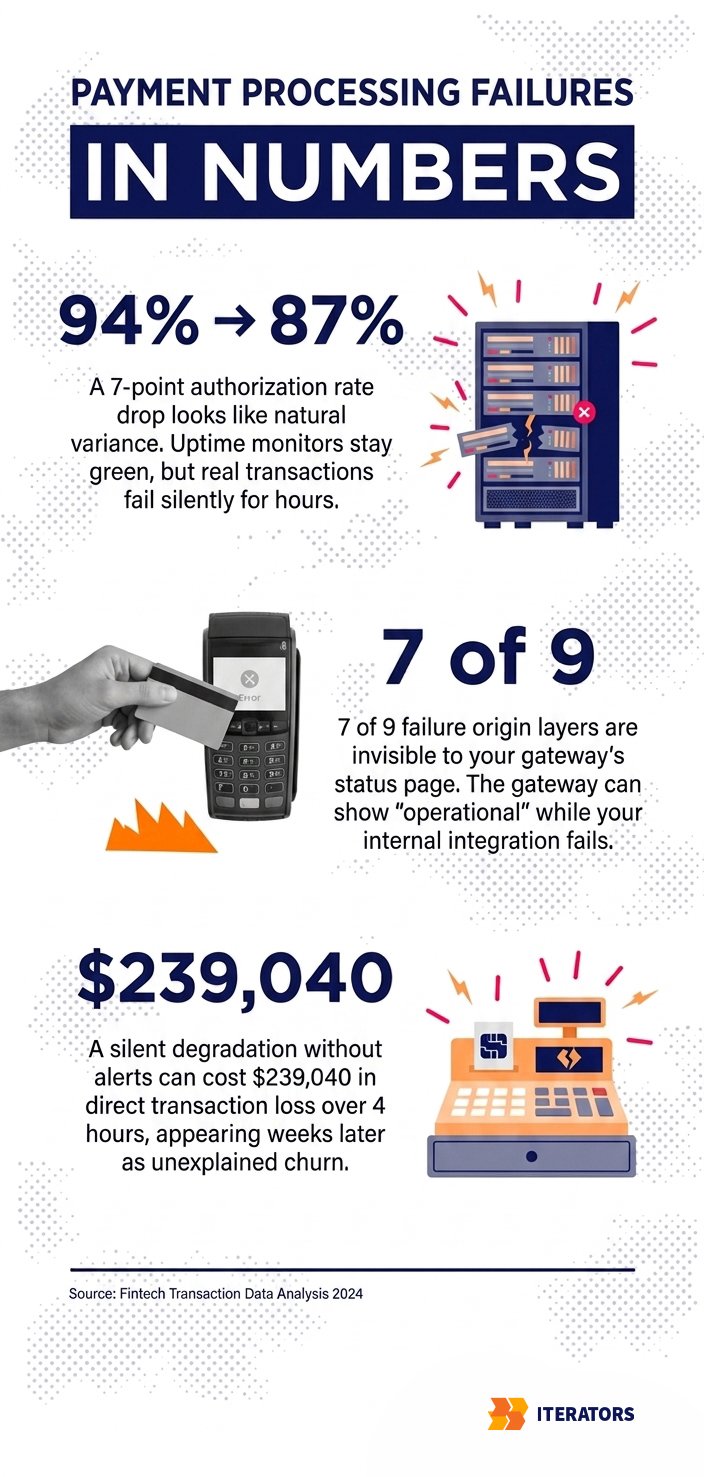
The most dangerous payment processing outage is not the one that fires all the alerts. It is the one that returns 200 OK while failing to complete transactions.
A payment gateway integration returning timeout errors on a single payment method while the server remains nominally online is invisible to standard infrastructure monitoring. Because the uptime check passes, the team does not open an incident channel. The failure persists. Authorization rates drop from 94% to 87%, which looks like a 7% variance in a metric that already has natural variance. The anomaly is detectable — but only if someone is watching the right metric.
The metrics that matter for payment reliability are not the same as the metrics that matter for application uptime:
- Authorization rate (separate from error rate)
- Capture success rate
- Payment latency by gateway and payment method
- Webhook delivery success and processing lag
- Failed renewal rate by cohort
- Checkout abandonment rate (correlated with payment errors)
- Decline reason distribution
- Regional failure patterns
- Settlement mismatch rate
Your application can be fully “up” while payments are failing inside the payment path. Uptime monitoring does not catch this. Payment-specific observability does.
The Google SRE approach to monitoring distributed systems distinguishes between symptoms (what the user experiences) and causes (what the system is doing). For payment systems, the symptom is a failed transaction. The cause could be at any layer of the stack. Monitoring that only watches causes — server health, API response time — will miss symptoms that originate in the interaction between layers.
Synthetic payment checks — automated test transactions that run on a schedule and alert on failure — are one of the more reliable ways to catch partial failures before customers do. They are not standard practice. They should be.
Architecture Patterns That Change the Failure Profile
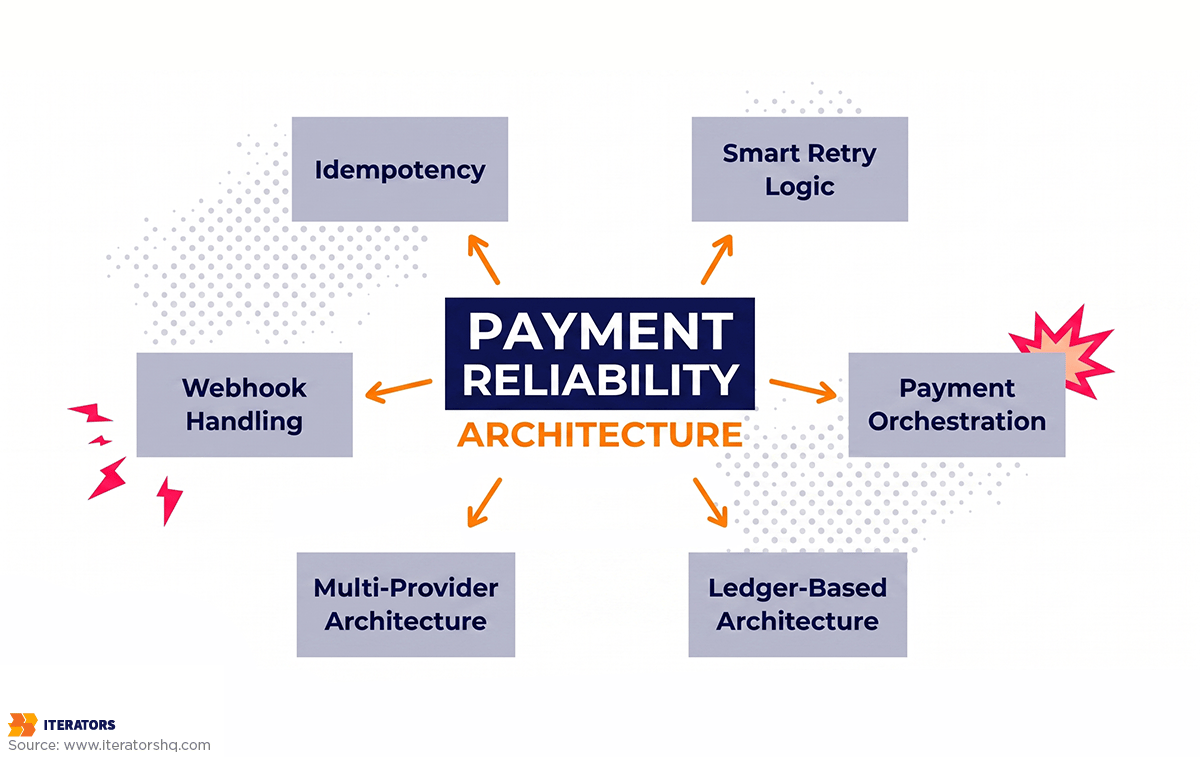
There are five architectural decisions that separate payment systems that fail gracefully from payment systems that fail badly. Each one shrinks the blast radius of a payment processing outage rather than assuming one will never happen.
Idempotency is the first one. If a customer clicks “Pay” three times, or if a network timeout causes a retry, or if a webhook is delivered twice, your system should recognize that it is the same payment event — not three separate charges. Stripe’s idempotency key implementation is a reference for how this works at the API level. The platform must use idempotency keys correctly — they are available, but they are not automatic.
Retry logic is the second. Not all payment failures are equal. A hard decline (stolen card, invalid account) cannot be recovered by retrying. A soft decline (insufficient funds, network timeout, issuer timeout) often can. Retrying a hard decline wastes resources and may trigger fraud flags. Not retrying a soft decline loses recoverable revenue. The logic needs to distinguish between them, apply exponential backoff, set retry limits, schedule subscription retries sensibly, and avoid the retry storm pattern where simultaneous retries from multiple failed attempts overwhelm the gateway during recovery.
Webhook handling is the third. Webhooks are frequently the truth source for payment status — the authoritative signal from the gateway about what actually happened. Webhook handlers that are not idempotent, that process synchronously, that do not verify signatures, or that do not store event history create a class of failures where the gateway correctly processed the payment but your system does not know it. Alerting on delayed or failed webhook processing is not optional. The reconciliation work to recover from a missed webhook is expensive and error-prone.
Payment orchestration is the fourth. Integrating payment logic directly into checkout creates a tight coupling that makes every change risky and every failure hard to isolate. A dedicated payment service or orchestration layer — separate from the checkout flow, with its own logging, retry logic, and state management — makes the system easier to monitor, easier to change, and easier to recover when something breaks. It also makes gateway switching feasible, which matters for the next point. Queue-based processing belongs here too: webhook handling, invoice generation, confirmation emails, settlement reconciliation, and refunds all run more safely as asynchronous work than as blocking calls in the checkout path.
Multi-provider architecture is the fifth. A single gateway dependency means that when the gateway has a bad day, you have a bad day. Active-active setups route live traffic across providers; active-passive setups keep a backup ready to take over when the primary shows degradation. Both reduce the blast radius of any single provider failure and can improve authorization rates through regional optimization. The tradeoff is real: more reconciliation complexity, more compliance surface area, more test cases, more integration maintenance. The question is whether your payment volume and risk exposure justify the added architecture. For platforms processing meaningful volume with enterprise customers or SLA commitments, the answer is usually yes.
For fintech and marketplaces, one more pattern sits underneath all of these: a ledger-based architecture. If you move money, you need a trustworthy internal record of what your system believes happened, what the gateway says happened, and what the bank eventually settled. Those three views drift apart during an incident, and the ledger is what lets you reconcile them afterward instead of guessing.
What to Do During a Payment Processing Outage
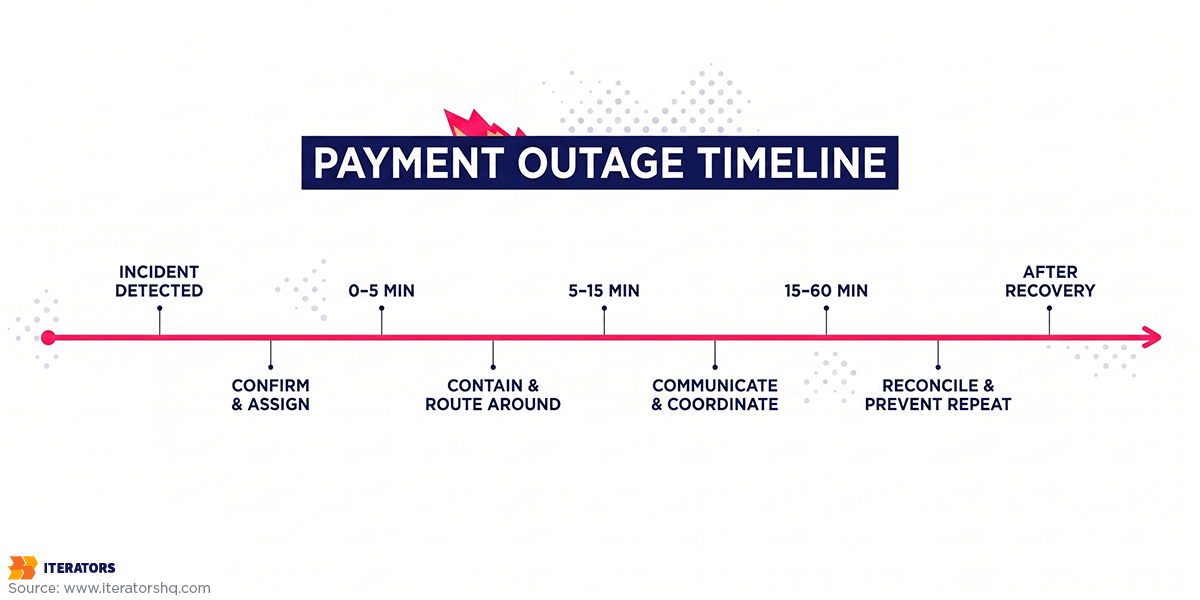
The first five minutes of a payment processing outage determine how much of the blast radius is contained.
0–5 minutes: Confirm whether the failure is internal or external. Check the gateway status page. Check your own logs and metrics. Assign an incident commander. Open an incident channel. Freeze any deployments that went out in the last two hours.
5–15 minutes: If the broken payment path is identifiable, disable it or route around it. Add checkout messaging so customers know what is happening instead of retrying blindly. Pause automated retries if there is any risk they are generating duplicate charges. Notify the support team with what is known. Start tracking affected user IDs and transaction IDs.
15–60 minutes: Communicate with customers. Not a generic “we’re experiencing issues” message — a specific message about what is broken, what they should do, and what you are doing. Monitor payment retries and any fallback methods. Coordinate with gateway support if the failure is confirmed as gateway-side. Export failed transaction records for reconciliation.
After recovery: Reconcile every payment state. Identify duplicate charges before customers do. Contact affected customers. Run a postmortem. The Atlassian incident management framework is a reasonable starting point for postmortem structure, and when an incident outruns the team on call, emergency IT support is the difference between a contained event and a two-day scramble.
The postmortem questions that matter:
- What failed first?
- Was the failure gateway-side, integration-side, infrastructure-side, or some combination?
- How many users were affected?
- How many transactions failed, and how many were retried successfully?
- Were any customers charged twice?
- Were webhook events delayed or lost?
- Did support have the right information, and did customers get clear communication?
- Which alerts fired? Which alerts should have fired but did not?
- What is the estimated total cost?
- What specific engineering work prevents the same incident?
The last question is the only one that produces output worth having.
How a Payment Processing Outage Damages Customer Trust
Every failed transaction generates a question in the customer’s head, and none of the questions are good ones. “Did you charge me?” “Should I try again?” “Why is my order missing?” “Why was I billed twice?” “Can I trust this app with my money?”
That last one is an expensive question. A failed checkout is a lost sale. A customer who no longer trusts you with their card is a lost lifetime. The transaction that fails is the first invoice. The customer who never comes back is the larger one.
The specific fear depends on what your product does with money:
| Industry | Customer fear during a payment failure |
|---|---|
| Fintech | “Is my money safe?” |
| E-commerce | “Did my order actually go through?” |
| SaaS | “Will my account get suspended?” |
| Marketplace | “Will I get paid?” |
| Travel | “Did I just lose the booking?” |
| Healthcare | “Did I pay for the appointment?” |
| Crypto / trading | “Did I miss the price window?” |
The practical takeaway is that silence is the worst response. A clear, specific message during a payment processing outage — what is happening, whether they were charged, what to do next — costs almost nothing and preserves most of the trust. A generic error page, or worse, no message at all, converts a technical incident into a relationship problem.
Payment Processing Outage: Do’s and Don’ts
The difference between surviving a payment processing outage and being defined by one usually comes down to a short list of habits.
Do:
- Track payment success rate separately from application uptime
- Use idempotency keys on every payment request
- Build retry logic that knows the difference between soft and hard declines
- Store every payment event so you can reconstruct what happened
- Monitor webhook delivery and processing lag
- Keep an incident playbook that names who leads, who talks to customers, and who talks to the gateway
- Test payment flows before major campaigns and billing runs
- Reconcile every transaction state after an incident
- Communicate clearly with affected customers
- Run a postmortem after every serious payment incident
Don’t:
- Treat the payment gateway as the whole payment system
- Retry failed payments blindly
- Deploy risky changes right before a billing run
- Assume a successful authorization means settled money
- Hide payment failures behind a generic error message
- Wait for customers to report a broken checkout
- Skip reconciliation once the incident “feels” resolved
- Blame the vendor before reviewing your own integration
When the Architecture Needs Outside Help
There is a set of conditions where the internal team is the wrong tool for the problem — not because they are not competent, but because the work requires a different kind of attention than a product team under delivery pressure can provide.
The clearest signals:
- You process meaningful payment volume and the exposure per minute is real
- Payment flow has grown organically over several years and nobody has a complete mental model of it
- A recent outage revealed that monitoring was watching the wrong metrics
- The platform is entering fintech, marketplace, or subscription billing for the first time and the existing architecture was not designed for it
- You need payment gateway redundancy and don’t have it
- Enterprise customers are asking about SLA commitments, SOC 2, or enterprise readiness, and the honest answer is “not yet”
- The team is strong but operating at capacity, and payment reliability work keeps getting deprioritized in favor of feature delivery
- A funding round or enterprise contract is contingent on demonstrating infrastructure maturity
Payments are not a plugin when they are the revenue engine, and a payment processing outage is the moment that distinction stops being theoretical. The security and reliability of digital financial infrastructure is not a feature that gets added after the product works. It shapes the architecture from the beginning — the logging strategy, the state management model, the monitoring approach, the incident response process. This is the work Iterators does for payment-critical platforms: fintech software development, DevOps consulting, emergency IT support, payment gateway integration, scalable infrastructure, observability, incident response, QA and automated testing, and the enterprise readiness that lets a platform survive its own growth.
Payment Processing Outage Prevention Checklist
For teams that want to audit their current payment reliability posture:
- Idempotency keys used for all payment requests
- Retry logic distinguishes soft declines from hard declines
- Webhook handlers are idempotent, verify signatures, and store event history
- Payment success rate tracked separately from application uptime
- Authorization rate, capture rate, refund success, and settlement monitored independently
- Synthetic payment checks running on a schedule
- Payment incident playbook exists and is current
- Customer-facing fallback messaging defined for common failure states
- Reconciliation process documented and tested
- Payment flows tested before major campaigns or billing windows
- Deployments avoided during billing runs
- Multi-provider payment architecture considered where volume and risk justify it
- Postmortem run after every significant payment incident
The technical debt that accumulates in payment systems is particularly expensive to carry, because unlike UI debt or test coverage debt, payment system debt has a direct revenue number attached to every failure it enables.
Frequently Asked Questions

What is a payment processing outage? A payment processing outage is any incident that prevents payments from being authorized, captured, settled, refunded, reconciled, or correctly reflected in your system. It ranges from a full gateway crash to a silent degradation where a subset of transactions fail while the app still reports health.
How much does a payment processing outage cost? It depends on revenue per minute, outage duration, whether the outage hits a peak window, failed renewals, recovery costs, support load, refunds, SLA penalties, and churn risk. Direct transaction loss is only the first term. For most platforms, the recovery and trust costs are larger than the missed sales.
How do you calculate revenue per hour during an outage? Divide average daily revenue by active sales hours. For a 24/7 business, divide daily revenue by 24. Then divide by 60 for revenue per minute, and apply a peak multiplier if the outage lands during a flash sale, billing run, or seasonal spike.
Is a payment gateway outage always the provider’s fault? No. Some failures are genuinely gateway-side, but many come from integration logic, missing retries, webhook failures, infrastructure bottlenecks, or fraud tool misconfiguration. A gateway status page that shows “all systems operational” during your incident is a strong hint the problem is on your side.
How can companies prevent duplicate charges during payment failures? Use idempotency keys, safe retry logic that distinguishes soft from hard declines, transaction state tracking, and idempotent webhook handling. The goal is for your system to recognize the same payment event no matter how many times it is submitted or delivered.
What payment metrics should we monitor? Authorization rate, capture rate, refund success, webhook delivery and processing lag, payment latency, gateway error rate, checkout abandonment, failed renewal rate, decline reason distribution, and settlement mismatch rate — all tracked separately from application uptime.
Should we use multiple payment gateways? Multiple gateways improve resilience and can lift authorization rates, but they add reconciliation complexity, compliance surface area, and test cases. It makes sense when payment volume, regional coverage, enterprise requirements, or risk exposure justify the added architecture.
What should we do after a payment processing outage? Reconcile every transaction state, identify duplicate charges, refund or credit affected customers, communicate clearly, run a postmortem, and ship the specific engineering work that prevents a repeat. Reconciliation is not optional just because the incident feels over.
The Takeaway
Build payment systems that fail safely. If your revenue depends on payment reliability, Iterators can help you assess, harden, and rebuild the systems behind checkout, billing, settlement, and reconciliation — from fintech software development and DevOps to incident response and payment infrastructure. Talk to us.
The question a payment processing outage actually asks is not “why did the gateway fail?” Most gateways fail occasionally. The question is whether your architecture was designed to absorb that failure, surface it, and recover from it — or whether it was designed on the assumption that the gateway would always be up.
Most payment systems are designed on the second assumption. The first outage is when teams find out which one they built.