

When a B2B SaaS platform crosses the enterprise threshold, it hits a hard floor. The system that served fifty SMBs perfectly well will fail a Fortune 500 vendor assessment, and the failure will be structural. The product works. The core logic is sound. But the administrative and compliance boundaries are missing.
Last quarter, we audited a Series B HR tech platform that had spent six months negotiating a $500K annual contract. The deal died in procurement because the platform’s RBAC model was hardcoded, they could not support SCIM provisioning, and their audit logs rolled over every thirty days. They did not lose to a better product; they lost to a competitor with a compliant architecture.
The enterprise readiness cost is not a vendor fee or a compliance audit invoice. It is the fully-loaded price of structural stability—the engineering time, the opportunity cost, the technical debt, and the revenue lost while the system is brought up to code. Founders frequently treat this as a pre-audit checklist. It is not. It is architecture from day one.
We classify the decision into three states: you can build the constraints in-house, you can defer the problem entirely, or you can run a compressed sprint to inject the missing load-bearing components. To understand what is actually at stake, we must first name the walls you will hit. For a broader baseline, you can review this guide to enterprise readiness for B2B SaaS.
The Architecture of Enterprise Readiness Cost
The venture capital landscape no longer funds “growth at all costs.” The mandate is operational efficiency, which means enterprise buyers are consolidating vendors. They demand structural proof that a startup will not become a supply-chain vulnerability.
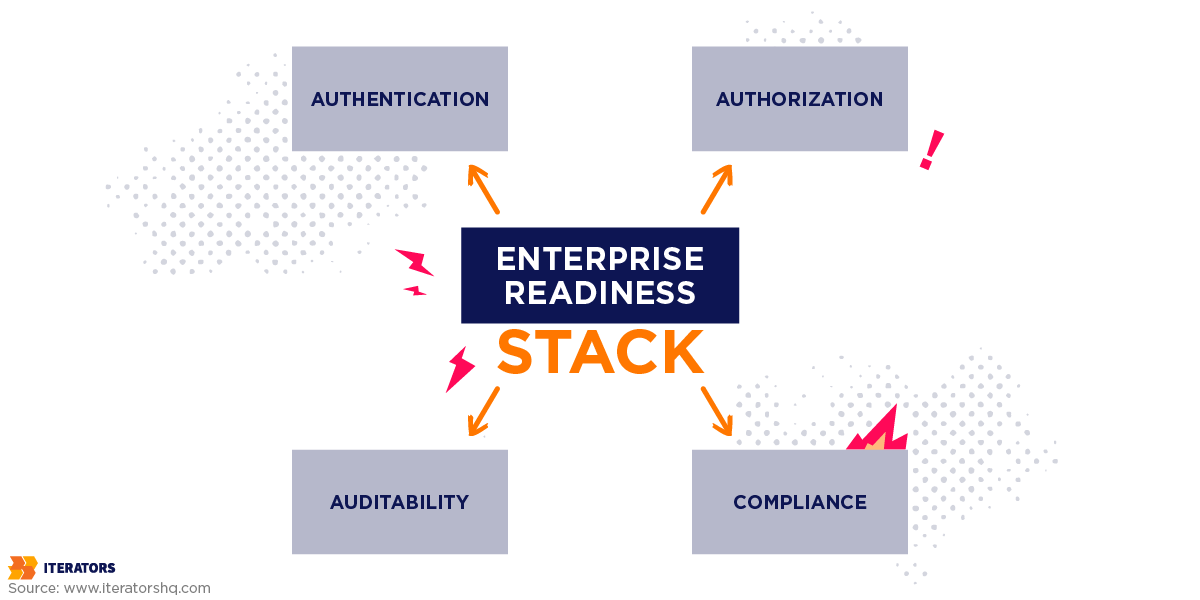
If you cannot pass the assessment, you do not exist to the buyer. Real enterprise readiness rests on three load-bearing pillars, and standard write-ups frequently skip the operational load required to maintain them.
1. Authentication: The SSO Mandate
Single Sign-On (SSO) is a kill condition for enterprise deals. According to EnterpriseReady.io, if you cannot federate identity, you cannot sell to the enterprise. But SSO is not a monolith.
SAML 2.0 is the legacy XML-based standard. It is rigid, requires complex metadata exchanges, and identity providers like Okta and Azure AD implement it with slight, undocumented variations. A competent engineering team will spend 400 hours mapping the edge cases of basic SAML, and another 40 hours per idiosyncratic identity provider. (Caveat: I use 400 hours based on forensic analysis of our own inherited codebases—if your team claims they can do it in a weekend, they are ignoring the error handling.)
OpenID Connect (OIDC) is the modern JSON-based alternative. It is structurally superior for web APIs, but enterprise IT teams will still mandate SAML because it is what their runbooks demand. You will have to support both. Our breakdown of web authentication and secure access documents the degradation paths for these implementations.
2. Authorization: The RBAC Constraint
Role-Based Access Control (RBAC) is the most underestimated driver of enterprise readiness cost. An SMB platform functions with a binary admin/user model. Enterprise buyers demand hierarchical roles, custom attribute mapping, and just-in-time provisioning.
If your initial architecture hardcoded role checks into the application logic, retrofitting RBAC requires a complete rewrite of your authorization middleware. We inherited a system where a fintech startup spent $120K over six months surgically extracting hardcoded permissions because they had not separated policy from application logic.
3. Auditability: The Storage Wall
Enterprise compliance mandates twelve months of searchable, tamper-proof audit logs. This is not a database table; it is a streaming data problem.
The math is unforgiving. A thousand active enterprise users generate roughly 500GB of log data annually. Pushing that to a searchable index costs between $2 and $5 per gigabyte monthly. This introduces a baseline infrastructure tax of $12K to $30K per year, entirely independent of the engineering time required to build the ingestion pipeline and the search interface. You can review the metrics required to prove compliance in our enterprise readiness monitoring framework.
Path 1: The Enterprise Readiness Cost of the In-House Build
When technical founders look at SAML and RBAC, their default move is to build it. We have audited the post-mortems of these decisions. The $3.5M cost is not an exaggeration; it is the fully-loaded operational reality of dedicating senior talent to commodity infrastructure.
The Upfront Infrastructure Allocation
Building the base layer requires three engineers for six months: a senior backend engineer, a security engineer, and a DevOps engineer.
- Base Salaries: Six months of this specific talent pool costs $351K in salaries and benefits.
- Tooling and Infrastructure: Identity provider testing accounts, certificate management, and compliance consulting add another $60K.
- Opportunity Cost: The core constraint. If this engineering triad typically ships feature work that generates $2M in ARR annually, deploying them to build SSO costs you $1M in deferred revenue capacity.
The Expansion and Maintenance Load
Once the base is built, the enterprise buyer will demand domain verification, custom attribute mapping, and System for Cross-domain Identity Management (SCIM) sync.
The hidden wall here is knowledge concentration risk. Building SSO is complex, but maintaining it is tedious. Identity providers deprecate endpoints. Certificates expire. When the single senior engineer who understands your bespoke SAML implementation resigns, the degradation path is steep. It takes four months to recruit and ramp up a replacement security engineer, during which time your enterprise integrations degrade silently.
Total In-House Forensic Cost
| Cost Category | Base Amount | Hidden Multiplier | Realized Cost |
|---|---|---|---|
| Infrastructure Build | $411K | 2.4x (opportunity cost) | $986K |
| Feature Expansion | $351K | 2.7x (distraction penalty) | $951K |
| Long-term Maintenance | $140K | 8.8x (knowledge loss) | $1.23M |
| Total Constraint | $902K | 3.9x average | $3.56M |
This $3.56M enterprise readiness cost does not include the separate financial load of the SOC 2 audit itself. For deep context on architectural allocation, review our thesis on SaaS development services and architecture decisions.
The $3.5M Trap Calculator
Your budget only accounts for salaries. You forgot about maintenance, context switching, and technical debt. Calculate the true cost of building in-house.
Path 2: The Enterprise Readiness Cost of the Deferred State
The alternative to building is ignoring the problem entirely and focusing on SMBs. This is the deferred state. It holds together perfectly until the math of churn breaks it.
An SMB account might yield $15K annually with a 25% churn rate and high support overhead. An enterprise account yields $150K annually with a 5% churn rate and negative net churn (expansion). You need ten SMBs to replace one enterprise client, but the enterprise client compounds value while the SMB cohort bleeds it.
The kill condition of the deferred state is the point of no return. In month 12, an enterprise prospect asks for a SOC 2 Type II report. You do not have it. The deal dies. By month 24, your competitor raises a Series B at a 12x revenue multiple because they unlocked the enterprise tier, while you are constrained to an 8x multiple because SMB revenue is inherently volatile.
When you finally attempt to catch up in month 30, you must retrofit compliance into an actively serving codebase—a process that is historically three times more expensive than building it structurally from the start.
Path 3: The Expert Sprint and Compressing Enterprise Readiness Cost
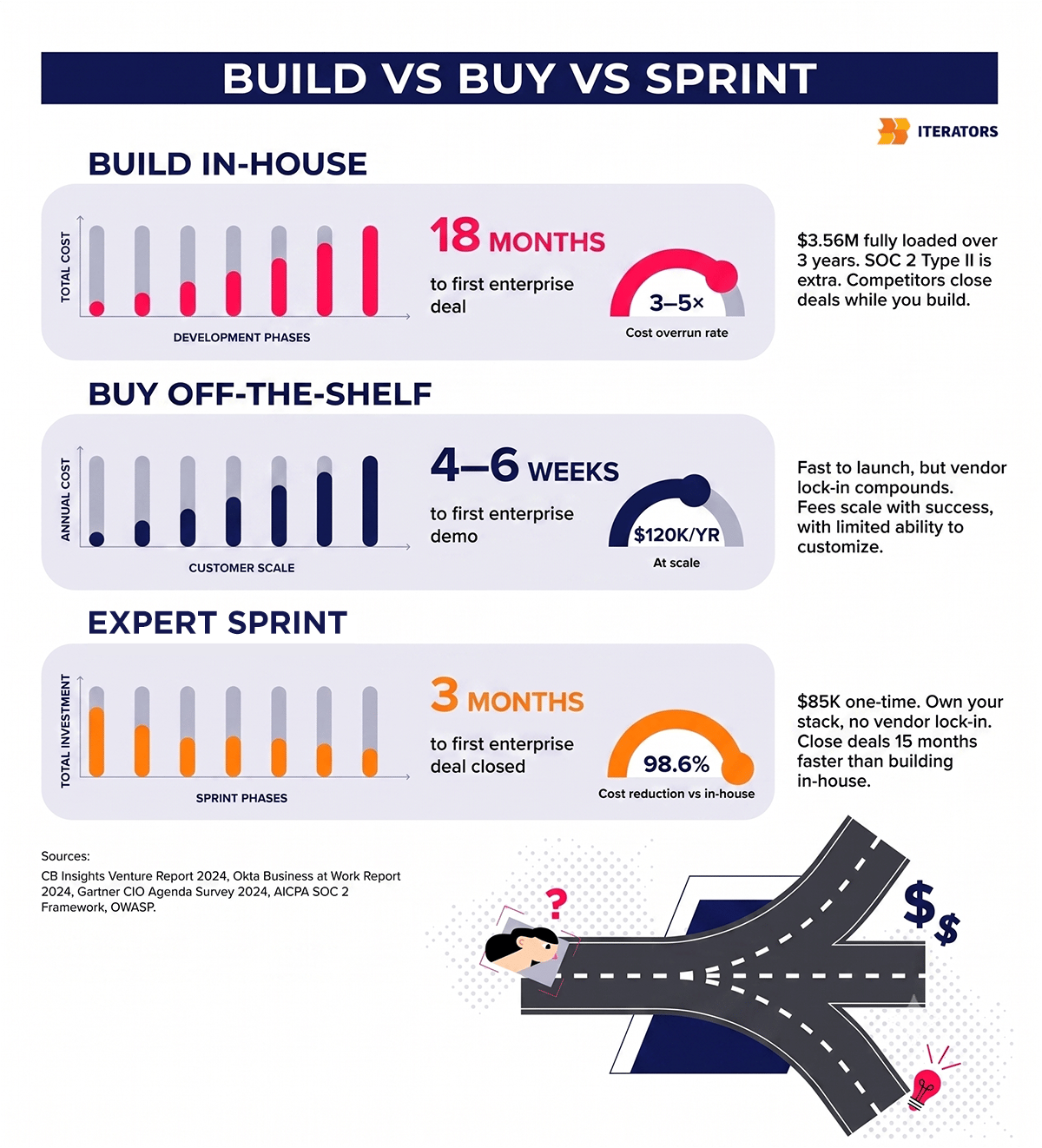
There is a third state. Instead of absorbing the $3.5M in-house load or the existential risk of the deferred state, you constrain the problem to a strict timebox. The Enterprise Readiness Sprint is the process of bringing in external domain expertise to carve out the exact features required to unblock procurement, and nothing more.
We run this specific operational sequence. It is designed to strip away the decorative aspects of compliance and install the load-bearing components.
The Structural Assessment
The first phase is a forensic gap analysis. We map the existing codebase against SOC 2 controls and the specific demands of the active enterprise pipeline. The output is not a generic strategy document; it is a prioritized taxonomy of the 20% of features that are killing 80% of the deals.
The Implementation Timebox
The second phase installs the critical infrastructure. We deploy SAML/OIDC handlers, configure the 12-month audit log retention pipeline, and stand up the RBAC scaffolding. This takes weeks, not months. We document exactly what enterprise buyers look for in our guide to preparing your product architecture for enterprise vendor assessment success.
Sprint Cost Breakdown
| System State | Deliverable | Timeline | Financial Load |
|---|---|---|---|
| Assessment | Gap analysis + architectural roadmap | 1 week | $4K-$8K |
| MVP Injection | Critical features (SSO, basic logs) | 2 weeks | $15K-$25K |
| Production Ready | Full enterprise stack + SOC 2 prep | 6-8 weeks | $40K-$60K |
| Ongoing Maintenance | Dedicated team handling iteration | Monthly | $8K-$15K/month |
The contrast is absolute. The in-house build incurs a $3.5M load over three years and delays the first enterprise deal by 18 months. The sprint caps the enterprise readiness cost at $50K to $85K and unblocks enterprise revenue in a single quarter.
The Hidden Variables of Enterprise Readiness Cost
There are variables in this equation that do not appear on standard engineering budgets. If you misclassify them, they will break your margins.
1. The Cost of Unstructured Code
When a sales team forces an engineering team to rush SSO to save a quarter-end deal, the result is unstructured code. There is no error handling, no test coverage, and no state recovery. Six months later, the integration fails silently. The engineer who wrote it is gone. You are now spending three times the original build cost just to map the degradation path.
2. The SOC 2 Reality
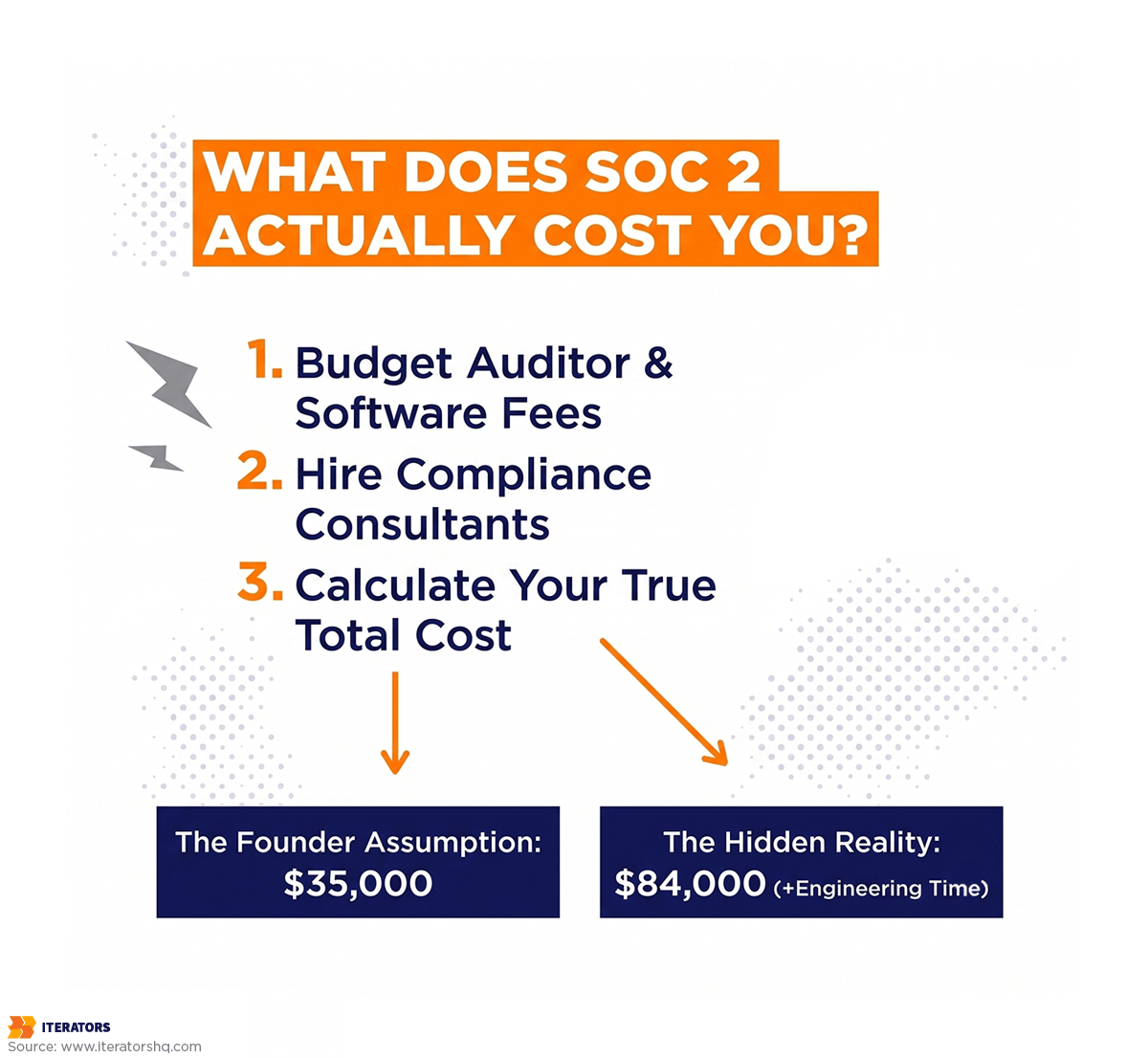
Founders budget $35K for SOC 2. This is classically plausible but operationally false. As documented by compliance authorities like Vanta and Secureframe, the auditor fee is only 20% of the load. The real enterprise readiness cost for SOC 2 includes the readiness assessment, continuous monitoring software, and fundamentally, the internal engineering time required to collect evidence and patch structural gaps. The true floor for a first-time certification is closer to $84K. Our SOC 2 compliance for SaaS guide details exactly where the hours go.
3. Talent Scarcity as a Hard Floor
Security engineers with active enterprise experience are highly illiquid assets. They command $200K+ base salaries and are off the market in ten days. If your enterprise readiness strategy relies on hiring one quickly, your strategy is built on a false premise. The cost of a vacant security role for six months is not just the unspent salary; it is the $500K in enterprise pipeline that evaporates because you cannot return a security questionnaire.
A Classification Framework for Enterprise Readiness Cost
You must classify your system’s state before you allocate capital. Not every platform should run a sprint, and not every platform should build in-house.
- State 1: Core Platform Ownership (Build In-House). You have crossed $10M ARR. Your platform operates in a highly regulated sector (e.g., defense, core banking) where the security architecture is the primary product differentiator. You have a dedicated platform team of at least five senior engineers. The enterprise readiness cost is justified because identity is your core intellectual property.
- State 2: Commodity Delegation (Buy). You are a pure-play SaaS where identity is irrelevant to your core value. You are comfortable paying connection fees to Auth0 or WorkOS. You accept the vendor lock-in because you have the margins to support a $4K monthly recurring tax for identity infrastructure.
- State 3: Time-to-Market Compression (Sprint). You are Series A or B. You have active enterprise pipeline but are failing procurement. You cannot absorb an 18-month delay or a $3.5M capital drain. You need to own your infrastructure without paying the vendor tax, and you need it deployed in four weeks.
Forensic Outcomes and Realized Costs

We can map these states to realized, witnessed outcomes from our portfolio and audits.
The Structural Failure of the Build A Series B SaaS with 40 employees chose to build in-house. They spent four months recruiting. They spent six months building RBAC and SAML. In month eleven, they pushed to production and the SSO implementation immediately failed under concurrent load. The debugging took three months. They secured their first enterprise deal 18 months after starting. The total load was $1.22M when factoring in the deferred revenue.
The Recurring Cost Wall of the Buy Option A Series A SaaS integrated Auth0 and WorkOS. They deployed in four weeks. The upfront integration cost was negligible. They closed three enterprise deals swiftly. But by year three, as their enterprise tenant count grew, they hit a hard floor: they were paying $48K annually in connection fees. At scale, their identity infrastructure became a margin-crushing liability.
The Sprint Outcome A Series A HR tech platform executed an Iterators Enterprise Readiness Sprint. Week one defined the architectural boundaries. Weeks two through four installed the SSO, RBAC scaffolding, and logging infrastructure. SOC 2 Type I was executed in parallel. They closed their first enterprise deal in week fourteen. The total enterprise readiness cost was $85K (including the external SOC 2 audit). They maintained full ownership of their code, paid no recurring vendor tax, and closed four enterprise deals that year generating $600K in new ARR. You can review the exact features they required in our analysis of enterprise-ready HR tech platforms.
The Iterators Position
We do not believe in theoretical compliance. The blog is the same voice as the architecture review. Iterators exists because founders are continually forced to make structural technology decisions under incomplete data.
We have built these pipelines for FinTech, HR tech, and BioTech platforms over 50 times. We do not sell decorative checklists. We build load-bearing infrastructure, we document the constraints, and we transfer the knowledge back to your engineering team. When we finish a sprint, your team owns the stack.
Our mandate is strict: build the 20% of features that unblock 80% of the deals, and defer the rest until the enterprise buyer pays for it. If you need to assess the structural integrity of your current system, review our software development consulting services or initiate a technical audit through our contact channel.
The Residual Risk
The enterprise readiness cost is not a line item you can optimize away. It is the price of admission to the enterprise market. You will either pay it upfront in engineering salaries, pay it perpetually in vendor connection fees, pay it efficiently through an expert sprint, or pay it catastrophically in lost revenue and stagnant valuation multiples.
The question is not whether the enterprise market will demand these architectural constraints—they already do. The question is whether your system notices the deficiency before the deal is already dead.