

In fintech development, systems fail in three different ways: they calculate the wrong amount, lose track of state, or cannot prove what happened. The first looks like a rounding error across thousands of microtransactions. The second looks like reconciliation drift after a third-party provider returns unexpected data during a bank holiday. The third looks like an AML block or an audit gap where a critical state change was not recorded. These are financial infrastructure failures, even when the interface still looks like an application.
Generic software development advice breaks down the moment money starts moving. While helpful elsewhere, fintech development operates under a different set of constraints. In most software, a bug creates friction. In fintech development, a bug can move money incorrectly, freeze funds, violate a regulatory obligation, or destroy the trust that is the actual product. Those are different categories of consequence, and they require different categories of fintech development engineering.
This is a field report on what those categories are, where they break, and what experienced fintech development engineering teams do differently.
Why Fintech Development Challenges Are Different From Normal Software Problems
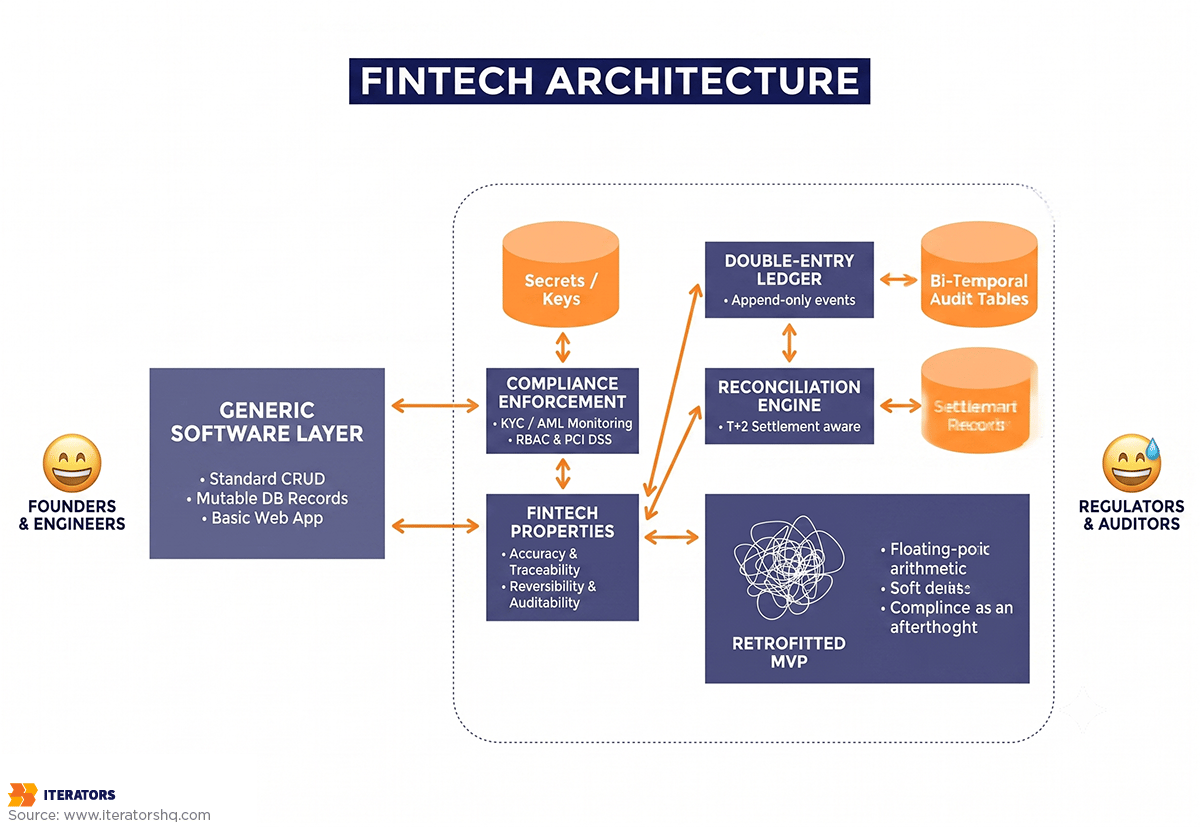
There is a useful classification here. Most software products have five properties that, when violated, create friction: availability, speed, correctness, usability, and security. Fintech development software has those five, plus five more that are structurally different in kind, not degree.
- Accuracy: Not approximate accuracy. Exact, deterministic, auditable accuracy. A rounding error in a social app means a like count is slightly off. A rounding error in a payment ledger means balances drift, and the drift compounds.
- Traceability: Every state change must be attributable to a specific actor, at a specific time, via a specific authorization chain. This is not for UX reasons. It is for legal ones.
- Reversibility: Payments fail, get disputed, and get charged back. The system must handle reversals without creating phantom balances or double-crediting users.
- Compliance: Not as a feature added at the end. As a constraint that shapes the architecture from the first schema design.
- Auditability: The ability to reconstruct exactly what happened, to whom, when, and why, months or years after the fact.
A fintech system that handles the first five but not the second five is a demo, not a product. The fintech development challenges that kill projects are almost always in the second five, because generic software advice doesn’t cover them.
Fintech Development Compliance Is Architecture, Not Paperwork
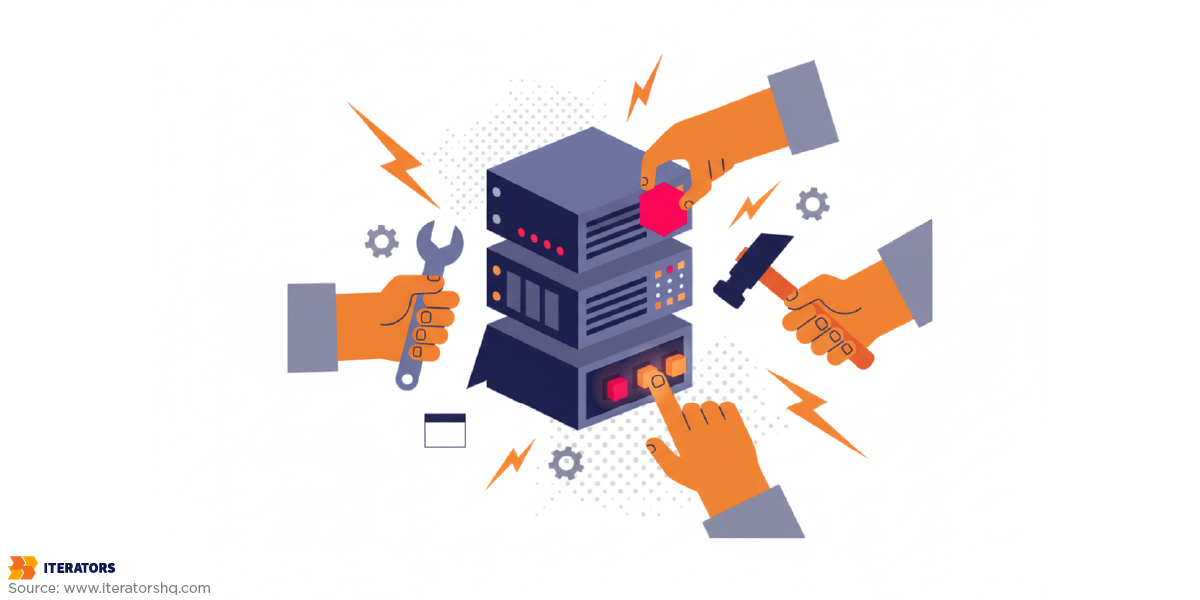
“Regulation isn’t a feature. It’s architecture. Treat compliance as a sprint-end checklist, and you’ll spend your launch year rewriting systems that should have been designed correctly from day one.” That observation comes from experience watching exactly that happen.
The mistake in fintech development is treating compliance as a legal obligation that engineers implement after the lawyers define it. That framing is backwards. Legal teams define what must be true. Engineers must build systems where those things are structurally impossible to violate, or at minimum, where violations are immediately detectable and attributable.
Fintech development compliance touches architecture at every layer:
User onboarding must implement KYC (Know Your Customer) and KYB (Know Your Business) workflows before a user can transact. That means identity verification, document collection, sanctions screening, and risk scoring, all with audit trails on every step.
Data retention means more than “store this for seven years.” It means storing it in a format that can be queried, exported, and handed to a regulator on request. That constrains your database schema, your storage architecture, and your backup strategy.
Access control under SOC 2 and PCI DSS requirements means role-based access control (RBAC) where every admin action is logged, every privilege is scoped, and no single engineer can move production funds without a second authorization. That is an architecture decision, not a policy memo.
Environment separation means production data never touches development or staging environments. That requires Terraform-managed infrastructure, separate AWS accounts, and CI/CD pipelines that enforce the boundary automatically, not a rule in a wiki that someone might remember.
AML monitoring requires transaction-level event streams, risk-scoring models, case management workflows, and human review queues. Not a single API call to a third-party vendor.
Frameworks like PSD2, Open Banking, PCI DSS 4.0 (mandatory as of March 2025), and AML/KYC regulations under the Bank Secrecy Act each add specific engineering obligations. Iterators does not replace your lawyers, auditors, or compliance officers. We build the software infrastructure that can meet their standards. That distinction matters: compliance is a joint responsibility between legal and engineering, and the engineering half is not optional or deferrable.
For a detailed look at what SOC 2 compliance actually requires from a software architecture perspective, see our breakdown of SOC 2 for SaaS.
Financial Software Complexity Starts With Precision Errors in Fintech Development
Here is a fact about computers that matters enormously in fintech development and almost nowhere else: the IEEE 754 floating-point standard, which is the default numeric representation in most programming languages, cannot represent 0.1 exactly in binary. The decimal 0.1 becomes an infinitely repeating binary fraction, and the system truncates it. The result of adding 0.1 and 0.2 in a standard floating-point environment is 0.30000000000000004, not 0.3.
In a social app, this is invisible. In fintech, this is a ledger integrity problem.
Reconciliation Drift Calculator
Rounding errors and lack of idempotency are invisible in a demo environment. See how much they will cost you after a year of scaling in production.
When a platform processes thousands of microtransactions, each one slightly wrong by a microscopic amount, the errors compound. A platform that charges a 1.5% fee on high-volume transactions and rounds inconsistently across services will find that its internal ledger slowly drifts away from reality. Nobody notices during a demo. Everyone notices during reconciliation, or during a regulatory audit.
Financial reporting rules and contractual fee schedules often require specific decimal precision. Floating-point arithmetic does not enforce those obligations by itself. The system needs decimal handling and rounding rules that are explicit enough to survive reconciliation and audit.
The fix is not complicated in concept, but it requires discipline across the entire codebase. Financial systems must use one of three approaches: arbitrary-precision decimal libraries (BigDecimal in Java, the decimal module in Python), integer minor units (storing $10.00 as 1000 cents and never converting to a decimal until display), or fixed-point arithmetic with explicit rounding rules defined once and enforced everywhere.
The fintech development complexity here is not in the math. It is in the discipline of establishing these constraints before writing the first line of business logic, and then enforcing them across every service, every API boundary, every currency conversion, every fee calculation, and every refund. The moment two services use different rounding strategies, the ledger starts drifting. The moment a developer uses a float because it was convenient, the audit trail has a hole in it.
This is one of the fintech development challenges that generic software advice skips entirely, because in most software contexts it simply does not matter.
Reconciliation Is Where Fintech Development Challenges Become Visible
Reconciliation is the process of verifying that your internal ledger matches the actual state of funds in external systems: banks, payment service providers, card networks. In fintech development, it is a continuous engineering problem because external systems and internal ledgers move on different timelines.
The core issue: a payment is not a single event. It is a sequence of state transitions that happen across multiple systems, on different timelines, with different failure modes at each step. Your internal system records a payment as "initiated." The PSP records it as "authorized." The bank records it as "pending." Settlement happens T+2 (two business days later). Chargebacks can arrive weeks after that.
Here are the failure modes that cause reconciliation to break:
| Failure Mode | What Happens | Why It Matters |
|---|---|---|
| Duplicate webhook | Same event processed twice | User may be double-credited |
| Provider timeout | App does not know final payment state | Funds may be pending or lost |
| Partial settlement | Only part of transaction clears | Ledger and provider records diverge |
| Chargeback | Money is reversed later | User balance and reporting must update |
| FX mismatch | Exchange rate changes mid-flow | Reported and settled amounts differ |
| Failed retry without idempotency | API request processed twice | Phantom transaction created |
| Batch net settlement | PSP settles net of fees in batches | Single internal gross transaction must match against a batch net deposit |
The last one is particularly insidious. Payment processors often settle in batches, net of interchange and scheme fees. Your internal system recorded ten transactions at gross value. The bank received one deposit at net value. Matching these requires an automated reconciliation engine capable of one-to-many and many-to-many matching, not a spreadsheet, and not a manual review queue.
The Synapse Financial Technologies bankruptcy in 2024 is the public case study here for fintech development. Synapse operated as Banking-as-a-Service middleware between consumer fintech apps and FDIC-insured sponsor banks. When it filed for Chapter 11, the internal ledgers did not match the actual funds in the banks' custodial accounts. Because the architecture lacked independent reconciliation mechanisms, the exact beneficial ownership of pooled funds could not be determined. Over 100,000 users lost access to more than $265 million for months. Court-appointed auditors found a shortfall of between $60 and $90 million that was simply unaccounted for. FDIC Director Jonathan McKernan noted that paying out deposit insurance might have been impossible had one of the partner banks failed.
This was not a front-end crash. It was a total collapse of recordkeeping: a reconciliation architecture failure at the most fundamental level.
Building a payment system means building the reconciliation engine, the idempotency layer, the retry logic, the webhook deduplication, and the exception routing that makes the payment button trustworthy.
Audit Trail Gaps Can Kill a Fintech Development Product
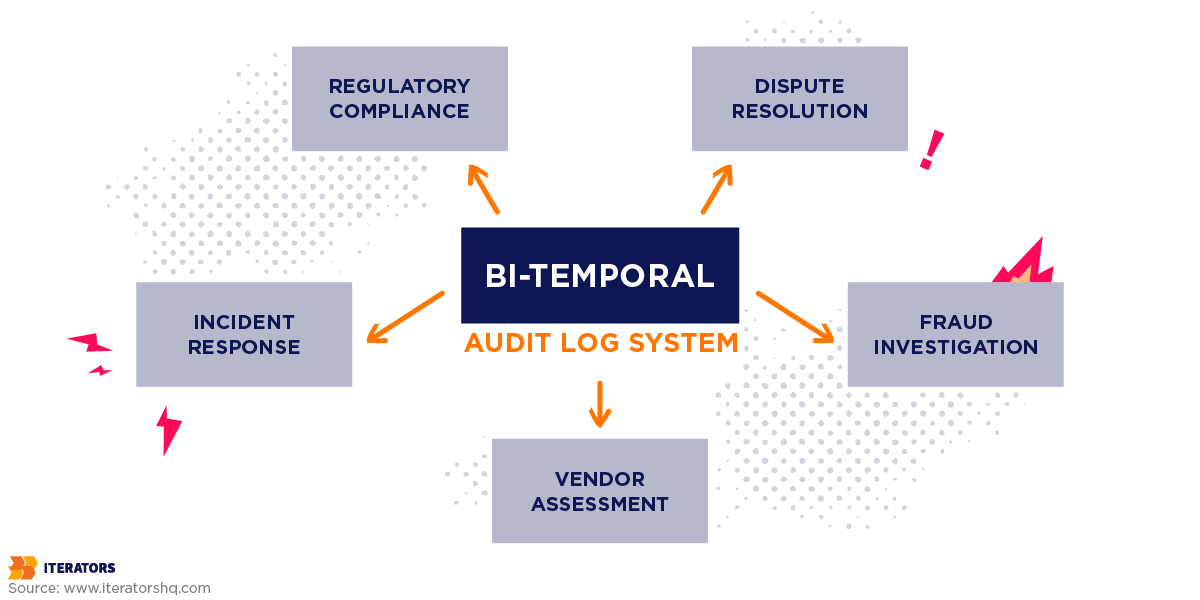
In fintech development, you must be able to prove what happened. Not describe it. Prove it. Who performed an action, what system executed it, what the state was before, what the state became, when it happened, and which authorization chain permitted it. This is not a nice-to-have for enterprise sales. It is a requirement for regulatory compliance, dispute resolution, fraud investigation, and vendor assessments.
Standard database designs destroy this evidence. A SQL UPDATE overwrites the previous state. A soft delete removes the record from active queries. Unless you build an explicit audit architecture, you end up with a system that knows the current state of everything and the historical state of nothing.
The engineering solution is bi-temporal database modeling: a schema that tracks two independent timelines simultaneously. Valid time is the period during which a fact is true in the real world. Transaction time is the exact system timestamp when the database recorded the information. With bi-temporal tables, you can query the database to reconstruct the exact state of a user's account as the system understood it at any historical millisecond, which is exactly what a regulator or auditor will ask for.
Alongside bi-temporal schemas, fintech development audit logs must be:
- Append-only and tamper-resistant (not soft-deletable records in a mutable table)
- Time-stamped with server-side timestamps, not client-supplied ones
- Linked to user IDs, admin IDs, session tokens, and transaction IDs
- Searchable and exportable on demand
- Preserved according to retention rules that vary by jurisdiction and regulation
An audit log entry that is useful in an investigation looks like this: User ID, Admin ID, Action, Previous State, New State, Timestamp, IP/Device/Session, Transaction ID, Authorization Method, System/Service Source, Correlation ID. An audit log that records only "payment processed" has no forensic value.
Missing logs create trouble in exactly the moments when you cannot afford trouble: customer disputes, regulatory reviews, vendor assessments, fraud investigations, and incident response. The time to build the audit architecture is before the first transaction, not after the first dispute.
AML False Positives Are a Product Problem
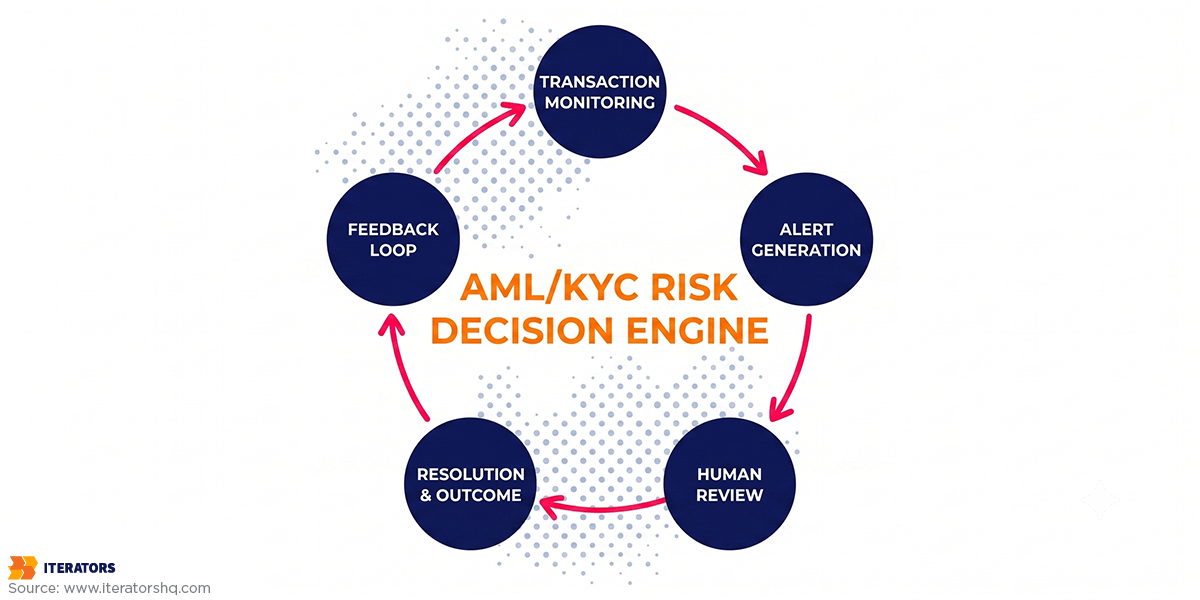
An AML false positive is a compliance alert on legitimate user behavior. Traditional rule-based AML transaction monitoring systems tend to produce far more false positives than true escalations. A compliance analyst may review many legitimate transactions for every case that becomes a Suspicious Activity Report.
The operational cost of this is large. Manual investigation is expensive, compliance budgets are already high, and review queues can grow faster than the team operating them. But the cost that founders underestimate is the product cost.
AML false positives freeze legitimate user accounts. They delay onboarding. They generate repeated document requests that have no clear explanation for the user. They create manual review queues that grow faster than compliance teams can process them. And they produce churn: users who leave because the product treated them like a suspect.
AML is not a switch you turn on. It is a workflow you operate.
A well-engineered AML/KYC system requires:
- Risk scoring that classifies users and transactions by risk profile, not by static thresholds
- Human review workflow with case management, escalation rules, and resolution tracking
- Explainable decisions, because financial regulators prohibit pure black-box AI models, every flag must be attributable to specific data vectors
- Feedback loops that update risk models based on analyst decisions
- Audit logs on every compliance action, including the reason for every flag and the outcome of every review
The fintech development challenges here are not in the compliance logic itself. They are in building a system where compliance is operationally sustainable, where the false positive rate is low enough that your compliance team can actually function, and where legitimate users are not treated as collateral damage.
Integrating a KYC vendor is not the same as building a KYC workflow. The vendor provides identity verification. The workflow provides the onboarding experience, the risk decision, the escalation path, the audit trail, and the user communication. The vendor is one component. The workflow is the product.
Building a Fintech Startup Means Designing Fintech Development for Vendor Assessments Early

Enterprise partners, banking partners, and institutional investors ask hard questions before they integrate with or fund a fintech development project. These questions arrive in the form of vendor assessments: structured security and compliance reviews that can take weeks and require documentation that takes months to produce if you have not been building for it.
A typical vendor assessment for a fintech development product may require:
- SOC 2 Type II report
- PCI DSS attestation
- Penetration testing report (dated within 12 months)
- Data retention and deletion policies
- An incident response plan
- Access control documentation
- Secure SDLC documentation
- Disaster recovery plan with tested RTO/RPO metrics
- Encryption details (at rest and in transit)
- Audit log samples
- Infrastructure diagrams
- Third-party vendor risk assessments
Startups that build MVPs without these in mind often discover the problem at the worst possible moment: during a sales process with an enterprise customer, or during due diligence for a funding round. The remediation is expensive, both in engineering time and in the technical debt that accumulates when you retrofit compliance controls onto an architecture that was not designed for them.
The alternative is to treat vendor assessment readiness as a design constraint from the beginning. Terraform-managed infrastructure produces the infrastructure diagrams. Proper RBAC produces the access control documentation. Bi-temporal audit logs produce the evidence trail. Staging environments with end-to-end validation produce the disaster recovery artifacts. None of this requires building the compliance documentation separately. It is the natural output of building the system correctly.
For a detailed breakdown of what enterprise-ready architecture looks like at the startup stage, see our guides on enterprise readiness and preparing your architecture for vendor assessments.
Security Is the Product in Fintech Development

Fintech users do not buy features. They buy trust. The security architecture is part of the product surface, experienced indirectly every time a user deposits funds, initiates a transfer, or checks a balance without incident.
Fintech development security must cover:
- Authentication and MFA: PCI DSS 4.0 now mandates MFA across the entire Cardholder Data Environment, not just for administrative access. Web authentication architecture must be designed accordingly.
- RBAC: every admin action scoped to the minimum necessary privilege, every action logged
- Secrets management: API keys, database credentials, and signing keys stored in a secrets manager (AWS Secrets Manager, HashiCorp Vault), rotated on a schedule, never in environment variables or version control
- Secure CI/CD: automated vulnerability scanning before code reaches production, not annual penetration tests as the only security gate
- Encryption: at rest and in transit, with key rotation policies and documented encryption standards
For crypto and wallet-based fintech, the security surface expands significantly:
- Hot/warm/cold wallet architecture: hot wallets hold minimum operational funds for real-time transactions; warm wallets hold operational reserves; cold wallets hold the majority of funds in offline storage
- Multisig: no single key controls fund movement; multiple independent signatories required
- Separation of funds: user funds and operational funds in separate wallet structures, with reconciliation between them
- Smart contract audits: third-party security audits before deployment, with documented upgrade paths and rollback procedures
A crypto-fiat exchange platform we built required all of this simultaneously: real-time crypto-fiat trading pairs, hot/warm/cold wallet flows, multisig separation of funds, Banking-as-a-Service integrations, KYC/KYB workflows, staking, and loyalty modules. The hard part was the interaction between components. Every component had to be correct simultaneously, because in fintech there is no safe version of "we'll fix security later."
Payment Processing Looks Simple Until Edge Cases Hit Fintech Development Production
A payment button is a UX element. In fintech development, a payment system is an engineering discipline.
The complexity hidden behind a payment button in fintech development includes:
- Idempotency: If a user's mobile app drops the connection and automatically retries a payment request, the server must recognize the retry and return the original result, not process the payment twice. Idempotency keys are the mechanism. Forgetting them is how users get double-charged.
- Retry logic: Payments fail for reasons unrelated to the user: network timeouts, provider outages, bank authorization delays. The system needs retry logic with exponential backoff, maximum retry limits, and clear state transitions for each outcome.
- Chargebacks: A user disputes a transaction weeks after it was processed. The system must reverse the transaction, update the user's balance, update the ledger, update reporting, and log the entire chain of events with attribution.
- Delayed settlement: Authorization and settlement are different events. A payment authorized on Monday may not settle until Wednesday. Systems that treat authorization as settlement will have reconciliation failures every week.
Fintech Development Challenges in Subscription Billing
Subscription billing adds another layer of fintech development challenges that compound over time:
- Proration when a user upgrades or downgrades mid-cycle
- Usage-based billing where the final invoice amount is not known until the billing period closes
- Per-seat models where adding a user mid-cycle requires a partial charge
- Credits and refunds that must reduce future invoices without breaking revenue reporting
- Invoice corrections when a billing error is discovered after the invoice was issued
- Revenue leakage from failed payment retries that are not automatically rescheduled
Each of these is a state machine with multiple valid transitions and multiple failure modes. Building them correctly requires the same discipline as building the core payment flow: idempotency, audit trails, reconciliation, and explicit handling of every edge case. For a detailed breakdown of how subscription models create engineering complexity, see our analysis of Stripe subscription types.
Real-Time Systems Need More Than CRUD Architecture in Fintech Development

A standard web application is a CRUD system: Create, Read, Update, Delete. A database, an API, a frontend. For most applications, this architecture is correct.
But fintech development systems that handle real-time transactions, trading, or high-volume payment flows are not CRUD systems. They are event-driven systems, and the architectural difference is significant.
Event-driven architecture means that every state change is represented as an immutable event appended to an event log, not as an overwritten database record. This gives you natural audit trails, natural replay capability for debugging and reconciliation, and natural separation between the write path (event ingestion) and the read path (query models).
Kafka (or equivalent message streaming infrastructure) handles the event backbone: high-throughput, durable, ordered event streams that multiple consumers can process independently. A payment event can simultaneously update the ledger, trigger the reconciliation engine, update the fraud risk score, and generate a compliance audit record, without any of those consumers blocking each other.
Real-time matching engines required for trading platforms, exchange products, and any system that matches buyers and sellers need deterministic, low-latency order processing with distributed locking or consistency strategies to prevent race conditions. This is not a problem that a standard ORM and a PostgreSQL database can solve at scale.
Idempotent consumers ensure that if a message is delivered twice (which Kafka guarantees can happen), the second delivery produces the same result as the first: no duplicate transactions, no phantom records.
Scala is a natural fit for this architecture: its type system enforces correctness at compile time, its functional programming model makes event transformations explicit and testable, and its JVM runtime handles the concurrency and throughput requirements of financial event streams. See our Scala development services for more on why it matters for fintech specifically.
On the crypto-fiat exchange build, the matching engine, the price aggregator, the fiat/crypto rails, and the wallet flows were event-driven because the production failure modes were state failures that CRUD architecture does not handle well.
Fintech Development Challenges Get Worse When Teams Skip Observability
Logging is not observability. Logging tells you what happened. Observability tells you why, where, and what the business consequence was.
In fintech development, observability must connect technical events to financial outcomes. A spike in API error rates is interesting. Knowing that the spike corresponds to a specific payment provider, affected withdrawals, and created delayed settlements is actionable.
Fintech development observability should track:
- Transaction state transitions (initiated → authorized → settled → reconciled)
- Payment provider latency and error rates by provider and payment method
- KYC funnel drop-off rates at each verification step
- AML alert volume, false positive rate, and manual review queue depth
- Reconciliation mismatch rate and exception volume
- Admin actions with full attribution
- Security events (failed authentication attempts, privilege escalation, unusual access patterns)
- Settlement delays by provider and currency
If you cannot trace a dollar through your system, from user initiation through provider authorization through bank settlement through ledger reconciliation through reporting, you cannot reconcile, audit, or defend the system in a dispute.
The observability infrastructure must be built alongside the product, not added after the first production incident. For a detailed framework on what production-grade monitoring looks like, see our guide on enterprise monitoring and observability.
Why Generic Software Agencies Struggle With Fintech Development Challenges

Generic software development agencies know how to build web applications. The problem is that fintech is not a web application with a payment processor attached. It is a regulated financial system that happens to have a web interface.
The specific failure modes when a generic agency builds a fintech development product:
Compliance as a final checklist. The agency builds the product, then asks the compliance team to review it. The compliance team identifies requirements that conflict with the existing architecture. The rewrite begins. This is the most common and most expensive fintech mistake.
Weak audit logging. Standard application logging captures errors and user events. Fintech audit logging must capture state transitions with full attribution, at the database level, in an append-only format. These are different systems with different requirements.
Underestimating reconciliation. Generic agencies build the payment flow. They do not build the reconciliation engine, because reconciliation is invisible to users and not in the initial spec. The first time a provider has an outage, the ledger diverges and nobody knows how to fix it.
MVPs that cannot pass vendor review. The MVP is built for speed. It has no SOC 2 controls, no penetration test, no documented incident response plan. An enterprise customer asks for a vendor assessment. The startup cannot provide one. The deal dies.
Overusing third-party services without architecture ownership. The Synapse collapse is the case study here. Relying on a third-party system for ledger management without independent reconciliation means that if the third party fails, you have no way to reconstruct your own financial state.
The alternative is an architectural owner with fintech-specific constraints in scope: reconciliation, auditability, compliance evidence, QA for financial edge cases, and long-term maintainability. If those responsibilities are split across vendors without a single owner, the system has no hard floor when state diverges.
How Iterators Approaches Fintech Development
Consulting slides don't move money; working code does. In fintech, outcomes are measured in settled funds, cleared trades, and audit-proof logs.
Our approach to fintech development starts with product clarity and compliance mapping before writing the first line of code. Which regulated flows are in scope? Which compliance obligations apply? What data must be stored, for how long, and in what format? What does the audit trail need to prove?
From there, the architecture is designed around those constraints. Double-entry ledger schema from day one. Bi-temporal audit tables from day one. Event-driven architecture where the transaction volume or real-time requirements demand it. Terraform-managed infrastructure with environment separation enforced at the infrastructure level, not the policy level.
On a crypto-fiat exchange build, the frozen constraints were clear: real-time trading state, fiat and crypto rails, KYC/KYB workflows, wallet segregation, multisig approvals, and Banking-as-a-Service integration all had to coexist without letting one subsystem become the only source of truth for the others. The open space was implementation: ledger schema, event backbone, workflow boundaries, QA surfaces, and operational evidence. The wall was integration density. The matching engine, the price aggregator, wallet flows, staking, and loyalty modules were manageable in isolation. The risk was that every component had to be correct simultaneously because a failure in any one of them had financial consequences.
Fintech Development Challenges Checklist for Founders

Before you build, verify:
Compliance and regulation
- Have you mapped every regulated flow in your product?
- Do you know which compliance obligations apply (KYC, KYB, AML, PCI DSS, PSD2, state money transmission licenses)?
- Have you selected KYC/KYB and AML providers with designed workflows, rather than only API integrations?
- Do you know what data must be stored, for how long, and in what format?
Architecture
- Have you chosen a ledger model (double-entry, event-sourced, or hybrid)?
- Have you designed audit logs as a first-class data flow, not a logging afterthought?
- Have you defined reconciliation workflows for every external payment provider?
- Have you established precision constraints (decimal types, integer minor units) across every service?
Operations
- Have you planned for failed payments, retries, duplicate webhooks, and chargebacks?
- Have you mapped admin roles and permissions, and enforced them at the infrastructure level?
- Have you planned security reviews, penetration testing, and incident response procedures?
- Have you defined vendor assessment requirements and designed your architecture to meet them?
Observability
- Have you built observability around transactions and financial outcomes, rather than only server metrics?
- Can you trace a specific dollar from user initiation through settlement through reconciliation?
Final Take: Fintech Is Hard Because Trust Is Hard
Mastering fintech development is hard because multiple parties trust the software simultaneously, for different reasons, with different evidence requirements.
Users trust it with money. Regulators trust it with compliance evidence. Banking partners trust it with integration stability. Investors trust it with scale. Auditors trust it with records that prove what happened.
Each of those trust relationships has a specific engineering expression. User trust requires precision, reliability, and transparent error handling. Regulatory trust requires audit trails, data retention, and explainable compliance decisions. Partner trust requires vendor assessment readiness and security posture. Investor trust requires scalable architecture that does not require a full rewrite at Series B. Auditor trust requires immutable records that can reconstruct any historical state on demand.
The fintech development challenges that kill projects are not usually the hard algorithmic problems. They are the structural ones: the ledger that was never designed for reconciliation, the audit log that was added as an afterthought, the compliance workflow that was bolted on after the MVP, the precision error that nobody noticed until the books didn't balance.
The hard floor is whether the system can still explain itself after the provider times out, the user disputes the payment, the AML queue backs up, and the auditor asks for the state of the account six months ago. If that evidence does not exist as a product of the architecture, where exactly will it come from?