
You know that feeling when Amazon somehow knows you need a new phone case before you do? That’s collaborative filtering – the unsexy name for one of the most profitable technologies in modern ecommerce.
Here’s what most articles won’t tell you: collaborative filtering isn’t new, and it’s not just “AI.” It’s been evolving since the 1990s, getting progressively smarter as computing power increased and machine learning techniques advanced. This guide goes deep into how these systems actually work—and more importantly, how you can implement one in your ecommerce platform without reinventing the wheel.
This guide is for CTOs, VPs of Engineering, and Product Managers who need to understand collaborative filtering beyond “it uses algorithms to recommend stuff.” We’ll cover:
- The real business impact (with actual numbers, not marketing fluff)
- Practical ecommerce automation examples you can implement today
- Why buying solutions almost always beats building from scratch
- The “buy vs. partner” decision framework (spoiler: building custom is rarely the answer)
- Real-world implementation examples from successful ecommerce brands
By the end, you’ll understand why 35% of Amazon’s revenue comes from recommendations, why Netflix saves $1 billion annually through personalization, and whether your ecommerce platform should invest in machine learning applications for a collaborative filtering system.
Ready to Stop Reading and Start Implementing?
Look, you can spend the next six months building a recommendation engine from scratch, or you can talk to someone who’s actually done this before. Iterators specializes in helping ecommerce platforms implement collaborative filtering and personalization systems that actually move the needle on revenue—without the typical enterprise software headaches.
Schedule a free consultation to discuss your specific use case, get honest advice about whether collaborative filtering makes sense for your business, and explore what implementation actually looks like (timeline, resources, ROI).
Schedule Your Free Consultation
No sales pitch. No obligation. Just a practical conversation about whether this technology fits your ecommerce strategy.
Why Collaborative Filtering Is No Longer Optional for Ecommerce
The Revenue Impact: Real Numbers from Real Companies
Amazon’s item-to-item collaborative filtering generates 35% of the company’s total revenue. More than one-third of the world’s largest retailer’s income comes from analyzing purchase patterns and telling customers “people who bought this also bought that.”
Netflix’s hybrid recommendation engine drives 75-80% of all viewing and saves over $1 billion annually in customer retention by keeping subscribers engaged with personalized content.
Spotify’s Discover Weekly—powered by collaborative filtering combined with NLP and audio analysis—has become one of the platform’s most beloved features, directly contributing to user stickiness and reduced churn.
But it’s not just the tech giants. Mid-sized ecommerce companies are seeing similar results with off-the-shelf solutions:
- A fashion retailer using Amazon Personalize saw a 32% increase in conversion rate within 3 months
- An electronics marketplace implementing Google Recommendations AI reduced cart abandonment by 18%
- A home goods store using Shopify’s recommendation apps increased AOV by 27%
According to McKinsey research, personalization can:
- Reduce customer acquisition costs by 50%
- Lift revenues by 5-15%
- Increase marketing ROI by 10-30%
Companies with faster growth rates derive 40% more revenue from personalization than slower-growing competitors. This isn’t correlation—it’s causation.
The conversion numbers are even more compelling:
- Personalized product recommendations increase conversion rates by 2-3x
- They boost average order value (AOV) by 20-30%
- They reduce cart abandonment by up to 4.35%—critical when cart abandonment averages 70.19% globally, representing $260 billion in recoverable lost orders
The Customer Experience Advantage
71% of consumers expect personalized interactions. More importantly, 76% get frustrated when personalization doesn’t happen.
Think about that. Three-quarters of your potential customers are actively annoyed when you treat them like everyone else. They’re not asking for personalization as a “nice-to-have”—they’re demanding it as table stakes.
Your customers aren’t comparing your recommendation engine to competitors—they’re comparing it to Amazon, Netflix, and Spotify. That’s the bar.
Competitive Pressure and Market Expectations
Hybrid and ensemble techniques commanded 43.91% market share in 2024. This isn’t just a trend—it’s proof that modern recommendation systems have evolved far beyond simple “customers who bought this also bought that” logic.
Retail and ecommerce led with 34.63% revenue share in the recommendation engine market, confirming this is the primary battleground for competitive differentiation.
The companies winning in ecommerce aren’t the ones with lowest prices or biggest catalogs. They’re the ones that make product discovery feel effortless—platforms where customers consistently find exactly what they didn’t know they needed.
What Is Collaborative Filtering for Ecommerce?
The Core Concept: “Users Like You Also Liked…”
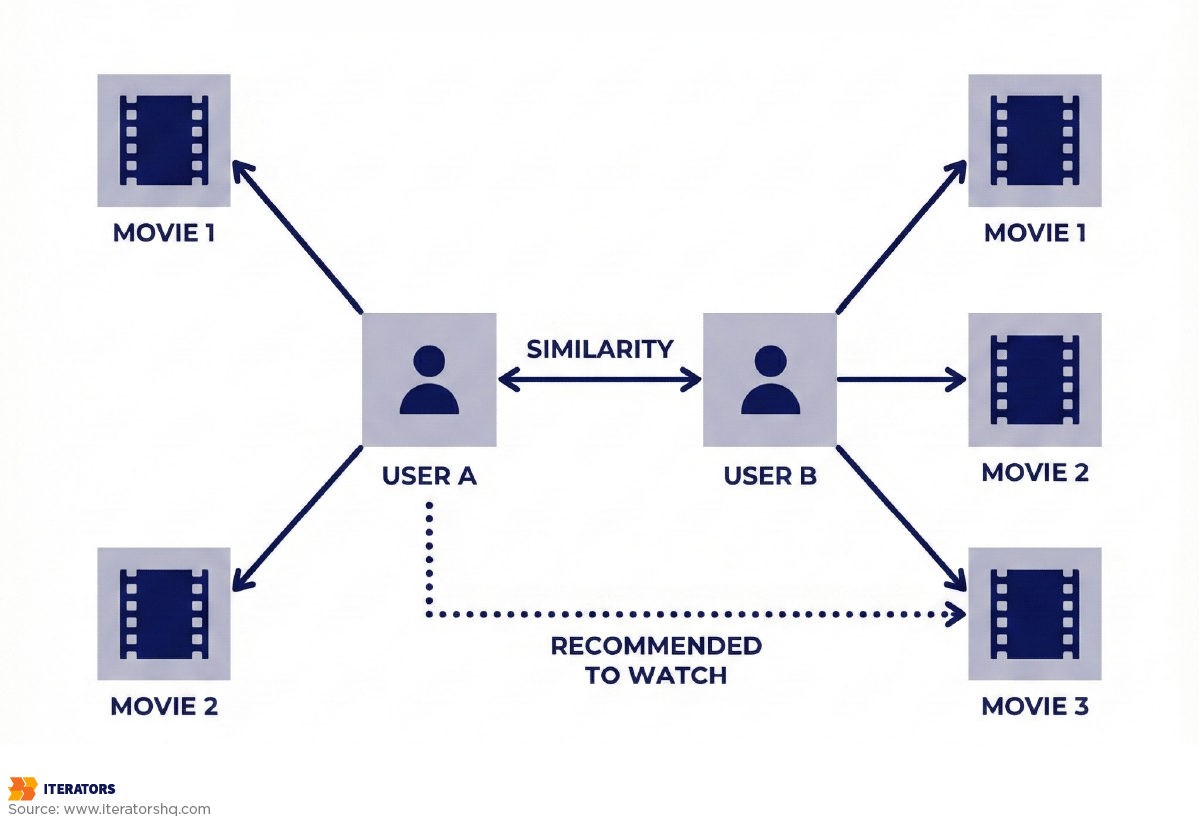
Collaborative filtering answers one question: “What would users similar to you recommend?”
Unlike content-based filtering—which recommends items based on attributes (“You liked action movies, so here are more”)—collaborative filtering focuses on user behavior patterns. It doesn’t care what a product is; it cares what people do with it.
The fundamental insight: If User A and User B have similar purchase histories, they probably have similar tastes. Items User B loves but User A hasn’t discovered are likely good recommendations for User A.
The magic is that collaborative filtering discovers latent patterns humans might never articulate. It doesn’t need to know why people who buy running shoes also buy protein powder and meditation apps—it just uses that pattern to make better recommendations.
IBM puts it succinctly: “While collaborative filtering focuses on user similarity to recommend items, content-based filtering recommends items exclusively according to item profile features.”
How Collaborative Filtering Differs from Content-Based Filtering
Data Requirements:
- Content-Based: Requires detailed item characteristics—keywords, tags, genres, specifications, descriptions
- Collaborative Filtering: Requires user-item interactions—purchases, ratings, views, clicks, time spent
The Cold Start Problem:
- Content-Based: Handles new users and items relatively well by using attributes
- Collaborative Filtering: Faces serious challenges with new users (no history) and new products (no interactions)
Discovery Potential:
- Content-Based: Recommends similar items, creating “filter bubbles”
- Collaborative Filtering: Surfaces unexpected discoveries based on collective wisdom
Scalability:
- Content-Based: Scales well because item attributes are relatively stable
- Collaborative Filtering: Can face computational challenges at massive scale
The reality? You probably need both. That’s why hybrid systems dominated 43.91% of the market in 2024. Collaborative filtering is the foundation that makes personalization feel genuinely intelligent rather than just categorically logical.
Real-World Examples: Amazon, Netflix, and Spotify
Amazon: The Pioneer of Scalable Item-to-Item Collaborative Filtering
Amazon’s innovation wasn’t just implementing collaborative filtering—it was making it scalable for millions of products.
Traditional user-based filtering compares users: “Find users similar to you, see what they bought.” But with hundreds of millions of users, this becomes computationally insane.
Amazon’s breakthrough was item-to-item collaborative filtering. Instead of comparing users, they compare items: “cameras and memory cards are often bought together.”
Why is this better?
- More stable: Item relationships change far less than user neighborhoods
- More scalable: Pre-compute item similarities in nightly batch jobs
- More accurate: Fewer items than users makes similarity calculations more robust
The result: That ubiquitous “Customers who bought this also bought…” generating 35% of revenue.
Netflix: The Master of Hybrid Model-Based Filtering
Netflix took collaborative filtering to the next level with the famous Netflix Prize competition, proving that model-based collaborative filtering (matrix factorization like SVD) dramatically outperforms simple approaches.
Netflix’s current system is a sophisticated hybrid combining:
- Collaborative Filtering: User-based and item-based behavioral analysis
- Content-Based Filtering: Genre, actor preferences, movie attributes
- Model-Based Techniques: Matrix factorization discovering “latent factors”—hidden patterns like preference for “dark” or “quirky” content
The key innovation: predicting ratings for unseen items by inferring hidden preferences. If you’ve rated 50 movies out of 10,000+, SVD can still predict the other 9,950 by finding latent factors explaining your patterns.
Business impact? 80% of content viewed and $1 billion in annual retention savings.
Spotify: The Modern Deep Learning Hybrid
Spotify’s Discover Weekly represents state-of-the-art hybrid recommendation systems—a three-pillar model:
- Collaborative Filtering: Analyzes listening behavior and similar user patterns
- Natural Language Processing: Scans blog posts, reviews, social media for context and buzz
- Audio Analysis (Deep Learning): Uses CNNs to analyze raw audio—key, tempo, loudness—for sonic similarity
This three-pillar approach solves multiple problems:
- Cold start: New artists get recommended via audio similarity and NLP
- Discovery: Audio analysis surfaces unexpected recommendations
- Accuracy: Combined signals create almost telepathic recommendations
The result: one of Spotify’s most beloved features and major driver of engagement.
Practical Ecommerce Automation Examples Using Collaborative Filtering
Before diving into technical implementation, let’s look at real-world automation scenarios where collaborative filtering creates tangible business value:
1. Automated Cross-Sell and Upsell Campaigns
The Automation: When a customer adds a camera to their cart, the system automatically suggests memory cards, camera bags, and tripods based on what similar customers purchased together.
Real Example: A photography equipment retailer using this automation saw customers who received these recommendations had 43% higher AOV and were 2.3x more likely to complete purchase within 24 hours.
Implementation: Most modern platforms (Shopify, WooCommerce, Magento) offer plug-and-play apps that handle this automatically—no custom development required.
2. Post-Purchase Email Sequences
The Automation: After purchase, customers automatically receive personalized email sequences with complementary products based on collaborative filtering patterns.
Real Example: A home goods store sends “Complete your kitchen” emails to customers who bought cookware, automatically recommending items that similar customers purchased within 30 days.
Result: 22% email open rate, 8% conversion rate on recommended products, generating $180K additional annual revenue with zero manual curation.
3. Dynamic Homepage Personalization
The Automation: Each visitor sees a different homepage featuring products predicted to match their preferences based on browsing history and similar user behavior.
Real Example: A fashion retailer implemented this using Amazon Personalize. First-time visitors see trending items; returning visitors see personalized recommendations. Result: 28% increase in click-through rate and 19% improvement in time-on-site.
4. Abandoned Cart Recovery
The Automation: When carts are abandoned, the system sends automated recovery emails featuring not just cart items but also complementary products that similar customers bought.
Real Example: An electronics marketplace recovered 15% of abandoned carts using this approach—significantly higher than the 8% recovery rate with standard “you forgot something” emails.
5. Personalized Search Results
The Automation: Search results are automatically re-ranked based on the user’s preference profile and behavior patterns of similar users.
Real Example: A large marketplace saw 24% increase in search-to-purchase conversion after implementing personalized search ranking using collaborative filtering.
6. Seasonal and Trending Product Promotions
The Automation: The system automatically identifies trending products within specific user segments and creates targeted promotion campaigns.
Real Example: A clothing retailer’s system automatically detected that users who bought winter coats were increasingly purchasing heated insoles. An automated campaign targeting coat buyers with insole recommendations generated $45K in revenue in two weeks.
7. Customer Segment Discovery and Targeting
The Automation: Collaborative filtering automatically identifies customer segments with similar behavior patterns, enabling targeted marketing campaigns without manual segmentation.
Real Example: A beauty products retailer discovered an unexpected segment: customers buying premium skincare were highly likely to purchase specific supplement brands. Automated targeting of this segment increased cross-category purchases by 34%.
The Key Insight: These automations work best when implemented through proven, off-the-shelf solutions rather than custom development. Companies like Amazon, Google, and specialized ecommerce platforms have already solved these problems at scale.
The Three Main Collaborative Filtering Approaches
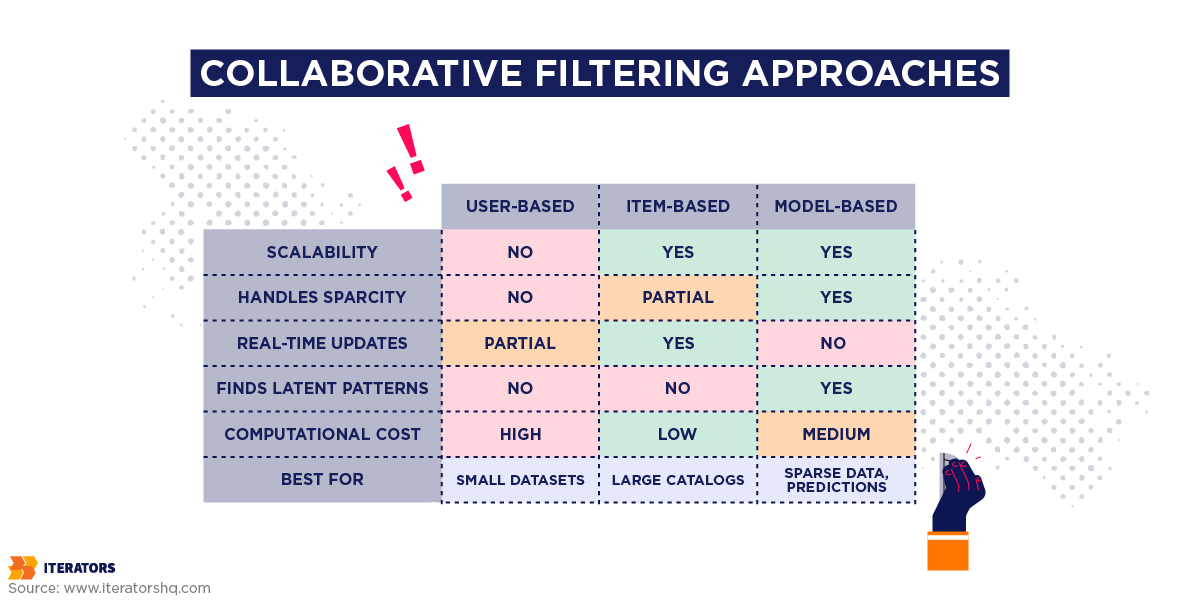
These approaches represent an evolutionary timeline, each solving critical flaws of the previous generation.
User-Based Collaborative Filtering: The Original (1990s)
Core Concept: “Find users similar to you, see what they liked, recommend those items.”
How It Works:
- Calculate similarity between all users (cosine similarity or Pearson correlation)
- Find top N most similar users to target user
- Recommend items similar users liked but target hasn’t seen
Pros:
- Simple to understand and implement
- Provides quality recommendations based on genuine collaboration
- Can surface unexpected discoveries
Cons (Why It Failed at Scale):
- Not Scalable: Comparing millions of users requires massive resources—O(n²) complexity
- Sparsity: Fails when users haven’t rated same items
- Instability: User preferences change constantly, requiring frequent recalculation
This worked for early systems with thousands of users and hundreds of items. It breaks completely at Amazon/Netflix scale.
Item-Based Collaborative Filtering: Amazon’s Breakthrough (Early 2000s)
Core Concept: “Find items similar to what you’ve bought, recommend those items.”
How It Works:
- Calculate similarity between items based on user interaction patterns (not attributes)
- For each item a user interacted with, find top N similar items
- Recommend those similar items
Why It’s Better:
- Faster & More Stable: Item relationships change far less than user neighborhoods
- More Scalable: Most catalogs have more users than items
- Pre-computable: Calculate similarities in batch jobs overnight
Remaining Problems:
- Still struggles with sparsity (relies on direct co-occurrence)
- Popularity bias (tends to recommend popular items)
- Can’t predict missing ratings
This powered Amazon’s massive scale-up but had fundamental limitations.
Model-Based Collaborative Filtering: The Netflix Prize Era (Late 2000s)
Core Concept: “Decompose the user-item interaction matrix into latent factors that explain preferences.”
How It Works (Matrix Factorization/SVD):
- Take sparse user-item matrix (most cells empty)
- Decompose into two smaller, dense matrices:
- User matrix: Each user by latent factors (“how much does this user like dark content?”)
- Item matrix: Each item by same latent factors (“how dark is this movie?”)
- Predict missing ratings by multiplying user and item factor vectors
Why It’s Revolutionary:
- Handles Sparsity: Specifically designed to predict missing ratings from sparse data
- Finds Hidden Patterns: Uncovers preferences users can’t articulate
- More Accurate: Netflix Prize proved SVD significantly outperforms memory-based methods
This is where AI enters collaborative filtering—matrix factorization is machine learning that learns patterns from data.
Hybrid Systems: The Modern Standard (2010s-Present)
Modern hybrid systems combine:
- Collaborative filtering (all types): User behavior patterns
- Content-based filtering: Item attributes and metadata
- Deep learning models: Neural networks for complex, non-linear patterns
- Context-aware features: Time, location, device, social context
Why It Dominates:
- Solves Cold Start: Uses content data when collaborative data is missing
- Highest Accuracy: Leverages multiple signals
- Flexibility: Tunable for different objectives (discovery vs. relevance)
Trade-off: Highest complexity, needs skilled ML engineers, resource intensive.
Hybrid techniques commanded 43.91% market share in 2024 because they work better than any single approach.
How to Implement Collaborative Filtering in Your Ecommerce Platform

Important Reality Check: For 95% of ecommerce businesses, implementing collaborative filtering means selecting and integrating the right pre-built solution, not building from scratch. Custom development is typically a $500K-$2M investment that takes 6-12+ months—resources almost always better spent on core business differentiation.
Step 1: Data Collection and Preparation
Before evaluating solutions, ensure you have the necessary data acquisition infrastructure. Collaborative filtering is fundamentally data-driven—garbage in, garbage out.
What Data Do You Need?
At minimum, you need user-item interaction data:
- Explicit Feedback: Ratings, reviews, likes/dislikes, favorites
- Implicit Feedback: Purchases, clicks, views, time spent, cart additions, search queries
Implicit feedback is often more valuable because:
- Volume: Users generate far more implicit signals than explicit ratings
- Honesty: Actions speak louder than words
- Coverage: Data for every interaction, not just ratings
Data Quality Requirements
Interaction data must be:
- Timestamped: Recency matters—yesterday’s purchase beats one from five years ago
- User-Identified: Connect actions to specific users
- Item-Identified: Every interaction maps to specific products
- Clean: Remove bots, test accounts, fraudulent activity
The Sparsity Challenge:
Your user-item matrix will be extremely sparse. Even active users interact with a tiny fraction of your catalog.
Example: 100,000 products, average user purchased 20 items = 99.98% empty matrix. This isn’t a bug—it’s the fundamental challenge collaborative filtering was designed to solve.
Data Pipeline Architecture
Most modern recommendation platforms handle this for you, but you’ll need:
- Real-time collection: Streaming user interactions
- Data warehouse/lake: Centralized historical storage
- ETL processes: Cleaning, deduplication, transformation
- Feature engineering: Derived features (days since purchase, category affinity)
- Versioning: Snapshot data for model training/evaluation
Step 2: Choosing the Right Pre-Built Solution
The Honest Truth: Unless you’re Amazon, Netflix, or have very specific proprietary requirements, you should buy or license a proven solution rather than build custom.
Enterprise Cloud Solutions (Best for Most)
Amazon Personalize:
- Best for: AWS-hosted ecommerce, need enterprise scalability
- Cost: Pay-per-use, typically $1K-$10K/month depending on traffic
- Timeline: 2-4 weeks to production
- Real Example: Fashion retailer saw 32% conversion increase in 3 months
Google Cloud Recommendations AI:
- Best for: Google Cloud users, retail/media focus
- Cost: Similar to Amazon Personalize
- Timeline: 2-4 weeks to production
- Real Example: Electronics marketplace reduced cart abandonment 18%
Platform-Specific Solutions
Shopify Apps (Product Recommendations, Wiser, LimeSpot):
- Best for: Shopify stores
- Cost: $10-$300/month
- Timeline: Hours to days
- Real Example: Home goods store increased AOV 27%
WooCommerce/WordPress Plugins:
- Best for: WordPress ecommerce
- Cost: $50-$200/month
- Timeline: Days
Magento Extensions:
- Best for: Magento/Adobe Commerce
- Cost: $200-$1000/month
- Timeline: 1-2 weeks
Specialized Platforms
Dynamic Yield, Algolia Recommend, Nosto:
- Best for: Mid to large ecommerce needing customization
- Cost: $2K-$20K/month
- Timeline: 4-8 weeks to production
- Advantage: More control than platform apps, less cost than custom
Step 3: Integration with Your Ecommerce Platform
The best solution is useless if not seamlessly integrated into customer experience.
Integration Points:
- Homepage: Personalized “Recommended for You”
- Product Pages: “Customers who bought this also bought…”
- Cart Page: “Complete your purchase with…”
- Post-Purchase: Email/push notifications
- Search Results: Personalized re-ranking
- Category Browsing: Personalized sorting
Most modern platforms provide:
- Pre-built widgets for common placements
- REST APIs for custom integration
- Webhook support for real-time updates
- Analytics dashboards for performance tracking
Performance Requirements:
- Latency: <100ms
- Availability: 99.9%+ uptime
- Scalability: Handle traffic spikes
Most enterprise solutions handle this automatically.
Step 4: Optimization and A/B Testing
The Testing Process:
- Baseline measurement: Capture current metrics (CTR, conversion, AOV)
- Gradual rollout: Start with 10% traffic, monitor carefully
- A/B testing: Compare recommendation performance vs. baseline
- Iterate: Adjust placement, number of items, presentation style
Key Metrics to Track:
- Click-Through Rate (CTR): Are users engaging with recommendations?
- Conversion Rate: Do recommendations drive purchases?
- Average Order Value (AOV): Are recommendations increasing basket size?
- Revenue Per User (RPU): Overall business impact
Most platforms provide built-in A/B testing and analytics.
Step 5: Continuous Improvement
Recommendation systems need ongoing optimization:
- Regular performance reviews: Monthly metric analysis
- Seasonal adjustments: Holiday, sales events need different strategies
- Catalog updates: New products need integration into recommendation logic
- User feedback integration: “Not interested” signals improve recommendations
Solving the Biggest Collaborative Filtering Challenges

The Cold Start Problem: When You Have No Data
The cold start problem is collaborative filtering’s Achilles’ heel, manifesting in two forms:
New User Cold Start: Zero purchase history. Zero browsing. How do you personalize?
New Item Cold Start: Just added to catalog. No purchases, views, or ratings. How do you recommend it?
Solutions (Most Handled by Modern Platforms)
1. Hybrid Approach (Best Practice):
- New users: Use content-based filtering from signup demographics (age, gender, location, interests)
- New items: Recommend to users who liked items with similar attributes (category, brand, price range, keywords)
2. Active Learning:
- New users: Quick onboarding questionnaire about preferences
- New items: Strategically show to diverse user samples for quick data gathering
3. Default to Popularity:
- Last resort: show trending/best-selling items
- Not personalized, but better than nothing
The Key Insight: Cold start is why pure collaborative filtering isn’t enough. You need hybrid approaches leveraging content and context when behavioral data is missing. Good news: Modern platforms handle this automatically.
Scalability & Performance at High Volume
Scaling from thousands to millions hits computational walls.
The Problem:
User-based CF requires comparing every user to every other user: O(n²) complexity. At 1 million users, that’s 1 trillion comparisons requiring big data applications to process efficiently.
Why Pre-Built Solutions Win:
Enterprise platforms like Amazon Personalize and Google Recommendations AI have already solved scalability:
- Distributed computing infrastructure: Handle billions of interactions
- Optimized algorithms: Item-based CF and matrix factorization
- Intelligent caching: Pre-computed recommendations served instantly
- Auto-scaling: Handle traffic spikes automatically
Building this infrastructure yourself costs $500K-$2M+. Licensing it costs $1K-$20K/month.
Data Sparsity: When Most Cells Are Empty
Even with millions of interactions, your matrix is mostly empty.
The Problem:
If User A and User B have no overlapping purchases, you can’t calculate similarity. If an item has one purchase, you can’t find similar items.
How Modern Platforms Solve This:
- Matrix Factorization: Algorithms specifically designed to “fill in blanks”
- Hybrid Models: Fall back to content similarity when behavioral data is sparse
- Transfer Learning: Use rich data (clicks) to inform sparse data (purchases)
Filter Bubbles & Diversity: Breaking the Echo Chamber
Collaborative filtering can trap users in filter bubbles, only recommending similar items.
The Problem:
Traditional recommendation systems base recommendations on similarity. If you’re an Apple user, you’ll increasingly see only Apple products. This creates:
- Reduced discovery: Never find products outside comfort zone
- Popularity bias: Rich-get-richer dynamic
- Long-tail neglect: Niche products never discovered
- Echo chambers: Isolated in narrow preference bubbles
Solutions in Modern Platforms:
- Diversity controls: Tune relevance vs. discovery balance
- Serendipity injection: Deliberately include unexpected recommendations
- User feedback loops: “Not interested” buttons improve recommendations
- Exploration algorithms: Multi-armed bandit approaches test new items
Key Metrics for Collaborative Filtering Performance

Understanding business metrics is fundamental to measuring recommendation system success. You can’t improve what you don’t measure.
Business Metrics (What Actually Matters)
Click-Through Rate (CTR): Percentage who click recommendations. Direct measure of relevance and engagement.
Conversion Rate: Percentage of clicks leading to purchases. Ultimate business metric.
Average Order Value (AOV): Are recommendations driving higher-value purchases? Measures upselling.
Revenue Per User (RPU): Total revenue attributed to recommendations ÷ users. Directly ties to business outcomes.
Customer Lifetime Value (CLV): Do better recommendations improve retention and repeat purchases?
Cart Abandonment Rate: Are recommendations helping complete purchases?
A/B Testing Framework
Gold standard for measuring performance through metrics tracking:
Setup:
- Control group: Baseline recommendations (or none)
- Treatment group: New CF-powered recommendations
- Random assignment: Users randomly assigned
- Statistical significance: Run long enough (1-4 weeks)
What to Test:
- Recommendations vs. no recommendations
- Different placement locations
- Number of recommendations shown
- Presentation formats (carousel vs. grid)
Most enterprise platforms include built-in A/B testing tools.
The Buy vs. Partner Decision: Why Custom Development Rarely Makes Sense
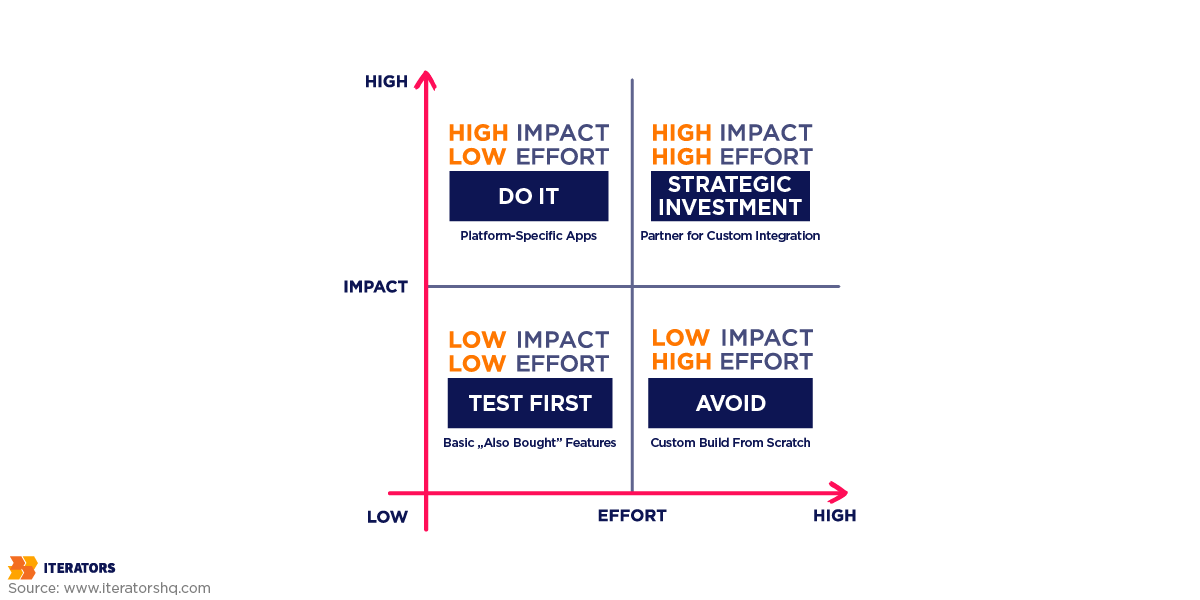
The most important decision for most ecommerce businesses: Should we buy an off-the-shelf solution or partner with experts for custom integration?
Spoiler: Building completely custom systems from scratch almost never makes sense unless you’re a tech giant.
The “Buy” Option: Off-the-Shelf Solutions (Recommended for Most)
When to Buy:
- Annual revenue under $50M
- Standard ecommerce use cases
- Want results in weeks, not months
- Budget-conscious ($1K-$20K/month)
- No specialized ML team
Real Success Examples:
Example 1: Mid-Sized Fashion Retailer ($8M annual revenue)
- Solution: Shopify + LimeSpot app ($200/month)
- Timeline: 2 days to implement
- Result: 27% increase in AOV, $2.16M additional annual revenue
- ROI: 900,000% (pays for itself in ~30 minutes)
Example 2: Electronics Marketplace ($25M annual revenue)
- Solution: Amazon Personalize ($5K/month)
- Timeline: 3 weeks to production
- Result: 32% conversion increase, 18% cart abandonment reduction
- ROI: Generated $3.2M additional revenue year one
Example 3: Home Goods Store ($12M annual revenue)
- Solution: Dynamic Yield ($8K/month)
- Timeline: 6 weeks to full rollout
- Result: 24% increase in click-through, 19% increase in revenue per session
- ROI: $2.8M additional annual revenue
Options by Platform:
Shopify: LimeSpot, Wiser, Product Recommendations ($10-$300/month)
WooCommerce: YITH, WooCommerce Product Recommendations ($50-$200/month)
Magento: Magento Product Recommendations, Nosto ($200-$2K/month)
Custom/Enterprise: Amazon Personalize, Google Recommendations AI, Dynamic Yield ($1K-$20K/month)
Pros: Fast implementation, proven algorithms, managed infrastructure, regular updates, immediate ROI, minimal risk.
Cons: Less customization (though usually sufficient), ongoing costs, potential platform lock-in.
The “Partner” Option: Expert Integration & Customization
When to Partner:
- Annual revenue $50M-$500M
- Complex business logic or unique requirements
- Need custom integrations with existing systems
- Want “buy” speed with more control
- Platform limitations preventing optimal performance
Real Success Examples:
Example 4: Multi-Brand Marketplace ($180M annual revenue)
- Challenge: Needed to balance recommendations across different vendor brands, complex commission structure
- Solution: Partnered with AI consultancy to customize Amazon Personalize with business logic layer
- Cost: $120K initial + $8K/month platform costs
- Timeline: 4 months to production
- Result: 41% increase in cross-brand purchases, $12.4M additional annual revenue
- ROI: Paid for itself in 3.5 months
Example 5: B2B Industrial Supplier ($95M annual revenue)
- Challenge: Complex account hierarchies, contract pricing, approval workflows
- Solution: Partner integrated Google Recommendations AI with SAP and custom ERP
- Cost: $200K initial + $12K/month
- Timeline: 5 months
- Result: 28% increase in reorder rate, 34% increase in cross-category purchases
- ROI: $8.6M additional annual revenue
Example 6: Subscription Box Service ($65M annual revenue)
- Challenge: Needed recommendations for curation, inventory management, churn prediction
- Solution: Partner built custom layer on top of Amazon Personalize integrating with logistics
- Cost: $180K initial + $10K/month
- Timeline: 6 months
- Result: 22% reduction in churn, 31% increase in box customization engagement
- ROI: $9.2M additional annual revenue, $4.1M in reduced churn
How It Works:
A specialized AI development company (like Iterators) provides:
- Solution selection: Identify optimal platform for your needs
- Custom integration: Connect with your existing systems (ERP, CRM, inventory)
- Business logic layer: Implement your unique business rules on top of base platform
- Advanced features: Custom reporting, specialized use cases
- Knowledge transfer: Your team learns as system is built
The Value Proposition:
You get the proven algorithms and infrastructure of enterprise platforms plus custom business logic and integration—typically at 25-50% of the cost of building completely from scratch.
Typical Investment:
- Initial: $80K-$300K (vs. $500K-$2M for fully custom)
- Ongoing: $5K-$20K/month (platform + support)
- Timeline: 3-6 months (vs. 12-18+ months for custom build)
Pros: Enterprise platform reliability, custom business logic, expert guidance, faster than building, lower risk, knowledge transfer.
Cons: Higher upfront than pure “buy” option, still some platform dependency, requires finding right partner.
The “Build” Option: Why It Almost Never Makes Sense
The Brutal Reality:
Unless you’re Amazon, Netflix, Spotify, or have truly unique requirements that no platform can handle, building custom collaborative filtering from scratch is almost always a mistake.
Why Building Custom Fails:
- Massive Cost: $500K-$2M+ initial investment
- Long Timeline: 12-18+ months to production-ready system
- Team Requirements: 3-5 ML engineers, 2-3 data engineers, 1-2 data scientists, DevOps—often need to hire/retain $1M+/year in salaries
- Opportunity Cost: Your ML team could build proprietary features that actually differentiate your business
- Ongoing Maintenance: Recommendation systems need constant updates, optimization, monitoring
- Risk: High failure rate—many projects never reach production or underperform off-the-shelf solutions
When Building Custom Might Make Sense:
- You’re a tech platform where recommendations ARE the product (like Netflix, Spotify)
- Annual revenue $500M+ with 8-figure technology budget
- Extremely unique data types no platform supports
- Recommendations provide core competitive moat
- Already have expert ML team with excess capacity
Real Cautionary Tale:
A $40M annual revenue retailer spent $800K and 14 months building custom recommendation engine. Result: Performed worse than $5K/month Amazon Personalize in A/B testing. They eventually scrapped it and moved to Amazon Personalize, wasting nearly $1M and losing 14 months of optimization time.
Decision Framework
Annual Revenue < $20M: → BUY platform-specific solution (Shopify apps, WooCommerce plugins)
Annual Revenue $20M-$100M with standard needs: → BUY enterprise cloud solution (Amazon Personalize, Google Recommendations AI)
Annual Revenue $50M-$500M with complex requirements: → PARTNER for custom integration on top of enterprise platform
Annual Revenue $500M+ and recommendations are core differentiator: → PARTNER for heavily customized solution, potentially with some custom components
Tech platform where recommendations ARE the product: → Consider BUILD, but even then, start with enterprise platforms and customize
The Smart Play:
- Start with off-the-shelf to validate business case
- Partner with experts if you need customization
- Never build completely custom unless you’re a tech giant
Future Trends: Where Collaborative Filtering Is Going

The field isn’t standing still. Here are trends defining next-generation recommendation systems:
Deep Learning & Neural Collaborative Filtering
Traditional matrix factorization uses linear models. Neural Collaborative Filtering uses deep neural networks to learn complex, non-linear patterns in user-item interactions.
Why It Matters: Can capture intricate relationships traditional CF misses. Google, Netflix, and Amazon are all using deep learning for AI-powered product recommendations.
Good News: Most modern platforms (Amazon Personalize, Google Recommendations AI) already incorporate deep learning—you get the benefits without building it yourself.
Context-Aware Recommendation Systems
Traditional CF assumes stable preferences. Reality: You want different restaurants for lunch vs. dinner, different movies alone vs. with family.
The Solution: Recommendations based on (User, Item, Context):
- Temporal context: Time of day, season
- Spatial context: Location, device
- Social context: Alone, with friends
- Activity context: Browsing, searching, ready to buy
Modern platforms are increasingly incorporating context awareness automatically.
Reinforcement Learning: Optimizing for Lifetime Value
The Paradigm Shift: Traditional CF optimizes for short-term accuracy (“Will user click this now?”). Reinforcement Learning optimizes for long-term engagement (“Will this maximize lifetime value?”).
Why It Matters: Myopic recommendations can increase clicks today but cause churn tomorrow. RL models long-term impact, balancing exploration (trying new things) with exploitation (showing what works).
Current Applications: Netflix optimizes for watch time and retention, not just clicks. Spotify balances familiar music (satisfaction) with discovery (engagement).
Practical Impact: Enterprise platforms are beginning to incorporate RL—another reason to use proven solutions rather than building outdated approaches from scratch.
Conclusion: The Collaborative Filtering Imperative
Collaborative filtering has evolved from simple similarity matching (1990s) to hybrid deep learning systems (today) to reinforcement learning and context-aware AI systems (future).
The business reality:
- Powers 35% of Amazon’s revenue
- Drives 75-80% of Netflix viewing
- $1 billion in annual savings for Netflix
- Fast-growing companies derive 40% more revenue from personalization
But it’s not just for tech giants:
- Mid-sized retailers see 25-40% conversion increases with off-the-shelf solutions
- Implementation can take days to weeks, not months
- ROI typically achieved in first 3-6 months
- Monthly costs often recovered in hours through increased sales
The competitive necessity:
71% of consumers expect personalization. 76% get frustrated without it. Your customers compare you to Amazon, Netflix, and Spotify—not your competitors.
The implementation reality:
For 95% of ecommerce businesses, the answer is buying proven solutions or partnering for custom integration—not building from scratch. The algorithms are commoditized; the differentiation is in business logic, integration quality, and optimization.
The smart play for most ecommerce companies:
- Under $20M revenue: Start with platform apps (Shopify, WooCommerce, Magento plugins)
- $20M-$100M revenue: Implement enterprise cloud solutions (Amazon Personalize, Google Recommendations AI)
- $50M-$500M with complexity: Partner with experts for custom integration
- Continuously optimize: A/B test, track metrics, iterate
The bottom line:
If you’re running an ecommerce platform in 2025 without leveraging collaborative filtering for ecommerce, you’re actively training customers to shop elsewhere.
The question isn’t whether to implement collaborative filtering. It’s which proven solution to deploy and how quickly you can start seeing results.
Ready to Build a Recommendation System That Actually Converts?
At Iterators, we’re an AI development company specializing in machine learning development services for ecommerce. We’ve helped platforms increase conversions by up to 40% with recommendation systems that combine proven enterprise platforms with custom business logic tailored to your needs.
We don’t just implement algorithms—we deliver complete, optimized solutions:
- Platform selection and evaluation based on your specific needs
- Custom integration with your existing systems (ERP, CRM, inventory)
- Business logic layer implementing your unique requirements
- A/B testing frameworks for continuous optimization
- Ongoing AI compliance monitoring and improvement
Our development team brings proven expertise in AI applications for ecommerce. We help you leverage the power of enterprise platforms like Amazon Personalize and Google Recommendations AI while adding the custom features that differentiate your business—at a fraction of the cost of building from scratch.
Whether you’re a growing retailer implementing your first recommendation engine or an established marketplace optimizing customer retention, we have the experience to deliver results quickly and cost-effectively.
Let’s talk about your personalization strategy. Schedule a free consultation with our product management team to discuss how collaborative filtering can transform your ecommerce platform and help you increase conversion rates.
Frequently Asked Questions
Q: What’s the difference between collaborative filtering and content-based filtering?
A: Collaborative filtering recommends based on user behavior patterns (“users like you also liked”), while content-based uses item attributes (“you liked action movies, here are more”). CF focuses on what users do, content-based on what items are. Modern systems use hybrid approaches combining both.
Q: How much data do I need to implement collaborative filtering?
A: Most modern platforms can start delivering value with as little as 1,000+ user interactions, though quality improves significantly at 10,000+. The good news: enterprise platforms are specifically designed to handle sparse data, so you don’t need millions of interactions to get started.
Q: Should I build a custom recommendation system or buy an existing solution?
A: For 95% of ecommerce businesses, buy or partner—don’t build. Off-the-shelf solutions like Amazon Personalize, Google Recommendations AI, or platform-specific apps deliver better results, faster, and at 5-10% the cost of custom development. Only tech giants where recommendations ARE the product should consider fully custom systems.
Q: How long until I see ROI from implementing collaborative filtering?
A: With off-the-shelf solutions, typically 3-6 months to full ROI. Many companies see positive results within weeks. Implementation time ranges from days (platform apps) to 4-8 weeks (enterprise solutions). Custom integrations take 3-6 months but still deliver ROI faster than building from scratch.
Q: What are realistic improvements I can expect?
A: Based on real client results: 20-40% increase in conversion rates, 20-30% increase in AOV, 15-25% reduction in cart abandonment. Exact results depend on your current baseline, industry, and implementation quality. A/B testing ensures you can measure actual impact for your business.
Q: How do I solve the cold start problem for new users and products?
A: Modern hybrid platforms handle this automatically by falling back to content-based recommendations, demographic targeting, or popular items when behavioral data is insufficient. This is a major advantage of enterprise solutions—they’ve already solved these problems at scale.
Q: What platforms work best for my ecommerce stack?
A: Shopify: LimeSpot, Wiser, or built-in Product Recommendations. WooCommerce: YITH or WooCommerce Product Recommendations. Magento: Adobe Product Recommendations or Nosto. Custom/Headless: Amazon Personalize or Google Recommendations AI. Most platforms offer free trials—test before committing.
Q: How do I measure if recommendations are actually working?
A: Track business metrics: click-through rate (CTR), conversion rate, average order value (AOV), and revenue per user (RPU). Use A/B testing to compare recommendations vs. baseline. Most enterprise platforms include built-in analytics dashboards showing real-time performance and business impact.