

A model that worked in the notebook and doesn’t work in production is not a modeling problem. It’s a classification problem that nobody did before building: what kind of debt are we actually carrying, and where does it live? Nine times out of ten the answer is data pipeline debt — the quiet liability that turns an approved AI budget into a year of “the data’s almost ready.”
Data pipeline debt is the accumulated cost of shortcuts in how data gets collected, moved, transformed, validated, stored, and monitored on the way into a model. It is not the same animal as the technical debt your engineering team already knows how to talk about, and that mismatch is exactly why most ML initiatives stall between “the demo worked” and “it’s in production.” Teams keep applying code-debt remediation, such as refactoring the function, adding a test, and shipping a patch, to a problem that lives one layer down, in the data itself.
If you’ve approved an ML budget, watched a promising demo, and then spent a year hearing “the data’s almost ready,” you’re not dealing with a slow team. You’re dealing with debt that doesn’t show up as a bug ticket. Here’s the blunt version: if you’re not collecting, cleaning, validating, versioning, and monitoring your data properly, you’re not building machine learning. You’re teaching your business to act on the past with broken evidence.
Not sure whether your ML problem is the model, the data, or the infrastructure? Iterators can audit your ML pipeline and show you where the real bottleneck is — before you fund another sprint of “model improvements.” Talk to us about a pipeline audit.
What Is Data Pipeline Debt?
Data pipeline debt is the accumulated cost of shortcuts in how data is collected, moved, transformed, validated, stored, and monitored. In machine learning projects, that debt shows up as unreliable training data, fragile ETL jobs, delayed deployments, degrading model performance, and maintenance costs that climb every quarter instead of falling.
It almost never starts as a bad decision. It starts as a reasonable one, repeated:
- A quick CSV export to unblock one analysis.
- Manual cleaning inside a notebook that never got rebuilt.
- A one-off script that quietly became load-bearing.
- Data ownership that was never actually assigned.
- A transformation nobody documented.
- No validation checks, no lineage, no reproducible training dataset.
Each of those is defensible in isolation. Stacked over eighteen months, they become the reason a competent team still can’t ship.
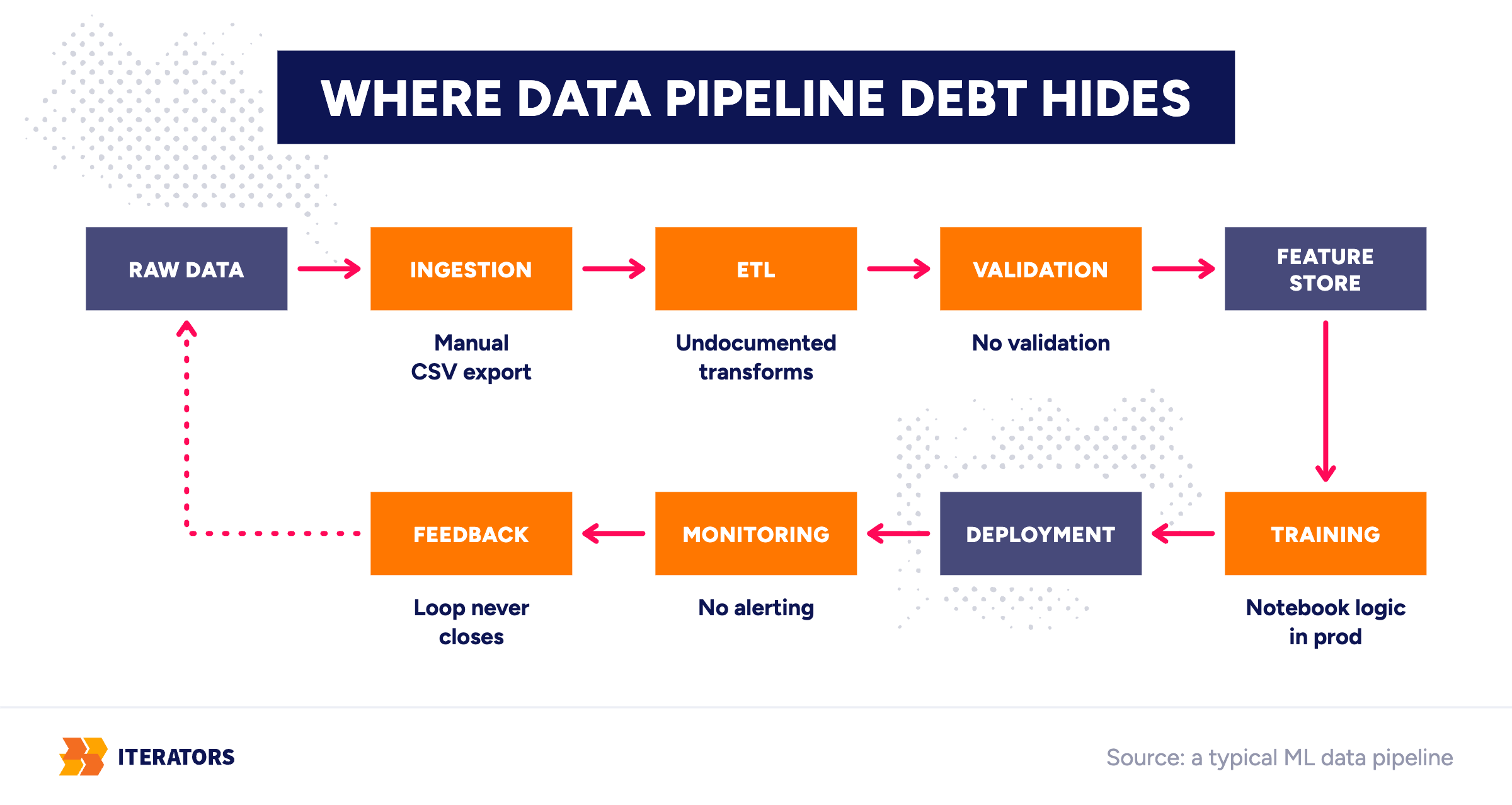
Here’s where it hides along the path from raw data to a live prediction:
Data Pipeline Debt vs. Technical Debt
Code debt and data pipeline debt share a name and almost nothing else. Code debt is deterministic: a shortcut produces a bug, the bug produces a stack trace, the stack trace produces a fix. Data pipeline debt is probabilistic: a shortcut produces a slightly wrong input, the input produces a slightly wrong feature, the feature produces a confidently wrong prediction, and nothing in the system raises its hand. (For the baseline concept the whole industry already shares, see technical debt — data pipeline debt is its stranger, quieter cousin.)
| Traditional technical debt | Data pipeline debt | |
|---|---|---|
| Origin | Code shortcuts, deferred refactors | Ingestion workarounds, manual cleaning, undocumented transforms |
| Failure signal | Compiler error, failed test, crash | No alert: the pipeline runs, but the output is wrong |
| Who owns it | Engineering | Data engineering, ML, product, sometimes nobody |
| Compounding pattern | Linear: harder to add features | Non-linear: small upstream changes break distant downstream consumers |
| Detection method | Static analysis, unit tests | Statistical tests, schema validation, anomaly detection |
| What it costs you | Slower development | Wrong decisions made with high confidence |
The asymmetry in the “failure signal” row is the one that matters. A broken function tells you it’s broken. A broken feature keeps feeding the model, the model keeps returning a number, and the number looks exactly like all the correct numbers that came before it. Nobody gets paged. The pipeline’s exit code is still zero.
Why Data Pipeline Debt Kills Machine Learning Projects
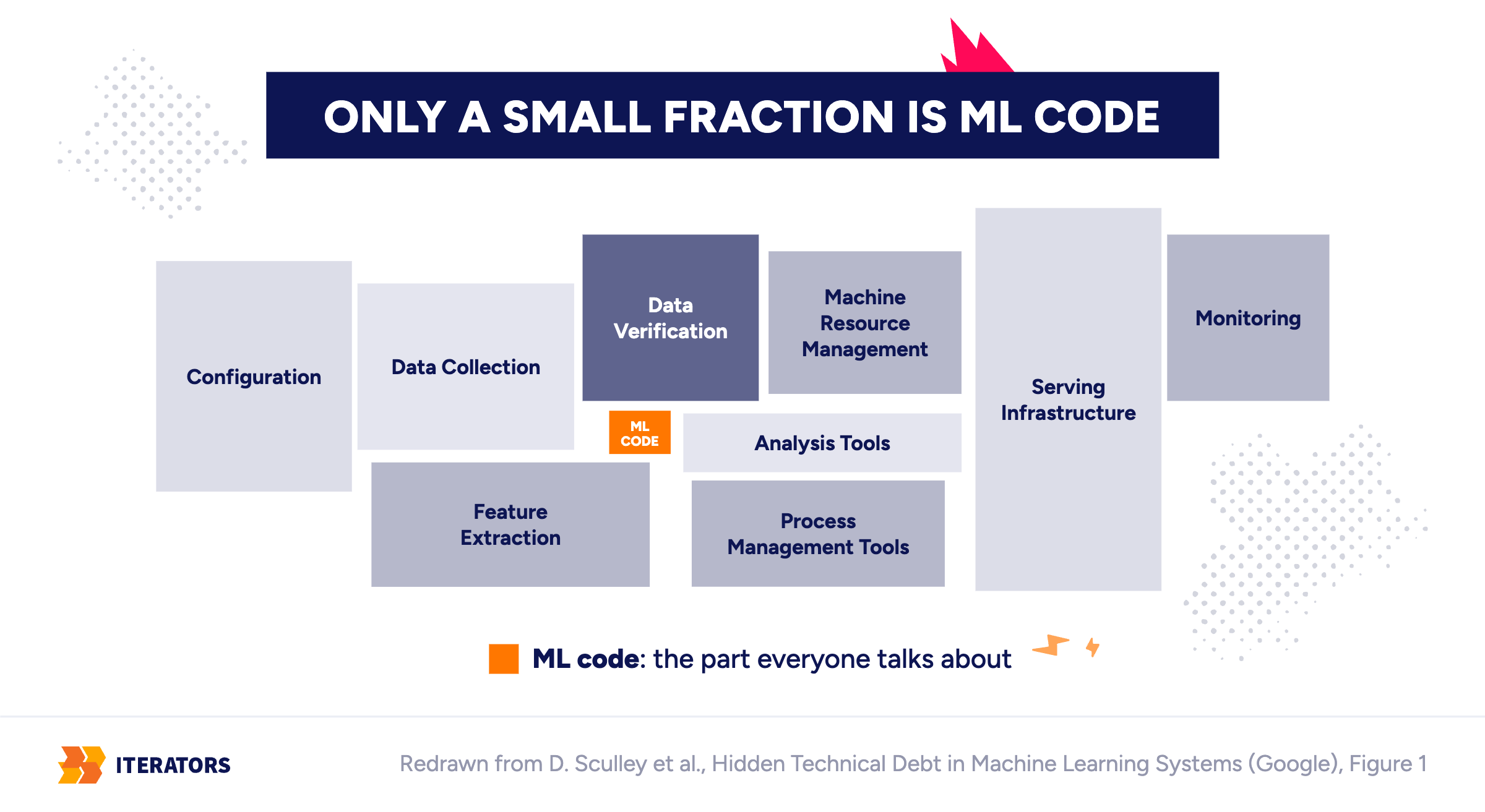
Google researchers who studied production ML systems at scale wrote a line that should be printed on the wall of every “why isn’t the model ready” meeting:
“Only a small fraction of real-world ML systems is composed of the ML code.” — D. Sculley et al., Hidden Technical Debt in Machine Learning Systems (Google)
The rest is ingestion, feature extraction, verification, serving infrastructure, monitoring, and the configuration glue holding all of it together. The model is the part everyone talks about because it’s the part with a name. It’s usually also the smallest part of the system that’s actually running.
The same research names the mechanism that makes this debt compound instead of staying flat: the CACE principle, or Changing Anything Changes Everything. In a normal codebase, a well-encapsulated module can be refactored without touching its neighbors. In an ML pipeline, there is no such boundary. Adjust a filtering rule upstream, rename a categorical field, or change how often a source refreshes, and you’ve altered the input distribution the model was trained against without raising an alert. No error fires. The model just starts being wrong in a way that looks like normal variance until someone checks.
The Model Is Usually Not the Bottleneck
This is the point where the executive question usually gets asked wrong. “Why isn’t the model ready?” assumes the bottleneck is modeling work. The question that actually diagnoses the stall is: can this system reliably hand the model clean, current, trusted data every single day, without someone manually intervening? If the honest answer is no, you don’t have a model problem. You have data pipeline debt, and it will eat every model you build on top of it.
The Executive Symptoms of Data Pipeline Debt
You don’t need to read a pipeline diagram to spot this. Data pipeline debt has a recognizable set of symptoms at the executive level, and if several of these sound like your last three status meetings, the diagnosis is already in:
- Your ML roadmap keeps slipping, and every update sounds like a new infrastructure excuse.
- Your data scientists spend most of their time cleaning data instead of building models.
- Nobody fully trusts the dashboards, so people quietly keep their own spreadsheets.
- Model performance changes without a clear reason.
- Data definitions differ between teams — “active customer” means one thing in sales and another in finance.
- Production data doesn’t match the data the model trained on.
- Every new data source requires a custom engineering project.
- Your “AI feature” only really works in demo conditions.
- Retraining is manual, rare, or hasn’t happened since launch.
- Nobody can explain where a given prediction actually came from.
None of these is a bug you can file. That’s precisely why they persist: the system reports success while the business outcome quietly fails to arrive.
“The Demo Worked” Is Not a Production Strategy
A prototype can look flawless because it runs on data a human already cleaned by hand. A production ML system has to work on data that is messy, live, late, duplicated, and changing shape without warning. The gap between those two conditions is where most ML initiatives collapse. The model didn’t get worse; the demo was never tested against the thing that actually breaks it. “It worked in the demo” is evidence that the idea is sound. It is not evidence that the system is ready.
Where Data Pipeline Debt Comes From
Data pipeline debt doesn’t arrive as one bad decision. It arrives as five small, individually reasonable decisions that nobody connected.
1. Notebook logic gets promoted to production without being rebuilt.
The first version of almost every ML pipeline lives in a notebook, because that’s the right place to validate a hypothesis fast. The problem starts when “the prototype works” becomes “ship the prototype.” Notebooks have no enforced state isolation, no dependency pinning, no test coverage, and, most importantly, they frequently compute global statistics (a mean, a normalization constant) across the entire dataset before any train/test split exists. That’s a leak. It makes the prototype look better than it is and guarantees the production version will underperform the demo that sold the project. It’s also fragile against people leaving — undocumented notebook logic is a classic form of organizational knowledge loss.
2. One-off ETL scripts become critical infrastructure with no owner.
Someone writes a script to pull a feed into a usable shape for one report. The report becomes a dashboard. The dashboard becomes a feature in a model. Eighteen months later that script is load-bearing for a production decision and it has no version control, no retry logic, and no one on the team who remembers why it joins two tables the way it does. This is what the literature calls a pipeline jungle: a dense, undocumented mesh of point-to-point data bridges that nobody can trace end-to-end anymore. It is held together by what gets called glue code: custom scripts written to force two systems to talk, with no interface contract and no test coverage, that quietly lock you into whatever assumptions were true the day they were written.
3. There’s no shared definition of what “clean” means.
Duplicate records, inconsistent date formats, a status field that means one thing in the CRM and a slightly different thing in the billing system: none of this is exotic. What makes it debt rather than a one-time cleanup is that nobody wrote down the definition, so every team re-derives their own version of “clean,” and the model trains on whichever version happened to be in the table that week. This is usually a symptom of data silos — product, sales, ops, and finance each maintaining their own version of the truth with no shared contract between them.
4. Failures produce no alert by default.
This is the one executives underestimate the most. A well-built pipeline fails loud: it quarantines the bad record, pages someone, and stops before it poisons the next stage. A pipeline carrying debt fails quiet: it coerces a malformed field to null, drops a few thousand rows nobody counted, and moves on. The job’s exit code says success. The report built on top of it is simply wrong, and it stays wrong until someone notices the business number doesn’t match reality. That can take months.
5. The feedback loop back to training never got built.
A prediction goes out, perhaps a risk score, a recommendation, or a classification, and the system has no mechanism to find out later whether it was right, whether a human overrode it, or whether it moved the business metric it was supposed to move. Without that loop closing, you can’t tell whether a model update helped or hurt. You’re maintaining a system you can’t evaluate, which is a strange thing to call “data-driven.”
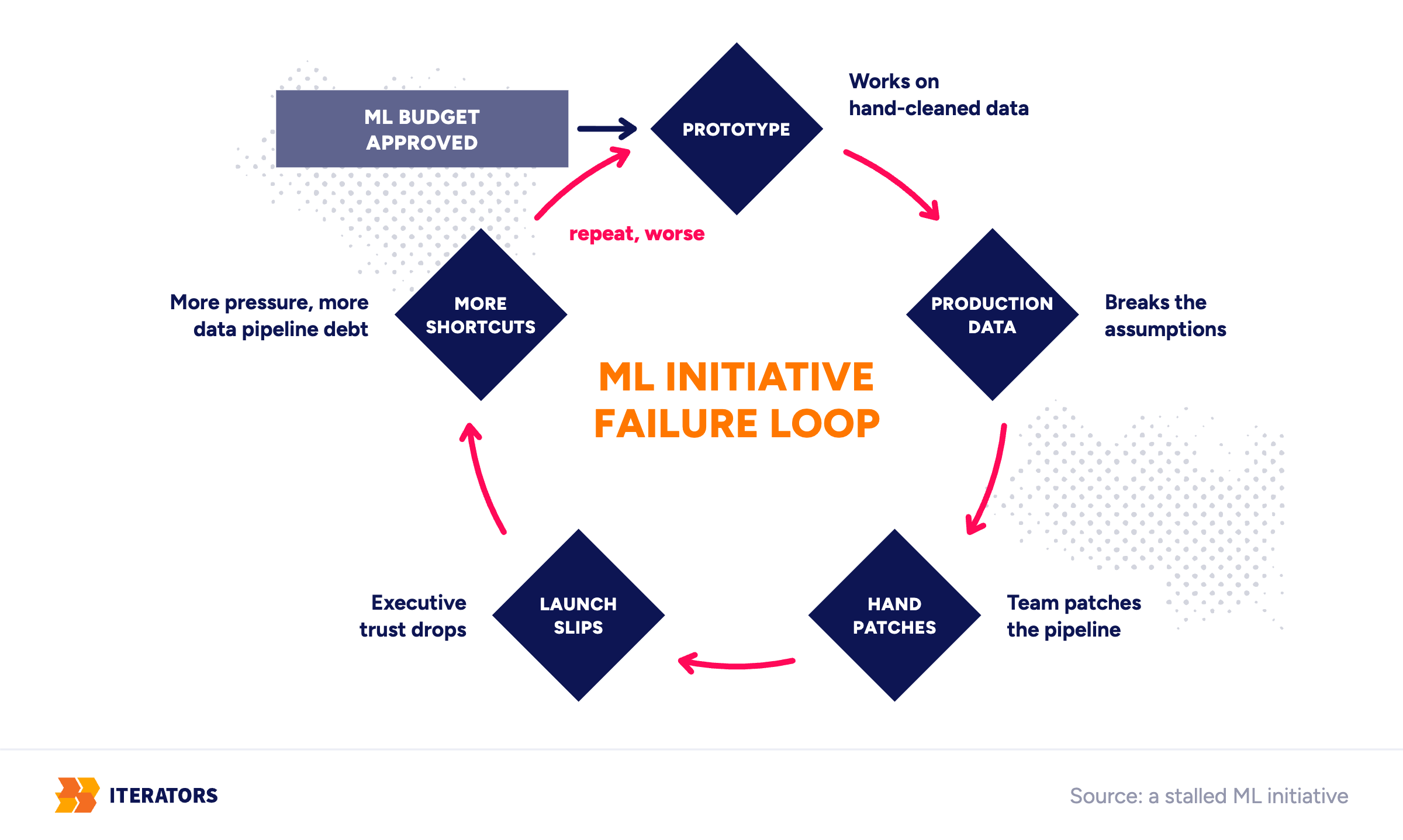
None of these five is dramatic on its own. Stacked together, they’re the reason a team that genuinely knows how to build models still can’t ship one. They also feed each other, which is why the problem accelerates rather than holds steady:
ETL Technical Debt: The Quiet Killer Behind ML Data Quality Problems
ETL technical debt is the specific form of data pipeline debt that lives in the extraction, transformation, and loading layer — the plumbing that moves data from where it’s produced to where the model consumes it. It’s worth isolating because it’s where the most damage hides in plain sight.
What ETL Technical Debt Looks Like
- Hardcoded transformation rules that encode a business assumption nobody wrote down.
- Undocumented joins — two tables merged a particular way for a reason now lost.
- Batch jobs that fail without an alert and get restarted by hand.
- No retry logic, so a transient upstream hiccup drops a day of data.
- No schema validation, so a renamed column passes straight through.
- No data lineage, so you can’t answer “where did this number come from.”
- Fragile cron jobs on someone’s forgotten server.
- Duplicated pipelines doing almost-but-not-quite the same thing.
- Transformations owned by exactly one person, who is on vacation.
Why ETL Debt Compounds Into Data Pipeline Debt
Every new source, feature, dashboard, or model you add is built on top of the existing plumbing. If the foundation is weak, each addition multiplies the number of things that can break, and the cost of any change rises non-linearly. This is the CACE principle wearing work clothes: the more consumers depend on a fragile transform, the more expensive it becomes to ever fix it, so teams stop trying and route around it instead, which adds more debt.
Change anything, change everything
Tap any box on the left or in the middle to make one small change upstream. Watch where it lands.
When ETL Debt Becomes a Board-Level Problem
Translated out of engineering terms, unmanaged ETL debt reads as: delayed ML launches, forecasts leadership can't rely on, recommendations that quietly underperform, personalization that misfires, compliance exposure when you can't prove where data went, and an AI budget that produced activity instead of outcomes. Sooner or later, the board asks about it as a line item.
ML Data Quality as Product Infrastructure
The most expensive misconception in this whole area is that data quality is a chore you do once, right before training. Treating it that way is how you end up retraining a model every quarter on a fresh batch of the same problems.
ML data quality has to be designed into the system, not bolted on before a deadline. That means validation rules that run on every batch, schema checks that catch structure changes, anomaly detection on the values themselves, explicit data contracts between producers and consumers, named ownership, lineage tracking, continuous monitoring, labeling-quality controls, governance, and access controls. Those aren't nice-to-haves layered on a working system. They are the system, in the same way brakes are part of a car rather than an accessory.
Garbage In, Expensive Garbage Out
The old "garbage in, garbage out" undersells the modern version of the problem. Bad data doesn't just produce a bad model you can throw away. It produces a confident system that generates wrong answers at scale, with a dashboard that makes them look authoritative. A model fed duplicated vendors or inconsistent product categories will happily emit precise, well-formatted, completely wrong predictions all day, and the polish is exactly what stops anyone from questioning them. Real remediation takes more than a one-pass scrub. A disciplined data cleaning process is the starting point. The finish line is a system that keeps the data clean without a human in the loop.
Machine Learning Infrastructure Debt: When Notebooks Pretend to Be Products
A research environment and a production system are different kinds of thing, and machine learning infrastructure debt is what you accumulate when you run the first as if it were the second. A notebook is for exploration. It is not an operating model for production AI.
Common Infrastructure Gaps
- No model registry — nobody can say which model version is actually live.
- No feature store — the same feature gets recomputed three different ways.
- No CI/CD for ML — deploys are manual and unrepeatable.
- No dataset versioning — you can't reproduce last month's training run.
- No inference monitoring — you learn the model degraded from a customer.
- No rollback strategy — a bad model update has no undo.
- No cost or GPU-utilization monitoring — spend creeps with no owner.
- No alerting for model degradation, and no security review of the whole path.
Why Cloud Notebooks Are Not Enough
Cloud notebooks are excellent for exploration and genuinely bad as a foundation for production AI, for the same reason a whiteboard is a great place to design a bridge and a terrible place to drive across one. Production ML needs monitored pipelines, reproducible builds, deployment automation, access controls, observability, rollback plans, performance testing, and cost controls. If your deciding factor between models is "which data lake or warehouse feeds it," that architecture question matters too — our breakdown of data lake vs. data warehouse covers the trade-offs — but no storage choice saves a system with none of the controls above.
Data Drift, Schema Drift, and Model Drift: The Three Failure Modes Executives Should Know
Traditional software fails with an exception. ML systems fail by drifting, and there are three distinct ways to drift that get flattened into one vague complaint, "the model stopped working," when they actually call for three different fixes.
| Schema drift | Data drift | Model drift | |
|---|---|---|---|
| What changes | The structure of the data itself | The distribution of input values | The relationship between inputs and outcomes |
| Mechanism | Upstream system renames, retypes, or removes a field | Real-world behavior shifts, inputs stop resembling training data | The world changes in a way the model never saw, even if inputs look normal |
| Example | customer_id (integer) becomes user_id (universally unique identifier, or UUID) after an auth migration | Post-pandemic mobility patterns no longer resemble pre-pandemic training data | A fraud model trained on last year's patterns misses this year's new fraud technique |
| How it shows up | Ingestion jobs error out or drop the column without an alert | Predictions still run, but accuracy degrades gradually | Accuracy degrades even though the input data looks completely stable |
| Fix | Schema validation and versioned data contracts | Statistical monitoring (distribution tests) on inputs | Monitored outcome tracking and scheduled retraining |
The reason this classification matters isn't academic. If you don't know which of the three you're looking at, you'll fix the wrong layer. Patching a schema contract doesn't help a model that's drifting because the world changed. Retraining a model doesn't help if the real problem is that an upstream team renamed a column three weeks ago without telling anyone downstream.
Why "It Worked Last Quarter" Means Nothing in ML
Traditional software that passed its tests last quarter still works this quarter, because nothing about it changed. An ML system can pass every test last quarter and be quietly wrong this quarter, because what broke it was a change in the world, and the code stayed the same. New fraud patterns, a new customer segment, a seasonal shift in buying behavior, a regulatory change, a pandemic rewiring how people move: none of those touch your codebase, and all of them can invalidate a model.
What This Looks Like When It's a Real System, Not a Diagram
The forensic findings above read clean in the abstract. In practice they show up as a specific, narrow bottleneck that's blocking one specific workflow, and the fix looks less like "rebuild everything" and more like "build the one piece of infrastructure that was missing the whole time."
At Citrine Informatics, the constraint wasn't a lack of modeling talent. Materials informatics is a research-heavy domain with academic-grade data science already in house. The gap was operational: there was no standardized path for data scientists to deploy and version their own work. We built a machine learning operations (MLOps) platform specifically oriented around that workflow, with scalable notebook deployment and versioning, and added Scala developers directly into the existing team rather than standing up a separate one. The debt wasn't in the models. It was in the absence of a repeatable path from "a data scientist has something that works" to "that thing is running, versioned, and reproducible."
At SCHWARTZ.AI, the bottleneck was upstream of any model at all: cost and purchase invoice processing was a manual, unstructured workflow creating a drag on the whole booking process. The fix was an AI invoice analysis pipeline paired with a usable web platform, built and refined through repeated UX workshops and usability testing. If the finance team hadn't adopted it, the bottleneck would only have changed shape.
At Bondspoke, the debt was almost entirely in unstructured input: prospectuses and sustainability reports that had to be read and scored manually before any sustainability analytics could happen. The constraint we were actually solving wasn't "can an LLM read a document." It was building the extraction and scoring pipeline that turns that reading into a consistent, auditable number against Bondspoke's own methodology and UN SDG targets, on infrastructure private and secure enough for client data. The model was the smallest part of that build. The pipeline around it, including ingestion, extraction, scoring, and confidentiality, was the actual deliverable.
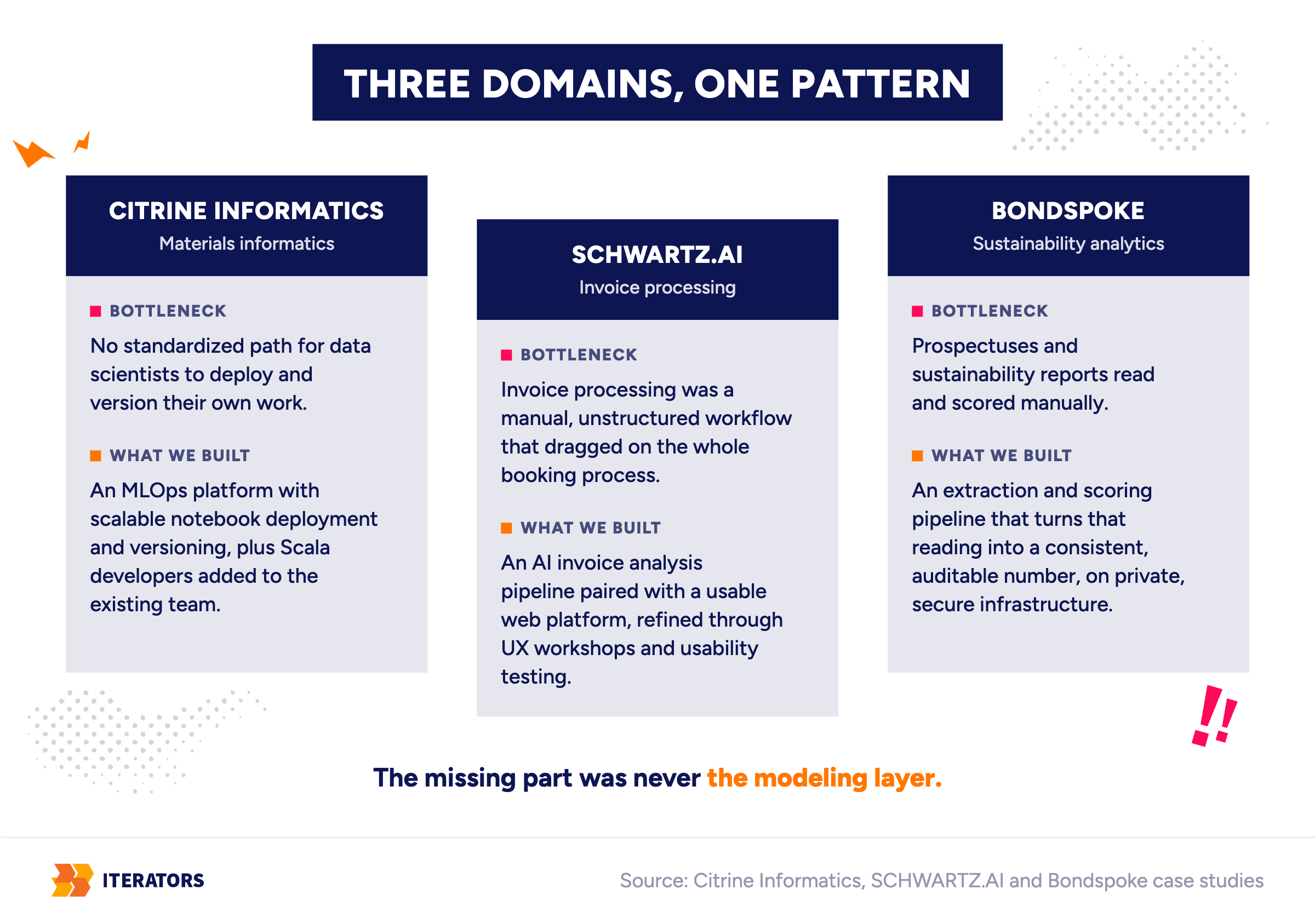
Three different domains, three different technical stacks, and the same underlying pattern: the part that was missing was never the modeling layer. It was the infrastructure that made the modeling layer trustworthy enough to run unattended.
How to Audit Data Pipeline Debt Before It Kills Your ML Initiative
Before you add a data scientist, buy an MLOps tool, or approve another sprint of "model improvements," there's a narrower question worth answering first: where, specifically, does this pipeline lose its grip on reality? You can run this audit in a week, and it needs no new tooling, only someone willing to trace the real path a record takes.
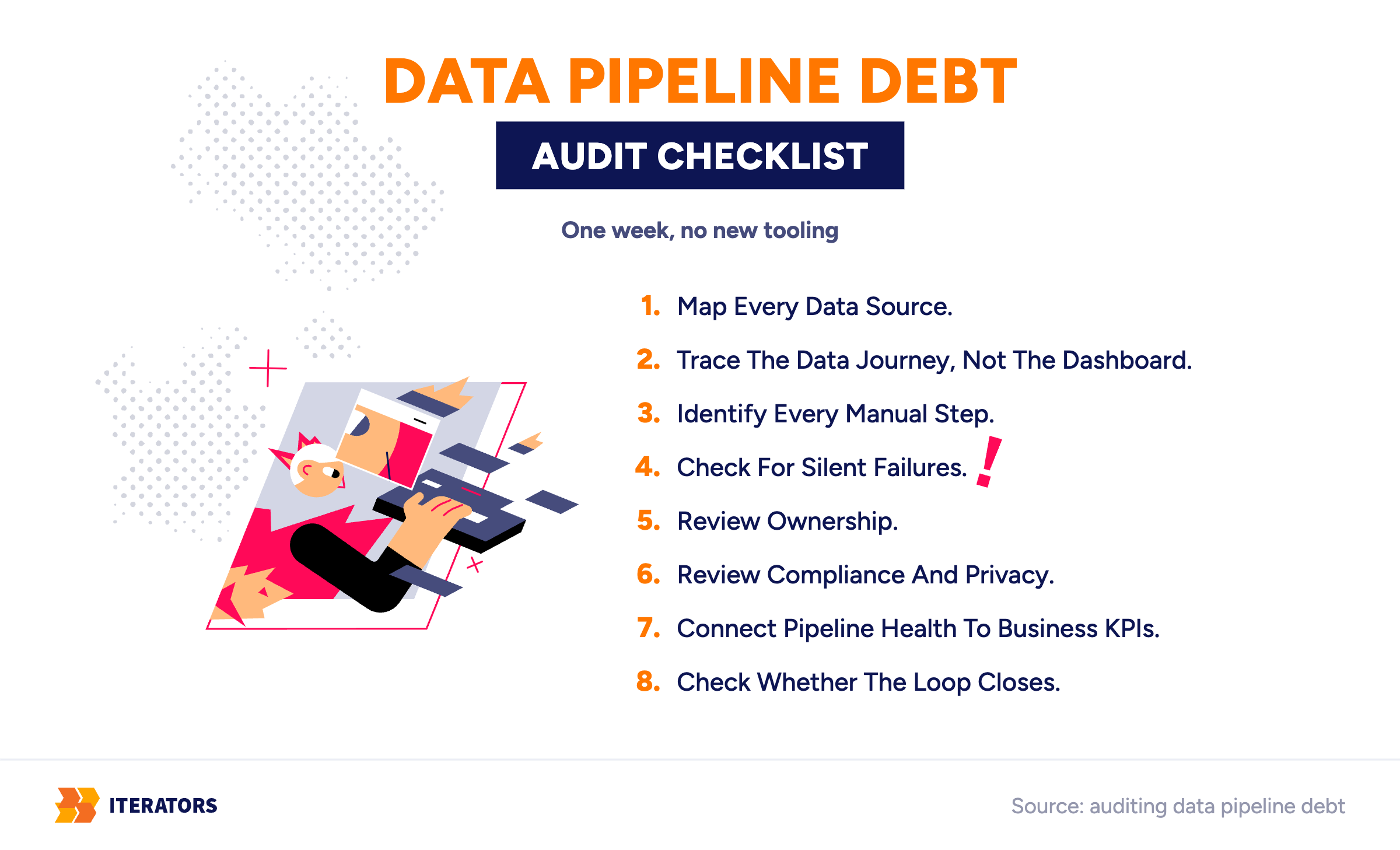
1. Map every data source. For each one: who owns it, how is it collected, how often does it change, how reliable is it, and is access controlled? A source nobody owns is a future outage with a date not yet assigned.
2. Trace the data journey, not the dashboard. Follow the feature that feeds your most important model backward through ingestion, transformation, validation, storage, feature creation, training, deployment, and feedback — all the way to the upstream system that produced the value, not just the table it reads from.
3. Identify every manual step. Literally open the deployment and find whether any transformation is a manual notebook run, a scheduled export, or a script someone runs from their laptop. Every manual step is a single point of failure disguised as a working system.
4. Check for silent failures. Does a malformed input get quarantined and flagged, or coerced to null and passed through? If this pipeline's output volume dropped 40% overnight, would a human find out before a customer did? This single question usually reveals how much debt you're carrying.
5. Review ownership. Every critical pipeline needs a named owner who is still at the company. "Whoever wrote it originally" is not an owner.
6. Review compliance and privacy. Especially in healthcare, fintech, biotech, HR tech, and enterprise SaaS, you need to know what data flows where, who can see it, and whether you can prove it. Frameworks like the NIST AI Risk Management Framework give you a vocabulary for this that maps to how auditors and enterprise buyers actually think.
7. Connect pipeline health to business KPIs. Tie each pipeline to the number it affects — model accuracy, fraud-detection rate, recommendation conversion, invoice processing time, analyst hours saved. A pipeline with no KPI attached is a pipeline nobody will fund fixing.
Check whether the loop closes. When the model makes a prediction, does anything downstream record whether it was right, accepted, or overridden? If not, you don't have a feedback loop. You have a one-way pipe, and every retraining decision downstream of it is a guess dressed up as data.
How to Fix Data Pipeline Debt Without Freezing the Business
The instinct, once the audit surfaces five different problems, is to fix all five at once. That's usually the wrong move, and it's the move that turns a six-week remediation into a company-wide freeze. Pay the debt down in order instead.
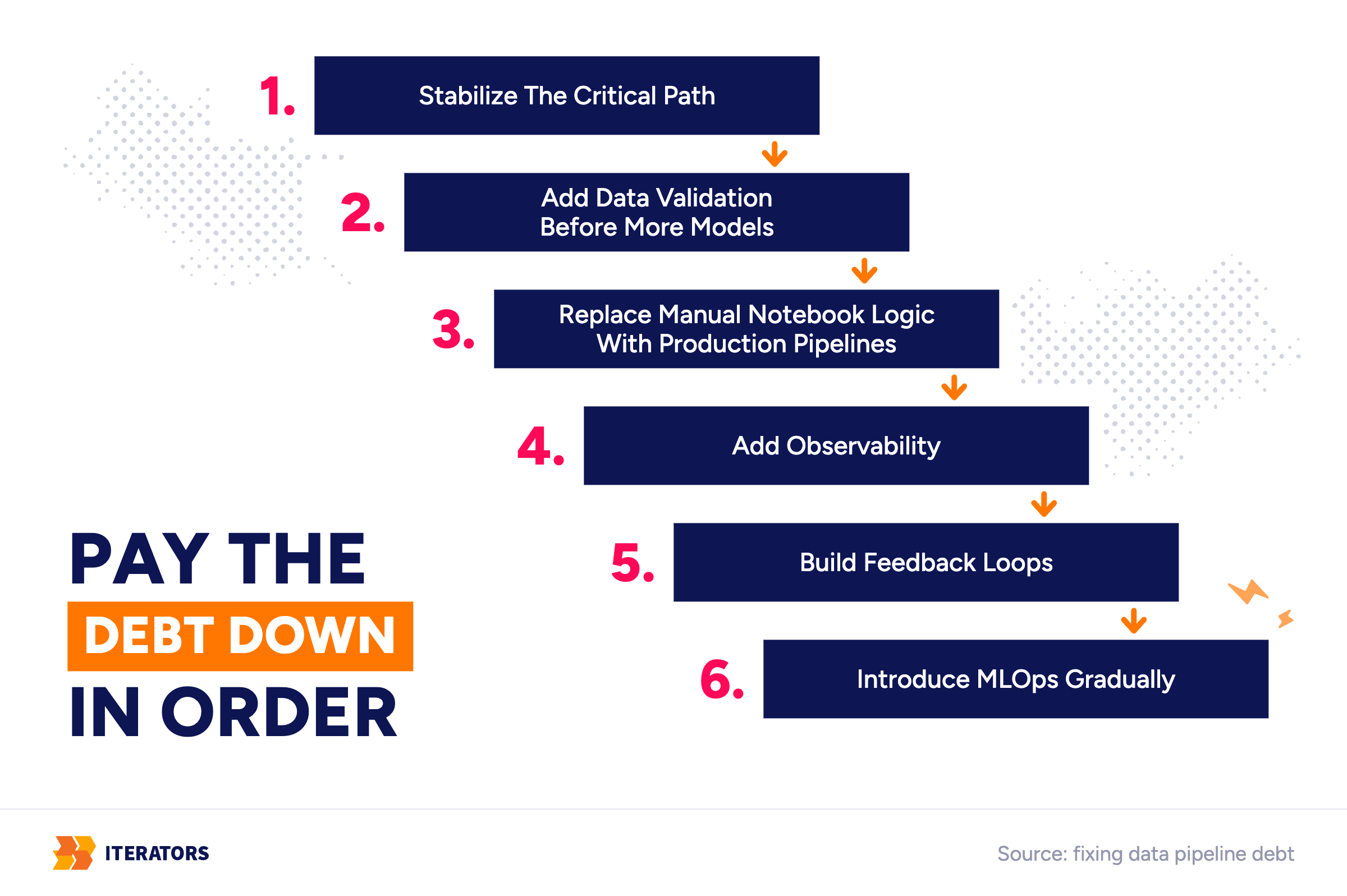
Step 1 — Stabilize the Critical Path
Identify the single pipeline feeding your highest-value model, and protect it. Nothing new ships on top of it until it runs clean, with validated inputs, documented transforms, and a real owner. Every other pipeline keeps running exactly as broken as it already is, because trying to fix everything simultaneously is how teams end up with zero stable systems instead of one.
Step 2 — Add Data Validation Before More Models
Do not build more ML on untrusted data. A validation layer — schema checks, range checks, null-rate thresholds, data contracts — at the entry to the critical pipeline stops bad data at the door instead of discovering it in a prediction three weeks later.
Step 3 — Replace Manual Notebook Logic With Production Pipelines
Any transformation that runs more than once belongs in tested, versioned, scheduled code, not in a notebook or a laptop script. This is the step that converts "it works when Maria runs it" into "it works."
Step 4 — Add Observability
Track job failures, data freshness, missing-value rates, schema changes, latency, throughput, prediction quality, and inference cost. The goal is simple: failures become loud instead of quiet.
Step 5 — Build Feedback Loops
Capture whether predictions were used, whether users accepted recommendations, whether classifications were correct, whether analysts overrode the output, and whether the model actually moved a business metric. Without this, you can't tell improvement from regression, and "data-driven" is just a slogan.
Step 6 — Introduce MLOps Gradually
You don't need every tool on day one. Add a model registry, a feature store, and dataset versioning as the pain justifies them, using whatever fits your stack — MLflow, Airflow, Prefect, Dagster, Feast, Tecton, SageMaker, Databricks. The tools matter less than the practices; for the full picture of how these fit together, see our guide to MLOps implementation, and the cloud reference architectures from Google Cloud and AWS are solid, vendor-specific blueprints.
Build vs. Buy vs. Partner: How to Pay Down Data Pipeline Debt
Once you know the shape of the debt, there's a sourcing decision. The work of paying it down is front-loaded — it needs heavy senior judgment to design the contracts, validation layer, and observability, then comparatively little ongoing attention. That shape should drive the decision.
| Option | Best for | Main risk |
|---|---|---|
| Buy a platform | Standard, well-trodden ML workflows | Vendor lock-in, poor fit for anything non-standard |
| Build internally | Teams with mature, spare data-engineering capacity | Slow, expensive, and a permanent hiring burden for front-loaded work |
| Partner with specialists | Spiky workload, urgent cleanup, productionization | Requires trust and clear ownership hand-off |
The staffing mistake cuts both ways. Hire a large permanent team for this and you own expensive idle capacity six months later. Try to do it with whoever's free internally and they usually take the same shortcuts that created the debt, because nobody gave them time to do it the slow way. The pattern that actually works is a spike: bring architectural judgment in hard for the design-and-implementation push, then drop to a small maintenance footprint once the pipeline is observable and the failures are loud.
Life After Data Pipeline Debt: What a Production-Ready ML Pipeline Looks Like
It helps to know what you're aiming at. A production-ready ML pipeline has documented data sources, automated ingestion, tested transformations, schema validation, data-quality checks, lineage tracking, dataset versioning, reproducible training, a model registry, monitored inference, retraining triggers, human-in-the-loop workflows where the stakes require them, cost monitoring, security controls, compliance documentation, and reporting that ties pipeline health back to a business KPI.
That's a long list, and no team has all of it on day one. The point isn't to build every item before shipping. It's to know which ones you're consciously deferring and why, instead of discovering the gaps during an incident.
The Goal Is Not Perfect Data. The Goal Is Controlled Data.
Perfect data does not exist and chasing it is its own kind of debt. Controlled data does exist: data you can observe, validate, trace, and improve, where the failures are visible and the path to fixing them is known. A system with controlled data can be wrong and recover. A system with uncontrolled data can be wrong and never find out.
How Iterators Helps Fix Data Pipeline Debt
If this sounds familiar, the next step is usually not another model. It's a pipeline audit. Iterators doesn't sell AI demos. We help teams build the infrastructure that makes AI useful after the demo.
Concretely, that means data pipeline audits, ETL flow development, data cleaning and validation systems, MLOps architecture, production ML deployment, model monitoring and retraining pipelines, data warehouse and data lake architecture, scalable backend infrastructure, AI and LLM integration, custom dashboards, and compliance-aware systems built for enterprise. And because the work is spiky, we can extend your team hard for the architecture push and scale back for maintenance, instead of leaving you to hire a permanent team for a front-loaded job.
The proof is in the pattern across very different domains: the MLOps platform implementation at Citrine Informatics that gave data scientists a repeatable path to production; the AI invoice analysis platform at SCHWARTZ.AI that turned a manual workflow into an adopted product; and the LLM-powered document scoring pipeline at Bondspoke where the model was the smallest part of the build. In each one, the thing that unblocked the initiative was the pipeline around the model, not the model.
If your ML initiative is stuck between promising prototype and real business value, the problem may not be your model. It may be your data pipeline debt. Talk to Iterators about auditing your pipeline and turning the prototype into a production system.
Conclusion: Your ML Initiative Is Only as Strong as Its Data Pipeline
ML failure is, far more often than anyone admits in the budget meeting, infrastructure failure wearing a modeling costume. Data pipeline debt hides behind "almost ready" updates precisely because it never throws an error — the job succeeds, the number looks plausible, and the business impact simply never arrives.
The question that separates a stalled ML initiative from a shipped one was never "is the model good enough." It's whether the system underneath it would survive next quarter's schema change without anyone noticing until the dashboard stopped matching reality. Most teams haven't checked, and it's far cheaper to find out now than six months into production. Production ML is a system, not a notebook, and you shouldn't keep funding models if the system feeding them can't support one.
Need to know why your ML initiative hasn't shipped? Iterators can audit your data pipelines, identify the debt, and help turn your AI prototype into a production-ready system. Start here.
FAQ About Data Pipeline Debt

What is data pipeline debt? Data pipeline debt is the accumulated cost of shortcuts in how data is collected, transformed, validated, stored, and monitored. In ML projects it causes unreliable training data, fragile ETL jobs, delayed deployments, and degrading model performance — and unlike a bug, it rarely produces an error, which is why it goes unnoticed for months.
How does data pipeline debt affect machine learning? Machine learning depends on consistent, high-quality data. If the pipeline is unreliable, the model trains on bad data, receives outdated or malformed inputs, produces inconsistent predictions, or fails in production while still reporting success. The model is usually fine; the system feeding it is the problem.
What is ETL technical debt? ETL technical debt is data pipeline debt in the extraction, transformation, and loading layer: one-off scripts, undocumented joins, manual steps, hardcoded rules, missing validation, no retry logic, and no monitoring. It compounds because every new source and model is built on top of it.
Why do ML projects get stuck in prototype mode? Because a prototype works on hand-cleaned data and production data is messy, live, incomplete, and changing. Without reliable pipelines, validation, and MLOps, the demo can't survive contact with real inputs — so the project loops between "almost ready" and "the data isn't ready."
What is the difference between data drift and model drift? Data drift means the input data's distribution changes over time (behavior shifts, new segments, seasonality). Model drift means the model's accuracy declines because the relationship between inputs and outcomes changed — the world moved in a way the model never saw. Data drift is about the inputs; model drift is about the world.
How can companies fix data pipeline debt? Start by auditing data sources and tracing the real data journey, remove manual steps, add validation before building more models, introduce observability so failures are loud, assign ownership, build feedback loops, and adopt MLOps gradually. Stabilize the highest-value pipeline first rather than freezing everything to rebuild at once.
Is MLOps the same as DevOps? No. MLOps borrows heavily from DevOps but adds ML-specific concerns: dataset versioning, model registries, feature stores, data and model drift, retraining pipelines, and prediction monitoring. A mature DevOps practice does not automatically give you production-ready ML.
When should we rebuild a data pipeline instead of patching it? Rebuild when the pipeline is undocumented, untestable, manually operated, business-critical, and actively blocking a major product or ML goal — that combination makes patching more expensive than replacing. Patch when the system is stable enough to improve incrementally without risking the business.