

Enterprise sales for startups is a game with two tracks—and most founding teams only know about one of them.
Your sales team is popping champagne. The demo crushed it. The VP of Engineering at a Fortune 500 company literally said “this is exactly what we need.” Your pricing is competitive. The verbal commitment feels solid. You’re already mentally allocating that $2M ARR toward hiring, scaling infrastructure, maybe finally getting that espresso machine for the office.
Six weeks later, the deal is dead.
Not “delayed.” Not “under review.” Just… gone. Radio silence. Your champion stopped returning emails. And your sales team has no idea what happened.
Here’s what happened: Your product was never the problem. Your enterprise readiness for enterprise sales for startups was.
Free Consultation
Stop Losing $2M Deals to
Checklists You Never Saw
Our team will identify the exact gaps killing your deals in vendor assessment — SOC 2, infrastructure, integrations, support — and deliver a 6-month roadmap to enterprise readiness without derailing your product roadmap.
Get Your Enterprise Readiness Roadmap →The Two Sales Tracks Nobody Tells You About in Enterprise Sales for Startups
Most founders think enterprise sales for startups is a linear journey: Discovery → Demo → Pilot → Contract → Champagne. That’s Track One—the visible track that your sales team obsesses over. It’s full of Zoom calls, Slack messages, and relationship building.
But there’s a Track Two running in parallel, completely invisible to your team until it kills your deal. This is the procurement track: security reviews, vendor assessments, compliance audits, and infrastructure validation. While your sales team is building rapport, a committee of people you’ve never met is systematically dismantling your technical credibility.
Research shows that 73% of enterprise sales for startups fail during vendor assessment—not because of product-market fit issues, but due to preventable due diligence failures. Learn how to prepare in our guide to preparing your product architecture for enterprise vendor assessment success. Your champion loved your demo, but the CISO just discovered you don’t have SOC 2 certification. The legal team found your data processing agreement “unacceptable.” The infrastructure team realized you can’t handle their scale.
And nobody told you any of this was happening.
The Veto Coalition
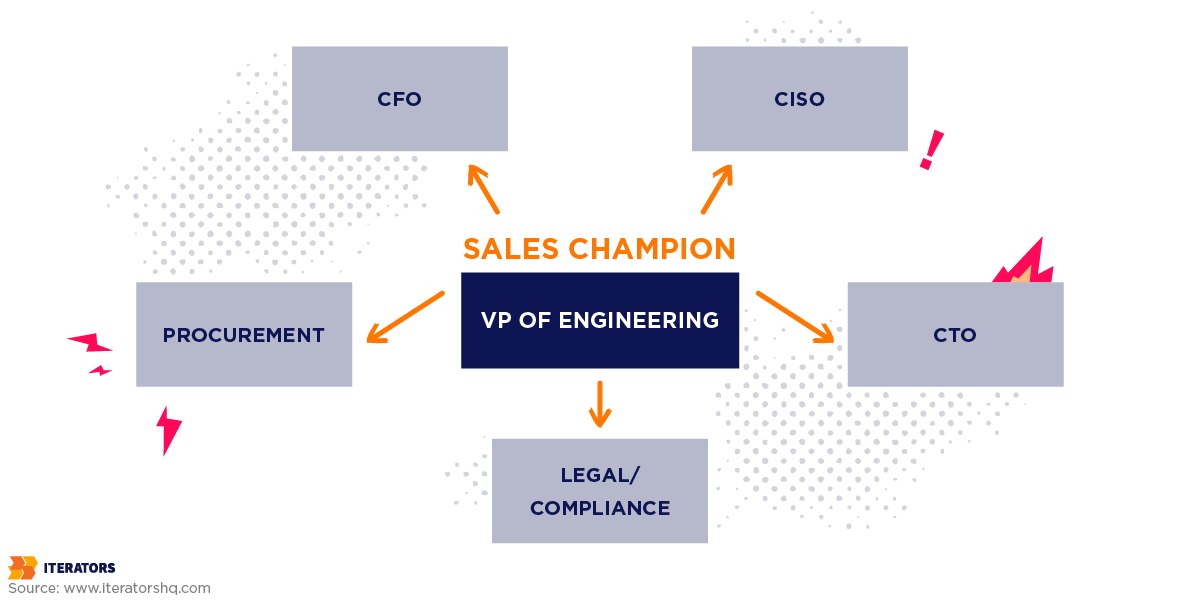
Here’s the brutal math of enterprise sales for startups: According to Gartner research, the average enterprise buying committee now includes 7 core decision-makers, but complex software implementations often involve 25+ stakeholders.Every additional stakeholder increases deal complexity by roughly 25%.
But here’s the kicker: In this coalition, any single person can kill the deal, but no single person can approve it.
Your sales champion—the VP of Engineering who loved your product—doesn’t have unilateral authority. They need sign-off from:
- The CFO (worried about budget and ROI payback periods)
- The CISO (concerned about security vulnerabilities and compliance gaps)
- The CTO (evaluating infrastructure debt and integration complexity)
- Legal/Compliance (scrutinizing liability and data privacy terms)
- Procurement (comparing you against “safer” alternatives)
Each of these people is playing defense, not offense. They don’t get rewarded for choosing innovative solutions—they get punished for visible mistakes. That’s why they favor “boringly safe” options over technically superior ones.
This explains one of the biggest challenges in enterprise sales for startups—why legacy systems like SWIFT or COBOL persist despite being objectively terrible. The professional risk of replacing them is perceived as existential. Your startup might have a better product, but you’re asking these people to bet their careers on you.
Why Enterprise Sales for Startups Catches Engineering Teams Off Guard
Let’s be honest about how most startups approach enterprise sales for startups: they build their MVP fast, scrappy, and with a healthy dose of “we’ll fix that later.”
You’re probably doing what the industry calls “vibe coding”—using AI tools and low-code platforms to rapidly assemble prototypes without deep architectural planning. This is perfect for validating your business hypothesis and getting to market quickly.
But it’s catastrophic for enterprise sales.
Enterprise buyers in enterprise sales for startups aren’t just evaluating your product—they’re evaluating whether you’ll still be around in five years., whether your infrastructure can handle their scale, and whether you’ll become their biggest security liability. When they ask “can you handle our scale?” they’re not asking if you think you can. They want documented evidence of:
- Load testing at 10x to 100x your current peak capacity
- Failover recovery times with actual SLAs
- Multi-tenant data isolation with cryptographic separation
- Disaster recovery procedures with documented RTO/RPO metrics
Your engineering team built a great product. But they built it for 100 users, not 100,000. They optimized for feature velocity, not fault tolerance. They focused on UX polish, not audit trails.
The “Vibe Coding” Problem That Kills Enterprise Sales for Startups
Here’s a scenario that plays out constantly: A startup uses AI-assisted development to ship an MVP in three months. It works beautifully. Customers love it. The product demonstrates clear value.
Then comes the moment that defines enterprise sales for startups—a Fortune 500 prospect asks: “What’s your disaster recovery plan?”
And the founder realizes they don’t have one. Not because they’re negligent, but because disaster recovery wasn’t necessary to validate product-market fit. The engineering team was optimizing for the right thing—speed to market—but that optimization is incompatible with enterprise requirements.
The gap between “startup-grade” and “enterprise-grade” isn’t about code quality. It’s about operational maturity. Enterprise buyers need to know:
- Who gets paged when things break at 3 AM?
- How do you handle data breaches?
- What happens when AWS goes down?
- How do you manage secrets and credentials?
- Where are the audit logs stored and for how long?
If your answer to any of these is “we haven’t thought about that yet,” you’re not ready for enterprise sales for startups.
The Enterprise Readiness Gap Framework for Enterprise Sales for Startups
Let’s break down the four layers that separate startups from enterprise-ready vendors in enterprise sales for startups. Think of these as a maturity model—you need to climb them sequentially, and skipping steps will cost you deals.
Layer 1: Security & Compliance
This is the layer that kills most enterprise sales for startups deals. For a deeper look at what enterprise buyers require, read our complete guide to enterprise readiness. Enterprise buyers need proof that you won’t become their next data breach headline.
Startup-Grade:
- Basic username/password authentication
- Activity logs stored in application database
- “Best effort” security practices
- Generic privacy policy from a template
Enterprise-Grade:
- OIDC/SAML SSO with SCIM user provisioning
- Immutable audit logs with 1-7 year retention
- SOC 2 Type II certification (or equivalent)
- Industry-specific compliance (HIPAA, PCI DSS, GDPR)
- Documented incident response procedures
- Regular penetration testing with public reports
The difference isn’t subtle. When an enterprise sends you a security questionnaire with 300 questions, they’re not making conversation. They’re building a risk profile. If you can’t answer questions about your encryption standards, key rotation policies, or vulnerability management process, you’re done.
Real vendor assessment question that kills deals:
“Describe your cryptographic key management procedures, including key generation, storage, rotation, and destruction protocols. Provide evidence of compliance with NIST SP 800-57 standards.”
If your answer is “we use AWS KMS,” that’s not enough. They want to know your key rotation schedule, who has access to keys, how you handle key compromise, and how you ensure keys are destroyed when no longer needed.
Layer 2: Infrastructure & Scalability
Enterprise buyers in enterprise sales for startups are risk-averse about infrastructure because they’ve been burned before. Understanding how to track and prove your infrastructure reliability is covered in our guide to enterprise readiness monitoring.They’ve seen vendors who looked great in demos but collapsed under production load.
Startup-Grade:
- Single AWS region deployment
- Manual scaling when needed
- 99% uptime (no financial penalties)
- Shared database schema for all customers
Enterprise-Grade:
- Multi-region high availability
- Automated horizontal scaling with documented capacity
- 99.9%+ uptime with financially-backed SLAs
- Sharded databases or dedicated instances per customer
- Documented disaster recovery with tested runbooks
- Load testing at 10x-100x current peak
Here’s what enterprises are actually checking: Can you handle their scale? Our guide to microservices architecture explains how to build infrastructure that can prove it. Not your current scale—their scale. If they have 50,000 employees and you currently serve 500 total users across all customers, they need proof you can handle a 100x increase.
According to IBM’s business continuity research, the average cost of unplanned downtime for large enterprises ranges from $1.25 billion to $2.5 billion per year. For an e-commerce platform processing $50M annually, an outage during peak hours costs $15,000 per hour in lost revenue, plus a $420K impact on customer lifetime value from churn.
They’re not going to risk that on a vendor who can’t prove their infrastructure won’t collapse.
Layer 3: Integration & Customization
One of the hardest parts of enterprise sales for startups is that enterprise organizations are complex beasts with decades of accumulated technical debt.They need you to fit into their existing ecosystem, not the other way around.
Startup-Grade:
- REST API with basic documentation
- Manual user provisioning
- Generic role-based access control
Enterprise-Grade:
- SAML/OIDC SSO with multiple identity providers
- SCIM for automated user lifecycle management
- Hierarchical RBAC mapping to complex org structures (country managers, department leads, read-only auditors)
- Webhooks for real-time event streaming
- On-premise deployment option for regulated industries
- Custom integration support with dedicated engineering
The integration layer is where deals get complicated. Large organizations don’t have a single “IT system”—they have dozens of interconnected systems that evolved over decades. Your product needs to play nice with:
- Their identity provider (often multiple: Okta, Azure AD, Google Workspace)
- Their HR system (Workday, SAP SuccessFactors, BambooHR)
- Their data warehouse (Snowflake, BigQuery, Redshift)
- Their monitoring stack (Datadog, New Relic, Splunk)
If your answer to “can you integrate with our existing systems?” is “we have a REST API,” you’re not ready. Our guide to web authentication and secure access covers what proper SSO and identity management looks like in practice.
Layer 4: Support & Documentation
Enterprises don’t want to figure things out—they want you to have already figured everything out and documented it comprehensively. See how leading SaaS companies approach this in our guide to superhuman client onboarding.
Startup-Grade:
- Email support (24-48 hour response time)
- Basic help docs
- Community Slack channel
- “We’ll figure it out together” mentality
Enterprise-Grade:
- Dedicated support with SLA-backed response times
- 24/7 coverage for critical issues
- Named Customer Success Manager
- Comprehensive technical documentation
- Admin training programs
- Quarterly business reviews with executive stakeholders
- Documented escalation procedures
Here’s a real example: A startup lost a $3M deal because they couldn’t guarantee 4-hour response times for critical issues. The enterprise buyer’s previous vendor had let a critical bug sit for three days, costing them $500K in lost productivity. They weren’t going to risk that again.
The SOC 2 Mandate: Why Compliance Is Now a Revenue Function
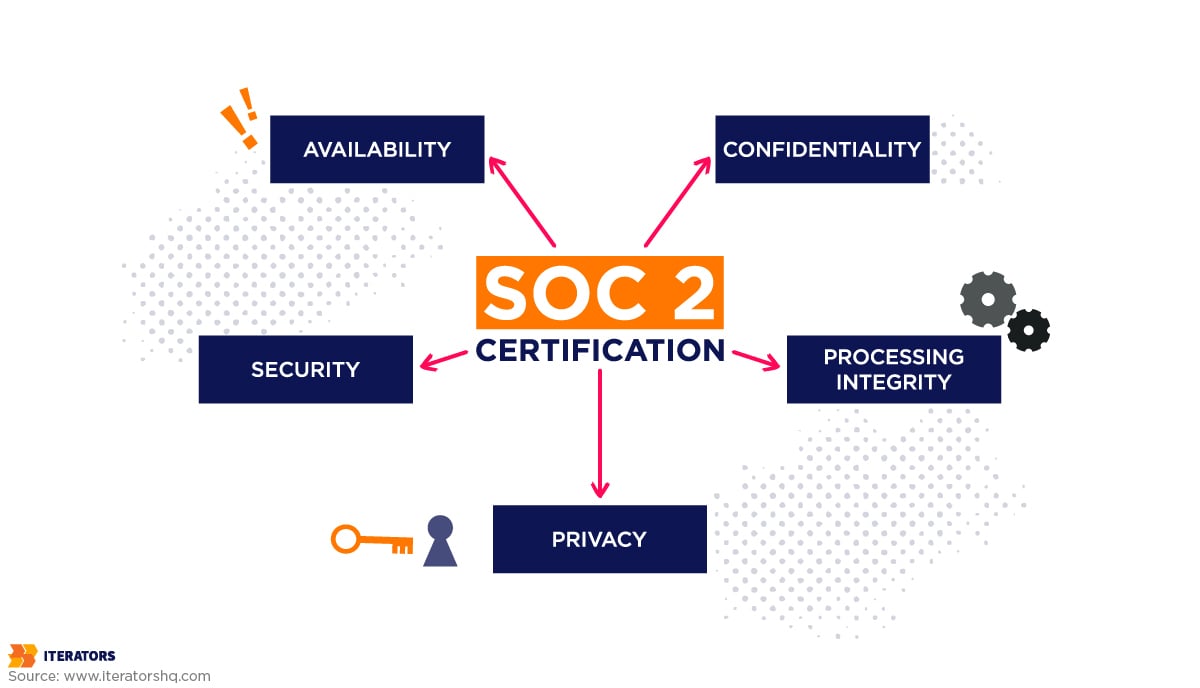
Let’s talk about the certification that kills more deals than any other single factor: SOC 2.
Founders often view SOC 2 as an expensive legal hurdle that compliance nerds care about. That’s wrong. In enterprise sales for startups, SOC 2 is a sales accelerator.
Sales teams report that having a public-facing Trust Center—displaying compliance status and security documentation—can reduce security review duration from three weeks to under five days. Conversely, lacking these credentials leads to “valuation discounts” during fundraising, as investors perceive structural risk in your ability to move upmarket.
The Real Cost of SOC 2
Let’s be honest about the investment required for enterprise sales for startups compliance.For a lean startup (under 50 employees), the total first-year cost typically lands between $80,000 and $350,000 when you account for:
Cost Breakdown:
- Auditor Fees (Type II): $10,000 – $40,000 initial, $10,000 – $25,000 annually
- Readiness Assessment: $5,000 – $15,000 (one-time)
- Internal Labor: 300-600 engineering hours (Year 1), 50-100 hours annually
- Security Tooling: $5,000 – $20,000 initial, $5,000 – $15,000 annually
- Penetration Testing: $5,000 – $15,000 initial, $3,000 – $10,000 annually
That’s not pocket change for a seed-stage startup. But here’s the ROI calculation that matters:
Lost deal scenario:
- $2M ARR enterprise deal dies during security review
- Company valuation multiple: 10x ARR
- Total opportunity cost: $20M in company valuation
Suddenly that $150K investment looks pretty reasonable.
Type I vs. Type II: What Actually Matters
Here’s what most founders don’t understand: SOC 2 Type I is basically useless for enterprise sales. It’s a point-in-time assessment that proves your controls existed on one specific day. Enterprise buyers want Type II, which evaluates whether your controls actually work over a 6-12 month period.
Think of it this way: Type I proves you have a fire extinguisher. Type II proves you know how to use it and that you actually check it monthly.
The Global Compliance Maze
If you’re selling into Europe, add GDPR to your compliance checklist. If you’re in healthcare, add HIPAA. Finance? Add PCI DSS. Government? Add FedRAMP (and good luck—that’s a 12-18 month process).
And now, entering 2026, there’s the EU AI Act. This mandate requires startups to provide technical proof of data provenance and “Explainable AI Operations.” Enterprises will demand cryptographic hashing of training sets and version control for vector databases. For engineering teams, this means “compliance by design” must be integrated into the product roadmap from day one.
Failing to maintain immutable audit trails of AI decision lineage can lead to immediate legal disqualification in highly regulated sectors like healthcare or finance.
The Invisible Procurement Timeline in Enterprise Sales for Startups
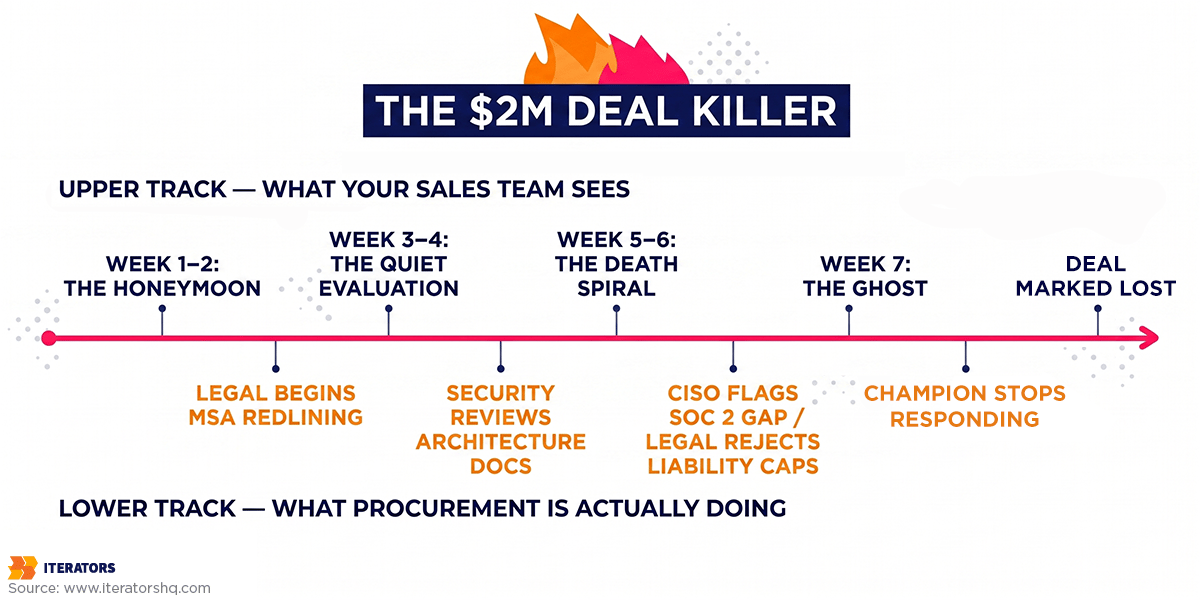
Let’s map out what’s actually happening during your enterprise sales for startups “6-week sales cycle” that ends in radio silence:
Week 1-2: The Honeymoon
- Your sales team is having great conversations
- Product demos are going well
- Champion is enthusiastic and engaged
- Meanwhile: Legal receives your MSA and starts redlining it
Week 3-4: The Quiet Evaluation
- You’re negotiating pricing and contract terms
- Champion is building internal support
- Meanwhile: Security team receives your architecture docs and starts their assessment
Week 5-6: The Death Spiral
- You think you’re in final negotiations
- Champion goes quiet (they’re dealing with internal pushback)
- Meanwhile: CISO flags that you lack SOC 2, Legal rejects your liability caps, Infrastructure team questions your scalability claims
Week 7: The Ghost
- No response to emails
- Champion “stuck in meetings”
- Deal marked “lost” in your CRM
- You never find out what actually happened
The average enterprise sales cycle has grown to 6.5 months (up from 4.9 months in 2019), and win rates hover around 21%. But here’s the thing: most of that time isn’t spent on your product evaluation. It’s spent on internal coordination among the 25+ stakeholders who all need to sign off.
Real-World Battle Scars: What Actually Happens
Let me share some enterprise sales for startups war stories from the trenches:
The $3M Deal That Died Over a Checkbox
A Series B SaaS startup pursuing enterprise sales for startups spent nine months courting a Fortune 500 manufacturer. The product was perfect. The ROI was undeniable. The champion was a VP-level executive with budget authority.
In week 36 of the sales cycle, procurement sent the security questionnaire. Question 47: “Do you have SOC 2 Type II certification?”
Answer: “We’re working on it.”
Deal dead within 72 hours. The manufacturer’s policy was explicit: No SOC 2 = No contract. No exceptions. The VP who championed the deal couldn’t override it even if he wanted to.
Opportunity cost: $3M ARR = $30M in company valuation at a 10x multiple. They got SOC 2 certified six months later and closed a similar deal, but that first loss cost them $30M in valuation they could never recover.
The Integration Hell That Never Ends
A startup pursuing enterprise sales for startups built a beautiful analytics platform. Their demo wowed everyone. They signed a $1.5M contract with a major financial services firm.
Then came implementation. The enterprise required:
- SSO integration with their custom identity provider
- Data export to their specific data warehouse format
- Custom role mappings for their 17-level organizational hierarchy
- Compliance with their internal API standards
None of this was in the original contract. The startup spent 18 months building custom integrations that weren’t on their roadmap. Their engineering team was so consumed with this one customer that they stopped shipping features for everyone else. The customer was unhappy with the slow pace. The startup was bleeding money on services work instead of building product.
Lesson: Enterprise deals aren’t just about closing the contract. They’re about being able to actually deliver what you promised—and what you didn’t realize you promised.
Industry-Specific Landmines
Not all enterprise deals are created equal. Each industry has its own special circle of hell:
Healthcare: Interoperability Nightmare

Healthcare isn’t just about HIPAA compliance (though that’s table stakes). It’s about integrating with Electronic Health Record (EHR) systems that run on protocols from the 1980s.
HL7 (Health Level Seven) is the data exchange standard that “looks like FTP but worse.” If you want to sell into healthcare, you need to either:
- Build native integrations with Epic, Cerner, and Allscripts
- Partner with an integration platform (adding 15-20% to your costs)
- Accept that you’ll lose deals to competitors who already solved this
One healthcare startup spent $400K and 14 months building EHR integrations before closing their first hospital contract. That’s the price of entry.
Fintech: Regulation Is Architecture
In fintech, you can’t bolt on compliance later. PSD2 Strong Customer Authentication, Open Banking consent management, and KYC/AML screening pipelines must be baked into your codebase from day one.
A single “off-by-one” error in your dynamic pricing algorithm can lead to catastrophic overbilling. Real example: A payments startup had a bug that charged customers 100x the intended amount. They caught it within hours, but the damage was done—three enterprise deals died immediately when word got out.
Fintech buyers demand:
- Real-time anomaly detection on transactions
- Financially-backed SLAs (not “best effort”)
- Immutable audit trails of every transaction
- Disaster recovery with sub-15-minute RTO
Biotech: The Productization Gap
Biotech companies have brilliant researchers who can build sophisticated models in Python. What they don’t have is product teams who can turn those models into production-grade SaaS platforms.
The $2M biotech deal goes to the vendor who can:
- Take raw research scripts and productize them
- Build UX that PhD researchers actually want to use
- Handle single-tenant deployments with data anonymization
- Support recorded, auditable remote sessions for production changes
One biotech startup (working with Iterators) built an AI-powered analytics engine that automated bond scoring for sustainable investing. The challenge wasn’t the AI—it was building the secure, scalable infrastructure that pharma companies required to trust it with sensitive data.
The Build vs. Partner Decision in Enterprise Sales for Startups
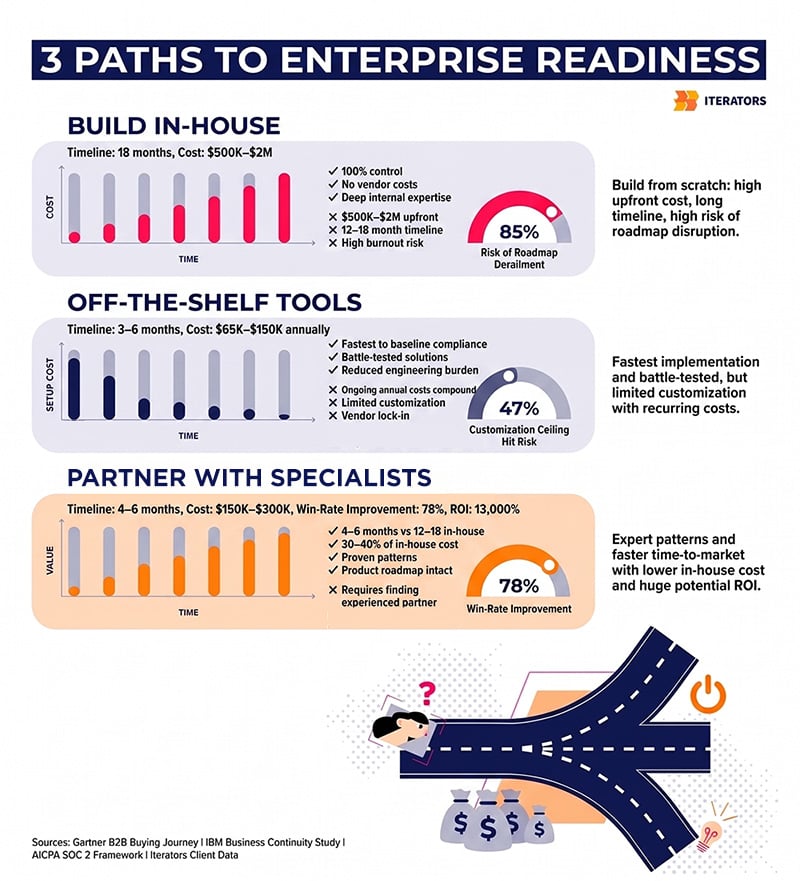
Here’s the uncomfortable truth about enterprise sales for startups: Most startups can’t build enterprise readiness in-house without derailing their product roadmap. Our software development consulting services exist specifically to solve this problem.
You have three options:
Option 1: Build It All In-House
Pros: Complete control, no vendor dependencies Cons: 12-18 months, $500K-$2M investment, requires hiring specialized talent (security engineers, compliance experts, infrastructure architects)
This is the “do it yourself” approach. It works if you have:
- Raised a Series B+ and have the capital
- A technical co-founder who’s done this before
- Time to delay your enterprise sales motion by a year
Most startups don’t have these luxuries.
Option 2: Use Off-the-Shelf Tools
Pros: Faster implementation, proven solutions Cons: Ongoing costs, vendor lock-in, limited customization
You can buy your way to enterprise readiness with tools like:
- Vanta or Drata for SOC 2 automation ($30K-$50K annually)
- Auth0 or Okta for SSO ($20K-$100K annually)
- PagerDuty for incident management ($15K-$50K annually)
This works for getting to “good enough” quickly. But you’re trading capital for time, and you’re still responsible for integrating everything and maintaining it.
Option 3: Partner with Specialists
Pros: Fastest path to enterprise-grade, access to deep expertise, flexible engagement Cons: Requires finding the right partner, some loss of control
This is where a development partner like Iterators comes in. We’ve built enterprise-grade infrastructure for companies like Imperative (serving Fortune 500 HR departments), Citrine Informatics (materials science), and Rödl & Partner (5,500 employees across 50 countries).
We don’t just build features—we build the enterprise readiness layer that lets you close those $2M deals:
- SOC 2 compliance infrastructure
- Multi-tenant architecture with proper data isolation
- SSO/SAML integration
- Audit logging and monitoring
- Disaster recovery and high availability
- On-premise deployment capabilities
The key difference: We’ve done this dozens of times. We know which corners can be cut and which can’t. We know what “good enough for procurement” looks like vs. “gold-plated over-engineering.”
The Enterprise Sales for Startups Self-Assessment: Are You Actually Ready?
Let’s do quick enterprise sales for startup diagnostic. Answer these questions honestly:
Security & Compliance:
- Do you have SOC 2 Type II certification (or equivalent)?
- Can you provide evidence of encryption at rest and in transit?
- Do you have documented incident response procedures?
- Can you produce immutable audit logs for the past year?
Infrastructure & Scale:
- Have you load-tested at 10x your current peak capacity?
- Do you have automated failover with documented recovery times?
- Can you deploy in multiple regions with data residency controls?
- Do you have financially-backed uptime SLAs?
Integration & Customization:
- Do you support SAML/OIDC SSO with major identity providers?
- Can you provision users automatically via SCIM?
- Do you support hierarchical RBAC for complex org structures?
- Can you deploy on-premise or in customer-controlled environments?
Support & Documentation:
- Do you offer 24/7 support with SLA-backed response times?
- Do you have comprehensive technical documentation?
- Can you provide dedicated Customer Success resources?
- Do you have documented escalation procedures?
If you answered “no” to more than 3 questions in any category, you’re not ready for enterprise sales. You might close some deals, but you’ll lose more than you win, and the losses will be painful.
Enterprise Sales for Startups: Prioritization Framework for What to Fix First
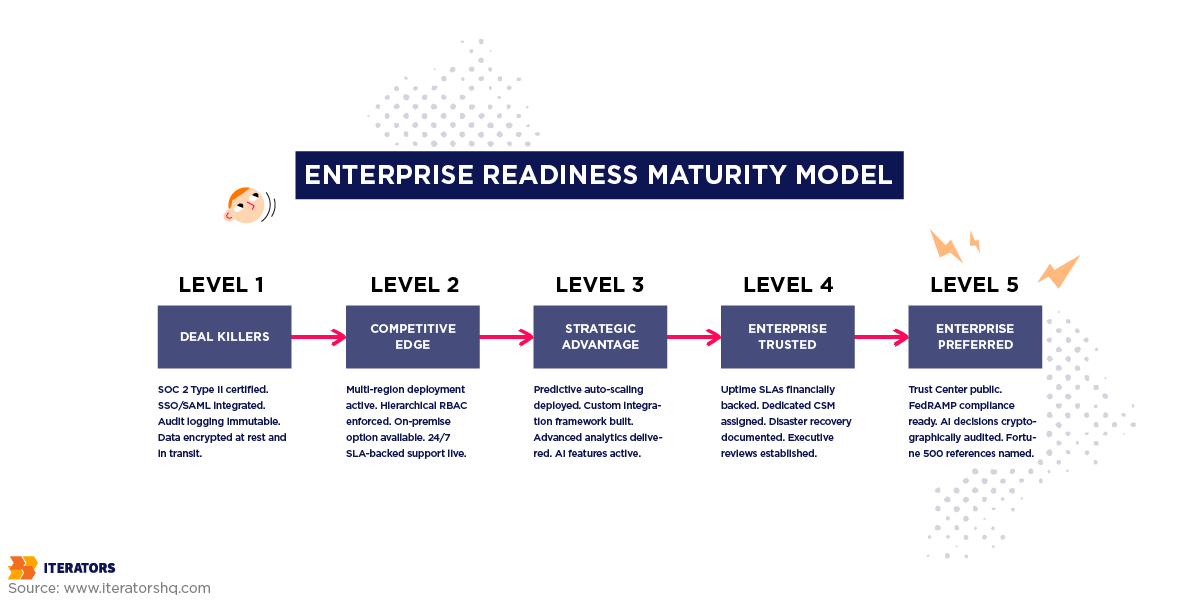
You can’t fix everything at once. Here’s how to prioritize your enterprise sales for startups readiness investments:
Tier 1: Deal Killers (Fix These First)
- SOC 2 Type II certification – This kills more deals than anything else
- SSO/SAML integration – Enterprises won’t manually provision hundreds of users
- Audit logging – Required for compliance and security reviews
- Data encryption – Table stakes for any B2B SaaS
Investment: $100K-$200K Timeline: 4-6 months ROI: Unlocks 80% of enterprise deals
Tier 2: Competitive Differentiators
- Multi-region deployment – Enables global customers
- Advanced RBAC – Supports complex organizational structures
- On-premise option – Required for highly regulated industries
- 24/7 support – Expected by large enterprises
Investment: $150K-$300K Timeline: 6-9 months ROI: Increases win rates by 30-40%
Tier 3: Strategic Advantages
- Predictive scaling – Demonstrates technical sophistication
- Custom integrations – Reduces implementation friction
- Advanced analytics – Provides business intelligence value
- AI-powered features – Future-proofs your platform
Investment: $200K-$500K+ Timeline: 9-18 months ROI: Enables premium pricing and strategic partnerships
The Iterators Approach: Enterprise Readiness Without the Detour
Here’s what we’ve learned from a decade of building enterprise-grade software:
You don’t need to boil the ocean. You need to get to “good enough for procurement” as quickly as possible, then iterate based on real customer feedback.
You don’t need a 12-month infrastructure rewrite. You need strategic investments in the 20% of features that matter for 80% of enterprise deals.
You don’t need to hire a full compliance team. You need partners who’ve already solved these problems and can implement proven solutions quickly.
Our typical engagement looks like this:
Month 1-2: Assessment & Quick Wins
- Comprehensive security and compliance audit
- Identify the 3-5 gaps killing your current deals
- Implement immediate fixes (encryption, basic audit logging, SSO foundation)
Month 3-4: Core Infrastructure
- SOC 2 readiness implementation
- Multi-tenant architecture (if needed)
- Automated deployment and monitoring
- Documentation and runbooks
Month 5-6: Enterprise Features
- Advanced RBAC and user management
- Integration framework (webhooks, APIs, SCIM)
- Support infrastructure and escalation procedures
- Customer-facing Trust Center
Result: You’re enterprise-ready in 6 months instead of 18, at 30-40% of the cost of building in-house, without derailing your product roadmap.
The Real Cost of Waiting on Enterprise Sales for Startups Readiness

Let’s do the math on what “we’ll get to it later” actually costs your enterprise sales for startups motion:
Scenario 1: You Wait
- Lose 3-4 enterprise deals per year ($6M-$8M ARR)
- Company valuation impact at 10x multiple: $60M-$80M
- Competitive disadvantage as rivals become enterprise-ready
- Difficulty raising next funding round due to slow growth
Scenario 2: You Invest Now
- Investment: $150K-$300K
- Timeline: 6 months
- Result: Close 2-3 additional enterprise deals per year
- Valuation impact: +$40M-$60M
- Net ROI: 13,000% – 20,000%
The opportunity cost of not being enterprise-ready dwarfs the investment required to get there.
Conclusion: Making Enterprise Sales for Startups Work in Your Favor
The $2M enterprise sales for startups deal you lost didn’t die because of your product. It died because you were playing a game you didn’t know existed.
While your sales team was building relationships and demonstrating value, a parallel evaluation was happening in the shadows. Security teams were assessing your risk profile. Legal teams were scrutinizing your contracts. Infrastructure teams were stress-testing your architecture claims.
And when you failed to meet their requirements—requirements you never knew about—the deal died quietly. Your champion couldn’t save you because they didn’t have the authority. The decision was made by people you never spoke to, based on criteria you never addressed.
The good news about enterprise sales for startups? This is completely fixable. Enterprise readiness isn’t magic—it’s a checklist. SOC 2 certification, proper infrastructure, integration capabilities, and support systems. These are known problems with known solutions.
The question isn’t whether you can become enterprise-ready. The question is whether you can afford to wait.
Because right now, while you’re reading this, there’s another $2M deal in your pipeline. The demo is scheduled. The champion is excited. The verbal commitment feels solid.
And six weeks from now, you’ll be wondering what went wrong.
Unless you do something about it today.
Ready to stop losing enterprise deals? At Iterators, we’ve spent a decade building enterprise-grade infrastructure for startups moving upmarket. We’ve helped companies like Imperative, Citrine Informatics, and Rödl & Partner become enterprise-ready without derailing their product roadmaps.
Schedule a free consultation to discuss your enterprise readiness gaps and get a custom roadmap for closing those $2M deals.
Because the next deal you lose shouldn’t be because of a checkbox you didn’t know existed.
FAQ
What is enterprise readiness and why does it matter for enterprise sales for startups?
Enterprise readiness is the set of security, compliance, infrastructure, and operational capabilities that large organizations require before they’ll buy your software. It includes SOC 2 certification, SSO integration, audit logging, scalability guarantees, and comprehensive support. Think of it as the “table stakes” for selling to Fortune 500 companies—without it, you won’t even make it past vendor assessment.
How much does SOC 2 compliance cost for a startup?
For a startup with under 50 employees, expect to invest $80K-$350K in the first year, including auditor fees ($10K-$40K), security tooling ($5K-$20K), internal labor (300-600 engineering hours), and penetration testing ($5K-$15K). Annual maintenance costs typically run $25K-$50K. While this seems expensive, the ROI is massive—a single lost $2M enterprise deal costs you $20M in company valuation at a 10x multiple.
What’s the typical enterprise sales cycle timeline?
The average enterprise sales cycle has grown to 6.5 months (up from 4.9 months in 2019), but complex deals often take 12-18 months. This includes discovery (1-2 months), product evaluation (2-3 months), vendor assessment and security review (2-4 months), legal and procurement (2-3 months), and implementation planning (1-2 months). The hidden killer is the vendor assessment phase, which happens in parallel with your sales process and often kills deals without warning.
Can you sell to enterprises without SOC 2 certification?
Technically yes, but practically no. While some enterprises will consider vendors without SOC 2, you’ll face significantly longer sales cycles, more intensive security reviews, and often lose to competitors who are certified. Many Fortune 500 companies have explicit policies requiring SOC 2 Type II—no exceptions. If you’re serious about enterprise sales, SOC 2 should be your top priority investment.
What security questions do enterprise vendor assessments ask?
Enterprise security questionnaires typically include 150-500 questions covering: encryption standards and key management, access controls and authentication methods, incident response procedures, data backup and disaster recovery, vulnerability management and penetration testing, employee security training, third-party vendor management, and compliance certifications. The most common deal-killers are questions about SOC 2 certification, data encryption at rest and in transit, audit log retention, and disaster recovery procedures.
How do you know if your startup is ready for enterprise customers?
Run this quick test: Can you answer “yes” to these questions without hesitation? (1) Do you have SOC 2 Type II certification? (2) Can you deploy in multiple regions with data residency controls? (3) Do you support SSO/SAML with major identity providers? (4) Can you provide immutable audit logs for the past year? (5) Have you load-tested at 10x your current peak capacity? If you answered “no” to more than one, you’re not ready for enterprise sales.
What’s the difference between SOC 2 Type I and Type II?
SOC 2 Type I is a point-in-time assessment that proves your security controls existed on a specific date. Type II evaluates whether those controls actually work over a 6-12 month period. Enterprise buyers almost always require Type II because it demonstrates operational effectiveness, not just good intentions. Think of it this way: Type I proves you have a fire extinguisher, Type II proves you know how to use it and that you check it monthly.
Do you need enterprise features before you have enterprise customers?
Yes and no. You need the foundational capabilities (SOC 2, basic SSO, audit logging, encryption) before you start enterprise sales, or you’ll lose deals during vendor assessment. But you don’t need advanced features (complex RBAC, on-premise deployment, custom integrations) until you have your first few enterprise customers who can guide your roadmap. The key is getting to “good enough for procurement” quickly, then iterating based on real customer feedback.
How long does it take to become enterprise-ready?
With focused effort and the right partners, you can become enterprise-ready in 4-6 months. This includes SOC 2 Type II certification (which requires a 6-month audit period), basic infrastructure improvements (multi-tenant architecture, monitoring, disaster recovery), integration capabilities (SSO, SCIM, webhooks), and support systems. Doing it in-house typically takes 12-18 months because you’re learning as you go. Working with specialists who’ve done it before can cut that timeline in half.
What’s the ROI of investing in enterprise readiness?
The ROI is massive. Typical scenario: Invest $150K-$300K to become enterprise-ready. Result: Close 2-3 additional enterprise deals per year at $2M ARR each. Valuation impact at 10x multiple: $40M-$60M increase. That’s a 13,000%-20,000% ROI. The opportunity cost of not investing is even higher—losing 3-4 enterprise deals per year costs you $60M-$80M in company valuation. Enterprise readiness isn’t an expense, it’s one of the highest-ROI investments you can make.