

There are three kinds of logs in a fintech stack, and only one of them, the fintech audit trail, was built to survive being subpoenaed.
Application logs tell you why a service crashed at 3 a.m. System logs tell you a container restarted. Neither one was designed to answer the question a regulator, an auditor, or a partner bank actually asks: who did this, when, and under what authority? That question has a specific name, a fintech audit trail, and most teams don’t realize they don’t have one until the moment they’re asked to produce it. Founders confuse “we have logs” with “we have auditability,” and the two are not the same system.
I’ve spent the last decade building software that moves money: a real-time crypto-fiat exchange, an enterprise time-tracking platform that survived a SOC 2 audit, an AI pipeline that scores bond prospectuses for sustainability compliance. In every one of those projects, the audit trail question showed up late, expensive, and disguised as something smaller. “Can you just add a log for that?” is the sentence that precedes six months of rework.
This isn’t a legal opinion. I’m not a compliance lawyer, and nothing here should be read as regulatory advice for your specific product, jurisdiction, or license. What follows is an engineering argument: a fintech audit trail is not a table, a dashboard, or a checkbox you tick before a security review. It’s a decision about your data model, made early, that determines whether your system can prove what happened, or just claims it probably knows. Regulators, banks, enterprise buyers, and investors will not accept “we can probably reconstruct it from the database.”
Building payments, lending, trading, or crypto infrastructure? If you need audit-ready fintech software before your next vendor assessment or compliance review, Iterators can help you design the audit trail into the architecture instead of bolting it on later. Talk to Iterators.
What a Fintech Audit Trail Actually Is
A fintech audit trail is a complete, chronological, tamper-resistant record of the events inside a financial system: user actions, administrative decisions, transaction state changes, permission changes, and the responses your system got back from every third party it talked to. It lets a company, auditor, regulator, or enterprise customer reconstruct exactly what happened, when, and why: not a summary, but the events themselves, in order, with enough context that someone who wasn’t there can follow the whole chain.
Take something mundane: a customer changes their linked bank account details. A system that “has logs” might record bank_account_updated. A system with an actual financial audit trail records who initiated the change, what the previous value was (or a secure reference to it), whether it required approval, the timestamp in UTC, the session and device it came from, whether multi-factor authentication was used, which internal service processed the request, and whether it triggered a hold on pending transfers.
That’s not paranoia. That’s the minimum someone needs to answer the question a fraud investigator, a compliance officer, or a regulator will eventually ask: was this the account holder, or an account takeover your system didn’t notice?
Why a Fintech Audit Trail Is Not Just Application Logging

The confusion starts because audit trails and application logs often live in the same pipe: the same message queue, sometimes even the same log aggregator. That proximity makes it easy to assume they’re the same thing wearing different labels. They’re not.
Application Logs Are Written for Developers
Application logs help engineers debug: an API timeout, a failed database query, a service restart, a stack trace, a latency spike. They’re ephemeral by design, most teams rotate them out in 7 to 30 days because nobody needs a stack trace from three months ago.
A Fintech Audit Trail Is Written to Prove What Happened
A fintech audit trail helps you prove what happened. It’s written for a compliance officer, an external auditor, a regulator, or your own legal counsel reconstructing a decision months or years later. It needs business context, actor identity, the event sequence, the before-and-after data state, integrity protection, retention, access controls, and the ability to be reported on. It has to survive being queried by someone who has never seen your codebase.
| Logging Type | Primary User | Purpose | Example Entry | Typical Retention |
|---|---|---|---|---|
| Application logs | Engineers | Debugging | “API returned 500” | 7–30 days |
| System logs | DevOps / SecOps | Infrastructure monitoring | “Server restarted” | 30–90 days |
| Transaction logs | Finance / engineering | Track money movement | “Payment moved from pending to settled” | Life of the account |
| Audit trail | Compliance / regulators / auditors | Prove what happened | “Compliance admin approved withdrawal after sanctions review passed” | 3–7+ years, statutory |
A log entry that reads status changed from 2 to 3 is technically true and practically useless. A fintech audit trail entry that reads withdrawal_request_88213 approved by compliance_admin_17 after sanctions screening passed, risk score reduced from 88 to 12 tells you the same underlying fact with the business meaning attached. One of those survives an audit. The other gets you a follow-up question you can’t answer.
What Regulators Actually Look For in a Fintech Audit Trail

I want to be precise here, because “regulators require X” gets abused constantly in fintech marketing. Requirements vary by product, jurisdiction, and license type: a payments app, a lending platform, a crypto exchange, and a financial analytics tool face different obligations. Iterators is not a law firm; this section explains engineering implications, not legal interpretation, so talk to compliance counsel for your specifics. What I can point to are patterns that show up consistently across SEC, FINRA, CFTC, and NIST guidance, and across every vendor security review I’ve sat through.
Completeness: Can You Reconstruct the Whole Story?
FINRA Rule 4511 sets a default six-year retention window for books and records where no more specific rule applies. CFTC Regulation 1.31 requires many covered records to be kept for five years, readily accessible during the first two. Both assume you can produce the whole record, not “we know the user clicked something, and we think the system did something after that.” A partial chain isn’t evidence. It’s a gap with a timestamp attached.
Integrity: Can Anyone Change the Record?
This is where NIST SP 800-92 on log management and the OWASP Logging Cheat Sheet converge: if the person who can perform an action can also edit the log of that action, the log has no evidentiary value. That’s the argument for append-only or write-once storage, cryptographic hashes or log signing, restricted admin access, and keeping audit records separate from the application database. An audit trail an admin can quietly modify isn’t an audit trail. It’s a diary the admin is allowed to rewrite.
Retention and Retrievability: Can You Produce It Later?
SEC’s modernized recordkeeping framework, the update to Rule 17a-4 that moved away from requiring physical WORM (write-once-read-many) media, now permits an audit-trail alternative: an automated system that logs every modification, deletion, and creation, with timestamps and actor identity, as long as it preserves that history in a way that can’t be quietly altered. That’s a direct statement that regulators care about the property (tamper-evidence, retrievability) more than the storage medium. Delivering it means thinking about retention policies, retrieval windows, cold storage, legal holds, and disaster recovery for the logs themselves. Different rules apply to different business models, so the retention number is not one-size-fits-all.
Access Control: Who Can See or Export the Logs?
Regulator-ready audit logs are sensitive data in their own right. They contain user identifiers, transaction metadata, IP addresses, internal risk scores, compliance decisions, admin actions, and security events. Who gets to view, export, or query them is itself something that should be logged.
SEC Chair Gary Gensler put the underlying logic plainly in the agency’s 2022 recordkeeping enforcement action, which resulted in over $1.8 billion in combined penalties against financial firms for failing to preserve business records:
“Finance, ultimately, depends on trust. By failing to honor their recordkeeping and books-and-records obligations, the market participants we have charged today failed to maintain that trust.” Gary Gensler, SEC Chair
That’s not abstract. Recordkeeping failures were the entire violation in that action, not a side issue attached to some other fraud. The records were the product being examined.
Financial Logging Requirements Start With the Data Model, Not a Dashboard

Here’s the part most fintech audit trail write-ups skip, because it’s the part that’s actually expensive to fix: financial logging requirements are a property of your data model, not a screen you add later.
If your system updates a row (account_status = approved) and moves on, the previous state is gone unless you deliberately kept it. You can’t retroactively add an audit trail to a system that overwrites its own history. You can only add a new system going forward and accept that everything before that point is a hole in your record. It shows up in four places especially, and each one is a wall teams hit at a predictable moment.
Your Data Model Has to Preserve History
Storing account_status = approved is a snapshot. Storing the approval as an event (actor, previous state, new state, timestamp, decision source, reason code, and a reference to the approval workflow) is a record. The difference only becomes visible when someone asks “what was the state on March 14th, and who changed it?” and the answer is either “here’s the event” or “we don’t know, we overwrote it.”
Your Permission System Has to Be Auditable
The permission system has to record changes as well as enforce access. Role changes, privilege escalation, service-account activity, internal staff access, support staff impersonating a customer to debug an issue. These show up in every fraud investigation and every insider-threat review. If your role-based access control (RBAC) enforces permissions but doesn’t log permission changes, you’ve built half of what you need.
Your APIs Need Traceable Events
The moment you have more than one service (and in fintech you almost always do, because you’re integrating a banking-as-a-service provider, a KYC vendor, an AML screening tool, maybe a card processor) a single user action fans out into multiple internal and external calls. Without a correlation ID that follows the request through every hop, alongside request IDs, idempotency keys, and webhook records, reconstructing “what actually happened” means manually stitching together five systems’ worth of partial logs. That’s not a reconstruction. That’s archaeology.
Your Infrastructure Needs Secure Log Retention
AWS CloudTrail, Google Cloud Audit Logs, and Azure Activity Logs exist because the platforms recognize that infrastructure-level actions need the same evidentiary treatment as application-level ones. Centralizing that into an encrypted, access-restricted system separate from your operational database, not co-located with it, is the part teams skip under deadline pressure, and the part that matters most if someone with elevated access to your production database is the person you’re investigating.
Privacy note: Avoid storing raw sensitive data in audit logs unless you truly need it. Audit trails and privacy obligations pull in different directions: you need completeness, but you also want to minimize how much raw personal data you persist in a store you’ve deliberately made hard to delete from. The practical answer is tokenization: store a reference to the sensitive field, not the field itself, and govern the token vault separately. That adds a layer. It’s still cheaper than an immutable log full of raw account numbers that your privacy counsel finds during a data-mapping exercise.
Compliance by Design: How to Build Regulatory Compliance Software That Doesn’t Need Rewriting
Compliance by design means auditability, security, privacy, retention, and data governance are decisions made in the architecture from the start, not patches applied before a security review. The reason it matters isn’t philosophical. It’s that the cost of adding a proper fintech audit trail rises sharply, and predictably, the later you do it.
Compliance by Design Reduces Rewrite Risk
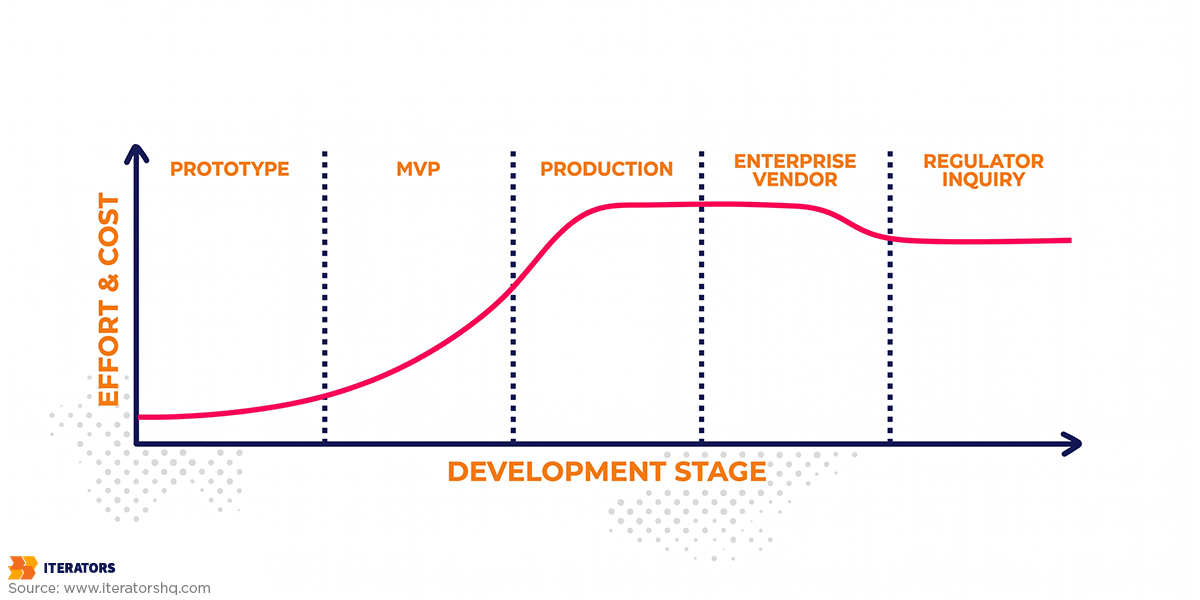
At the prototype stage, retrofitting this is a data model change, annoying but contained. At MVP, it means going back through every service that touches money or identity and adding event emission where none existed. At production scale, with real customer funds moving, it means a zero-downtime migration plus backfilling historical records you may not be able to fully reconstruct, touching database tables, APIs, permissions, workflows, deployment pipelines, and admin interfaces all at once.
I’ve watched this play out with a client whose exchange platform needed to move from staging into a regulated environment with KNF-adjacent oversight and AML/KYC obligations built into the transaction flow. The parts designed with auditability from the start (wallet movements, KYC decisions, staking events) moved into compliance review without drama. The parts bolted on late needed rework before the review could even start, because you can’t produce six months of history for a table that started keeping history four months ago.
Compliance by Design Helps You Pass Enterprise Vendor Assessments
At the enterprise vendor assessment stage, when a bank partner or an enterprise customer’s security team runs through a questionnaire, the absence of a proper audit trail isn’t a finding you fix during the review. It’s a reason the deal stalls for a quarter. Enterprise buyers ask for SOC 2, access logs, audit logs, security controls, incident response, encryption, backup policies, role-based access control, data retention, and admin action history. If those are architectural facts rather than promises, the questionnaire is a formality. If they’re not, it’s a blocker. This is why we treat auditability as part of enterprise readiness rather than a compliance afterthought, and why monitoring and observability belong in the same conversation.
Compliance by Design Makes Fundraising and Due Diligence Easier
Investors and acquirers doing technical due diligence care about operational risk, compliance debt, architecture quality, security posture, and regulatory exposure. A clean, queryable audit trail is one of the fastest ways to signal that a team understands its domain. The pattern is consistent enough that I’d call it a hard floor: below a certain point in your build timeline, adding audit trail architecture is a design decision. Above it, it’s a migration project with a compliance deadline attached, and those two things cost very differently.
“In fintech, regulation isn’t a feature: it’s architecture. If your audit trail is an afterthought, your compliance debt is already compounding.”
The Events Every Fintech Audit Trail Should Capture
A useful audit trail is not “log everything”: that’s how you end up with an expensive, un-queryable haystack. It’s “log the events a compliance officer, a fraud investigator, or a regulator would ask about.” In a typical fintech product, those cluster into a handful of categories.
User and access events: authentication, MFA setup and changes, password resets, account creation, admin logins, role and permission changes, API key creation and rotation, and support impersonation.
Identity and compliance events: KYC/KYB submissions, KYC/KYB decisions, AML screening results, and sanctions screening.
Money movement events: payment initiation, authorization, settlement, failed payment attempts, refunds, reversals, chargebacks, ledger entries, wallet transfers, and balance changes.
Risk, pricing, and control events: risk score changes, fraud alerts, manual overrides, pricing or fee changes, and withdrawal limit changes.
System, data, and integration events: configuration changes, data exports, webhook delivery and retries, third-party provider responses, and customer communication events.
And across every category, one rule holds: capture the failures, not just the successes. A failed login, a rejected withdrawal, a declined KYC submission, a blocked admin access attempt. These are disproportionately where investigations start.
Capture the Actor, Action, Target, Time, and Context
The Event Anatomy X-Ray
Interactive Breakdown
One log line looks like proof something happened. Toggle it to see what a real fintech audit trail has to capture for that same event.
That’s the entire record of what happened to withdrawal #88213.
This is what most systems record: a status flip and a row ID. If a regulator asks who approved this, why, and under what authority — there’s no answer here.
Talk to Iterators →The way to keep this manageable is to give every audit event the same shape, no matter which service emits it. A well-formed event answers nine questions:
An Audit Event consists of:
- Actor: Who did it? (e.g., user, admin, service)
- Action: What did they do? (e.g., approved withdrawal)
- Target: What object was affected? (e.g., withdrawal_id)
- Previous state: What was it before? (e.g., pending)
- New state: What is it now? (e.g., approved)
- Timestamp: When did it happen? (Recorded in UTC)
- Source: Where did the request originate? (e.g., API, admin panel)
- Context: Environmental metadata. (e.g., IP address, device, session, reason code)
- Result: The final outcome. (Success or failure)
- Correlation ID: The trace identifier used to track the event across services.
If every event in your system can answer those questions, you have a fintech audit trail. If some can only answer three of them, you have a log that will let you down at the exact moment you need it.
Common Fintech Audit Trail Mistakes That Create Compliance Debt

These aren’t hypothetical. Each is a wall I’ve watched a team hit, and each is diagnosable from the outside: you can usually tell within an hour of looking at a schema whether a team is going to have this problem.
Mistake 1: Treating the Audit Trail as an Admin Table
A database table called audit_logs that a developer added because a stakeholder asked for “some kind of history” isn’t an architecture. It’s a symptom that nobody defined what events matter, what fields are required, or who’s allowed to write to it.
Mistake 2: Logging Only the Successes
Failed logins, failed withdrawals, failed KYC submissions, blocked admin access, rejected API calls, failed webhooks. These are disproportionately where fraud investigations and security incidents live. A system that only records what worked has thrown away the half a forensic reviewer wants first.
Mistake 3: Letting Admins Edit or Delete Logs
Letting the same role that performs an action also edit or delete the log of it is the integrity failure NIST and OWASP both flag. If an admin can approve a withdrawal and later edit the record of having approved it, you don’t have an audit trail. You have theater with a database behind it.
Mistake 4: Forgetting the Third Parties
Fintech products are integration-heavy by nature: banking-as-a-service providers, payment processors, KYC/AML vendors, crypto custody providers, notification systems. Every one produces callbacks, webhooks, and API responses carrying business-critical information. If your audit trail stops at your own service boundary, you have a record with a hole exactly where the interesting part of most disputes happens.
Mistake 5: Recording the State Change Without the Reason
status changed from 2 to 3 tells a future reader nothing. withdrawal approved by compliance_admin_17 after sanctions review cleared tells them everything. The difference is one field (a reason code, a policy reference, a decision source), and it’s the field that turns a log into evidence.
Mistake 6: Designing for MVP Speed Only
An MVP can and should be lean. It should not be architecturally blind to the fact that certain workflows (money movement, identity verification, regulatory decisions) will need to scale into auditability later without a rewrite. This is a specific instance of technical debt that nobody notices until the invoice arrives disguised as a compliance deadline.
Fintech Audit Trail Architecture: A Practical Blueprint
The audit trail architecture that holds up under audit has five layers, and the important thing about this list is that it’s ordered: each layer depends on the one before it existing correctly.
The Audit Log Pipeline
Reference Architecture
A fintech audit trail isn’t one log line — it’s a pipeline. Here’s what has to happen between “something happened” and “a regulator can verify it.”
01
Application Services
Business events emitted at meaningful moments
02
Event Normalization
Consistent schema; sensitive fields tokenized
03
Immutable Audit Store
Append-only, encrypted, write-restricted
04
Search & Retrieval
Queryable, indexed, read-only for investigators
05
Access, Monitoring & Reporting
Access to logs is itself logged; anomalies alert; reports export for auditors and vendor reviews
Runs across every stage
- Encryption
- Access control
- Retention policy
- Monitoring
- Alerting
Event generation. Services emit structured audit events at meaningful business moments (approvals, status changes, payment state transitions, permission grants), not at every database write.
Event normalization. Events pass through a layer that enforces one consistent schema regardless of which service produced them, and tokenizes sensitive fields before anything touches immutable storage.
Immutable storage. Events land in append-only, write-restricted storage, separate from your operational database. If your audit store and your production database are the same system with the same admin credentials, you haven’t achieved separation of duties. You’ve achieved the appearance of it.
Search and retrieval. Auditors and investigators need to query this data without being able to alter it. Indexing for search is a different concern from write-protection; conflate them and you get logs that are either safe or usable, but not both.
Access, monitoring, and reporting. Access to the audit trail itself is logged. Unusual query patterns (an admin exporting six months of records at 2 a.m.) trigger alerts. Reports export in a form you can hand to an auditor or a vendor assessment team.
A few choices inside that blueprint are worth naming directly.
Use Event-Driven Design Where It Makes Sense
Event sourcing, storing events as the source of truth, is powerful where history is the product: ledgers, approvals, transaction state. It’s unnecessary ceremony for a UI preference toggle. The mistake isn’t choosing event sourcing; it’s applying it uniformly instead of asking, service by service, whether history matters more than current state.
Use Correlation IDs Across Services
Correlation IDs are non-negotiable once you have more than one service. When a user action fans out across your payments service, your KYC vendor, your ledger, and a notification system, you need a single ID that follows the request through every hop, or “what happened” becomes a manual reconciliation project every time someone asks.
Separate Audit Storage From Operational Storage
Separate the audit store from the operational store, physically and by permission. This is the single highest-leverage decision in the blueprint: everything else can be adjusted later with moderate pain, but co-locating audit and operational data usually can’t be fixed without a migration.
Make Audit Logs Queryable Without Making Them Editable
Regulators and internal teams need access, but not dangerous access. The goal is a store an investigator can read every row of and change none of. If querying and editing run through the same permission, the people who investigate incidents can also erase them.
Designing payments, trading, lending, or crypto infrastructure? Auditability gets expensive when it’s bolted on late. Iterators can help you build the right foundation now: the enterprise infrastructure that supports audits, vendor assessments, and regulatory scrutiny instead of buckling under them. Talk to Iterators.
What a Regulator-Ready Fintech Audit Trail Looks Like in Practice
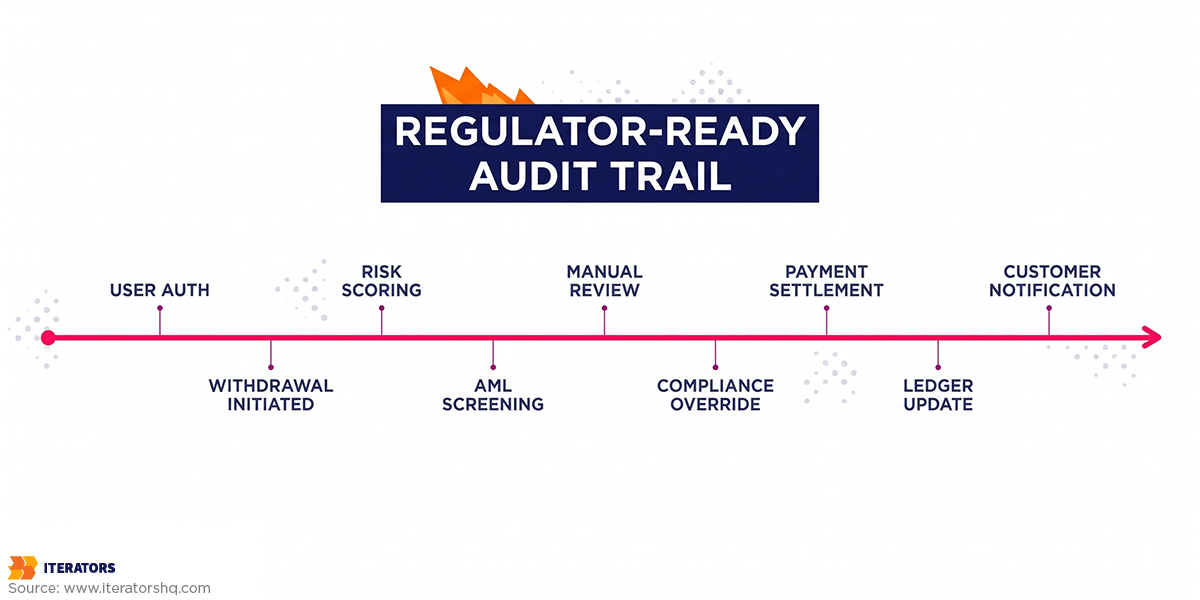
A withdrawal request for an unusually large amount comes in. The destination account is in a country the user has never transacted with before. Here’s what a system with a working fintech audit trail can reconstruct, end to end, months later:
The user authenticated and completed a step-up MFA challenge. The withdrawal was initiated and entered a pending state under a single correlation ID. The risk engine recalculated the transaction’s risk score from a baseline of 12 to 88, citing a specific rule (geographic anomaly on a high-value transfer) and recorded which model version made that call. The transaction was routed to a third-party AML screening provider, which returned a fuzzy match against a watchlist; that response and the vendor’s reference ID got logged alongside the internal correlation ID. The system placed a hold on the funds and moved the withdrawal into manual review. A compliance analyst opened the case (that view is itself logged), reviewed supporting documentation, and cleared the flag with a specific reason code: documented source of funds. The override carries the analyst’s ID, session context, and the policy citation authorizing that kind of manual release. The payment then settled through the banking rail, the ledger recorded a double-entry update, and a notification went out to the customer.
Every step has an actor, an action, a target, a before-and-after state, and a timestamp. That one record does five jobs at once: it satisfies compliance, gives a fraud investigation its timeline, lets support answer “what happened to my money,” gives engineering a debugging trace, and answers a regulator’s inquiry without a scramble. If anyone asks about this transaction eighteen months from now, the answer isn’t “let us check the database and get back to you.” It’s a query against the correlation ID.
That’s the actual test of whether you built a fintech audit trail or just something that resembles one. Not whether it looks complete on demo day. Whether it survives being asked about long after the people who built the feature have moved to a different project.
Fintech Audit Trail Checklist for Founders and CTOs
For a fast read on where your system stands, walk this list. Every “no” is a place your audit trail will let you down under scrutiny.
- Do we capture business events, not just technical logs?
- Can we trace every money movement from initiation to settlement?
- Can we reconstruct every user and admin action?
- Are logs append-only or tamper-evident?
- Are audit logs encrypted and access-controlled?
- Is access to the audit logs itself logged?
- Do we capture failed events, not just successful ones?
- Do we capture external provider events and responses?
- Do we use correlation IDs across services?
- Do we have retention policies matched to our business model?
- Can we export audit data safely for a review?
- Can we support enterprise vendor assessment requests?
- Do we have disaster recovery for the logs?
- Do we test audit trail completeness, not just assume it?
- Does compliance review event definitions before launch?
- Does product management know which workflows need auditability?
- Does DevOps own secure retention and monitoring?
- Does engineering treat audit events as part of the Definition of Done?
If most answers are “yes,” a vendor assessment is a formality. If most are “no,” it’s a roadmap.
When Should You Build Your Fintech Audit Trail?
Earlier than founders think, but “earlier” doesn’t mean “all of it on day one.” The right amount depends on where you are.
Prototype Stage
You don’t need compliance infrastructure yet, but you need to know where it will go. Action item: map which user actions involve money movement, identity verification, or a regulatory decision. That map is the actual first deliverable, not the audit trail itself.
MVP Stage
Capture the core transaction, identity, and admin events. Action item: implement event logging for payments, KYC submissions, and admin permission changes (with the actor/action/target shape) before your first customer launch.
Production Stage
You need secure retention, access controls, alerting, and exportable reports. Action item: set up centralized, immutable logging (for example, AWS CloudTrail plus an append-only audit store) and define retention policies before processing real customer funds.
Enterprise / Regulated Stage
You need SOC 2-ready controls, immutable logs, vendor assessment documentation, incident response, and clear ownership. Action item: prepare audit-log export capability and access-control documentation. If you’re not sure what those reviews ask for, our guide to preparing your product architecture for enterprise vendor assessment is a good place to start.
How Iterators Builds Regulatory Compliance Software Without Turning Your Product Into Concrete

I’ll keep this short, because the point of everything above wasn’t to set up a pitch: it was to describe a problem I’ve watched teams solve well and badly, from the inside, on systems still running years after launch. Iterators builds software; we don’t hand you a slide deck about compliance and leave. We’re a custom software development partner that has built the fintech systems this article describes: in Scala, Kafka, AWS, blockchain, wallets, and KYC/KYB flows, with SOC 2 and enterprise readiness baked in.
- A real-time crypto-fiat exchange: we built the wallet architecture, KYC/KYB flows, and staking mechanics for the eventual compliance review before that review existed, because in a regulated exchange you don’t get to retrofit the transaction core later.
- A long-running enterprise platform: we embedded SOC 2 Trust Services Criteria (security, availability, processing integrity, confidentiality, privacy) into the architecture from early on, part of why it scaled to enterprise clients without a rewrite. (More in our SOC 2 compliance guide for SaaS.)
- An AI-driven bond scoring pipeline: the traceability requirement wasn’t regulatory in the SEC sense, but the discipline was identical: every score has to be explainable back to the source document, because “the model said so” isn’t an answer a sustainability analyst can defend.
None of that makes audit trail architecture easy. It makes it a known cost, paid early, instead of an unknown cost, paid later with interest.
Final Takeaway: Your Fintech Audit Trail Is the Product’s Memory
Every fintech founder I talk to agrees with the argument in principle, then asks the same follow-up: how much of this do we need on day one, versus how much can wait? The honest answer is that it depends on which workflows touch money, identity, or a regulatory decision, and that mapping exercise, done early, is the real first step.
The harder question, the one without a clean answer, is what happens to the record you didn’t design for auditability from the start. You can build the right architecture going forward. You generally can’t reconstruct history you never captured. That gap doesn’t close. It becomes a known blind spot in your books, and at some point someone is going to ask you how big it is.
So think of it this way. If your product moves money, makes financial decisions, or handles regulated customer data, it needs memory. A fintech audit trail is that memory. If it’s incomplete, editable, scattered, or context-free, your product can’t defend itself. Build it early. Build it intentionally. Build it into the architecture.
Disclaimer: This article is not legal advice. Fintech compliance requirements vary by product, jurisdiction, and business model. Use it as an engineering and architecture guide, and consult qualified legal and compliance professionals for regulatory interpretation.
Need a fintech development team that understands auditability, compliance architecture, and production-grade financial systems? Let’s talk about your roadmap. Talk to Iterators.
Frequently Asked Questions

What is a fintech audit trail? A chronological, tamper-resistant record of user actions, system events, transaction changes, and administrative decisions inside financial software, so a company, auditor, regulator, or enterprise customer can reconstruct exactly what happened, when, and under whose authority.
Is an audit trail the same as application logging? No. Application logs help developers debug and are usually rotated out within weeks. A fintech audit trail proves what happened in a financial, compliance, or operational workflow, and has to survive for years with its integrity intact.
What should a fintech audit trail include? User actions, admin activity, authentication and MFA events, transaction state changes, KYC/KYB decisions, AML and sanctions screening, permission changes, API calls, configuration changes, third-party responses, and every failed attempt at any of the above.
Why are immutable audit logs important? Immutable or tamper-evident logs prove records weren’t changed after the fact. If the person who performs an action can also edit the record of it, that record carries no evidentiary weight in an investigation, audit, or regulatory inquiry.
When should fintech startups build audit trails? Start during MVP architecture. You don’t need enterprise-grade compliance on day one, but design regulated workflows (money movement, identity, admin actions) so auditability can scale without a rewrite later.
What is compliance by design? Building security, auditability, privacy, retention, and regulatory requirements into the architecture from the start instead of patching them in before a review. In fintech it shapes the data model, permissions, event design, and infrastructure.
Do all fintech products need the same audit trail requirements? No. Requirements depend on the product, market, jurisdiction, transaction type, customer profile, and regulatory exposure. A payments app, a lending platform, a crypto exchange, and a financial analytics tool each have different needs.
Can audit trails help with SOC 2? Yes. Audit logging supports the security, availability, confidentiality, processing integrity, and privacy criteria, but SOC 2 requires broader policies, processes, and evidence beyond logs alone. See what SOC 2 is for the full picture.