

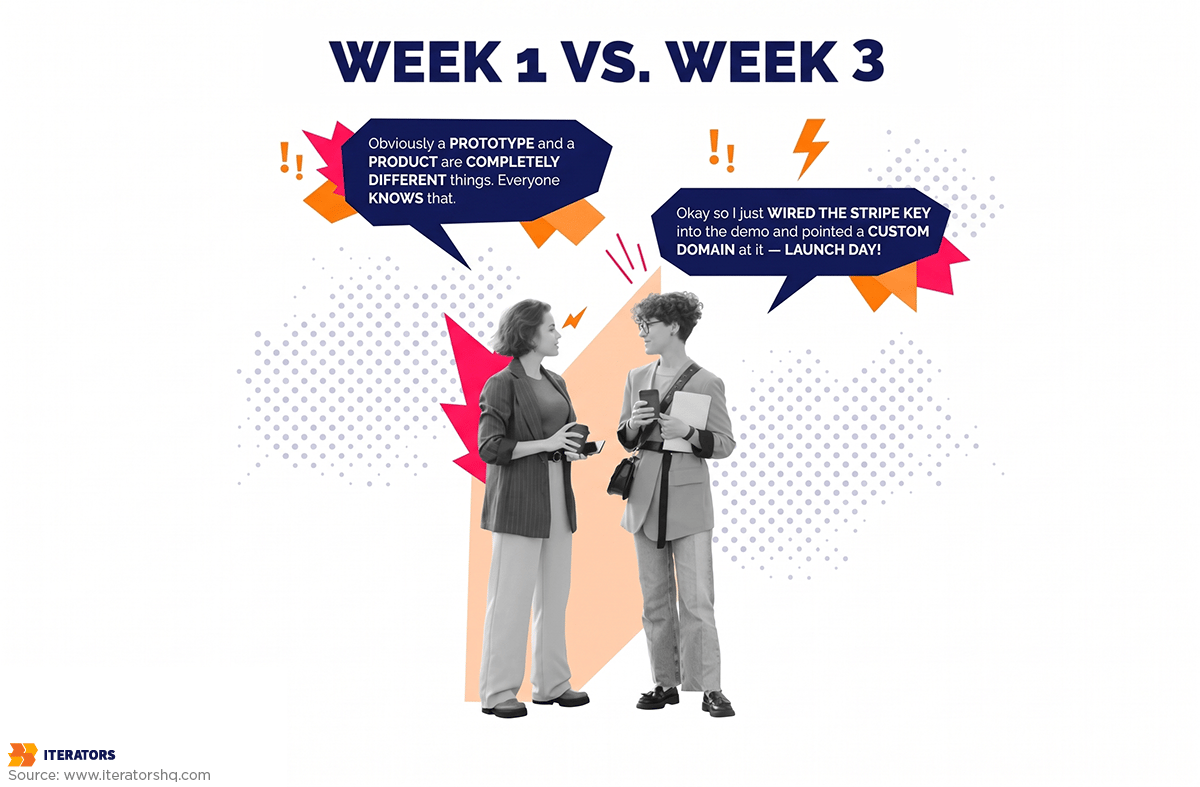
Everyone agrees a startup prototype and a product are not the same thing. Say that sentence out loud in a planning meeting and watch heads nod — of course they’re different, everyone knows that, we’re not idiots.
And then, two weeks later, the same team wires a Stripe key into the clickable demo, points a custom domain at it, and calls it launch day.
I’ve watched this happen enough times now that I don’t think it’s a stupidity problem. It’s a startup prototype problem, and it’s a very specific kind: the thing that impressed everyone in the room is quietly, structurally incapable of surviving the room it’s about to walk into next. Nobody lied. Nobody cut corners on purpose. The prototype did exactly what a prototype is supposed to do — it proved the idea could work, on a screen, for an audience that wanted to believe it.
The trouble starts when nobody officially decides what happens after that.
Nobody decided what this startup prototype was supposed to become
Here’s the pattern I keep running into, and it’s not really about code.
A founder comes to us with something that “basically works.”
- Users can sign up (sort of).
- There’s a dashboard (mostly populated with the founder’s own test data).
- There’s a checkout flow (never actually charged a real card).
Every individual piece, if you click through it in the right order, at the right speed, without doing anything weird — works.
The founder isn’t wrong to be proud of it. Building that thing, in the time they built it, is genuinely hard. What’s missing isn’t effort. It’s a decision. Somewhere around week two, someone needed to answer a boring but enormous question: is this thing disposable, or is this thing the beginning of the real one?
Nobody asked, because there was no meeting scheduled for “decide the philosophical status of our codebase.” There was a demo scheduled for Thursday. So the team optimized for Thursday. Fast, forgiving, forgivable choices — mock the data, skip the login, hardcode the happy path — because those choices make Thursday go well.
They also make month four go badly, because those exact same choices are still sitting in the codebase, except now there are real users on the other end of them.
That’s the whole shape of startup prototype failure, in my experience: not a bad idea, not bad execution in the moment, but an unexamined assumption about what kind of artifact you were building, carried forward past its expiration date.
What “temporary” quietly becomes
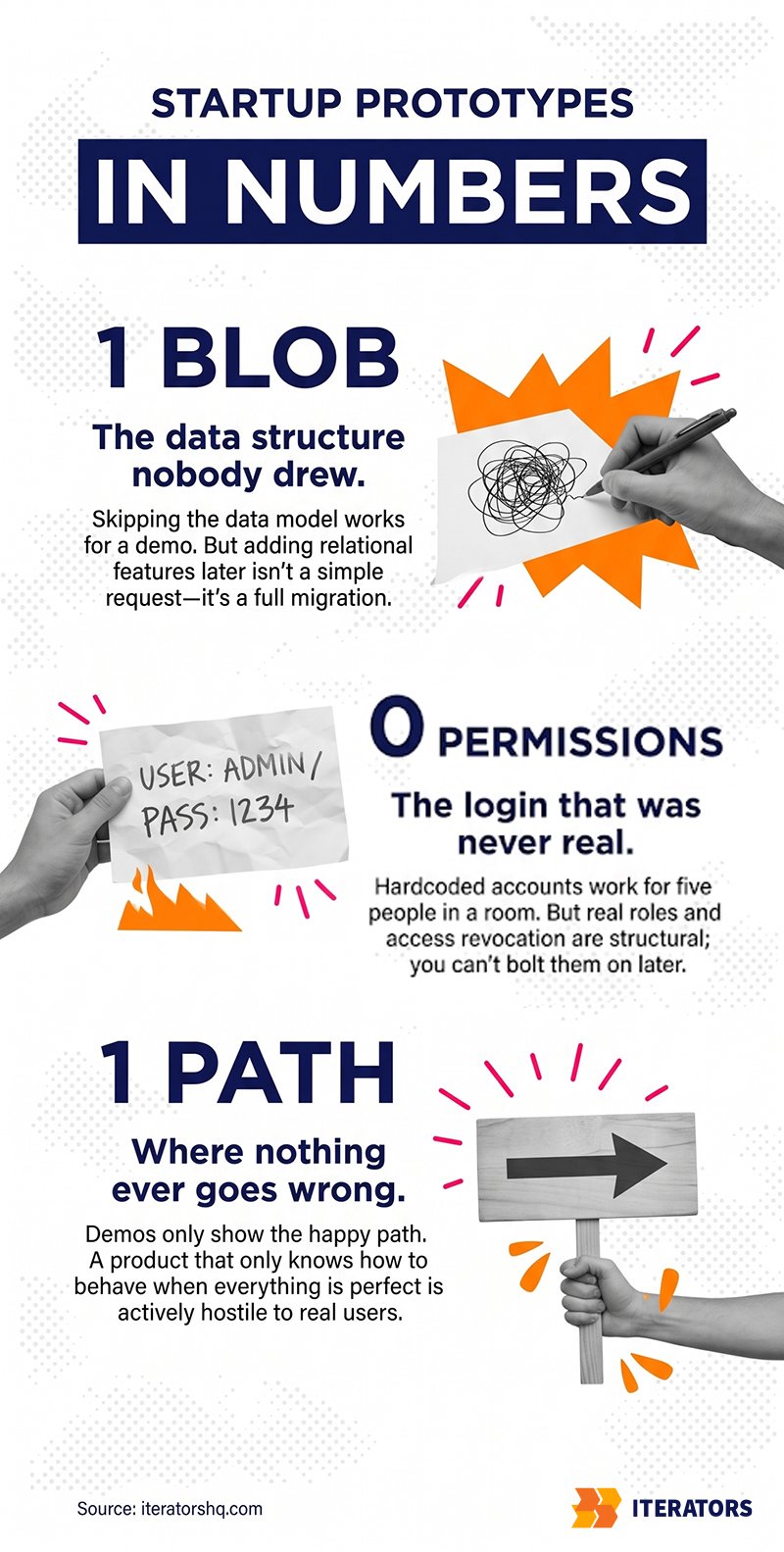
I want to be specific about what actually breaks, because “technical debt” is one of those phrases that sounds serious and says nothing. Three things, over and over.
The data model nobody drew
The fastest way to build a demo is to not think about your data structure at all. One big object. A JSON blob (one loose data container, basically a drawer where everything gets thrown) that holds “the user” and everything about them, shaped exactly the way the current screen needs it shaped. It works. It works right up until you need a second screen that wants the same information arranged differently, or a second user type, or an audit trail, or literally anything relational.
I’ve sat in on calls where a developer is asked to add “just a simple team feature” and the honest answer is that there’s no way to represent a team in the data at all, because the data was never designed to hold more than one kind of thing. Adding it isn’t a feature. It’s a migration (moving existing data into a new structure without breaking what’s already there), disguised as a feature request.
The login that was never real
Almost every early startup prototype has some version of a fake front door — a hardcoded admin account, a login screen that accepts anything, an “auth” system that’s really just a flag in local storage (the browser’s little memory drawer). Completely reasonable for a demo. Nobody needs real security to show five people a screen.
The problem is that “real security” isn’t a feature you bolt on later, the way you’d add a new button. Roles, permissions, who can see what, what happens when someone’s access should be revoked — that’s structural. It shapes how every other part of the system is built. Adding it after the fact usually means touching almost everything you already built, which is a strange kind of punishment for having moved fast when moving fast was the correct call.
The path where nothing ever goes wrong
This is the one that’s closest to my actual job, so I notice it the most.
Every demo shows the happy path. Click here, then here, then here, everything loads, everything’s there, the internet connection is perfect and the API always responds in under a second. Nobody designs for the moment the payment fails, or the upload times out, or the user double-clicks submit, because in a demo, none of that happens. You control the room.
Real users are not a room you control. They lose signal on the subway. They open the app, get distracted, come back to it forty minutes later in a different state than they left it. They hit “back” at exactly the wrong moment. A product that only knows how to behave when everything’s going right isn’t unfinished — it’s actively hostile the first time something doesn’t go right, which for any real audience is roughly immediately.
If the interface needs explaining, it’s not ready. That’s true of finished products. It’s doubly true of the paths nobody bothered to design, because nobody’s there to explain anything when it happens — the user is just alone with a spinner that never resolves.
AI didn’t invent this startup prototype problem. It just made it faster

I want to be fair to the AI-assisted and no-code tools people are using to spin up prototypes right now, because they’re genuinely good at what they do. What they do is build the interface for the version of the world where everything goes right.
That’s not an insult, it’s the entire design brief they were given. Describe a feature, get a working screen. The tools are extremely good at the part they were asked to do. What they systematically don’t do is build the part nobody asked for out loud: the error state, the empty state, the “what if this field is missing” state, the retry logic. Those are invisible in a prompt. You don’t think to ask for them because you’re imagining the version where you don’t need them.
So what you get, fast, is a prototype that’s even more convincingly finished-looking than the ones we used to hand-build slowly — and even less equipped underneath. The gap between “looks done” and “is done” didn’t close. It got wider, because the speed increased and the review didn’t.
I don’t think the answer is “don’t use these tools.” I think the answer is treating their output the exact same way you’d treat a junior developer’s first pass: genuinely useful, definitely not something you ship without someone senior looking hard at what’s underneath the parts that look fine.
The startup prototype fidelity trap, and why it’s actually a design problem
There’s a version of this that’s purely about how something looks, and it trips people up constantly.
When you show someone a rough, obviously-unfinished sketch — boxes, gray rectangles, placeholder text — they give you feedback about the flow. Does this make sense? Where would I expect to go next? That’s exactly the feedback you want at that stage.
Show that same person a polished, pixel-perfect screen, and something shifts. Now they’re telling you the button should be blue, the spacing feels off, they don’t like the font. Not because they’re shallow — because you gave them something that looks like a finished decision, so they respond to it like one. Nielsen Norman Group has written about this exact effect with prototype fidelity, and it matches everything I’ve seen in the room: the level of polish you choose isn’t a style decision, it’s a question you’re asking, and the fidelity determines which question people think you asked.
This matters for prototype failure specifically because founders love showing the pretty version to investors and the pretty version to users, and then they’re confused when the feedback from both groups is about buttons instead of about whether the thing solves a real problem. You asked a cosmetic question. You got a cosmetic answer. Nothing went wrong with the feedback — something went wrong with the question.
What actually has to be true before real users show up
Here’s where I’ll admit something that took me a while to internalize, because it’s not the sexy part of the job. Getting from a demo that works to a product that survives contact with strangers isn’t really a list of features. It’s a list of gates — things that have to be true, not things you add.
| Gate | What it actually means | What breaks if you skip it |
|---|---|---|
| Product validation | People changed real behavior because of this, not just said nice things about it | You scale a feature nobody actually wanted, just faster |
| UX validation | A stranger can finish the core task with zero explanation from you | Support tickets, silent churn, “users are confused” postmortems |
| Data structure | The model can hold a second user, a second team, a second edge case without a rewrite | Every new feature becomes a migration in disguise |
| Access & auth | Roles and permissions exist for real, not as a flag someone forgot to remove | One customer sees another customer’s data, and now it’s a headline |
| Failure handling | The product does something sane when the API times out or the network drops | The app just looks broken, and broken looks unbootable to a first-time user |
| Basic QA | Someone other than the original builder tried to break it before a real user did | The first bug report comes from a paying customer instead of a teammate |
None of these are glamorous. All of them are the difference between a startup prototype that gets to keep existing and one that has to be quietly, expensively rebuilt six months from now while customers are already inside it.
When to keep it, fix it, or bury it
Keep It, Fix It, or Bury It
Prototype Diagnostic
Two things decide what happens next to a prototype — and they’re independent. Drag both sliders to match your own, and see which move actually makes sense.
The tech is solid. Nobody’s proven anyone actually wants this yet — this is exactly when to go find out, before writing another line of code.
Not Sure Which Quadrant? Talk To Us →I’ve noticed founders treat “should we rebuild this” as an emotional question — like admitting the startup prototype needs replacing is admitting the whole effort failed. It isn’t. If anything, a prototype that clearly told you what to build next did exactly its job. That’s the win condition, not the loss condition.
What actually determines the answer isn’t feelings, it’s two separate questions that people keep collapsing into one: did users prove they want this, and is the thing underneath capable of growing. Those are independent. You can have strong validation on top of a broken foundation, or a solid foundation nobody’s actually validated yet, and the right move is different in every combination.
| Situation | What we’d actually do |
|---|---|
| People love the workflow, but the data model can’t hold new use cases | Rebuild the core, keep the workflow as the spec — it already told you the shape of the thing |
| The backend logic is genuinely sound, the interface is the fragile part | Refactor the front end, leave the working logic alone |
| Real traction, but it was built fast in a no-code tool with no one checking underneath | A focused productization sprint before growth outpaces the foundation |
| Nobody can explain how the thing currently works, there’s no documentation, no tests | Stop building. Audit first. You can’t safely change what you can’t currently describe |
| Solid tech, weak or absent validation | Don’t touch the code yet — go find out if anyone actually wants this |
The one row people skip most often is the last one. It’s tempting to keep polishing something technically impressive while quietly avoiding the harder question of whether anyone asked for it.
The audit nobody wants to schedule
We worked with a client, a while back, on an AI tool that analyzed invoices — genuinely clever piece of modeling, did something a room full of accountants used to do by hand. The model worked. That part was never the issue.
What wasn’t there yet was any version of it a real finance team could actually live inside. So before touching the model further, we ran a round of proper UX workshops and usability testing with the actual people who’d be staring at this thing forty hours a week. Not because the AI needed fixing — because the product around the AI hadn’t been designed at all, it had just been demonstrated.
That’s a distinction I keep coming back to. A working model, a working checkout flow, a working login — those prove the mechanism is possible. They don’t prove anyone can live inside the thing you built around the mechanism. Eric Ries’s original framing of the MVP is worth remembering here: it’s the version that gets you the maximum validated learning for the minimum effort. Emphasis on learning — not on shipping the exact artifact you happened to learn from.
A prototype can be one of the best specifications you’ll ever hand a development team. That’s genuinely one of its most useful jobs. It is not, on its own, evidence that it should become the production codebase — those are two different claims, and confusing them is where most of this goes wrong.
We’ve seen the opposite pattern too — teams so worried about “doing it right” that they run discovery workshops for months before writing a line of code, and by the time they ship, the market moved. So this isn’t an argument for slowing everything down. It’s an argument for knowing, at any given moment, whether you’re currently building a question or currently building an answer. Those require different levels of care, and treating a question like it’s already an answer is how a startup prototype quietly becomes the thing you’re stuck maintaining for the next three years.
I keep thinking about that gap between “the demo went great” and “we can actually take real money now.” It’s not a technical debt problem, not really — that’s just where it shows up first. It’s a decision that never got made out loud, sitting there unmade, collecting interest.
The prototype isn’t the mistake. Forgetting to ask what it was for is.