

A vendor assessment arrives late in the sales cycle. The questionnaire has two hundred rows. Legal wants it answered by Thursday. Sales says the deal is close. Engineering says you don’t have half of what’s being asked about—and suddenly, finding credible security questionnaire help becomes the only thing standing between closing the deal and losing it entirely.
That’s the dilemma. There are three available moves, and each one fails in a different way.
You can answer fast and hope the buyer doesn’t check. You can halt the product roadmap and build every missing control before responding. Or you can get expert security questionnaire help — someone who can separate what’s answerable today, what needs documentation, what requires actual engineering, and what can go on a credible roadmap without killing the deal.
Each path has a real cost. The article is about naming those costs clearly enough that you can make the right call for your situation.
What a Vendor Assessment Actually Is
A vendor assessment is a buyer’s structured due diligence process for determining whether a software vendor is safe, compliant, and operationally reliable enough to bring inside their organization. It typically involves multiple internal stakeholders: InfoSec, legal, privacy, compliance, IT, and procurement risk management — each with their own checklist.
A security questionnaire is the most common instrument in that process. It arrives as a spreadsheet, a shared document, or a platform like OneTrust or Whistic. It asks whether you have specific controls, policies, and technical capabilities — and then asks for evidence to prove it.
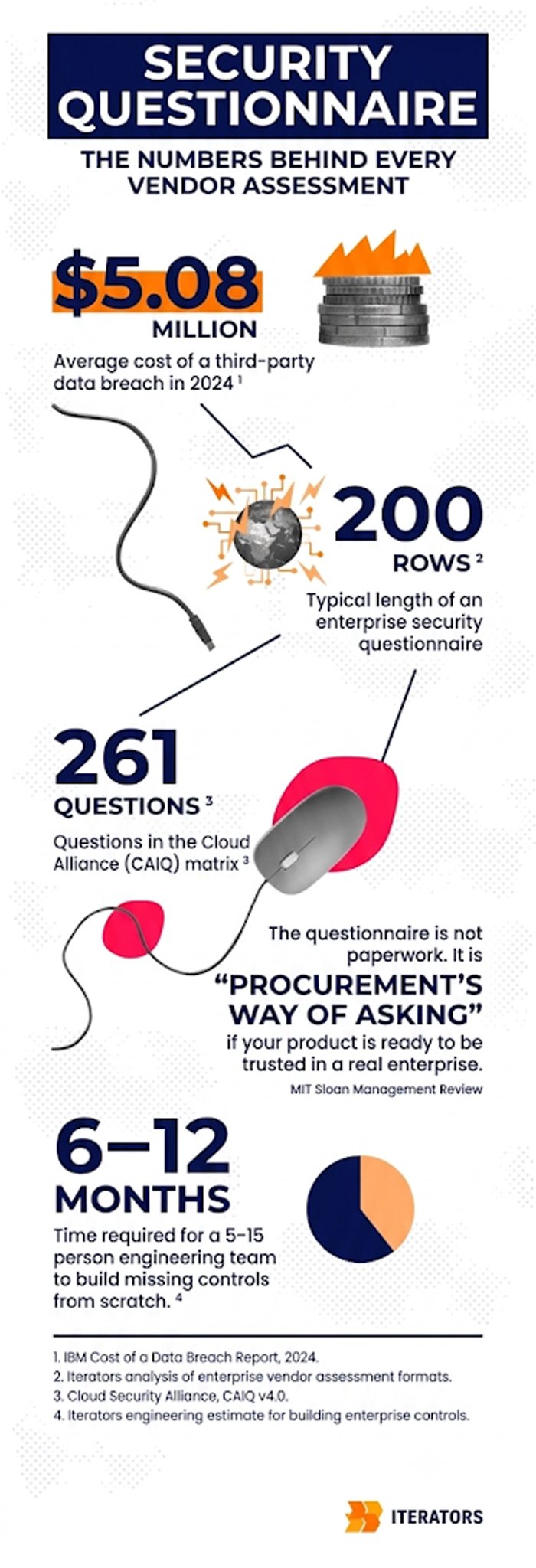
Enterprise buyers issue these questionnaires because they are legally and operationally accountable for the vendors they bring into their environment. NIST SP 800-161 establishes federal baseline requirements for cybersecurity supply chain risk management, and most large organizations have internalized equivalent policies. When a Fortune 500 company’s procurement team asks whether you have immutable audit logs, they’re not being bureaucratic. They’re asking because a vendor breach inside their environment can cost them millions — the average third-party breach cost $5.08 million in 2024 (IBM Cost of a Data Breach Report, 2024) — and they need to know whether your architecture creates that exposure.
Common triggers for a vendor assessment include:
- Selling to enterprise or mid-market buyers with formal procurement processes
- Handling customer data, especially regulated categories (healthcare, HR, financial, legal)
- Integrating with SSO (single sign-on, where users authenticate through the buyer’s identity provider), identity providers, or internal directories
- Processing payments or supporting financial workflows
- AI or LLM systems that ingest or generate content from sensitive data
- Cloud infrastructure with external exposure
- Any contract that includes security warranties or data processing obligations
The questionnaire is not paperwork. It is procurement’s way of asking whether your product is ready to be trusted inside a real enterprise.
Why Security Questionnaires Delay Enterprise Deals
The questionnaire arrives late in the sales cycle, usually after the technical evaluation and before legal sign-off. That timing creates a specific kind of pressure: the deal feels close, the revenue team is watching, and suddenly engineering is being asked to answer questions about controls that were never a product priority.
The most common blockers are not exotic. They appear in almost every assessment targeting a SaaS vendor:
- No SOC 2 report or formal readiness plan
- No documented incident response process
- Missing or incomplete audit logs
- No SSO support, or SSO that only works for one customer through a manual configuration
- Access controls that are hard-coded or undocumented rather than role-based
- No formal access review process — not even a manual one
- Encryption at rest implemented but not documented
- No disaster recovery plan that has ever been tested
- Subprocessors not formally listed or evaluated
- No secure SDLC documentation
- Cloud environments without proper separation between production and staging
Each of these is a real architectural or process gap. The questionnaire exposes them. And once exposed, they don’t disappear because the deal is close.
Enterprise procurement does not pause for a developer sprint. If your controls are not live, documented, or defensible, the security review will stall — and stalled security reviews kill momentum faster than almost anything else in an enterprise sales cycle.
The Three Paths to Navigating Security Questionnaire Help
Should You Answer This Yourself?
Adjust the sliders to reflect your current deal. Find out immediately if a DIY response exposes your company to legal breach or procurement failure.
Evaluating…
…
Before going into each path in detail, here’s the comparison at a glance:
| Path | Speed | Deal Risk | Legal Risk | Engineering Load | Best For |
|---|---|---|---|---|---|
| Answer fast / answer wrong | High | High | High | Low now, very high later | Low-stakes questionnaires with clear, supportable answers only |
| Build everything internally | Low | Medium | Low if done correctly | High, often misdirected | Teams with time, budget, and a clear prioritization framework |
| Get expert security questionnaire help | Medium to high | Lower | Lower | Targeted and scoped | Teams under enterprise deal pressure with real architectural gaps |
The article is not arguing that every company needs outside help. It is arguing that the stakes determine the path — and that most teams underestimate the stakes until they’re already in trouble.
Path 1: Answering the Security Questionnaire Wrong
Why Fast Security Questionnaire Answers Feel Tempting
The sales team has been working this account for six months. The founder is personally invested. Legal says the contract is almost ready. Engineering is mid-sprint. And the questionnaire has 200 rows.
In that environment, the instinct is to answer “Yes” wherever the answer is close to yes, to treat roadmap items as current capabilities, and to assume that enterprise buyers won’t verify individual rows in a spreadsheet.
That assumption is wrong, and it’s wrong in a specific way.
What Happens When You Answer a Security Questionnaire Incorrectly
Security questionnaire responses are frequently incorporated by reference into the final Master Services Agreement. That makes them legally binding warranties. If you claim encrypted backups and the buyer later discovers unencrypted storage, you are in material breach — not just embarrassed.
Beyond legal exposure, the evidence trap is the more immediate problem. Enterprise buyers don’t just read the “Yes” column. They ask for artifacts. If you claim annual penetration testing, they’ll ask for the report. If you claim audit logs, they’ll ask for a sample export. If you claim SSO, they’ll ask for your SAML (Security Assertion Markup Language) configuration documentation.
Common examples of answers that create immediate problems:
- Claiming annual penetration testing when you only ran an automated vulnerability scan
- Claiming SSO support when it’s a manual OAuth integration that works for one customer
- Claiming role-based access control when permissions are hard-coded in the application layer
- Claiming encrypted backups without being able to demonstrate retention policies, recovery testing, or access controls on the backup environment
- Claiming audit logs when the logs are incomplete, stored in a mutable format, or not exportable to the buyer’s SIEM (security information and event management system, where security logs are centralized)
When the evidence request comes — and it will come — the inability to produce artifacts doesn’t just delay the deal. It signals to the buyer’s security team that the initial answers were not grounded in reality. That damages trust in a way that is very difficult to repair mid-procurement.
When DIY Security Questionnaire Responses Are Fine
To be fair, not every questionnaire requires expert support. The fast-answer path is acceptable when:
- The questionnaire is short and the questions are clearly within your current capabilities
- The buyer is small and the contract does not include security warranties
- No regulated data is involved
- You have existing policies, architecture diagrams, and evidence you can attach immediately
- Your answers are supported and you’re not stretching the truth to close the deal
If all of those conditions are true, fill it out yourself. The problem is that most teams apply the fast-answer approach to situations where none of those conditions are true.
Path 2: Building Missing Controls Before Seeking Security Questionnaire Help
The opposite instinct is to treat the questionnaire as a complete product specification and build everything on it before responding.
This is honest. It is also frequently a trap.
What Enterprise Buyers Actually Expect You to Have Built
A comprehensive enterprise assessment will touch most of the following:
- SSO via SAML or OIDC (OpenID Connect, a modern authentication layer built on OAuth 2.0)
- Role-based access control with documented role hierarchy
- Admin roles with separation from standard user access
- Immutable or exportable audit logs with configurable retention
- Encryption at rest and in transit with documented key management
- Backup and disaster recovery with tested RTOs (recovery time objectives — the target time for restoring service after failure)
- Formal access review process (automated or manual)
- Vulnerability management program with documented remediation SLAs
- Centralized logging and alerting
- Documented incident response workflow with defined escalation paths
- Data deletion and retention process
- Subprocessors list with security evaluation criteria
- Secure SDLC documentation
- CI/CD pipeline with security checks integrated
- Environment separation between production, staging, and development
- Monitoring and alerting with defined response thresholds
That is a real engineering workload. For a team of five to fifteen engineers, building all of it from scratch while maintaining a product roadmap can take six to twelve months.
Why “Build Everything” Can Kill the Deal
The timing problem is the critical one. Enterprise buyers often need a response in days, evidence in weeks, and a credible remediation roadmap for the gaps — not a nine-month rebuild.
More specifically: enterprise buyers routinely accept compensating controls. If you lack automated quarterly access reviews, a buyer may accept a manual access review process backed by MFA, least-privilege access, and logged access events — provided you can document it. If you don’t know that, you’ll spend three months building an automated access review system that wasn’t actually blocking the deal.
The other risk is building without documentation. Teams often implement controls correctly but fail to produce the written policies, architecture diagrams, and process records that make those controls legible to a procurement team. The control exists; the evidence doesn’t. The buyer can’t credit what they can’t verify.
This is where technical debt compounds the problem. A team that built fast in the early stages often has real security controls that are undocumented, inconsistently applied, or implemented in ways that are technically sound but architecturally opaque. The work isn’t starting from zero — but the documentation gap makes it feel that way.
Security Questionnaire Help vs. Building Blind
Expert security questionnaire help changes the prioritization problem. Instead of building everything, you build what actually matters for this specific buyer in this specific deal.
A good gap analysis distinguishes between:
- Must-have controls — absolute procurement blockers that will kill the deal regardless of compensating controls
- Acceptable compensating controls — interim measures that satisfy the risk requirement without full implementation
- Roadmap commitments — features the buyer will accept on a credible timeline with interim mitigations documented
- “Not applicable” answers — questions that genuinely don’t apply to your architecture, explained precisely
- High-risk “no” answers — gaps that need to be acknowledged honestly, with a remediation plan attached
Without that prioritization, teams either overbuild (wasting months on low-priority controls) or underbuild (missing the actual blockers). Both outcomes delay or lose the deal.
Path 3: Getting Expert Security Questionnaire Help
What Expert Security Questionnaire Help Should Actually Do
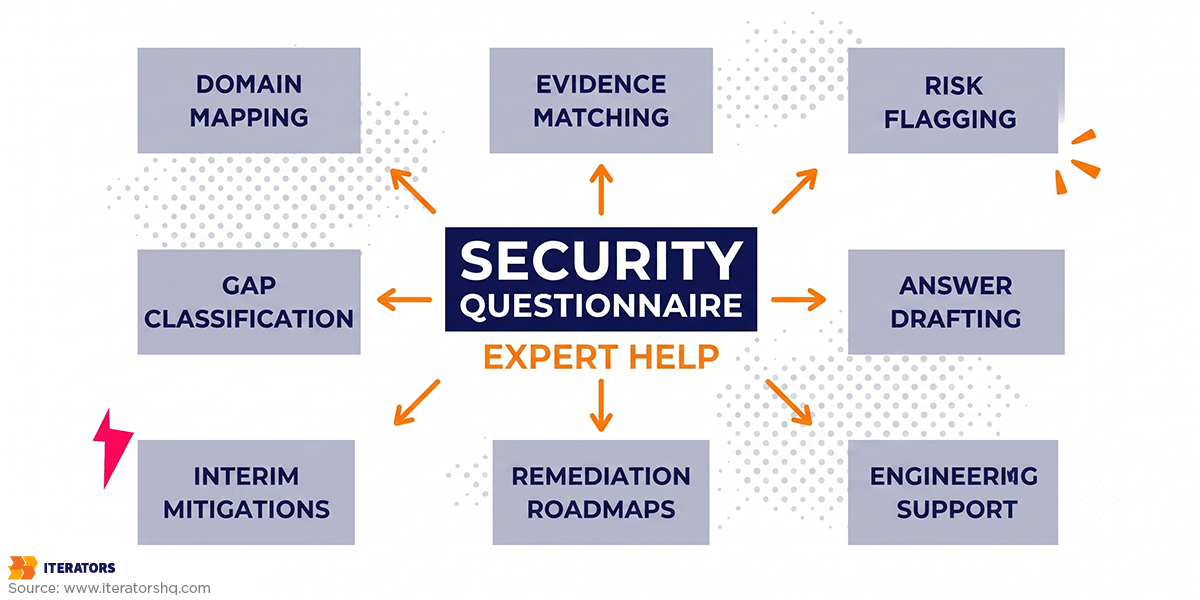
A strong provider of security questionnaire help is not a basic form-filling service. It is a gap analysis and remediation planning service that happens to produce accurate questionnaire answers as an output.
The process should look like this:
- Review the full questionnaire and categorize questions by domain (infrastructure, access control, compliance, privacy, operational security, etc.)
- Map each question to existing evidence, policies, or system capabilities
- Interview the engineering, product, and security owners who know the actual state of the system
- Flag answers that carry legal or reputational risk if answered inaccurately
- Identify missing controls and classify them by deal impact
- Recommend precise, defensible answer wording — not generic policy language
- Prepare supporting documentation or identify what documentation needs to be created
- Produce a remediation roadmap with prioritized gaps, interim mitigations, and realistic timelines
- Help build the highest-priority missing controls when actual engineering is required
The Cloud Security Alliance’s Consensus Assessments Initiative Questionnaire contains 261 questions mapped to their Cloud Controls Matrix. Most enterprise assessments draw from frameworks like this, NIST 800-53, and the OWASP Application Security Verification Standard. Expert support means understanding which questions in a 200-row spreadsheet map to which framework requirements — and which ones your architecture already satisfies, even if you haven’t documented it that way.
What Expert Security Questionnaire Help Should Never Do
This section matters for trust.
Expert support should never:
- Invent controls that don’t exist
- Advise answering “Yes” when the honest answer is “No”
- Copy-paste generic security policies that don’t reflect your actual system
- Hide material security gaps from the buyer
- Promise compliance certification without an actual audit
- Treat the questionnaire as a performance rather than a technical evaluation
- Ignore engineering reality in favor of a cleaner-looking response
The goal is not to pass by pretending. The goal is to pass by being clear, credible, and technically defensible.
“Checkbox theater” — creating the appearance of security without real controls — is detectable. Enterprise security teams have seen it before. When they detect it, the deal doesn’t just stall. It ends, and the relationship ends with it.
How Iterators Approaches Security Questionnaire Help
Iterators is not a law firm and not a compliance auditor. The support we provide is technical: reviewing the questionnaire against your actual architecture, identifying what’s missing, helping you document what exists, and building what needs to be built.
That includes:
- Technical gap analysis against the questionnaire requirements
- SaaS enterprise readiness assessment
- DevOps and cloud infrastructure review
- SOC 2 readiness support — see what SOC 2 actually requires and why enterprise buyers demand it
- Audit log implementation and monitoring and observability architecture
- SSO and RBAC implementation
- Secure CI/CD pipeline configuration
- Infrastructure-as-code compliance controls
- Security documentation and policy drafting
- Product architecture changes required for enterprise readiness
- Vendor assessment response support
The questionnaire response and the implementation plan should describe the same system. If they do not, the gap will surface during evidence review.
Security Questionnaire Timeline: What Happens After It Arrives
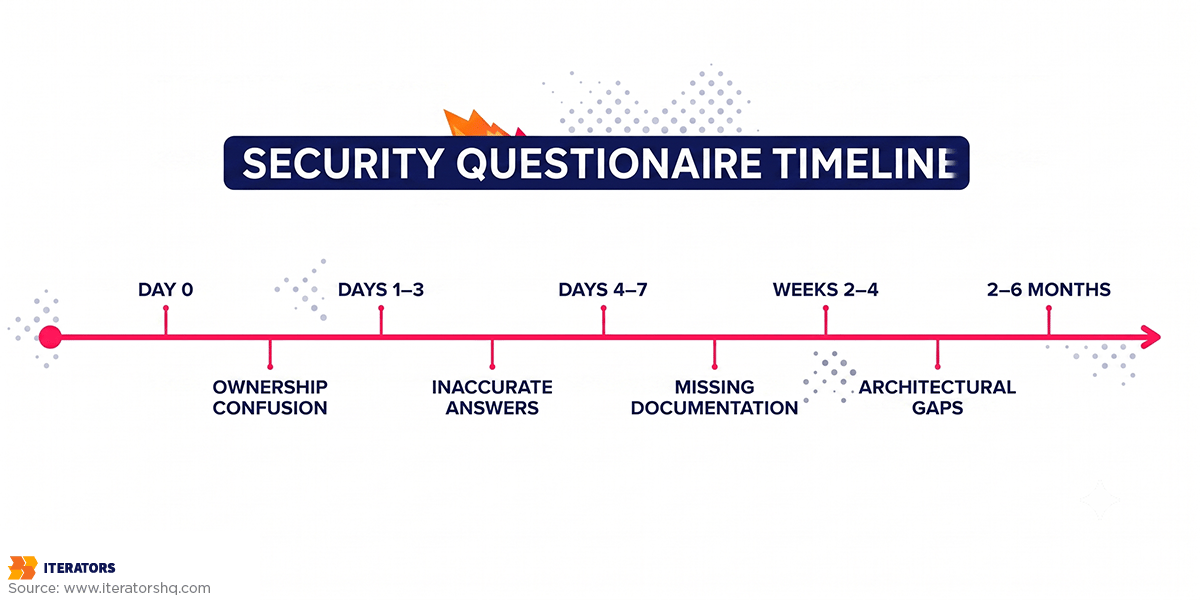
| Timeline | What Usually Happens | Risk |
|---|---|---|
| Day 0 | Sales receives questionnaire, forwards to product or engineering | Ownership confusion — nobody knows who’s responsible |
| Days 1–3 | Product, engineering, and legal scramble to produce answers | Inaccurate answers written under time pressure |
| Days 4–7 | Buyer requests evidence to support specific answers | Missing documentation surfaces immediately |
| Weeks 2–4 | Security follow-up calls, clarifying questions, deeper technical review | Architectural gaps become visible to the buyer’s security team |
| Weeks 4–8 | Remediation requests — buyer asks for specific controls to be built | Deal delay, engineering context-switching, roadmap disruption |
| 2–6 months | Major missing controls built if the deal is still alive | Full roadmap disruption, potential loss of deal momentum |
Timelines vary based on questionnaire complexity, data sensitivity, and the buyer’s internal review process. A 50-question assessment from a mid-market buyer moves differently than a 300-question SOC 2-anchored review from a Fortune 500 procurement team.
The Fastest Route Is Not Always the Safest Route
Answering fast creates the appearance of momentum. But when the evidence request arrives and the artifacts don’t exist, the deal stalls harder than it would have if the gaps had been disclosed upfront with a remediation plan attached.
Expert-supported prioritization changes the math: accurate answers with attached evidence move faster through procurement than fast answers that trigger follow-up after follow-up. Enterprise security reviews are not scored on how quickly you submit the spreadsheet. They’re scored on how credible and complete the submission is.
Security Questionnaire Help Checklist: What to Prepare
Gather these before touching the questionnaire. Having this documentation organized is the ultimate form of internal security questionnaire help you can give your team. If a document doesn’t exist, note it — don’t invent it.
Compliance and certification documents:
- SOC 2 Type 1 or Type 2 report, or a formal readiness plan if in progress
- ISO 27001 certification, if applicable
- HIPAA Business Associate Agreement template, if applicable
- GDPR Data Processing Agreement template
Security policies and plans:
- Information security policy
- Incident response plan (tested, not theoretical)
- Business continuity and disaster recovery plan with tested RTOs
- Access control policy
- Data retention and deletion policy
- Acceptable use policy
- Vulnerability management policy
Technical artifacts:
- Architecture diagram (current, not aspirational)
- Data flow diagram showing where sensitive data lives and moves
- Penetration test report or vulnerability scan summary (dated within 12 months)
- Subprocessors list with security evaluation criteria
- Encryption documentation (at rest and in transit, key management)
- Backup policy with retention schedules and recovery testing records
- Audit logging documentation with retention periods and export capabilities
- SSO and RBAC documentation
- Secure SDLC documentation
- CI/CD security controls documentation
Operational records:
- Employee security training records
- Access review records (manual or automated)
- Cloud infrastructure overview
If you don’t have a document, do not claim you do. Missing documentation is fixable — it is an administrative gap, not necessarily an architectural one. False claims are harder to repair, especially after they’ve been submitted to a procurement team under a contract warranty.
How to Pass a Security Questionnaire Without Overpromising
Use Precise Answers Instead of Blanket “Yes”
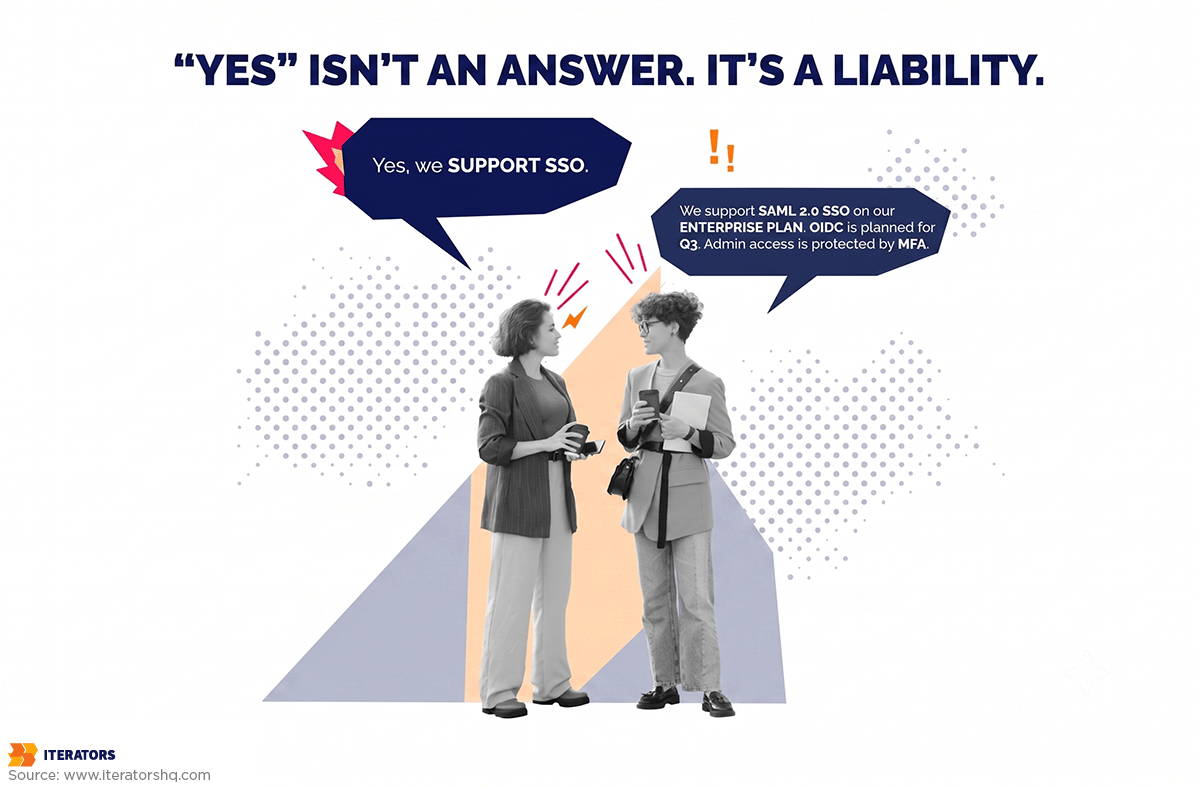
The difference between a vague answer and a defensible one is specificity. Vague answers trigger follow-up questions. Precise answers close them.
Bad answer:
Yes, we support SSO.
Better answer:
We support SAML 2.0 SSO for customers on our Enterprise plan. OIDC support is currently in development and planned for Q3 2025. All admin access to production systems is protected by MFA regardless of SSO configuration.
The better answer is more honest, more complete, and harder to challenge. It also signals architectural maturity — the buyer can see that you understand your own system.
Bad answer:
Yes, we perform annual penetration testing.
Better answer:
We conduct annual third-party penetration testing of our application and infrastructure. Our most recent test was conducted in [month, year] by [firm name or “an independent security firm”]. A summary report is available under NDA upon request. Critical and high findings are remediated within 30 and 90 days respectively per our vulnerability management policy.
The AICPA SOC 2 framework and the NIST Cybersecurity Framework both emphasize that evidence — not intent — is what counts in a security evaluation. Precise answers are the written equivalent of evidence.
Use Compensating Controls Where Appropriate
A compensating control is a security measure that reduces the same risk as the required control, even if it doesn’t satisfy the requirement exactly.
If you don’t have automated quarterly access reviews, you might have:
- Manual access reviews conducted by a designated administrator every 90 days, documented in a shared log
- MFA required for all production system access
- Least-privilege access enforced at the infrastructure level
- All access events logged with 90-day retention
- Immediate access revocation process documented and tested
That combination may satisfy the buyer’s risk requirement without the automated system. Documenting it precisely — rather than claiming the automated system exists — is both honest and commercially viable.
Create a Remediation Roadmap
For gaps that are real and material, a remediation roadmap is more credible than a blank “No” with no context.
A useful roadmap includes:
- The specific control gap
- The risk it represents to the buyer
- The interim compensating control currently in place
- The implementation owner
- The estimated completion timeline
- The evidence that will be provided upon completion
Enterprise buyers understand that SaaS vendors are not always at the same maturity level as their internal security teams. What they cannot accept is a vendor that doesn’t know what it’s missing or has no plan to address it.
Security Questionnaire Help for Startups Selling to Enterprise
The tension is structural. Startups are built for speed. Enterprise procurement is built for risk reduction. Those two systems are in direct conflict, and the security questionnaire is where that conflict becomes visible.
A startup’s MVP architecture is optimized for shipping fast: shared databases, manual processes, informal access controls, no formal policies. An enterprise-ready architecture is optimized for auditability, organizational complexity, and operational resilience. Those are not the same architecture.
The SaaS development decisions that feel irrelevant at seed stage — multi-tenant data isolation, role hierarchy, audit logging as a first-class data flow — become procurement blockers at Series A when the first enterprise deal arrives.
The pattern we see repeatedly: a startup has a genuinely strong product, real enterprise interest, and a questionnaire that exposes the gap between what was built for speed and what enterprise buyers require for trust. When you hit this wall, getting professional security questionnaire help provides the exact translation layer needed between startup speed and enterprise risk. The product works. The architecture just needs to grow up.
That gap is addressable — but it requires honest assessment, targeted engineering, and documentation that reflects the actual system rather than the ideal one.
When Should You Get Professional Security Questionnaire Help?

Strong signals that expert help is the right call:
- The deal is strategically important — losing it would materially affect the business
- The questionnaire has more than 100 questions
- The buyer is asking for SOC 2, ISO 27001, HIPAA, or GDPR evidence you don’t currently have
- Your team is uncertain which answers carry legal risk
- Engineering needs to build missing controls and doesn’t know which ones to prioritize
- A security review is actively blocking procurement and the buyer is waiting
- You need SSO, RBAC, audit logs, or infrastructure hardening that doesn’t exist yet
- The answers require cloud architecture review beyond your current team’s expertise
- You’re selling into fintech, healthcare, HR, biotech, or enterprise SaaS
- You have no dedicated security or compliance lead on the team
When you probably don’t need it:
- The questionnaire is short (under 50 questions) and clearly within your current capabilities
- The buyer is small and the contract doesn’t include security warranties
- No regulated or sensitive data is involved
- You already have mature compliance documentation and a security owner who understands it
- Your answers are fully supported by existing evidence
Final Security Questionnaire Decision Framework
| Situation | Recommended Path |
|---|---|
| Low-value deal, short questionnaire, clear answers with existing evidence | DIY |
| High-value deal, unclear answers, weak or missing documentation | Get expert security questionnaire help |
| Buyer requires controls you don’t currently have | Expert help + targeted build |
| Regulated data involved (health, financial, HR, legal) | Expert security questionnaire help strongly recommended |
| Enterprise asks for SOC 2 and you don’t have it | Transparent response + readiness plan + expert support |
| You already failed one security review with this buyer | Expert help before resubmission |
| You need SSO, RBAC, or audit logs implemented fast | Expert implementation support |
| Your team is answering “Yes” to things that aren’t fully true | Stop, get expert security questionnaire help immediately |
The right answer is not “build everything.” The right answer is: know what matters, answer honestly, and build the gaps that actually block the deal.
Conclusion
Vendor assessments are trust tests. They expose whether your architecture, your processes, and your documentation are at the level your buyer needs before they bring your software inside their organization.
Unsupported answers create legal and reputational exposure that is difficult to repair once a procurement team has seen it. Building every missing control without prioritization wastes engineering capacity on requirements that may not be blocking the deal at all. Securing expert security questionnaire help that combines accurate answers, technical gap analysis, and targeted implementation reduces deal risk by aligning what you say with what you’ve actually built — and by identifying which gaps are actually kill conditions versus which ones have acceptable compensating controls.
The open question for most startups at this stage: do you know which of your “Yes” answers are fully supported, which are compensating controls, and which are architectural gaps that will surface the moment evidence is requested?
If the answer is uncertain, that’s the first thing to resolve — before the spreadsheet goes back to procurement.