

Every team I’ve worked with that got burned by staff augmentation failure made the same mistake: they treated the first thirty days as an access-provisioning task instead of an integration protocol. Someone gets a GitHub invite, a Slack handle, and a Jira login. Nobody explains why the architecture looks the way it looks, who owns the release, or what happens when a pull request sits untouched for four days. Six months later, the client says the developers “needed too much management.” The vendor says “requirements were unclear.” Both statements are true, and neither one is the actual problem.
I’ve sat on both sides of this. As a co-founder at Iterators, I’ve onboarded developers into other people’s codebases and brought outside developers into ours. The pattern repeats with almost mechanical consistency: staff augmentation failure rarely starts with a bad engineer. It starts with a plan that never existed.
A plan without execution is fantasy. Execution without a plan is chaos. Both are equally unprofessional. Staff augmentation sits at the intersection of those two failure modes. A company executes fast by hiring developers now and expecting faster delivery, but has no plan for onboarding, ownership, or measuring whether the engagement works. That combination is what causes staff augmentation failure in the first six months, not skill gaps.
What Staff Augmentation Failure Actually Looks Like
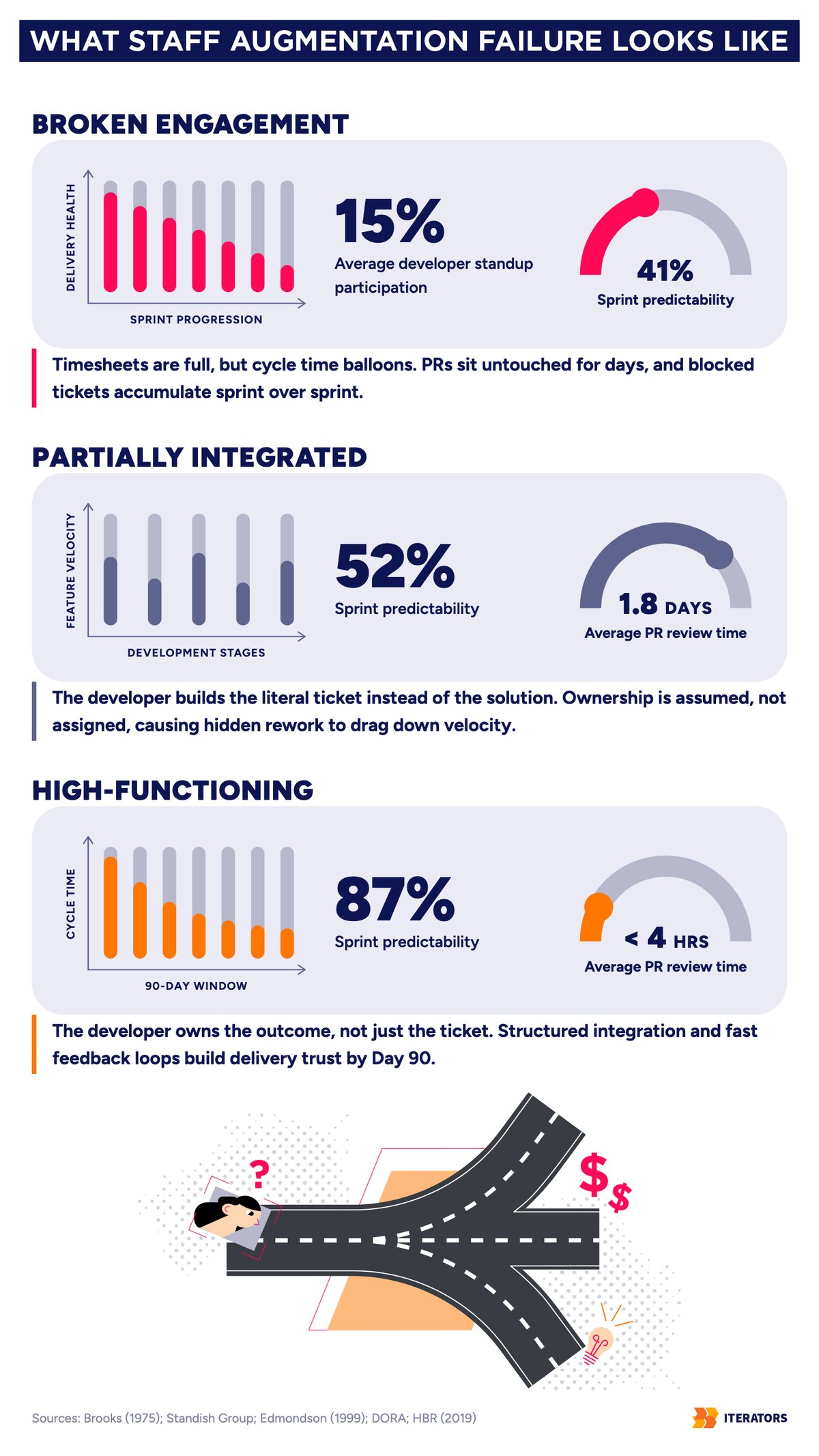
It doesn’t look like a disaster. It looks like normal Tuesday.
A developer waits three days for repository access because nobody assigned an owner to provisioning. A sprint starts with tickets that describe what to build but never why, so the augmented developer builds the literal request instead of the useful solution. Standups turn into a ritual where the external team speaks only when addressed directly. Pull requests pile up because the one person who understands the payment module is also the one person reviewing every PR touching it.
None of this shows up as an incident. It shows up as a slow erosion of trust, and by month four someone on the client side says the augmented team “just isn’t proactive,” while someone on the vendor side says the client “never explains anything.” Both are symptoms. The disease is structural.
Here’s the definition I use when a client asks me to diagnose a failing engagement: staff augmentation failure happens when external developers are added to a team without enough onboarding, ownership clarity, communication rhythm, or delivery accountability to produce measurable progress. It is an integration failure, not a talent failure.
Six Staff Augmentation Failure Modes, Not One
I don’t think staff augmentation failure has a single cause. I think it happens for six specific, repeatable reasons, and most failing engagements have three or four running at once.
1. Onboarding is treated like access provisioning
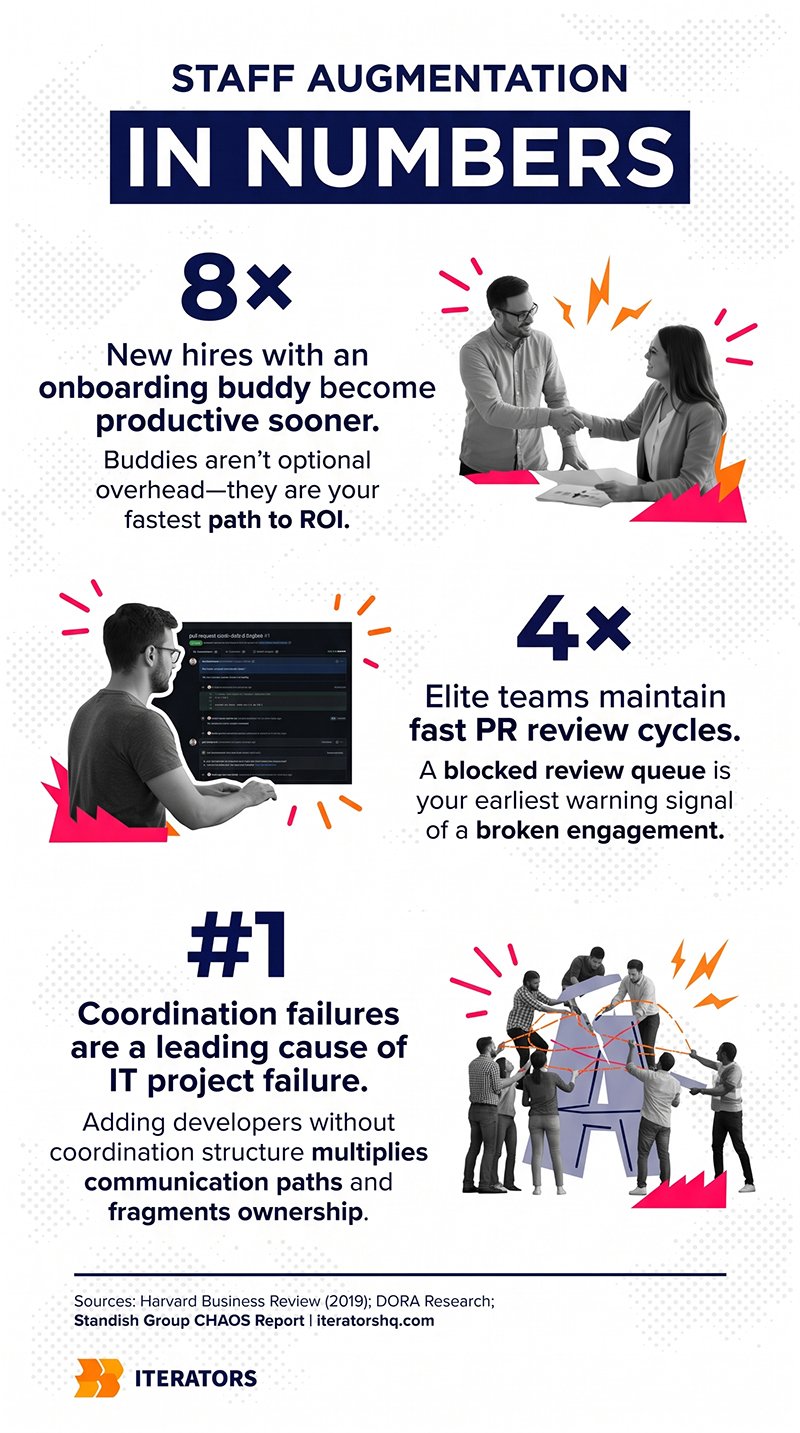
Giving someone a login is not onboarding. Real onboarding means the developer understands the business problem the code is solving, has a map of the architecture, knows who reviews their code and how fast, and has a first ticket small enough to finish and real enough to matter.
At Iterators, when we brought developers into Citrine Informatics’s platform to help build out their MLOps tooling, the first two weeks weren’t spent writing feature code. They were spent understanding how Citrine’s data scientists actually worked: what made a notebook deployment painful and what “versioning” meant to them specifically, not in the abstract. Skipping that step doesn’t save time. It moves the confusion later, when it’s more expensive to fix. This early shortcut is one of the most common triggers of staff augmentation failure I see.
Developer onboarding often takes months, not days. Without a structured onboarding process, companies also increase the risk of early disengagement and absorb the cost of recruiting, lost context, and another ramp-up when someone leaves. If your staff augmentation contract is six or twelve months long, a long ramp can consume much of the engagement.
2. Ownership is unclear
If nobody owns the outcome, everyone owns the excuse.
I’ve watched projects where backlog priority, architecture decisions, QA sign-off, and release approval each belonged to a different implicit owner. They were implicit because nobody wrote them down. The augmented developers didn’t know who could say “yes, ship it.” The client’s internal team assumed the vendor’s tech lead was making architecture calls. The vendor assumed the client’s product manager was setting priority. Everyone was accountable to nobody. This kind of ambiguity is a textbook cause of staff augmentation failure.
This is where a RACI matrix earns its place: Responsible, Accountable, Consulted, and Informed. It isn’t bureaucracy. It prevents the exact ambiguity that kills augmented teams.
| Delivery Area | Responsible | Accountable | Consulted | Informed |
|---|---|---|---|---|
| Backlog priority | Product Manager | Product Owner | Tech Lead | Augmented team |
| Architecture decisions | Tech Lead | Engineering Lead | Senior augmented dev | PM |
| Pull request review | Designated reviewer | Tech Lead | Dev team | QA |
| QA acceptance | QA Lead | Product Owner | Developers | Stakeholders |
| Release to production | DevOps / Tech Lead | Engineering Lead | QA | Business team |
Before you add a single external developer to a team, this table should already have names in it. Roles aren’t enough. It needs names.
3. Communication turns into “speak when spoken to”
We use AI transcription on internal meetings now to check participation, and the pattern is consistent: in functional projects, even the quiet developers talk a meaningful share of the time during standups and planning. In broken ones, one person dominates and everyone else waits to be asked a direct question before opening their mouth.
That silence is data. It tells you the augmented developers have stopped believing their input matters, usually because the first three times they raised a concern, nobody acted on it. Once that happens, they stop flagging risk. They just build what the ticket says, even when the ticket is wrong, because raising the flag costs social capital they no longer have.
Every engineer must think about the product. The moment an augmented developer stops thinking about the product and starts only executing tickets, you’ve lost the value of hiring a senior person and you’re paying senior rates for junior output. That shift, quiet compliance instead of engagement, is exactly how staff augmentation failure builds up.
4. Management overhead is underestimated
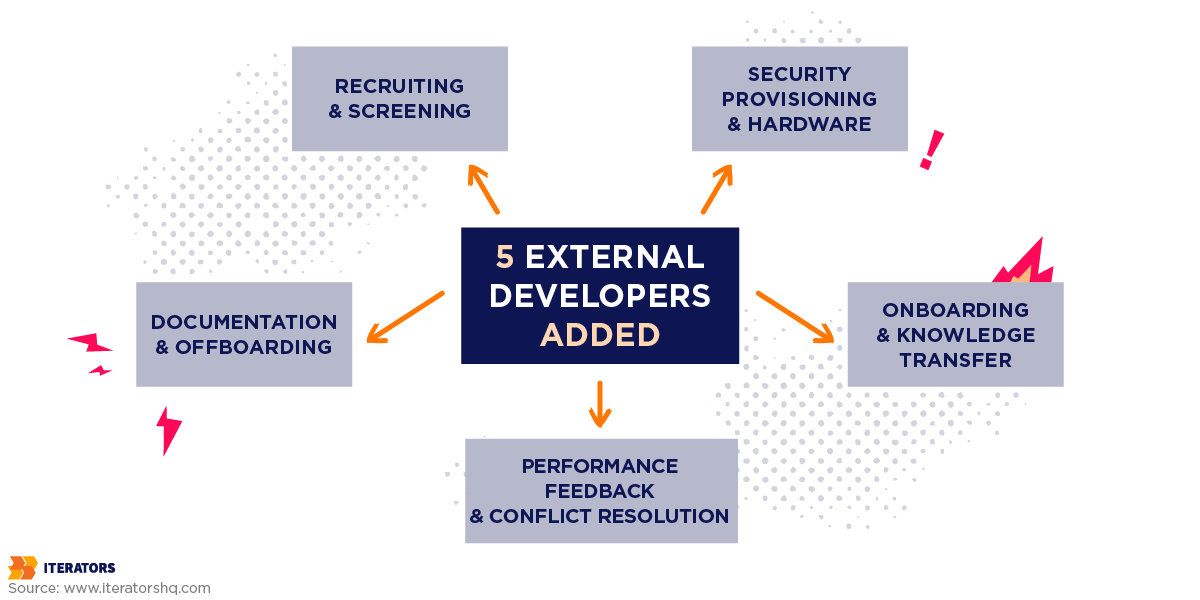
“We’ll just hire five developers” sounds simple until you count what surrounds the developers: recruiting, technical screening, security provisioning, hardware, onboarding, performance feedback, offboarding, knowledge sharing, mentorship, documentation, conflict resolution. Companies routinely price the developer and forget to price the coordination.
Frederick Brooks named this problem decades ago and it hasn’t gone stale: “Adding manpower to a late software project makes it later.” Every new person on a team adds communication paths, not just hands. Five external developers dropped into a team without additional process multiply the number of Slack threads, not the output.
The Standish Group’s CHAOS research has repeatedly identified project management and coordination problems as causes of failed IT delivery. This isn’t specifically a vendor problem or a client problem. It’s a planning gap created by whoever assumed capacity equals capability, and underestimating that overhead is one of the fastest paths to staff augmentation failure.
5. Culture gets reduced to time zones
I get this question constantly from US clients evaluating nearshore teams: “How’s the time zone overlap?” It’s a fair question, and for Poland-based teams working with US clients, the overlap is usually solid, with several hours of shared core work time.
But the real failure mode isn’t scheduling. It’s status bias. I’ve seen clients treat developers from lower-cost countries as inherently less senior, less smart, less capable of strategic input because they cost less per hour. In practice, those developers are often writing the core code and carrying deep technical expertise while being excluded from the “validation” conversations where product decisions get made.
That exclusion is what destroys the value of the engagement, not the time zone. Amy Edmondson’s research on psychological safety describes this mechanism: people stop raising ideas, questions, and concerns when they believe doing so will get them marginalized rather than heard. An augmented developer who’s been quietly signaled that their opinion doesn’t count will stop offering one. You’ll keep getting code. You’ll stop getting judgment. That erosion is a slower, quieter version of staff augmentation failure, but it’s just as costly.
6. Success gets measured by hours instead of outcomes
Hours tell you someone was present. They don’t tell you whether the partnership works. I’ve reviewed engagements where every timesheet looked clean, every ticket got closed, and the product still shipped the wrong thing, slower than it should have, with more rework than anyone budgeted for.
The metrics that surface staff augmentation failure early are tied to flow, not attendance: cycle time, pull request review time, number of blocked tickets, defect escape rate, sprint predictability. DORA’s research connects fast feedback and effective review practices with better software delivery performance. If your augmented developer’s PRs are sitting for three days before anyone looks at them, that number tells you more about the state of the engagement than any status meeting will.
Where does your staff augmentation contract go?
Interactive ramp model
With a clear onboarding process, a strong developer should be up to speed in about a month. Switch on the failure modes you recognize on your team and watch the ramp eat into the contract.
Your first-90-days fixes
Staff Augmentation, Team Extension, Outsourcing: Not the Same Thing
A lot of what gets called "staff augmentation failure" is actually a model mismatch. The client bought one thing and expected a different one.
| Model | Who owns delivery | Best fit | Where it breaks |
|---|---|---|---|
| Staff augmentation | Client | Filling a specific skill gap when internal management capacity is strong | Client underestimates the coordination work required |
| Team extension | Shared, client-led | Scaling an existing team while keeping strategic control | Poor integration into existing rituals and tooling |
| Outsourcing | Vendor | Defined scope, limited internal management bandwidth | Scope drifts and nobody agreed on what "done" means |
| Full product takeover | Vendor/partner | No internal CTO or product delivery capacity | Wrong fit if the client actually wants full control |
We've run all four models. With Myopolis, an entire internal team had to be replaced and a new platform plus mobile app launched within months. That's closer to a full team extension with heavy delivery responsibility on our side because there was no internal capacity left to manage anything. With Deed's Slack integration, it was closer to classic staff augmentation: a scoped feature, weekly syncs, a shared Jira board, clear boundaries. With Imperative, what started as augmentation turned into full technical ownership over nearly a decade because the relationship survived multiple leadership transitions and the trust to hand over more responsibility built up over time.
None of these are better or worse in the abstract. They fail when the client thinks they bought outcome ownership but actually bought developer capacity. They also fail when a vendor assumes they were handed strategic control they were never given.
What is the business question this answers? That question should get asked before you pick a model, not after the engagement stalls.
The Ninety Days That Prevent Staff Augmentation Failure
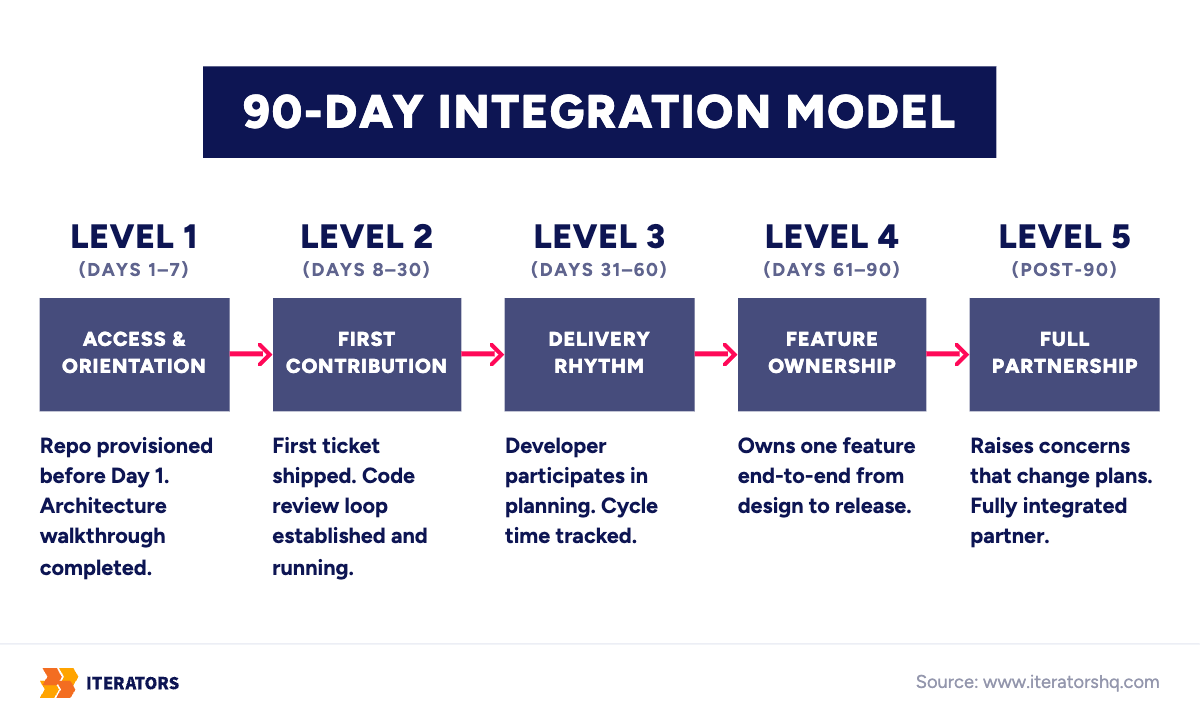
If I had to compress everything above into an operating window that prevents staff augmentation failure, it's this: the first ninety days determine whether an augmented engagement becomes a partnership or a slow-motion breakup. Here's how we structure it.
Days 1–30: Integration. Access is ready before day one, not requested on day one. The developer gets an architecture walkthrough, not just a repo link. There's a named internal buddy. Microsoft's onboarding research found that more frequent contact with an onboarding buddy helped new hires report becoming productive sooner. The first ticket is small enough to ship inside the first sprint. By day 30, you should have a working code review loop and a documented list of whatever confused the new developer most. That list tells you exactly what your documentation is missing for the next person.
Days 31–60: Delivery rhythm. The augmented developer starts participating in planning, rather than only executing what planning produced. You start tracking a cycle time baseline. Decisions made in Slack get written down somewhere permanent: a decision log, a Jira comment, anything searchable. Six weeks from now, nobody will remember why a particular tradeoff got made, and re-litigating settled decisions is one of the most expensive things a team can do to itself.
Days 61–90: Ownership. By now, the augmented developer should own a feature end-to-end. This means actual ownership from design conversation through production release, rather than assigned tickets related to a feature. If they can't operate in ambiguity yet, that's diagnostic information, not a failure. It tells you whether to invest more in ramp-up or whether the fit is wrong. This is also the point where you have enough data, including cycle time trend, PR review speed, defect rate, and sprint predictability, to make an informed call on whether to scale the engagement, adjust the ownership model, or walk away.
If you don't understand what will happen when it breaks, you're not done. That applies to code, and it applies to engagements. If you can't describe what happens when the augmented developer goes on vacation, or when the client's product owner leaves, you haven't built a resilient partnership. You've built a dependency on two specific people staying in their seats.
Where Staff Augmentation Failure Starts on the Vendor Side
I want to be fair about this, because it's easy to write an article like this and make it sound like every failure is the client's fault for underinvesting in management. Plenty of failures start with the vendor.
The most common vendor-side mistake is treating staff augmentation as a sales funnel for CVs instead of a delivery problem. A client says they need a senior backend developer. The vendor sends three CVs, the client picks one, and the vendor considers the job done. That pattern is a direct setup for staff augmentation failure, even when every CV was strong. Nobody on the vendor side asks whether the client's existing process can actually absorb a new person productively. Nobody checks in at day 30 to ask what's confusing. Nobody flags that the client's ticket descriptions are too vague to act on without a clarifying conversation that never gets scheduled.
Technology is a tool, not a religion, and the same applies to staffing models. Augmentation is a tool for a specific problem, not a religion you sell regardless of fit. If a vendor keeps proposing more headcount when the actual gap is process, that's malpractice dressed up as customer service.
What I Watch For to Catch Staff Augmentation Failure Early
After enough of these engagements, I've stopped asking "are the developers good?" as my first diagnostic question. Good developers get wasted inside bad integration all the time. The questions I actually ask:
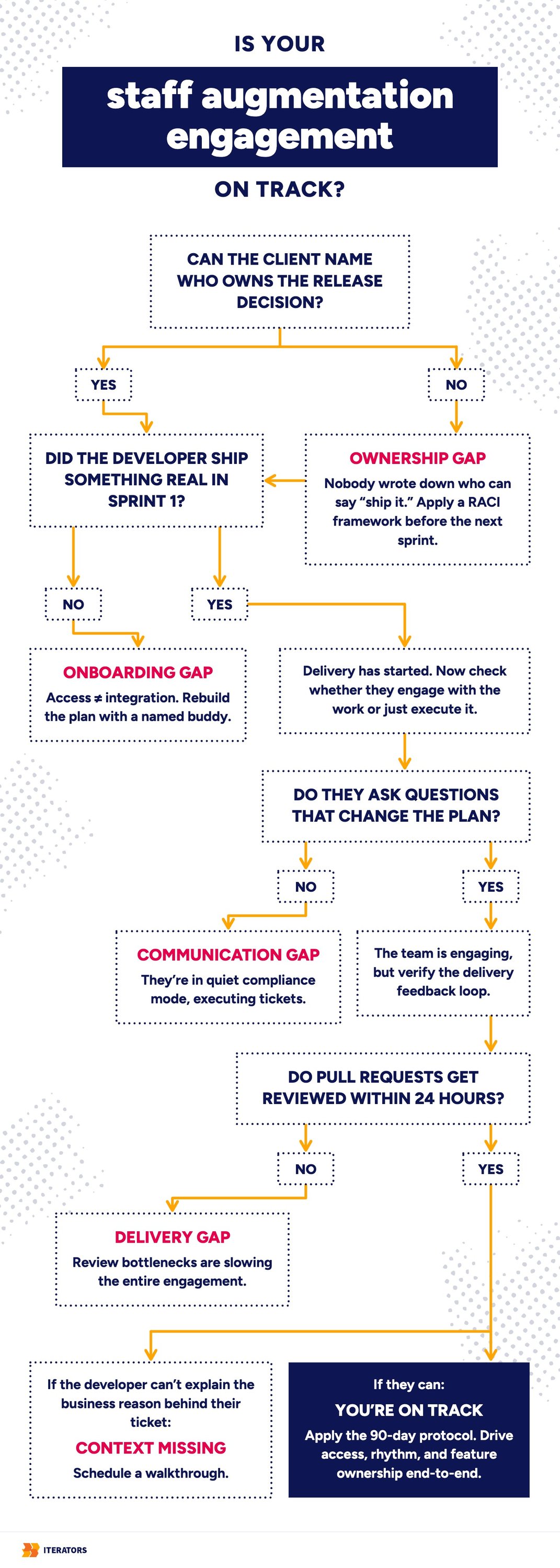
- Can the client name who owns the release decision, without hesitating?
- Did the augmented developer ship something real in the first sprint, or spend two weeks "getting oriented"?
- In the last three standups, did the augmented team ask a clarifying question that changed the plan, or did they just report status?
- How long did the last three pull requests sit before someone reviewed them?
- If I asked the augmented developer to explain the business reason behind their current ticket, could they answer without checking the ticket description?
If the answer to most of these is bad, you're looking at staff augmentation failure regardless of how the invoices look. The most important part of engineering work is sometimes saying something doesn't need to be built. The augmentation equivalent is saying an engagement doesn't need to continue in its current shape. Not every failing partnership needs a rescue plan. Some need an honest conversation about whether the model was ever right for the problem in front of you.
Staff augmentation isn't broken as a model. It breaks when companies buy capacity and expect capability, when onboarding stops at access, and when nobody writes down who owns what before the first sprint starts. Fix those three things and most of what gets called staff augmentation failure never happens in the first place.