

Every founding team I’ve worked with that hit a velocity wall made the same mistake, resulting in a CTO gap: they hired engineers before anyone owned the system those engineers were building. Not because they were careless. Because early on, it felt like it was working. Three developers, fast decisions, features shipping. Then they hired two more. Then three more. And somewhere between five and ten engineers, the team that used to ship weekly started shipping monthly, and nobody could explain why.
That’s the CTO gap. Not a missing job title. A missing function: the person or structure accountable for architecture, engineering standards, security posture, and the tradeoffs between what the product needs now and what the system can sustain long-term.
The technical leadership gap in startups usually appears quietly: first as a few unmade architecture decisions, then as compounding technical debt, and finally as a development team that gets slower as it gets bigger.
What the CTO Gap Actually Is
Here is a precise definition, because the term gets used loosely:
The technical leadership gap in startups is the point where engineering headcount grows faster than technical ownership. Developers are writing code. Features are being built. But no one is accountable for architecture, technical strategy, quality standards, security, documentation, hiring standards, or the tradeoffs between product speed and long-term scalability.
The CTO gap is not about having the wrong engineers. It is about having no one whose job it is to answer the questions that determine whether the system can keep growing.
Those questions include:
- What database pattern are we standardizing on?
- Who decides when we split a service versus keep the monolith?
- What is our definition of done, and who enforces it?
- How do we handle authentication across services?
- When a senior engineer proposes a rewrite, who arbitrates?
- What does our infrastructure look like when we have 10x the current load?
- Who is responsible for knowing our security posture?
In a startup with a CTO function, these questions have owners. In a startup without one, they get answered informally, by whoever has the most opinions, by the founder in a late-night Slack message, or by nobody at all.
The CTO Function Exists Before the Job Title Does
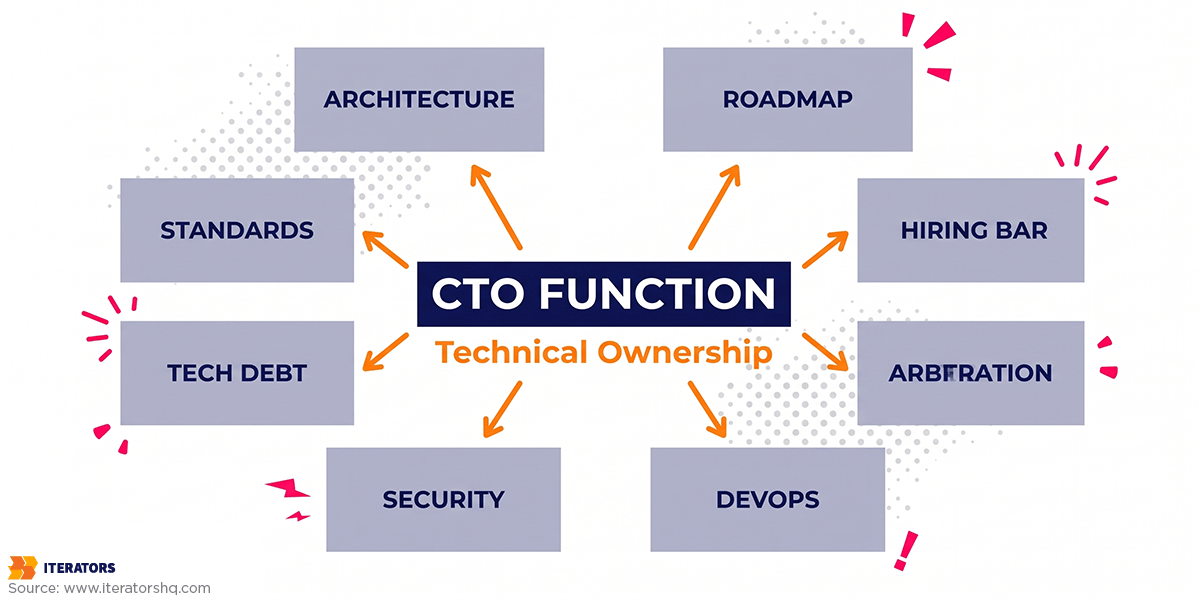
This is the nuance most articles miss. A startup does not need a Chief Technology Officer on day one. But it does need someone to own the CTO function, even if that person is a senior engineer with explicit decision authority, a fractional technical leader, or an external development partner.
The CTO function includes:
- Architecture ownership and documentation
- Technical roadmap and sequencing
- Engineering standards and quality gates
- Hiring bar and onboarding process
- Security posture and compliance direction
- DevOps and infrastructure decisions
- Technical debt prioritization
- Product/engineering tradeoff arbitration
When none of these have a named owner, the startup is running without a technical foundation. It can survive that way for a while. It cannot scale that way.
Why Early Startups Can Survive Without a CTO
At one to two engineers, the cognitive load is small enough that informal decisions work. One person knows why the database was structured a certain way. The other person knows why the deployment is set up as it is. They talk constantly. The system fits in both their heads.
This creates a false baseline. The startup builds a mental model of itself as an organization that moves fast without process. When it hires more engineers, it tries to maintain that model. It doesn’t work.
The 3-5-10 Pattern: How the CTO Gap Compounds
The CTO Gap: Coordination Tax
Interactive Insight
Every engineer you hire adds a line, not just a name. Drag the slider to grow the team and watch how fast unmanaged coordination overtakes it.
(Brooks’ Law: n(n−1)/2)
Decisions happen quietly. Informal calls still work — nobody’s noticed the missing architecture yet.
Close The Gap →This is not a theoretical framework. It describes what actually happens on teams that grow without technical leadership.
At 3 Engineers, Decisions Happen Quietly
One engineer picks a framework. Another sets up deployment. Someone else chooses the database pattern. It feels fast because nobody is asking for permission.
Hidden risk begins here:
- No shared architectural principles
- No documentation of why decisions were made
- No explicit assumptions about future scale
- No definition of what “done” means
None of this is visible yet. The product is shipping. The founders are happy.
At 5 Engineers, Product Speed Starts Hiding Architecture Drift
Pull requests become harder to review. Each engineer has a preferred pattern: one uses a repository layer, another writes queries directly, a third imports a library the others have never seen. Deployment is inconsistent. Testing is whatever each engineer does by default.
The product manager starts seeing estimates that don’t make sense. “Why does adding a filter take two weeks?” The engineers know why: the data layer was built three different ways and none of them support the query efficiently. But they don’t have the authority or the shared framework to fix it systematically.
The founder starts getting pulled into technical conversations they shouldn’t be having.
At 10 Engineers, Every Missing Decision Becomes a Tax
This is where the CTO gap becomes expensive.
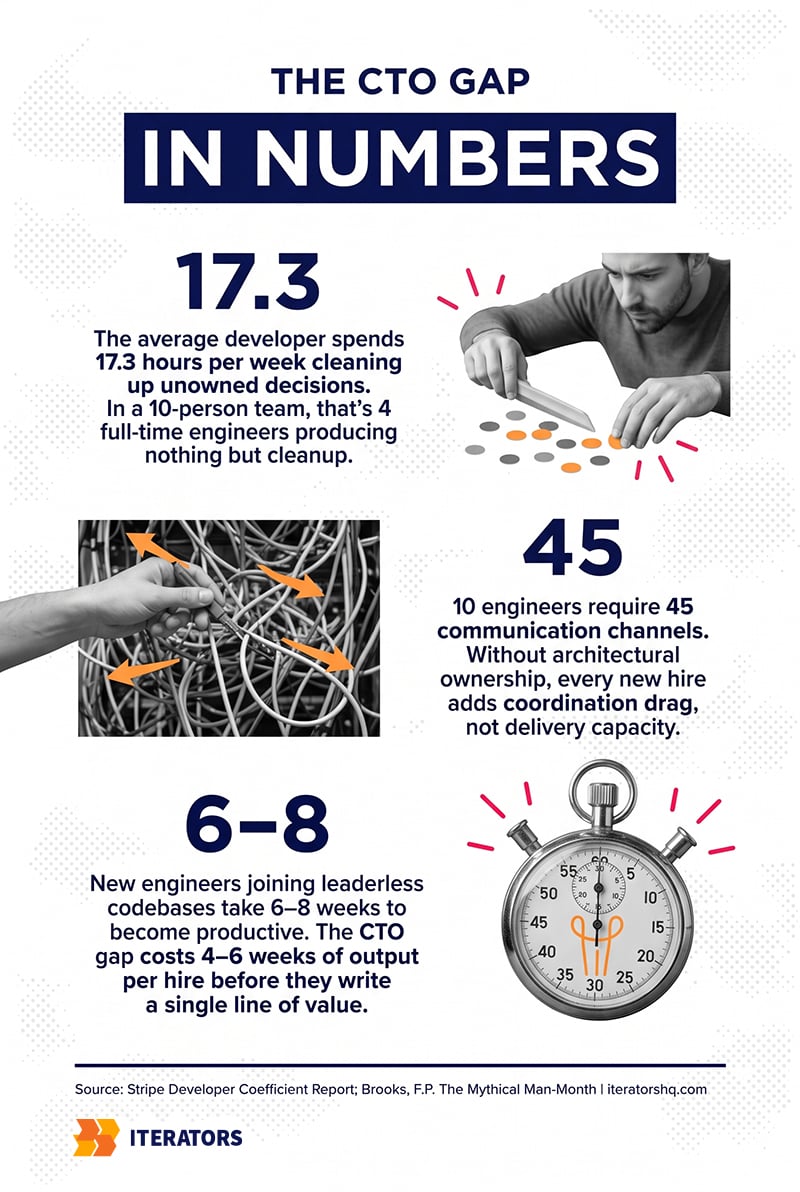
New hires take three to four weeks to become productive because there is no documented architecture, no onboarding runbook, and no standard for how the codebase is organized. Senior engineers spend meeting time debating architecture instead of building. The founder is now the default technical decision-maker, which means every technical decision waits on the founder’s calendar.
Fred Brooks described this in 1975: “Adding manpower to a late software project makes it later.” The mechanism is communication overhead. Ten engineers require 45 communication channels. Three engineers require three. When there is no technical owner to set the architectural framework that reduces those channels to a manageable set of interfaces, every new hire adds coordination drag rather than delivery capacity.
A useful benchmark is Stripe’s Developer Coefficient report, which estimated that developers spend 17.3 hours per week on maintenance work, including debugging, refactoring, and dealing with bad code. At a team of ten, that is roughly the equivalent of four full-time engineers cleaning up after decisions that were never owned.
What Breaks First When the CTO Gap is Ignored
The failure patterns are predictable. I have seen all of them.
Technical Debt Becomes Product Debt
Technical debt starts as code-level shortcuts: a hardcoded value here, a duplicated function there. Without a technical owner enforcing standards and allocating time for remediation, it compounds into architectural technical debt: the wrong abstraction baked into the core data model, a service boundary that made sense at 1,000 users but breaks at 100,000, a deployment pipeline that requires manual intervention for every release.
Martin Fowler’s framing on technical debt is useful here: debt accrues interest. Every new feature built on top of a broken architecture costs more than the feature before it. At some point, the interest payments consume the entire engineering budget. The product roadmap stops being a list of things the team wants to build and becomes a list of things the team cannot build until they fix the foundation.
Senior Engineers Become Competing Architects
Strong engineers have opinions. That is a feature, not a bug, until there is no one to arbitrate.
Without a CTO function, architecture decisions get made by whoever argues most persistently in Slack. The loudest engineer wins, not the one making the best tradeoff. This is not a people problem. It is a structural problem. Engineers cannot be expected to reach consensus on decisions that require business context they do not have.
Good engineers leave when direction is unclear. They do not leave because the work is hard. They leave because they cannot tell whether the work they are doing is going to be thrown away in three months.
Project Management Starts Masking Architecture Problems
More Jira discipline will not fix missing technical direction.
When a team suffers from a CTO gap, project managers often try to compensate by adding process: more detailed tickets, more sprint ceremonies, more status updates. This creates the appearance of organization while the underlying system continues to decay. Velocity charts show symptoms. Stories are being closed, tickets are being completed. But the root cause is invisible to anyone who is not in the codebase.
The PM is managing coordination. Nobody is managing the system.
Security and Compliance Arrive Too Late
A startup that has been operating without a technical owner for two years will eventually land an enterprise client. That client will send a vendor security questionnaire. It will ask about SOC 2 compliance, audit logging, data encryption at rest and in transit, access control policies, and incident response procedures.
The NIST Secure Software Development Framework requires these controls to be integrated into the development lifecycle, not bolted on after the fact. When a startup has a CTO gap, security is nobody’s job. Infrastructure is manually patched. Access credentials are shared. Audit logs do not exist.
Retrofitting these controls into a two-year-old codebase built without them is not a sprint task. It is a multi-month engineering project that pauses the product roadmap and risks the enterprise deal the startup was trying to close.
We saw this pattern with Imperative. When Iterators took on full technical ownership of their HR platform, one of the first tasks was building SOC 2-grade controls, including security, availability, processing integrity, confidentiality, and privacy, into the architecture from the ground up. That work was foundational to Imperative’s ability to close enterprise clients at companies like Airbnb, MetLife, and GSK. It could not have been done as an afterthought.
The Founder Becomes the Bottleneck
This is the failure mode founders recognize last, because it does not feel like a failure. It feels like staying involved.
When there is a CTO gap, the founder becomes the default arbitrator for every technical decision. Engineers wait for the founder to approve architecture choices. Product commitments are made without understanding technical constraints. The founder thinks they are helping. They are slowing the entire system down.
A founder making technical decisions they do not fully understand is not a substitute for technical leadership. It is a liability.
What the Startup CTO Role Actually Owns

The confusion between “CTO” and “senior engineer” causes founders to underhire for the function. Here is what the role actually covers.
Architecture Decisions Are Business Decisions
Technology is a tool, not a religion. Every architecture decision is a business decision in disguise. Before designing anything, the technical owner asks: What is the business question this answers?
Monolith versus microservices: a business decision about whether the team can operationally manage distributed systems at this stage of growth. Build versus buy: a business decision about where the company’s engineering investment creates proprietary advantage. Cloud provider selection: a business decision about cost, compliance jurisdiction, and vendor lock-in.
A senior engineer can implement these decisions. A CTO function makes them, with full context about the business’s financial runway, the team’s operational maturity, the compliance requirements of target customers, and the tradeoffs between speed and long-term flexibility.
Engineering Process Is Not Administrative Overhead
Definition of done, testing strategy, CI/CD pipeline, code review norms, Architecture Decision Records, documentation ownership, release process: these are not bureaucratic overhead. They are the infrastructure that determines whether the team can ship consistently.
Software documentation is a direct example. When a startup lacks a technical owner, documentation does not happen. When a senior engineer leaves, they take with them the knowledge of why the system was built a certain way. The next engineer who touches that code spends days or weeks reconstructing context that should have taken ten minutes to read.
Hiring and Onboarding Are Technical Strategy
The technical leader sets the hiring bar. That means more than “can this person code.” It means what level of seniority the team actually needs, what skills are missing, and how to evaluate candidates without wasting two months on a process that produces the wrong hire.
Developer onboarding is directly tied to documentation and architectural clarity. A new engineer in a well-led team can be productive within two weeks. A new engineer in a leaderless team with no documentation and inconsistent patterns takes six to eight weeks to become productive, if they stay.
Product Management vs Technical Leadership
This distinction matters because founders often assume a strong PM can fill the gap.
Product management owns what to build and why. Project management owns coordination, delivery visibility, and timeline tracking. Technical leadership owns how the system should be built, what it can sustain, and what tradeoffs are acceptable.
A PM can manage a backlog. They should not be forced to arbitrate architecture debates. When they are, they make decisions without the context to make them well, and the engineers lose respect for the process.
When to Fill the CTO Gap
Does your startup have
a CTO gap?
Find out before it costs you.
“At 10 engineers, the CTO gap costs ~4 FTEs in maintenance alone.”
— Stripe Developer Coefficient Report
Here is a diagnostic checklist. If more than three of these are true, the gap is already costing the startup money.
- Three or more engineers and no named architecture owner
- New engineers take more than two weeks to become productive
- Every new feature triggers a discussion about rewriting something else
- The founder is the default technical decision-maker
- Senior engineers disagree on core patterns with no resolution mechanism
- Security or compliance questions are appearing in sales conversations
- The product roadmap has items blocked by “technical debt” with no remediation plan
- Deployment requires manual steps
- There is no documented definition of done
- The team is shipping, but nobody is confident in the estimates
Full-Time CTO vs Fractional CTO vs Development Partner
| Option | Best For | Weakness | What They Own |
|---|---|---|---|
| Full-time CTO | Series A+, complex technical domain, large team | 3–6 month hiring cycle, $250K+ cost, equity dilution | Everything, but only after they’ve ramped |
| Advisory-only fractional CTO | Board-level governance, investor communication | Often 10 hrs/week with no execution capacity; strategy without delivery | Strategy documents, not systems |
| Technical advisor | Specific domain expertise, one-time decisions | No ongoing accountability, no team authority | Recommendations |
| Senior tech lead with authority | Stable product, small team, low compliance needs | Limited strategic scope, may lack business context | Implementation standards |
| Development partner with technical leadership | Immediate need, variable team size, execution + strategy required | Requires trust and clear scope | Architecture, delivery, team, process |
The critical failure mode in the fractional CTO market is the strategy-execution gap. A fractional leader who attends board meetings and produces architecture diagrams but has no authority over the delivery team and no capacity to build anything is not filling the CTO gap. They are describing it more clearly.
Technical leadership without decision rights and execution capacity is advice. Startups in the CTO gap do not need more advice. They need someone accountable for outcomes.
When a Tech Lead Is Enough
Be honest about this. A tech lead with real decision authority may be sufficient when:
- The product scope is narrow and stable
- The team is small (under five engineers)
- The founder has strong technical fluency and can make architecture calls
- Compliance and security requirements are low
- The tech lead has explicit authority to make and enforce decisions
The distinction is authority, not title. A tech lead who can say “we are not building it that way” and have that decision stick is performing a CTO function. A tech lead who makes recommendations that get overruled by whoever argues loudest is not.
How to Close the CTO Gap Without Overhiring
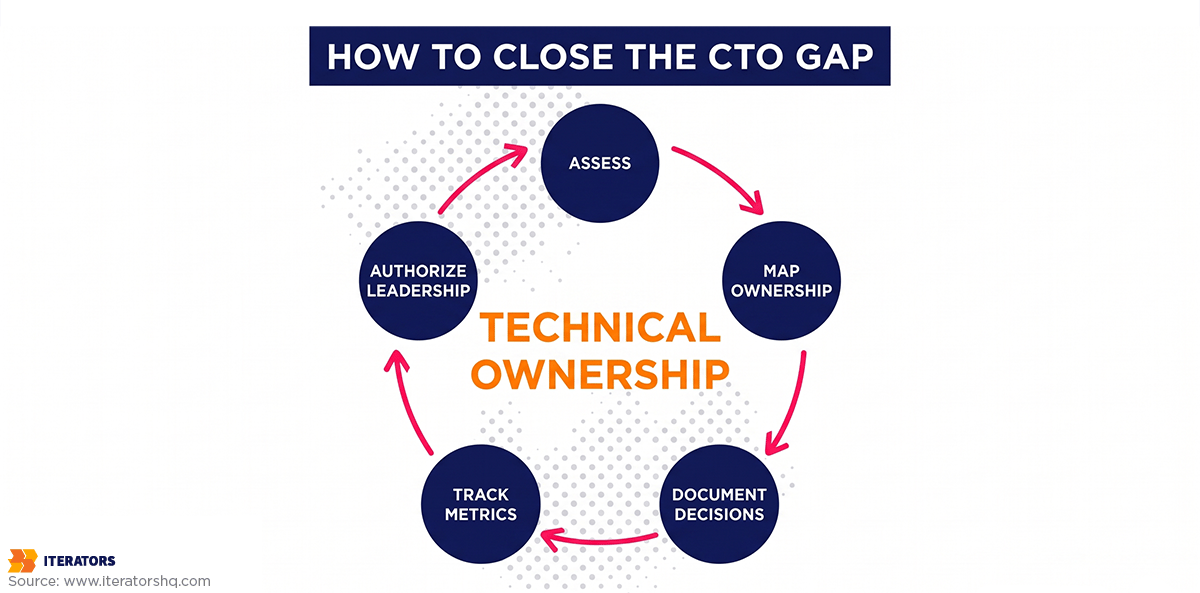
If the team is already stuck in the CTO gap, here is a practical sequence.
Run a Technical Assessment First
Before any hiring decision, understand the current state. Audit:
- Architecture: is there a documented system design?
- Deployment: is it automated and repeatable?
- Security: what is the actual access control posture?
- Documentation: can a new engineer understand the system in two days?
- Technical debt: what percentage of the roadmap is blocked by it?
- Team structure: who is making which decisions, and how?
The output of this assessment is a prioritized list of risks, not a list of features to build. Strategic roadmapping cannot happen until the technical baseline is understood.
Map Decision Ownership Explicitly
Use a RACI framework. For each decision area, including architecture, database, security, DevOps, QA, integrations, third-party vendors, AI/data systems, and technical debt prioritization, assign who is Responsible, Accountable, Consulted, and Informed.
If the founder holds Accountable for more than two of these, the gap is confirmed and the map shows exactly where it is.
Start Writing Architecture Decision Records
An ADR is a short document that captures:
- The decision being made
- The context that made it necessary
- The options that were considered
- The tradeoff that was accepted
- The owner of the decision
- The date and when to revisit
ADRs do not require a CTO to write. They require discipline to write. But without someone whose job it is to enforce that discipline, they do not happen. This is why the CTO function is a prerequisite, not a consequence, of good documentation.
Track Metrics That Expose Reality
Cycle time, lead time for changes, deployment frequency, change failure rate, mean time to recovery: these are the DORA metrics that software delivery performance research has consistently linked to business outcomes. They expose architectural health in ways that Jira ticket counts do not.
Add: new hire onboarding time to first commit, percentage of roadmap blocked by technical debt, bug escape rate. These metrics make the cost of the CTO gap visible in numbers the business can act on.
Give Technical Leadership Real Authority
This is the step that gets skipped. Founders hire a technical leader, then override them when the decision is inconvenient.
Technical leadership must be empowered to say: “Not yet.” “This needs refactoring before we add to it.” “This shortcut is acceptable given our runway.” “This shortcut will cost us six months in eight months.” “We need to hire differently.” “We need to simplify.”
Without that authority, the title is decorative. The gap remains.
How Iterators Fills the CTO Gap

Iterators is not a staffing agency. The distinction matters.
When a startup hires through a staffing agency, they get headcount. They still need someone to own the technical direction, set the standards, make the architecture decisions, and be accountable for the outcome. If that person does not exist, the new headcount makes the problem larger.
What Iterators provides is software development consulting that includes technical ownership. Engineers who execute tickets are not enough when the ownership structure is missing. Depending on where a startup is in the gap, that can mean:
- A technical strategy assessment to diagnose the current state
- Architecture planning and documentation to establish the foundation
- Project management support to separate coordination from technical direction
- Full product ownership, where Iterators holds the CTO function and the delivery team simultaneously
- Development team extension that integrates into an existing team with leadership already in place
The Myopolis engagement is a direct example. The entire team needed to be replaced and a new platform and mobile app launched under a tight timeline. Iterators provided not only the engineers but the technical ownership structure that made it possible to execute under that pressure. The platform shipped. The transition held.
The Nexus fintech engagement is another. Complex exchange infrastructure: real-time matching, wallet orchestration, KYC/KYB, fiat and crypto rails, built to staging in months. That required both the engineering capacity and the architectural ownership to make decisions quickly without creating a system that would need to be rebuilt at the first compliance audit.
The pattern I keep seeing: founders who recognize the gap hire more engineers to close it. That is the wrong order. More engineers without technical ownership produces more code with more inconsistency and more coordination overhead. The team gets larger and slower simultaneously.
The fix is not headcount. It is ownership. Someone has to own the system: its architecture, its quality, its direction, and its future. Until that is true, every engineer you hire is working on borrowed time.