

Enterprise readiness for startups means understanding three kinds of enterprise software rejection. The first kind: your product doesn’t solve the problem. The second: your product solves the problem but the deal dies in procurement. The third: your product solves the problem, procurement wants to buy, and something in the vendor security review kills it anyway.
This post is about the third kind, because that’s the pattern that looks like random bad luck but isn’t.
Enterprise readiness for startups is the term for the gap between “works for 50 SMB customers” and “passes Fortune 500 vendor assessment.” Most startups with functional products fail enterprise sales not because the software is bad, but because the infrastructure around it—security controls, compliance posture, support SLAs, organizational process—doesn’t meet institutional risk thresholds.
The rejection emails are polite. They don’t say “you failed our security review.” They say “not the right fit right now” or “we’ve decided to go in a different direction.”
These phrases follow patterns. Once you know what they mean, you can map them to specific, fixable gaps.
Enterprise Readiness Diagnostic
Which Gap Is Blocking Your Fortune 500 Deals?
Toggle what you already have. See your readiness score, your riskiest gap, and the revenue at stake — updated live.
Security & Compliance
Architecture & Scalability
Support & Operations
Organizational Maturity
Score
Per Year
Annually
The Enterprise Rejection Language Patterns
Enterprise stakeholders have developed a rejection vocabulary designed to preserve vendor relationships while avoiding specifics that could create liability or require explanation. The result is linguistic consistency that maps predictably to operational gaps.
Here’s the decoder:
“We don’t see this as a fit at this time”
Operational meaning: You failed our security review.
When an enterprise buyer uses “fit,” they’re not referring to product-market fit—they already validated that or they wouldn’t have run a six-month evaluation. They’re referring to infrastructure fit: whether your system can integrate with their environment without creating security exposure or compliance debt.
The kill condition is usually one of: no Single Sign-On (SSO) support for their identity provider, missing audit logging sufficient for their SOC 2 or ISO 27001 requirements, or role-based access control (RBAC) that can’t map to their organizational hierarchy.
The fix: Implement SAML 2.0 or OIDC authentication, add SCIM for automated user provisioning, build audit logging that exports to their SIEM systems. Read our complete guide to enterprise readiness for B2B SaaS for the full implementation checklist.
“We don’t have the budget right now”
Operational meaning: You didn’t prove ROI to the CFO.
According to Gartner’s B2B buying research, 79% of enterprise purchases require CFO approval. When buyers cite budget, they mean you failed to provide the financial justification their CFO needs to move money from existing budget lines.
You demonstrated features. They needed a business case with specific dollar figures showing cost savings or revenue impact versus their current state.
The fix: Build an ROI calculator using their actual numbers. Provide case studies with verified customer metrics. Quantify their current problem in dollars, not efficiency abstractions. If you can’t show $500K in annual savings or revenue impact, the CFO has no reason to approve a $100K purchase.
“Call us back next quarter”
Operational meaning: We’re worried you’ll go bankrupt before implementation completes.
Enterprise buyers have been burned by startups that folded mid-contract, leaving them with maintenance obligations and replacement costs. When they defer to “next quarter,” they’re calculating your burn rate and runway as a proxy for vendor stability risk.
They’re reviewing your funding announcements, employee growth trajectory on LinkedIn, and Glassdoor reviews for signs of financial stress.
The fix: Share customer growth metrics demonstrating traction. Highlight existing enterprise customers as social proof of stability. If you’re well-funded or profitable, state it plainly. The buyer needs evidence you’ll exist in 24 months, not optimistic projections.
“We’re focusing on other priorities”
Operational meaning: You’re categorized as “nice to have” instead of “mission critical.”
This is often about internal politics you’ll never fully see. Someone on the buying committee has a competing preference, or they’ve decided to build internally, or—most commonly—they’ve classified your solution as discretionary rather than strategic.
If you haven’t positioned your product as load-bearing for their stated strategic initiatives, you’re competing with every other roadmap item. And discretionary items lose.
The fix: Reframe your solution in terms of their strategic objectives. If they’re focused on “digital transformation” (confirm this from earnings calls or annual reports), demonstrate how you enable it. If they’re under regulatory pressure, lead with compliance benefits. Make yourself mission-critical or accept the deal isn’t viable.
Why Enterprise Buyers Avoid Sales Conversations
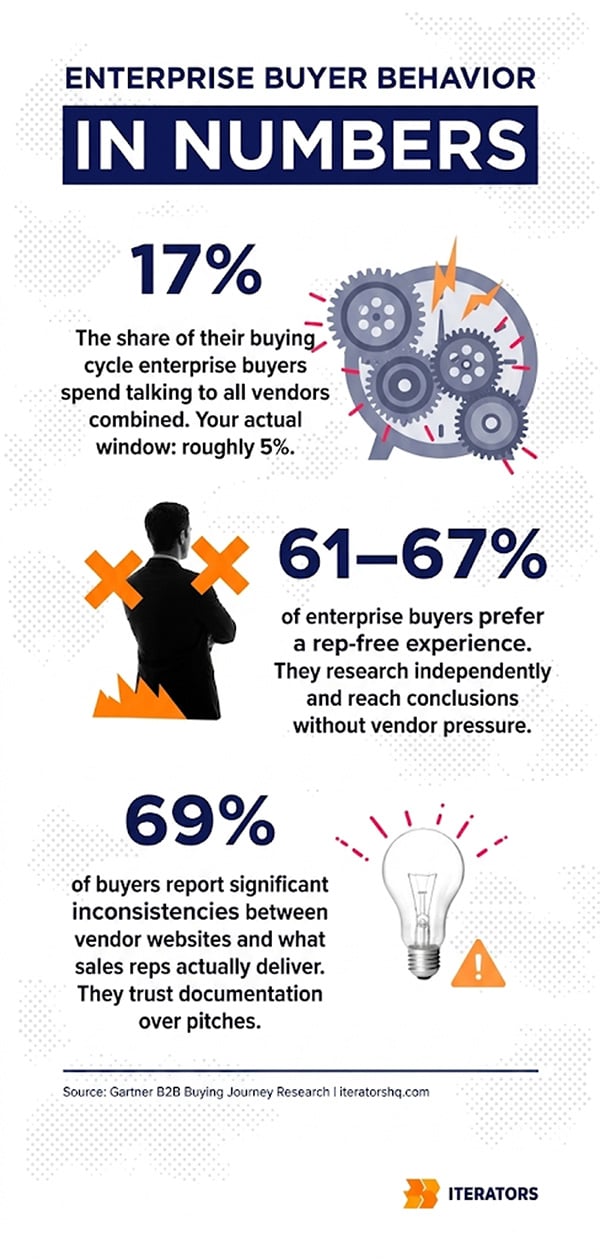
Modern B2B buyers spend only 17% of their total buying time talking to vendors, according to the Gartner buying journey research. When you account for multiple vendors in evaluation simultaneously, your actual contact time drops to roughly 5% of their decision cycle.
More revealing: 61-67% of buyers now explicitly prefer a “rep-free” experience. They don’t want sales calls. They want to research independently, read technical documentation, check peer reviews, and reach conclusions without vendor pressure.
The operational reason: 69% of buyers report significant inconsistencies between vendor website claims and what sales representatives actually deliver. They’ve experienced overpromising. They trust peer reviews and technical documentation more than sales pitches.
The implication for enterprise readiness for startups: Your security white papers, SLA commitments, compliance certifications, and integration documentation must be discoverable without a sales gate. If the enterprise buyer researching you at 11 PM on Sunday can’t find answers to technical questions without filling out “Contact Sales” forms, you’re eliminated before the first meeting.
The 10-Person Buying Committee and Veto Power Distribution
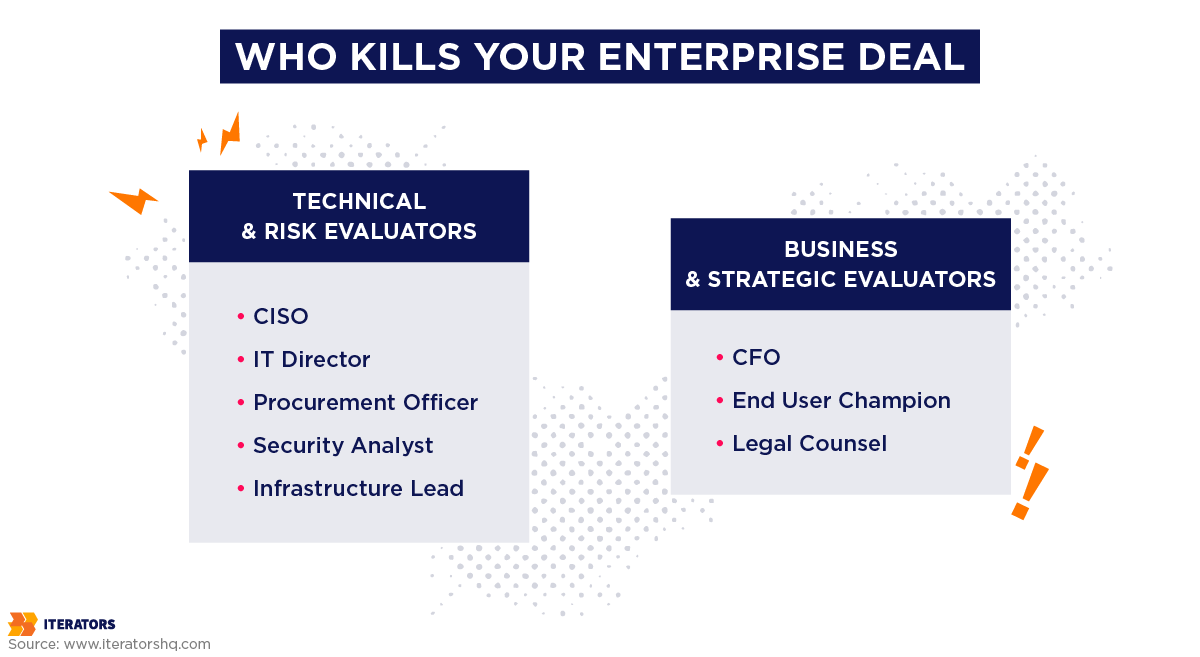
The average enterprise purchase now involves approximately 10 stakeholders spanning IT, Finance, Legal, Security, and Operations. Each stakeholder has different evaluation criteria and functional veto power.
The CFO evaluates time-to-value and total cost of ownership. Without clear ROI demonstration, they block funding.
The CISO prioritizes risk mitigation and regulatory compliance. If you can’t provide SOC 2 Type II certification or comprehensively answer their security questionnaire, they veto on risk grounds.
The Procurement Officer focuses on contract terms, billing system integration, and vendor risk scoring. Non-standard legal terms or inability to integrate with their procurement system creates friction they’ll avoid.
The IT Director assesses integration complexity and operational support burden. If you can’t integrate with their existing technology stack or don’t offer enterprise-grade support SLAs, they advocate for alternatives with lower operational overhead.
The End User Champion often loves your product but typically has the least decision power. They can advocate, but they can’t override the CISO’s security objection or the CFO’s budget concern.
According to the same Gartner research, 74% of enterprise buying committees experience “unhealthy conflict” during the decision process. This means even when some stakeholders strongly favor your solution, others are actively opposing it. In enterprise sales, one “no” usually trumps nine “yes” votes because the risk of a bad vendor decision falls on the objector if they don’t block it.
The Four Enterprise Readiness Gaps That Kill Deals
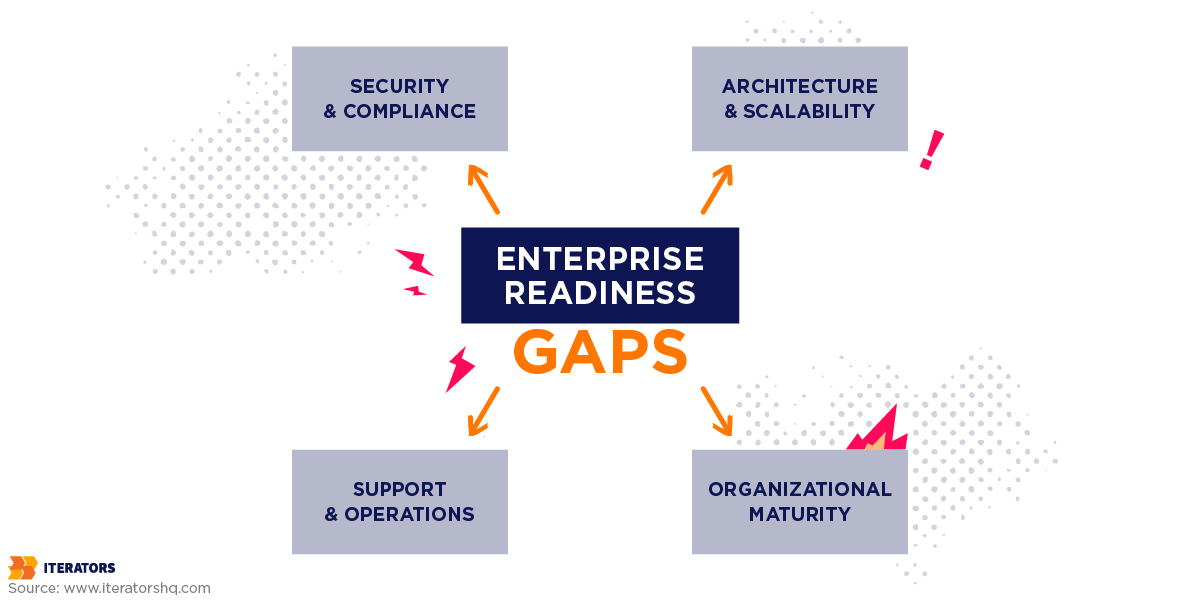
When enterprise deals die in vendor assessment, they die from one or more of four specific gaps. Understanding which gap caused the rejection determines your remediation path.
Our guide to preparing your product architecture for enterprise vendor assessment documents exactly what enterprise security teams check during technical review.
Gap 1: Security and Compliance
This is the highest-frequency deal killer. According to IBM’s 2024 Cost of a Data Breach Report, 35.5% of data breaches originated from third-party vendors, up from 29% in 2023. Enterprise buyers are operationally terrified of becoming the next “Fortune 500 Company Breached Through Startup Vendor” headline.
What enterprise security teams actually check:
SOC 2 Type II certification: 80% of Fortune 500 companies now require this as minimum qualification. Type I (point-in-time audit) might pass for pilot programs, but you need Type II (6-12 months of operational evidence) for full production contracts.
Recent penetration testing: Third-party security assessment showing professionals attempted to compromise your system and documenting what they found. “We haven’t been breached” is not evidence of security; a penetration test report is.
Vendor security questionnaire responses: Expect 80-100 questions covering encryption standards, access controls, incident response procedures, data retention policies, and disaster recovery plans. If you answer “no” or “not applicable” to more than 40% of questions, the deal is likely dead.
Data residency options: Can you guarantee their data remains in the EU for GDPR compliance? Can you provide data sovereignty guarantees for regulated industries (healthcare, finance, government)?
The fix: Start SOC 2 Type I preparation immediately if you have enterprise deals in pipeline. Budget $7,500-$15,000 for Type I, $12,000-$20,000 for Type II. Use automation platforms like Vanta or Drata to streamline evidence collection. Build security documentation that preemptively answers common questionnaire items.
Read our detailed SOC 2 compliance guide for SaaS for step-by-step implementation.
Gap 2: Architecture and Scalability
Enterprise buyers need evidence your infrastructure won’t collapse under their load. They’re modeling deployment to 10,000 employees across 50 countries and need confidence the system will function under that stress.
What enterprise architecture teams actually check:
Single Sign-On (SSO): Can you integrate with their identity provider—Okta, Microsoft Entra ID (formerly Azure AD), Google Workspace? SAML 2.0 is the legacy standard; OpenID Connect (OIDC) is increasingly preferred for modern implementations.
User provisioning (SCIM): Can you automatically create accounts for new employees and immediately deactivate accounts for departing employees? Without SCIM, their IT team faces manual provisioning work and security risk from “orphan accounts” that should have been deactivated.
Multi-tenancy and data isolation: Can you prove Customer A’s data is architecturally isolated from Customer B’s data? Enterprise buyers need technical guarantees (separate database schemas, encryption key separation, network isolation), not assurances.
API rate limiting and SLAs: What happens when they hit your API 10,000 times per minute during their quarterly data sync? Do you have documented rate limits, guaranteed uptime (99.9% minimum, 99.99% preferred), and defined degradation behavior?
The fix: Implement SSO via third-party authentication providers rather than building SAML/OIDC from scratch (the specification is complex and error-prone). Add SCIM support for automated provisioning. Document your multi-tenant architecture and data isolation strategy with architectural diagrams. Establish and publish SLA commitments with monitoring dashboards to demonstrate compliance.
Our guide to web authentication and secure access covers exactly how to implement enterprise-grade authentication correctly.
Gap 3: Support and Operations
Enterprise buyers aren’t purchasing software—they’re purchasing a multi-year operational relationship. They need evidence you’ll be available when systems break at 3 AM or when they need to onboard 500 users next quarter.
What enterprise operations teams actually check:
Dedicated account management: Will they have a named person who understands their implementation and can escalate issues? Or will they be routed to a generic support queue with SMB customers?
Enterprise SLA requirements: Response times are contractual. They expect acknowledgment within 1 hour for critical production issues, 4 hours for high-priority problems, 24 hours for normal requests. Can you staff and deliver those response times?
Professional services: Can you provide implementation support, user training, and customization services? Or are they responsible for figuring out deployment on their own?
Documentation quality: Is your documentation comprehensive enough that their IT team can troubleshoot common issues without opening support tickets? Poor documentation equals high operational cost equals rejected vendor.
The fix: Establish tiered support with guaranteed response times for enterprise customers. Build comprehensive documentation covering implementation scenarios, API usage, troubleshooting procedures, and admin workflows. Consider hiring a dedicated customer success manager before closing your first enterprise deal—their presence during the sales process demonstrates organizational commitment to support.
Our analysis of enterprise-ready HR tech platforms shows what enterprise-grade support infrastructure looks like in production systems.
Gap 4: Organizational Maturity
This is the subtlest gap and the hardest to remediate quickly. Enterprise buyers are assessing whether your company is “serious” enough to be a long-term partner—whether you have institutional processes or are making operational decisions ad hoc.
What enterprise risk teams actually check:
Security policies and procedures: Do you have documented, board-approved policies for incident response, data handling, employee access management, and vendor management? Or are you improvising based on whoever is on call when an issue occurs?
Change management processes: How do you communicate product changes to customers? Do you provide advance release notes, breaking change notifications, and scheduled maintenance windows? Or do customers discover changes when things break?
Business continuity planning: What happens if your office floods, your AWS region fails, or your CEO is incapacitated? Do you have documented disaster recovery and succession plans that have been tested?
Dedicated security ownership: At minimum, someone on your team needs security as their primary responsibility with appropriate authority. Ideally, you have a CISO or Head of Security role.
The fix: Document your existing processes even if they’re currently informal. Create a security policy framework covering access control, data handling, incident response, and vendor management. Establish a change management process with defined customer communication requirements. Assign security ownership to a specific person with budget authority and executive sponsorship. These don’t need to be complex initially—they need to exist and be followed consistently.
The Minimum Viable Enterprise Readiness Checklist

Not all enterprise features block the same percentage of deals. Some are non-negotiable for 80%+ of Fortune 500 buyers; others are industry-specific or deal-size-specific differentiators.
Here’s the prioritization framework:
Must-Have (Blocks >80% of Enterprise Deals)
- SOC 2 Type II certification (or Type I with documented path to Type II)
- SSO via SAML/OIDC
- Basic RBAC (minimum: Admin, User, Read-Only roles)
- Audit logging with 1-year retention and export capability
- 99.9% uptime SLA with public status page
- Documented security policies (incident response, access control, data handling)
- Vendor security questionnaire responses prepared
Timeline: 6-9 months if starting from zero
Estimated cost: $50,000-$100,000 including compliance certification, development work, and infrastructure improvements
Should-Have (Blocks 30-50% of Deals)
- User provisioning via SCIM
- Advanced RBAC with custom roles and granular permissions
- Data residency options (EU, US, other regions)
- Dedicated account management for enterprise customers
- Professional services for implementation and training
- API rate limiting with usage analytics
Timeline: 3-6 months after must-haves are operational
Estimated cost: $30,000-$75,000
Nice-to-Have (Differentiators for Specific Verticals)
- On-premise deployment options
- Custom branding and white-labeling
- Advanced compliance (HIPAA, FedRAMP, ISO 27001)
- 99.99% uptime SLA (versus 99.9%)
- 24/7 phone support with guaranteed pickup times
- Custom SLA terms negotiated per customer
Timeline: 6-12 months, typically post-Series B funding
Estimated cost: $100,000+ depending on scope
Industry-Specific Requirements
Healthcare: HIPAA compliance, Business Associate Agreement (BAA) signing capability, audit logging sufficient for OCR investigations
Financial services: SOC 2 Type II mandatory, PCI-DSS if handling payment data, detailed data lineage documentation
Government: FedRAMP considerations (extremely expensive and time-consuming—don’t pursue without confirmed government contracts), specific data residency requirements
EU customers: GDPR compliance, data residency within EU, Data Processing Agreement (DPA) terms
Common Over-Engineering Mistakes
Don’t build on-premise deployment before validating demand. You need multiple enterprise prospects explicitly requesting it before investing 6+ months of engineering time. The market is shifting toward private cloud (VPC) deployments rather than true on-premise installations anyway.
Don’t create custom compliance frameworks. Use standard certifications (SOC 2, ISO 27001) that enterprise procurement officers already understand and have approved vendor processes for. Your proprietary “security excellence program” means nothing to someone who needs checkbox compliance.
Don’t over-architect for scale you don’t have yet. You need to handle their actual load, not theoretical future load. Focus on proven scalability patterns and horizontal scaling capabilities, not premature optimization for 100 million users when you have 100 customers.
Building Enterprise Readiness for Startups Without Derailing Your Roadmap
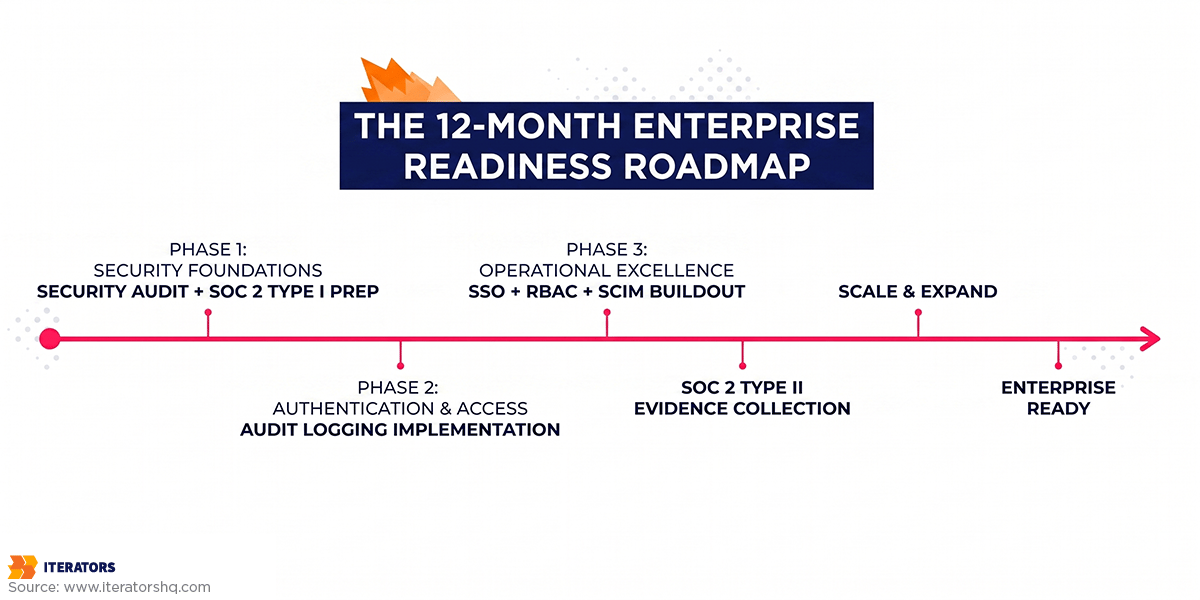
The valid fear for startup founders: enterprise readiness will consume the entire engineering team for 12 months, killing product velocity and alienating your SMB customer base.
This fear is manageable with phased implementation and ruthless prioritization.
Phase 1: Security Foundations (Months 1-3)
Week 1-2: Security Audit
Hire a third-party security firm to conduct vulnerability assessment and penetration testing. This isn’t just about finding issues—it’s about getting external validation you can share with enterprise prospects during vendor review.
Cost: $10,000-$25,000
Output: Security assessment report, prioritized remediation list
Week 3-8: SOC 2 Type I Preparation
Engage a SOC 2 auditor and compliance automation platform (Vanta, Drata, or equivalent). Focus on the Security trust service criteria initially—you can add Availability, Confidentiality, and Privacy criteria later if specific customers require them.
Cost: $15,000-$30,000 (platform subscription + audit fees)
Output: SOC 2 Type I report
Week 9-12: Audit Logging Implementation
Build comprehensive audit logging covering user actions, administrative changes, data access, and configuration modifications. Ensure logs are immutable (append-only) and exportable in standard formats (JSON, CSV, SIEM integration).
Engineering time: 2-3 weeks for one senior backend engineer
Output: Audit log system with 1-year retention
Phase 2: Authentication and Access (Months 4-6)
Month 4: SSO Implementation
Integrate with third-party authentication provider rather than building SAML/OIDC from scratch. WorkOS, Auth0, or Okta provide pre-built integrations that handle protocol complexity, edge cases, and ongoing maintenance.
Engineering time: 3-4 weeks for one senior full-stack developer
Cost: $0-$5,000 monthly for authentication provider (depends on volume)
Output: SSO support for major identity providers (Okta, Microsoft, Google)
Month 5: RBAC Framework
Design and implement role-based access control that maps to enterprise organizational structures. Start with basic roles (Admin, Manager, User, Read-Only) and build extensibility for custom roles without requiring code changes.
Engineering time: 4-6 weeks for one senior backend developer + one frontend developer
Output: RBAC system with role management UI
Month 6: SCIM Provisioning
Add SCIM 2.0 support for automated user lifecycle management. This is increasingly non-negotiable for enterprises with large user populations who need automated onboarding/offboarding.
Engineering time: 2-3 weeks for one senior backend developer
Output: SCIM API endpoints for user provisioning and deprovisioning
Phase 3: Operational Excellence (Months 7-12)
Months 7-9: SOC 2 Type II Evidence Collection
Continue operating your security controls while collecting evidence for Type II certification. This is largely automated if you’re using a GRC platform—the main requirement is consistent operation of controls over 6-12 months.
Cost: $12,000-$20,000 for Type II audit
Output: SOC 2 Type II report
Months 10-11: Advanced Features
Add data residency options, advanced RBAC capabilities, and enhanced monitoring based on specific customer requests from your sales pipeline. Don’t build speculatively—build based on actual deal requirements.
Engineering time: Varies based on specific features
Output: Customer-driven enterprise capabilities
Month 12: Documentation and Enablement
Create comprehensive security documentation, API reference guides, admin training materials, and troubleshooting procedures that enterprise customers can use for self-service implementation.
Engineering time: 2-3 weeks for technical writer + product manager
Output: Enterprise documentation library
Balancing SMB and Enterprise Customer Needs
The risk of alienating your SMB customer base while building for enterprise is real. Here’s how to manage both:
Feature flagging: Use feature flags to enable enterprise capabilities only for customers who need them. Your SMB customers never see the complexity of advanced RBAC administration or SCIM provisioning configuration.
Tiered pricing: Create clear pricing tiers that signal which features are enterprise-only. Don’t hide enterprise features behind “Contact Sales” walls—be transparent about what’s included at each tier.
Separate onboarding flows: Enterprise customers expect white-glove implementation; SMB customers want self-service. Build different onboarding experiences rather than forcing one-size-fits-all that satisfies neither segment.
When to Partner vs. Build In-House
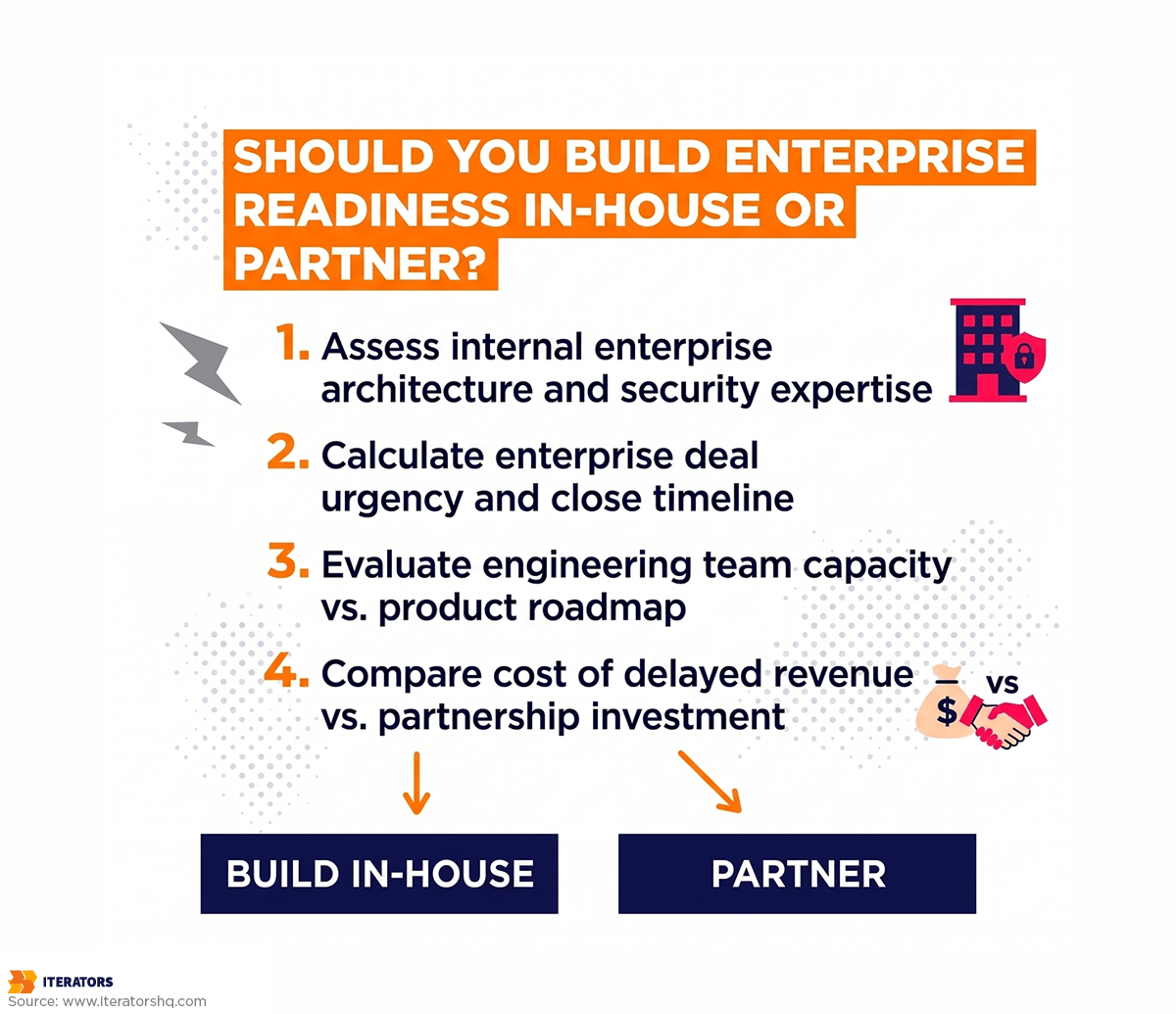
Not every startup should build enterprise readiness for startups alone. Sometimes the right answer is partnering with development teams who have solved these problems repeatedly.
Signals You Need External Help
Signal 1: Enterprise deal with 90-day close timeline
You have a Fortune 500 prospect ready to sign, but they need SOC 2 certification and SSO implemented before issuing a purchase order. You don’t have 12 months to learn these systems—you need them operational in 90 days.
Signal 2: Failed multiple vendor security reviews
You’ve lost 2-3 enterprise deals specifically because of security or architecture gaps. The pattern is clear, but your internal team lacks the expertise to remediate quickly.
Signal 3: Engineering team at capacity
Your product roadmap is already 6 months behind, and adding enterprise requirements would push delivery to 18 months. You need parallel capacity without hiring 5 new engineers.
What Experienced Partners Bring Beyond Code
Battle-tested architecture patterns: Teams that have built enterprise readiness for startups dozens of times know which approaches work and which create technical debt. They know which authentication providers integrate cleanly and which create ongoing maintenance problems. They know how to structure RBAC systems that scale from 10 users to 10,000 without requiring rewrites.
SOC 2 expertise: They understand what auditors examine and how to structure systems to pass compliance reviews efficiently. They’ve seen the common failure patterns and know how to avoid them.
Faster time-to-market: What takes your team 12-18 months of learning and iteration takes experienced teams 3-6 months because they’re applying proven patterns, not discovering them.
Risk mitigation: Security mistakes are expensive. IBM’s Cost of a Data Breach Report pegs the average breach cost at $4.44 million. Experienced partners help you avoid costly mistakes by implementing security correctly the first time.
The Build vs. Partner Framework
Build in-house when:
- Enterprise features are core product differentiators that provide competitive advantage
- You have a 12+ month timeline before enterprise deals are expected to close
- You have senior engineers with prior enterprise architecture experience on the team
- You’re well-funded and can absorb the learning curve cost
Partner when:
- Enterprise deal urgency requires 3-6 month delivery
- You lack internal compliance or security architecture expertise
- Your engineering team is already at capacity with product development
- The cost of delayed enterprise revenue exceeds partnership investment
At Iterators, we’ve guided multiple startups through the SMB-to-enterprise transition. We built the enterprise-grade infrastructure for Imperative’s breakthrough HR platform that closed deals with Fortune 500 customers including Zillow, Hasbro, and Boston Scientific.
We’ve implemented SOC 2-certified platforms, built enterprise SSO and RBAC systems, and helped startups close their first Fortune 500 contracts. Enterprise readiness for startups is a solved problem—you don’t need to reinvent authentication protocols, audit logging architectures, or compliance frameworks. You need experienced teams who can implement proven patterns quickly while your team focuses on core product innovation.
What Success Actually Looks Like

Enterprise readiness for startups in practice means specific operational outcomes:
A Fortune 500 security team reviews your architecture documentation and approves it without requiring remediation. They don’t send a list of 40 concerns that need to be addressed before proceeding.
Your SOC 2 Type II report answers approximately 80% of vendor questionnaire items automatically, reducing their security review cycle from 5 weeks to 5 days. Learn how to track and demonstrate this readiness in our guide to enterprise readiness monitoring and observability.
Their IT team configures SSO integration in 30 minutes instead of opening a support ticket that requires 3 days of back-and-forth debugging.
When the CISO asks about your incident response plan, you send them a documented procedure that’s been tested, not an explanation that you “handle issues as they come up.”
Your first enterprise customer becomes a reference account that accelerates your next 10 enterprise deals instead of a cautionary tale about implementation problems that prospects hear about during back-channel reference checks.
Enterprise readiness for startups isn’t about checkbox compliance. It’s about building institutional trust that you’re a safe bet for a multi-year, mission-critical partnership worth hundreds of thousands of dollars in contract value.
The Real Cost of Waiting

Every month you delay enterprise readiness for startups costs you in three ways:
Direct opportunity cost: If an average enterprise contract is worth $100,000-$500,000 annually, every enterprise deal you lose to readiness gaps costs you that revenue plus multi-year expansion potential. Lose 3 enterprise deals per year to fixable gaps, and you’re leaving $300,000-$1,500,000 on the table.
Competitive disadvantage: While you’re building enterprise features, your competitors are closing enterprise deals and accumulating reference customers. Every quarter you wait, they establish more market share in enterprise segments and build case study libraries you’ll need to overcome.
Technical debt accumulation: Building enterprise features retroactively into an existing codebase is substantially harder than architecting them correctly from the start. Our guide to SaaS development architecture decisions before writing code explains how to make the right choices early. The longer you wait, the more expensive remediation becomes as your architecture solidifies around patterns that don’t support enterprise requirements.
The operational cost for most startups: delaying enterprise readiness for startups typically costs $300,000+ in rushed engineering work, 6 months of lost sales momentum, and potential churn of early enterprise customers when contracts come up for renewal and your infrastructure still doesn’t meet their evolved requirements.
Compare that to the $50,000-$100,000 investment in building enterprise readiness for startups systematically, and the ROI case is clear.
What’s Still Unresolved
Enterprise readiness for startups solves the infrastructure gap, but three residual risks remain:
The technical debt cost curve accelerates non-linearly. If you’re already at 50,000 lines of code with no audit logging, retrofitting it is 5-10x more expensive than building it at 5,000 lines. The cost curve isn’t linear—it’s exponential as your system complexity grows. There’s no formula to predict exactly when you’ve crossed the point where retrofitting becomes more expensive than rebuilding, but the inflection point typically occurs around Series A when you have 2-3 years of accumulated architectural decisions.
Market expectations are shifting faster than compliance frameworks. SOC 2 Type II is table stakes today, but the specific controls enterprise buyers expect within that certification are evolving. Five years ago, SSO was differentiating. Three years ago it became mandatory. Today, SCIM is following the same path. The gap between “we have SOC 2” and “we have the specific SOC 2 controls this buyer requires” is widening. No one has solved predicting which controls will shift from differentiator to mandatory next.
The organizational maturity gap is the hardest to close quickly. You can build SSO in 6 weeks. You can’t build institutional trust in 6 weeks. Enterprise buyers are assessing whether your company has the organizational discipline to be a reliable long-term partner. That assessment is based on accumulated evidence of how you operate—your communication patterns, how you handle incidents, whether you follow your own documented procedures. You can fake security controls with enough engineering effort. You can’t fake organizational maturity. It either exists or it doesn’t, and building it requires time and consistent execution, not just capital.
Frequently Asked Questions

How long does it actually take to become enterprise ready?
6-18 months depending on your starting point. SOC 2 Type II alone requires 6-12 months of evidence collection after you implement controls. However, you can achieve “minimum viable enterprise readiness for startups” in 3-6 months by focusing on SOC 2 Type I, basic SSO implementation, and documented security policies. The timeline depends on how much of your existing architecture already supports enterprise patterns versus how much requires rebuilding.
What’s the minimum budget for enterprise readiness?
$50,000-$100,000 for core requirements including SOC 2 certification ($15,000-$30,000), SSO integration and testing ($5,000-$15,000), third-party security audit ($10,000-$25,000), and engineering time for audit logging and RBAC implementation. Costs scale to $200,000+ if you’re adding advanced features like SCIM provisioning, multi-region data residency, and dedicated professional services capabilities.
Do I need SOC 2 to sell to enterprises?
80% of Fortune 500 companies now require SOC 2 Type II as a prerequisite for vendor approval. While some enterprises accept alternatives (ISO 27001, custom security reviews with detailed evidence), SOC 2 has become the de facto standard in the US market. Start with Type I to unblock pilot programs while you work toward Type II for full production contracts. Read our detailed guide to SOC 2 compliance for the complete certification roadmap.
Can I become enterprise ready without rebuilding my product?
Yes, in most cases. Most enterprise readiness for startups features are additive rather than requiring core architecture rewrites. SSO integrates via third-party authentication providers, RBAC wraps existing permission systems, and audit logging captures actions your system already performs. The key is whether you architected with extensibility in mind initially. If your user authentication is tightly coupled to application logic throughout your codebase, refactoring will be expensive. If you have clean separation of concerns, adding enterprise features is straightforward.
What’s the ROI of enterprise readiness for startups investment?
Average enterprise contracts range from $100,000-$500,000 annually, compared to $5,000-$50,000 for SMB deals. A single enterprise customer can cover your entire readiness investment. More importantly, enterprise customers have 3-5x higher lifetime value and substantially lower churn rates (5-10% annually) compared to SMB customers (20-40% annually). The ROI calculation depends on your specific deal sizes and sales cycle, but most startups see payback within 1-2 closed enterprise deals.
Should I build enterprise features before I have enterprise customers?
Start security foundations (SOC 2 prep, SSO planning, policy documentation) when you have 2-3 enterprise prospects actively in your sales pipeline with realistic close timelines. Don’t over-engineer for enterprise scenarios you haven’t validated with real buyer requirements. But also don’t wait until you have a signed contract—the implementation timeline is too long. The right trigger point is when enterprise deals represent >30% of your pipeline value, not when you’ve already closed them.
How do I know which gap caused my rejection?
Request detailed feedback from the buyer (many won’t provide it, but ask). Security rejections typically mention “compliance concerns” or “unable to meet our security requirements.” Architecture rejections reference “scalability concerns” or “integration complexity with existing systems.” Support rejections cite “resource concerns” or “implementation support requirements.” Organizational maturity rejections are often vague: “not the right fit at this time” or “focusing on more established vendors.” If you can’t get specific feedback, review their vendor security questionnaire responses—the sections where you answered “no” or “partially” are likely the kill conditions.
What’s the difference between SOC 2 Type I and Type II?
Type I is a point-in-time audit proving your controls are designed correctly as of the audit date. Type II proves your controls operated effectively over 6-12 months. Most enterprises require Type II for final vendor approval because it demonstrates sustained operational discipline, not just well-documented processes. However, Type I can unblock pilot programs and proof-of-concept work while you accumulate the evidence period required for Type II.
Can I pass vendor security reviews without SOC 2?
Rarely, and with significantly more effort. You’ll need to manually answer 80-100 questionnaire items with detailed evidence for each control. SOC 2 reports answer approximately 80% of common questions automatically through the auditor’s attestation, reducing review cycles from 5 weeks of back-and-forth to 5 days of clarification. Some enterprises will accept ISO 27001 or custom security assessments, but SOC 2 has become the path of least resistance in US markets.
When should I hire a dedicated security or compliance person?
When you have 2-3 enterprise customers or are actively pursuing SOC 2 certification. This can initially be a fractional role (consultant or part-time contractor) before becoming a full-time hire. The key is having someone who owns security as their primary responsibility with appropriate authority rather than treating security as an afterthought that falls to whoever has bandwidth. Budget $75,000-$150,000 for fractional CISO support, $150,000-$250,000+ for full-time Head of Security depending on location and experience level.