

There are three kinds of engineering problems that block enterprise deals. The first kind: your product doesn’t solve the customer’s problem. Fair—no amount of enterprise readiness for startups guidance fixes that. The second kind: your product solves the problem but your pricing model doesn’t align with how enterprises budget. Fixable, painful, but fixable.
The third kind: your product solves the problem, pricing works, the champion wants to buy, legal has approved the contract, and then Question 47 on the security questionnaire asks whether you support SAML 2.0 SSO with enterprise identity providers. You don’t. The deal stalls. Your competitor—who ships a slightly worse product but can answer “yes” to the security questionnaire—closes instead.
This post is about the third kind. Specifically: enterprise readiness for startups as a procurement constraint, not a feature discussion. The question isn’t whether you need it. If you’re selling B2B SaaS and targeting contracts above $100K ARR, you need it. The question is whether you’ll lose six months building it while competitors who partnered for it are closing deals.
What follows is the classification of what “enterprise readiness for startups” actually means, what it costs to build, where teams systematically underestimate timelines, and the build-versus-partner decision framework that determines whether you spend the next six months debugging SAML edge cases or shipping product.
Free Consultation
Question 47 Shouldn’t Kill a Deal
You Spent Six Months Closing
We’ll assess your authentication, authorization, and auditability gaps against real enterprise procurement criteria — then execute an Enterprise Readiness Sprint in 6–8 weeks so your team can answer “yes” before the security questionnaire arrives.
Start Your Readiness Sprint →Enterprise Readiness for Startups: Three Mandates, Not a Feature List
Most startup CTOs hear “enterprise readiness for startups” and think it’s a feature request. It’s not. It’s a procurement clearance system. Enterprise IT governance enforces three non-negotiable mandates: Authentication, Authorization, and Auditability. If you can’t satisfy all three, the vendor assessment process stops.
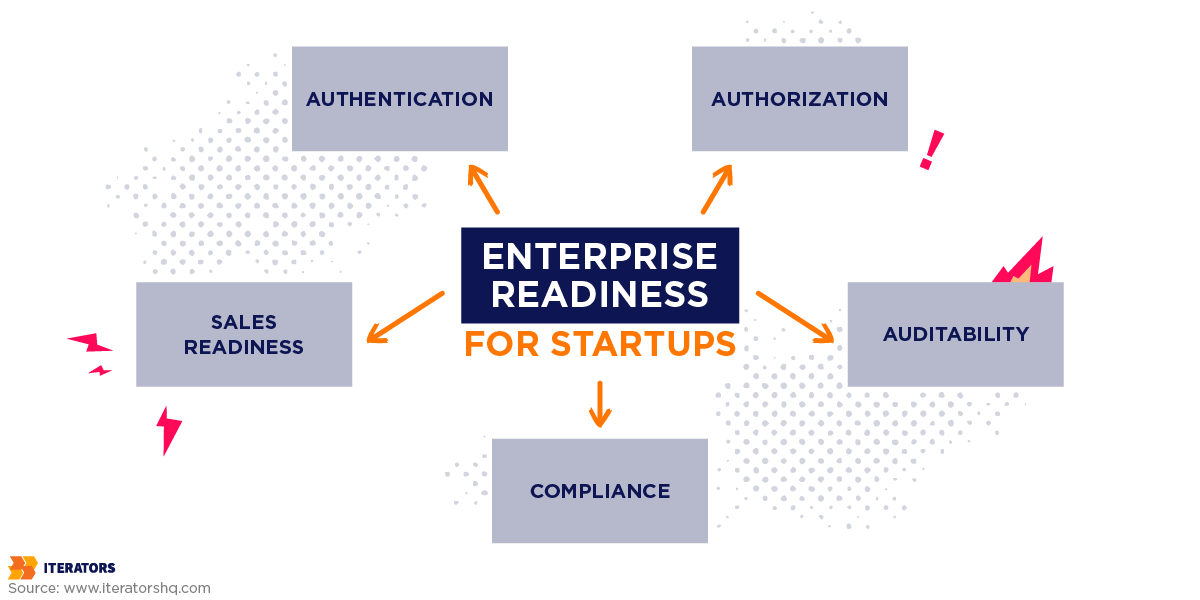
Authentication: Identity Federation as a Hard Floor
Enterprises don’t allow employees to manage separate credentials for SaaS tools. Authentication flows through their corporate Identity Provider—Microsoft Entra ID, Okta, Ping Identity, or equivalent. This means you need federated Single Sign-On.
SSO isn’t one protocol. You need SAML 2.0—an XML-based standard that’s older, verbose, and still entrenched in Fortune 500 IT—alongside OpenID Connect (OIDC), the JSON-based successor. SAML is where the build-from-scratch approach reliably fails. XML Signature Wrapping attacks can compromise your entire multi-tenant architecture if your parser has subtle flaws. Different IdPs implement the spec differently. The BambooHR SAML flow is not the same as Workday’s. Edge cases appear in production, not in testing.
The two-sprint estimate for SSO becomes four months when you discover that Azure AD’s SAML assertions don’t match Okta’s documentation, and your XML signature validation logic fails for Google Workspace but not for OneLogin.
Authorization: SCIM and Multi-Level RBAC
Enterprise IT teams require automated user lifecycle management through the System for Cross-domain Identity Management (SCIM) protocol. When someone is hired, their IdP provisions access across every tool in the stack. When they leave, access revokes immediately—not the next day, not when someone remembers to click a button. Immediately.
Building SCIM endpoints to handle user create, read, update, and delete operations sounds straightforward until you encounter the implementation variance problem: different IdPs implement the SCIM spec differently, with undocumented behaviors you’ll discover only when a customer tries to use them.
Beyond provisioning, your authorization model must support organization-level Role-Based Access Control that mirrors the hierarchical structures of enterprise clients. Country-level admins, department managers, read-only auditors, billing contacts—the permission model needs to handle nested organizational complexity. If your current RBAC is user-level or flat-tenant, you’re rebuilding your authorization layer.
Auditability: Immutable Logs as Forensic Evidence
Security teams need immutable audit logs of every action in your platform—not for compliance theater, but for forensic investigations when something breaks or when a regulatory audit happens. These logs must be retained for at least a year, exportable to SIEM systems, and queryable without degrading application performance.
Building performant, immutable logging is a distributed systems problem. The naive approach—writing every action to a relational database—fails at scale. The logs bloat your primary database, queries slow, and six months later you’re re-architecting your entire logging infrastructure because it’s degrading production performance.
The Code Spaces failure in 2014 illustrates the kill condition. A hosting company was destroyed within 24 hours by an attacker who gained AWS control panel access. The root cause: no MFA enforcement, no separation of duties, weak identity controls. The company ceased to exist. Enterprise readiness for startups isn’t a sales enablement exercise—it’s the architectural discipline that prevents catastrophic failure modes.
What It Costs to Build Enterprise Readiness for Startups In-House
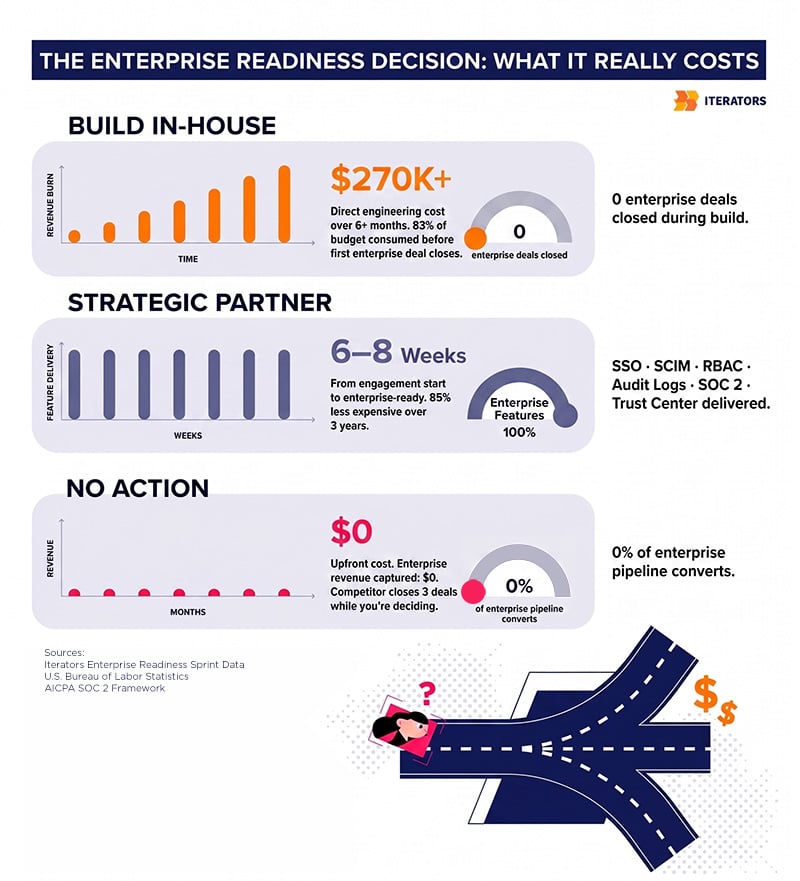
The six-month timeline is not pessimistic. It’s the observed median when tracking startups building SSO, SCIM, organization-level RBAC, and audit logging for the first time. Here’s why the estimate always breaks.
The Scope Creep Pattern
The initial estimate: “We’ll knock out SSO in two sprints.” This assumes SSO is one thing. It’s not. SAML 2.0 for Azure AD is sprint one. Discovering that Okta’s SAML implementation differs is sprint two. Google Workspace’s SAML assertions fail your XML parser—sprint three. You need OIDC for modern IdPs—sprint four. The security review finds XML Signature Wrapping vulnerabilities—sprint five, now a re-architecture.
SCIM endpoints: two sprints. Except BambooHR’s SCIM differs from Workday’s, which differs from Okta’s. Each has quirks you discover in production. Add three sprints.
Organization-level RBAC: your current permission model is user-scoped. You’re rebuilding the authorization layer to support nested hierarchies. Add four sprints.
Audit logging: your current logs aren’t immutable, aren’t SIEM-exportable, and querying them degrades production. You’re building a separate logging infrastructure. Add six sprints.
The two-sprint estimate becomes six months. This is the pattern. It’s not an engineering failure—it’s what happens when product-focused engineers encounter a specialized domain for the first time.
The Opportunity Cost Model
Two senior engineers at $270,000 total annual compensation each. Six months of dedicated work: $270,000 in direct labor. Add infrastructure, compliance tooling, security testing, ongoing maintenance (conservatively 20% of build cost per year): three-year TCO exceeds $400,000.
During those six months, your team isn’t building differentiating features. They’re building table stakes. And your enterprise pipeline—zero deals close because you can’t pass the security questionnaire.
Compare: a specialized partner executes an Enterprise Readiness Sprint in 6–8 weeks. Engagement cost: $40,000–$60,000. During the delta—the four-plus months you saved—your sales team closes enterprise deals. If your average enterprise ACV is $100,000 and you close two deals in that window, you’ve generated $200,000 in ARR that the in-house scenario never captures.
| Build In-House | Strategic Partner | |
|---|---|---|
| Timeline | 6+ months | 6–8 weeks |
| Direct Cost | $270,000+ | $40,000–$60,000 |
| Enterprise Deals Closed During Build | 0 | 2–3 |
| Revenue in Delta Period | $0 | $200,000–$300,000 ARR |
| 3-Year TCO | $400,000+ | $80,000–$100,000 |
The financial model isn’t close. The in-house approach costs five times more and delivers six months later.
The Morale Cost
The engineers you hired to build product didn’t sign up to maintain a custom SAML parser. They’ll tell you this—politely at first. When the best ones start taking recruiter calls, you lose institutional knowledge of both your core product and the custom enterprise infrastructure they built. This is the morale tax. It’s real, expensive, and entirely avoidable.
Why Startups Still Build In-House: Three Cognitive Traps
If the math favors partnering, why do technical founders still build? Three biases, all of which feel rational.
The Speed Illusion
Technical founders are people who are very good at building things. This creates a systematic bias: “We know our codebase better than anyone. We can ship this faster than evaluating and integrating a third-party solution.”
This logic confuses “working” with “enterprise-grade.” Your engineers can absolutely build something that handles SSO. Getting it to pass a 150-question security questionnaire from a Fortune 500 CISO, handle every IdP edge case, and maintain 99.99% uptime under enterprise SLA requirements—that’s a different project. The delta between a working prototype and enterprise-grade infrastructure is where the months disappear.
The Customization Myth
Approximately 80% of enterprise requirements are commoditized. SSO is SSO. Audit logs are audit logs. SCIM follows a spec. SOC 2 Trust Services Criteria are standardized. Every enterprise customer demands these in essentially the same form.
The features that differentiate your product—your algorithms, your workflows, your domain-specific intelligence—those justify custom engineering. Authentication and compliance infrastructure? That’s plumbing. It needs to work. It doesn’t need to be artisanal.
The “we need custom everything” myth costs engineering bandwidth on work that provides zero competitive advantage.
The Sunk Cost Trap
Two months into an internal build, the estimate shows four more months to completion. The logic: “We’ve already invested eight weeks. If we stop now, we’ve wasted all that work.”
So you continue. Four months later, you’re at 70% complete. Two more months. You’re now eight months in. The deal that triggered this initiative closed with a competitor six months ago.
The eight weeks are gone regardless. The question is whether you’ll lose another four months. The correct decision at month two is to stop, assess whether partnering would be faster, and make the unsentimental choice.
The Competitive Scenario: What Happens Over Twelve Months

Model two identical startups:
Company A allocates two senior engineers in month 1 to build enterprise readiness for startups in-house. The build completes in month 7. After fixing issues discovered during the first security questionnaire, they’re enterprise-ready in month 8. First enterprise deal closes in month 10.
Company B engages a strategic partner in month 1. They achieve enterprise readiness for startups in month 2. First enterprise deal closes in month 3. By month 10, they have three enterprise customers and $300,000 in ARR from enterprise contracts.
At month 12: Company A has one enterprise customer. Company B has three, plus six months of enterprise sales experience, reference customers that accelerate future deals, and $200,000 more ARR. That gap compounds. Enterprise customers generate referrals. Reference customers shorten sales cycles. The network effects of early enterprise success are durable.
The Classification: What to Outsource vs. What to Build
The build-versus-partner decision isn’t binary. It’s about correctly classifying the work.
Partner for commoditized requirements:
- SSO (SAML 2.0, OIDC)
- SCIM provisioning
- SOC 2 compliance infrastructure
- Immutable audit logging architecture
- Organization-level RBAC frameworks
- Security hardening and penetration testing
- Vendor assessment documentation
Build in-house for differentiation:
- Core product features
- Proprietary algorithms
- Industry-specific workflows
- Competitive moat features
The test: if every enterprise customer demands it and it follows an established spec, it’s commoditized. Partner for it. If it’s what makes your product uniquely valuable, build it.
The Enterprise Readiness Sprint: Six to Eight Weeks, Parallel Work Streams
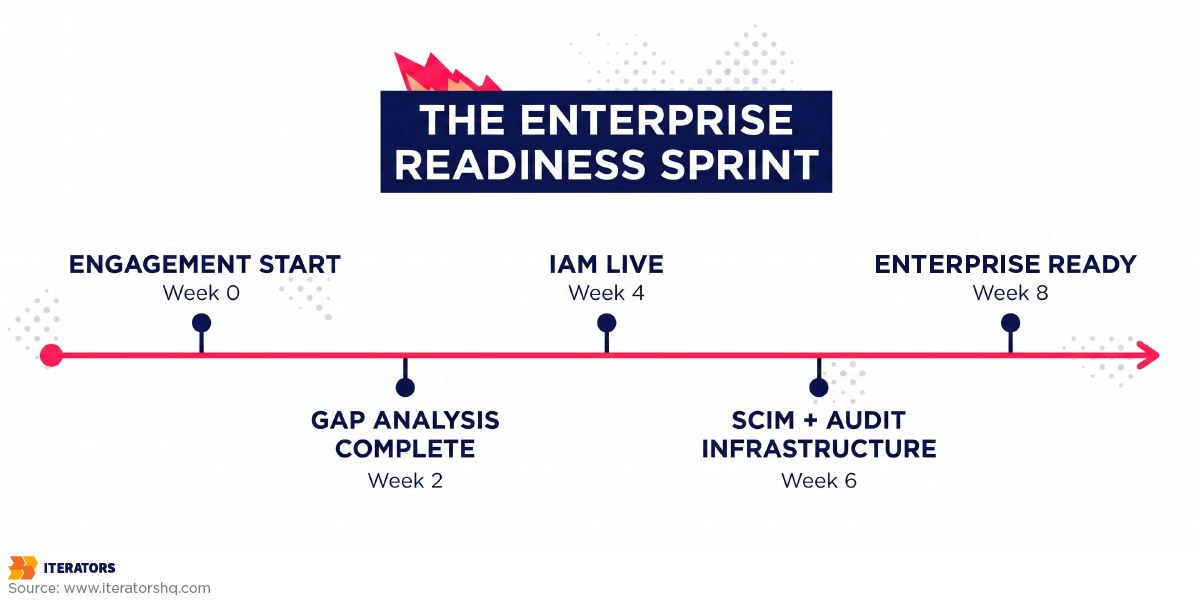
An Enterprise Readiness Sprint is a focused engagement designed to achieve baseline enterprise readiness for startups through parallel execution. Here’s the structure:
Weeks 1–2: Gap Analysis and Architecture Review
Before writing code, conduct a comprehensive assessment: review current cloud architecture, map data flows against SOC 2 and GDPR requirements, identify security vulnerabilities, produce a prioritized remediation roadmap.
This phase typically surfaces issues internal teams miss—not because internal engineers are incompetent, but because enterprise security is specialized knowledge that product-focused engineers haven’t needed to develop. A team that has run this assessment fifty times knows where to look.
Output: a sequenced plan with specific timelines and resource requirements.
Weeks 3–4: Identity and Access Management
Integrate federated identity solutions—typically leveraging Identity-as-a-Service platforms like WorkOS, Kinde, or Auth0 to support SAML 2.0 and OIDC—rather than building from scratch. The value isn’t in custom code. The value is in having enterprise SSO that works reliably with every major IdP your prospects use.
Using proven platforms for the identity layer means you’re not debugging XML parsing edge cases when a Fortune 500 CISO tries to provision their team. Alongside identity, organization-level RBAC is implemented to support hierarchical permission structures.
Weeks 5–6: Provisioning and Audit Infrastructure
Deploy SCIM endpoints for automated user lifecycle management. Establish immutable audit logging infrastructure, formatted for SIEM export. Verify data encryption at rest and in transit. Review and tighten access controls.
This phase includes compliance instrumentation that automated tools like Vanta or Drata monitor—but critically, it ensures the underlying architecture actually passes those monitors rather than generating an endless failure list.
Weeks 7–8: Documentation and Sales Enablement
Finalize SOC 2 readiness documentation. Deploy a public Trust Center. Create a Security Questionnaire Playbook—a pre-approved set of technically accurate answers to the 100–200 questions that appear on enterprise vendor assessments.
The Playbook is often the most immediately valuable deliverable. When your sales rep gets a security questionnaire at 4pm on Friday, they don’t hunt down the CTO. They have a playbook. They fill it out. The deal moves forward.
Deliverables at Week 8
- SOC 2 readiness (certification initiated or completed)
- Working SSO with SAML 2.0 and OIDC
- SCIM provisioning endpoints
- Organization-level RBAC
- Immutable audit logging
- Vendor assessment documentation
- Security Questionnaire Playbook
- Public Trust Center
Your sales team can now answer “yes” to the security questionnaire. Your enterprise deals move forward. Your internal engineering team spent those 8 weeks building differentiating features.
The Build-Versus-Partner Decision Framework
Build In-House When:
The feature is a core differentiator. If it’s what makes your product uniquely valuable to your market, build it. Don’t outsource your moat.
Your team has deep expertise in this specific domain. If you have a world-class engineer who has built SCIM implementations before, use that expertise.
The feature is central to your long-term product vision. If you’re building an identity-centric product where auth IS the product, build it.
Partner When:
The requirement is commoditized. If every enterprise customer demands it in the same form, it’s table stakes. Don’t reinvent table stakes.
Time-to-market is critical. If you have enterprise deals in pipeline right now, the cost of a four-month delay is measured in lost revenue.
Your team lacks specialized expertise. SOC 2 compliance, enterprise security architecture, and identity federation are specialized domains. The learning curve is real. Specialists who have done this dozens of times will execute faster.
The maintenance burden is high relative to value. Custom SAML implementations require ongoing maintenance as IdPs update. If this isn’t core to your product, that maintenance is pure overhead.
The Resource Reality
| Build In-House | Strategic Partner | |
|---|---|---|
| Engineers Required | 2–3 senior engineers | 1 technical liaison |
| Timeline | 4–6 months | 6–8 weeks |
| Direct Cost | $200,000–$300,000 | $40,000–$60,000 |
| Opportunity Cost | High (roadmap blocked) | Low (core team focused) |
| Maintenance Burden | Ongoing, significant | Minimal |
The “we can’t afford a partner” objection fails when you run these numbers. The partner engagement costs less than one month of two senior engineers’ fully-loaded compensation and delivers in 8 weeks instead of 6 months.
The Risk Categories
Technical risk: Getting enterprise security wrong isn’t embarrassing—it’s potentially catastrophic. A SAML implementation with XML Signature Wrapping vulnerabilities can compromise your entire multi-tenant architecture. Specialists who have built these systems dozens of times have already solved the edge cases that catch first-timers.
Market risk: Every month you’re not enterprise-ready is a month competitors close deals you can’t compete for. In a market where enterprise sales cycles run 6–18 months, a 4-month head start compounds.
Team risk: Burning your best engineers on compliance work is a retention risk. The engineers who built your core product are your most valuable asset. Protect their time.
What to Look for in an Enterprise Readiness Partner

Not all partners are equal. The wrong partner is worse than building in-house.
Domain Expertise Beyond Generic Development
Enterprise readiness for startups requires specialized knowledge: how enterprise procurement works, what CISOs look for in security questionnaires, how different IdPs implement SAML and SCIM differently, what SOC 2 auditors scrutinize.
A generic development shop that has built web applications but never navigated an enterprise vendor assessment is not an enterprise readiness partner. They’ll learn enterprise readiness on your dime and your timeline.
Ask specifically: How many enterprise vendor assessments have you helped clients pass? What IdPs have you integrated with? Have you taken a client through SOC 2 Type II? What was the timeline?
Red flag: Enthusiasm without specifics.
Speed Without Shortcuts
The point of a strategic partner is accelerated timeline. Speed achieved by cutting security corners is worse than no speed. A rushed SSO implementation with vulnerabilities will fail the security questionnaire—or worse, pass it and create a security incident later.
The right partner has pre-built frameworks that enable speed without shortcuts. They’ve solved the common problems. They have templates for compliance documentation. They know which IdP edge cases to test for. Their speed comes from experience, not from skipping steps.
Knowledge Transfer, Not Dependency
The worst outcome: you achieve enterprise readiness for startups, your partner leaves, and six months later no one on your team can maintain or extend the infrastructure.
The right partner builds with you, not for you. Documentation is included. Your team is involved in implementation, not handed a finished product. When the engagement ends, your engineers understand what was built and why. They can maintain and extend it independently.
Ask specifically: What does knowledge transfer look like? What documentation do you deliver? How do you ensure our team can maintain this after the engagement?
Cultural Alignment with Startup Speed
Enterprise readiness work happens in the context of a startup with a product roadmap, limited runway, and competing priorities. A partner who treats your engagement like an enterprise IT project—with endless discovery phases and 200-page specifications—will slow you down.
The right partner moves at startup speed. They make decisions quickly. They communicate directly. They deliver working software in weeks.
At Iterators, this is what we mean when we say we work as co-founders rather than vendors.
The Compounding Effect: Why Early Enterprise Readiness Matters Beyond the First Deal

The immediate opportunity cost models focus on the first 6–12 months. The long-term compounding effects are larger.
First-Mover Advantage in Your Segment
Enterprise sales have network effects. Your first enterprise customer becomes a reference. That reference shortens the sales cycle for your second customer. Your second and third customers generate case studies that build credibility with prospects.
The startup that achieves enterprise readiness for startups first in a market segment doesn’t just close more deals in year one—it builds the reference customer base that makes closing deals dramatically easier in years two and three.
A four-month head start on enterprise readiness for startups translates to a 12-month head start in enterprise market position.
The Flywheel
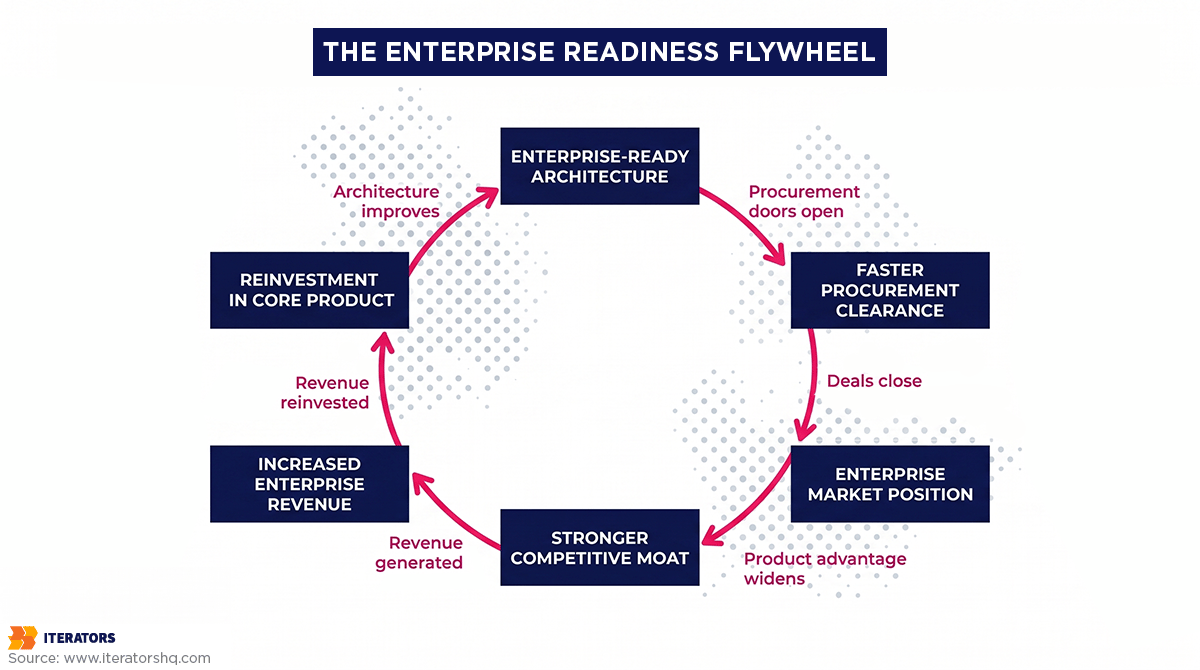
Enterprise-ready architecture → faster procurement → more enterprise revenue → reinvestment in core product → stronger competitive moat → more enterprise deals → repeat.
The startup that breaks into this cycle first captures compounding advantages. The startup that delays enterprise readiness while building features that don’t close deals watches that flywheel spin for someone else.
Series A and B Positioning
Enterprise customers aren’t just revenue—they’re validation signals that matter to investors. A startup with three Fortune 500 customers and SOC 2 Type II attestation is a fundamentally different fundraising story than a startup with strong SMB metrics and no enterprise traction.
The architectural discipline of enterprise readiness for startups also signals technical maturity that sophisticated investors recognize.
Common Objections
“We Can’t Afford a Partner Right Now”
Two senior engineers, six months, fully loaded: $270,000 in direct labor. Ongoing maintenance: $50,000+ annually. Revenue you didn’t generate because you weren’t enterprise-ready: $200,000–$300,000 in ARR.
Total three-year cost of DIY: $500,000+.
Strategic partner engagement: $40,000–$60,000.
The question isn’t whether you can afford a partner. It’s whether you can afford the six-month delay and the enterprise deals you won’t close while building.
“We Need to Understand This Ourselves”
Knowledge transfer must be non-negotiable in any partnership engagement. Your team should understand the enterprise infrastructure that’s built. They need to maintain it, extend it, and explain it to enterprise customers.
But understanding something and building it from scratch are different. You don’t need to build a plane to learn how to fly. The right partnership includes thorough documentation, active knowledge transfer during the build, and your team embedded in the process—not handed a finished product.
“Our Product Is Too Unique for Standard Enterprise Features”
This is almost never true for the enterprise features being discussed. SSO is SSO. SCIM follows a spec. SOC 2 Trust Services Criteria are standardized. The requirements on enterprise security questionnaires are remarkably consistent.
Your product may be unique. Your core algorithms may be proprietary. Your UX may be innovative. None of that changes the fact that enterprise customers need SAML SSO and audit logs in the same form as every other enterprise customer.
The uniqueness of your product lives in the features that differentiate you. Enterprise infrastructure is the plumbing that lets enterprise customers use it.
“We’re Not Ready for Enterprise Yet”
If you have enterprise deals in pipeline—or if you want enterprise deals in pipeline—you’re ready for enterprise readiness for startups. The time to achieve it is before you lose your first enterprise deal, not after.
The startup that achieves enterprise readiness for startups proactively captures deals. The startup that achieves it reactively is always six months behind.
The Iterators Approach
We’ve helped startups navigate this exact challenge—from gap analysis through SOC 2 readiness, enterprise identity implementation, and vendor assessment preparation.
Our work with Citrine Informatics: they needed to enhance their materials informatics platform with streamlined MLOps infrastructure while strengthening their engineering team with Scala expertise. We didn’t deliver code—we embedded our team into theirs. We built with them. We left them with infrastructure they understood and could extend independently.
Our work with Imperative, a peer coaching platform serving enterprise HR teams, required full-spectrum enterprise readiness for startups including SOC 2 compliance, enterprise-grade security, and the reliability that Fortune 500 customers like Airbnb, MetLife, and Sony Music demand. We’ve been their technology partner since 2015.
The pattern: we move fast, we build with the client’s team, we deliver working infrastructure, and we leave clients with knowledge and documentation to maintain what we’ve built.
We’re not consultants who deliver slide decks. We’re engineers who deliver enterprise-ready software.
Enterprise Readiness Self-Assessment

Answer these honestly:
Authentication:
- Do you support SAML 2.0 SSO with major IdPs (Okta, Azure AD, Google Workspace)?
- Do you support OIDC for modern enterprise identity federation?
- Have you tested SSO implementation against edge cases that commonly fail security reviews?
Authorization:
- Do you have SCIM provisioning endpoints for automated user lifecycle management?
- Does your permission model support organization-level RBAC with granular role definitions?
- Can you support hierarchical structures of enterprise organizations?
Auditability:
- Do you have immutable audit logs of all user actions?
- Are logs retained for at least 12 months?
- Can logs be exported to SIEM systems in standard formats?
Compliance:
- Do you have SOC 2 Type II attestation (or is the process underway)?
- Do you have a public Trust Center?
- Do you have a pre-prepared Security Questionnaire Playbook?
Sales Readiness:
- Can your sales team answer enterprise security questions without escalating to engineering?
- Have you passed at least one enterprise vendor assessment?
If you checked fewer than half: you’re not enterprise-ready. If you have enterprise deals in pipeline, you’re losing some of them right now.
Conclusion: The Constraint That Doesn’t Go Away
The argument for building enterprise features in-house feels intuitive. Your team is talented. You know your codebase. You can ship things.
The math tells a different story. DIY enterprise readiness for startups costs $400,000–$500,000 over three years when you factor in engineering time, maintenance, and lost revenue from delayed enterprise sales. It diverts your best engineers from features that differentiate your product. It burns team morale. It leaves competitors six months ahead in enterprise market position—a lead that compounds.
The strategic partnership model achieves enterprise readiness for startups in 6–8 weeks, costs a fraction of the in-house alternative, and frees your engineering team to build the things that actually win deals.
Enterprise readiness for startups is not your competitive advantage. Your product is. Enterprise readiness is the procurement clearance that lets you into the arena where your product can compete.
Here’s what we’d watch for next: the compliance requirements aren’t static. SOC 2 is table stakes today. GDPR, CCPA, and industry-specific regulations (HIPAA, FedRAMP) raise the bar further. The architectural decisions you make now determine how expensive those future compliance requirements will be. Build enterprise readiness as infrastructure that can absorb expanding compliance scope, not as a one-time checklist.
Frequently Asked Questions
How long does it take to become enterprise-ready for a B2B SaaS startup?
Building enterprise readiness for startups in-house typically takes 3–6 months of dedicated engineering bandwidth. With a specialized strategic partner executing an Enterprise Readiness Sprint, the timeline compresses to 6–8 weeks. The difference comes from pre-built frameworks, specialized expertise, and parallel work streams that eliminate sequential bottlenecks.
What are the most important enterprise features for B2B SaaS?
The non-negotiable baseline for enterprise readiness for startups: Single Sign-On (SSO) with SAML 2.0 and OIDC support, SCIM user provisioning, organization-level Role-Based Access Control (RBAC), immutable audit logs, SOC 2 Type II attestation, and enterprise SLA support. Beyond this baseline, enterprise customers often require custom data residency options, dedicated infrastructure, and advanced security controls depending on industry and regulatory environment.
How much does SOC 2 certification cost for startups?
Direct audit fees range from $10,000 to over $100,000 depending on environment complexity. Automated compliance monitoring tools (Vanta, Drata, Secureframe) cost $7,000–$30,000 annually. Implementation timeline for first-time compliance averages 3–9 months. Total first-year cost including tooling, audit fees, and engineering time typically runs $50,000–$150,000.
Can small engineering teams build enterprise features?
Yes, but at significant opportunity cost. A team of 3–5 engineers that allocates 2 senior engineers to enterprise readiness for startups for 6 months has effectively halved its product development capacity for half a year. For most early-stage startups, this opportunity cost exceeds the cost of a strategic partnership by a substantial margin.
What’s the difference between enterprise features and enterprise readiness?
Enterprise features are specific functionality: SSO, audit logs, RBAC. Enterprise readiness for startups is the holistic state of being prepared for enterprise procurement—which includes security architecture, compliance certifications, vendor assessment documentation, support SLAs, and the organizational processes to maintain all of the above. A startup can have enterprise features without being enterprise-ready if security architecture is weak or compliance documentation doesn’t exist.
When should startups start thinking about enterprise readiness?
The moment your first enterprise prospect enters your sales pipeline. Ideally before—proactively achieving enterprise readiness for startups before you need it means you can compete for enterprise deals from day one rather than scrambling after losing your first one. If you’re targeting enterprise customers, enterprise readiness should be on your roadmap from the beginning.
How do enterprise customers evaluate vendor readiness?
The process typically starts with a 100–200 question security questionnaire covering authentication, authorization, data handling, incident response, compliance certifications, and business continuity. This is followed by vendor assessment review, often involving the CISO and IT architecture team. For high-value contracts, this may include penetration testing or security audit. Having SOC 2 Type II attestation and a pre-prepared Security Questionnaire Playbook dramatically accelerates this process.
What mistakes do startups make when building enterprise features?
The most common: underestimating SAML 2.0 implementation complexity across different IdPs, treating SOC 2 as a checklist rather than architectural discipline, building custom solutions for commoditized requirements, failing to document implementation (creating maintenance nightmares), and attempting sequential builds rather than parallel work streams. The meta-mistake is treating enterprise readiness for startups as a feature request rather than a strategic business decision.
At Iterators, we’ve helped startups from seed to Series B achieve enterprise readiness for startups and close the deals that transform growth trajectories. Schedule a free consultation with Iterators.