

Building a product is like jumping out of a plane and assembling the parachute on the way down—except you’re also trying to convince investors the parachute is actually a rocket ship, and your team is arguing about whether you even need a parachute. Welcome to product development. This is where SaaS development services become your lifeline—transforming chaos into strategy, assumptions into validated hypotheses, and ambitious visions into market-ready products that customers actually want to use..
Here’s the brutal truth: 90% of startups fail. And before you comfort yourself thinking “well, at least 10% make it,” consider this—10% fail within the first year, and nearly 70% crash between years two and five. That’s not a survival rate; it’s a massacre with a brief intermission.
The kicker? Most of these failures happen because founders skip the one phase that actually matters: the product development kickoff. They treat it like a formality—a quick meeting where everyone nods enthusiastically before diving into code. But the kickoff phase isn’t administrative theater. It’s where you either build the foundation for a scalable business or lay the groundwork for an expensive lesson in humility.
SaaS development services aren’t just about writing code—they’re about preventing you from building something nobody wants, with technology that won’t scale, using a team that can’t execute. Professional SaaS development services combine strategic planning with technical execution to transform vague product ideas into market-ready solutions. And if that sounds harsh, remember: 42% of startups fail because they built something the market didn’t need. That’s not a technology problem. It’s a “we skipped the boring strategic stuff” problem.
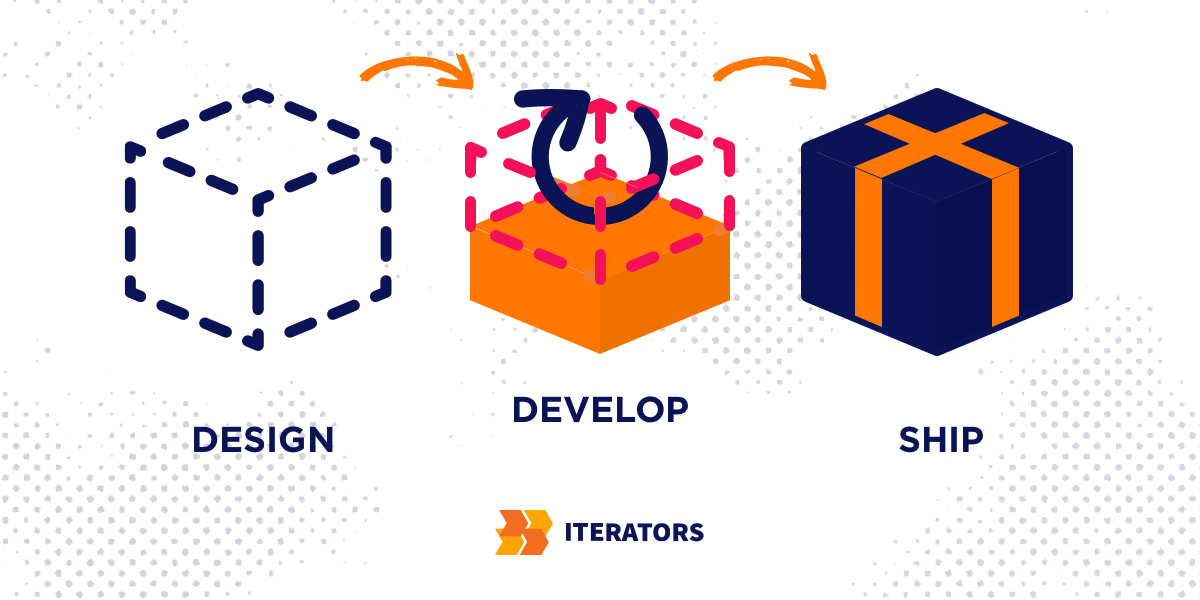
Ready to get your product kickoff right the first time? At Iterators, we’ve helped dozens of founders navigate the treacherous waters between idea and launch. Our team combines strategic product thinking with technical execution to ensure you’re building the right thing, the right way, from day one. Schedule a free consultation to discuss your product vision and get expert guidance on your kickoff strategy.
This guide will walk you through everything you need to consider before your first sprint begins. We’ll cover market validation, team composition, technology decisions, budgeting, compliance, and all the unsexy-but-critical details that separate successful launches from cautionary tales. By the end, you’ll have a framework for making decisions that won’t haunt you six months into development when you realize you’ve built a beautiful solution to a problem that doesn’t exist.
Why Product Development Kickoff Determines Your SaaS Success
Let’s start with the uncomfortable economics of failure.
When a startup collapses, it’s not usually because the developers couldn’t code. It’s because the fundamental assumptions made during kickoff were wrong. The market wasn’t there. The business model didn’t work. The technology couldn’t scale. The team couldn’t execute. And by the time these problems became obvious, the company had already burned through most of its runway.
The cost of getting this phase wrong is staggering. The average SaaS MVP costs between $60,000 and $150,000 to build. Add in hidden costs—hosting, third-party APIs, legal fees, marketing—and you’re looking at another 20-30% on top. Now imagine discovering six months after launch that your core assumption about customer behavior was completely wrong. You’re not just out the development costs; you’ve also wasted the opportunity cost of what you could have built instead.
Contrast this with the cost of a proper discovery phase: $12,000 to $25,000. That investment buys you validation, reduces scope uncertainty, and dramatically increases your odds of building something people actually want. It’s the difference between gambling and making an informed bet.
Here’s what proper planning with experienced SaaS development services actually prevents:
Budget overruns: IT projects routinely exceed their budgets by 75% when initial planning is deficient. That $100,000 MVP you budgeted for? It’s now $175,000, and you’re out of runway.
Timeline failures: Projects without solid kickoff planning blow their timelines by 50% on average. Your “three months to launch” becomes six months, and your competitor just shipped their version.
Market misalignment: Remember Quibi? They raised $2 billion and collapsed because they never validated that people wanted high-production short-form content exclusively on mobile. That’s a $2 billion kickoff failure that even the best SaaS development services couldn’t have saved without proper market validation.
The ROI of getting this right is equally clear. Companies that invest in thorough discovery and validation don’t just avoid catastrophic failures—they build better products faster. When your team has clear, validated requirements, development velocity increases dramatically. There’s no endless debate about what features to build because you’ve already tested your assumptions with real users.
Think of the kickoff phase as buying insurance against your own optimism. Founders are naturally optimistic—that’s why they start companies. But optimism is dangerous when you’re allocating capital. The kickoff phase forces you to confront uncomfortable questions before they become expensive mistakes.
Strategic Considerations Before Building Your SaaS Product
Before you write a single line of code or design a single screen, you need to answer the fundamental strategic questions that will determine whether your product succeeds or joins the 90% graveyard.
Validate Your Market and Problem-Solution Fit
The most dangerous assumption any founder can make is that their vision represents market reality. Your conviction that a problem exists doesn’t make it true. Your belief that customers will pay for your solution doesn’t make it profitable.
Customer Discovery and User Research Methods
Real validation requires evidence, not enthusiasm. You need to talk to potential customers every week—not to pitch your idea, but to understand their actual problems and current solutions.
The best framework for this is The Mom Test: ask questions about past behavior, not hypothetical future actions. Don’t ask “Would you use a tool that does X?” Ask “How do you currently solve this problem? What have you tried? What did it cost you?”
If someone can’t demonstrate that they’ve already attempted to solve the problem you’re addressing—whether by spending money, cobbling together a manual process, or suffering significant pain—the problem probably isn’t urgent enough to support a business.
Use Opportunity Solution Trees (Teresa Torres’s framework) to map the path from your desired business outcomes to actual customer problems. This prevents you from building “orphan features”—things that seem cool but don’t connect to any validated customer need.
Aim for at least 20 deep customer interviews before you commit to building anything. These conversations should reveal:
- Specific pain points and their frequency
- Current workarounds and their costs
- Willingness to pay (demonstrated through past behavior)
- Decision-making processes and buying criteria
Competitive Analysis and Positioning
Your biggest competitor probably isn’t another startup—it’s the status quo. For many B2B products, you’re competing against Excel spreadsheets, email workflows, and organizational inertia. Understanding what you’re really up against is crucial.
Competitive benchmarking should analyze both direct and indirect competitors:
- Direct competitors: Other solutions solving the same problem
- Indirect competitors: Different approaches to the same outcome
- The status quo: What people do when they do nothing
Your differentiation strategy needs to be specific. Are you competing on:
- Price: Significantly cheaper than alternatives
- Speed: Dramatically faster implementation or results
- Vertical expertise: Deep understanding of a specific industry
- Integration: Better connectivity with existing tools
In 2025, Vertical SaaS (industry-specific solutions) is outperforming Horizontal SaaS because it can solve deep, specific workflow problems that generalist tools can’t address. If you’re building a horizontal product, you need exceptional execution and significant capital to compete.
Market Size and Opportunity Assessment
Calculate your Total Addressable Market (TAM), Serviceable Available Market (SAM), and Serviceable Obtainable Market (SOM). This isn’t just investor theater—it tells you whether the opportunity is worth pursuing.
For venture-backed startups, the market needs to support “unicorn” potential (valuations over $1 billion). For bootstrapped or lifestyle businesses, smaller niche markets with higher profitability can be more attractive.
Define Your Business Model and Success Metrics
A product without a business model is a hobby. Before you build anything, you need to know exactly how you’ll capture value from the value you create. Professional SaaS development services understand that technical architecture must support your business model, not dictate it.
Revenue Model Clarity
Modern SaaS companies use several pricing models, each with different implications:
Freemium: Great for Product-Led Growth (PLG), as demonstrated by Slack and Notion. The challenge is balancing free features (enough to be useful and viral) with paid features (compelling enough to convert users). Get this wrong and you’ll have millions of free users who never convert.
Usage-Based Pricing: Increasingly popular for AI and infrastructure products (Snowflake, OpenAI). Revenue scales with customer success, but forecasting becomes difficult and you need sophisticated metering infrastructure.
Tiered Subscription: The classic model (Basic, Pro, Enterprise). You need to define clear “fences” between tiers that align with customer willingness to pay without creating perverse incentives. Understanding Stripe subscription types can help you implement these models effectively.
Key Performance Indicators (KPIs) to Track
Define success metrics before launch to prevent “vanity metrics” from obscuring reality.
North Star Metric: The single metric that best captures core value delivered to customers. For Slack, it’s “messages sent.” For Airbnb, it’s “nights booked.” This metric should directly correlate with customer value and business growth.
The Rule of 40: For SaaS companies, growth rate plus profit margin should exceed 40%. This is a critical health metric that investors use to evaluate sustainability.
Unit Economics: Understanding the relationship between Customer Acquisition Cost (CAC) and Lifetime Value (LTV) is fundamental. A healthy ratio is typically 3:1 (LTV:CAC)—customers should generate three times more revenue than it costs to acquire them. Track these essential SaaS metrics from day one.
If your unit economics don’t work, scaling will only accelerate your path to failure.
Clarify Your Product Vision vs. MVP Scope
This is where most founders struggle: balancing their grand vision with the constraints of reality.
The MVP Mindset: Build to Learn
Your MVP is not a “stripped-down version” of your final product. It’s the smallest thing you can build to start the learning process while still delivering value.
There’s a growing shift toward Minimum Lovable Products (MLP), which prioritize user delight over bare-bones utility. In saturated markets, a clunky MVP may fail to gain traction even if it solves the functional problem—user expectations for UX/UI are significantly higher than they were a decade ago.
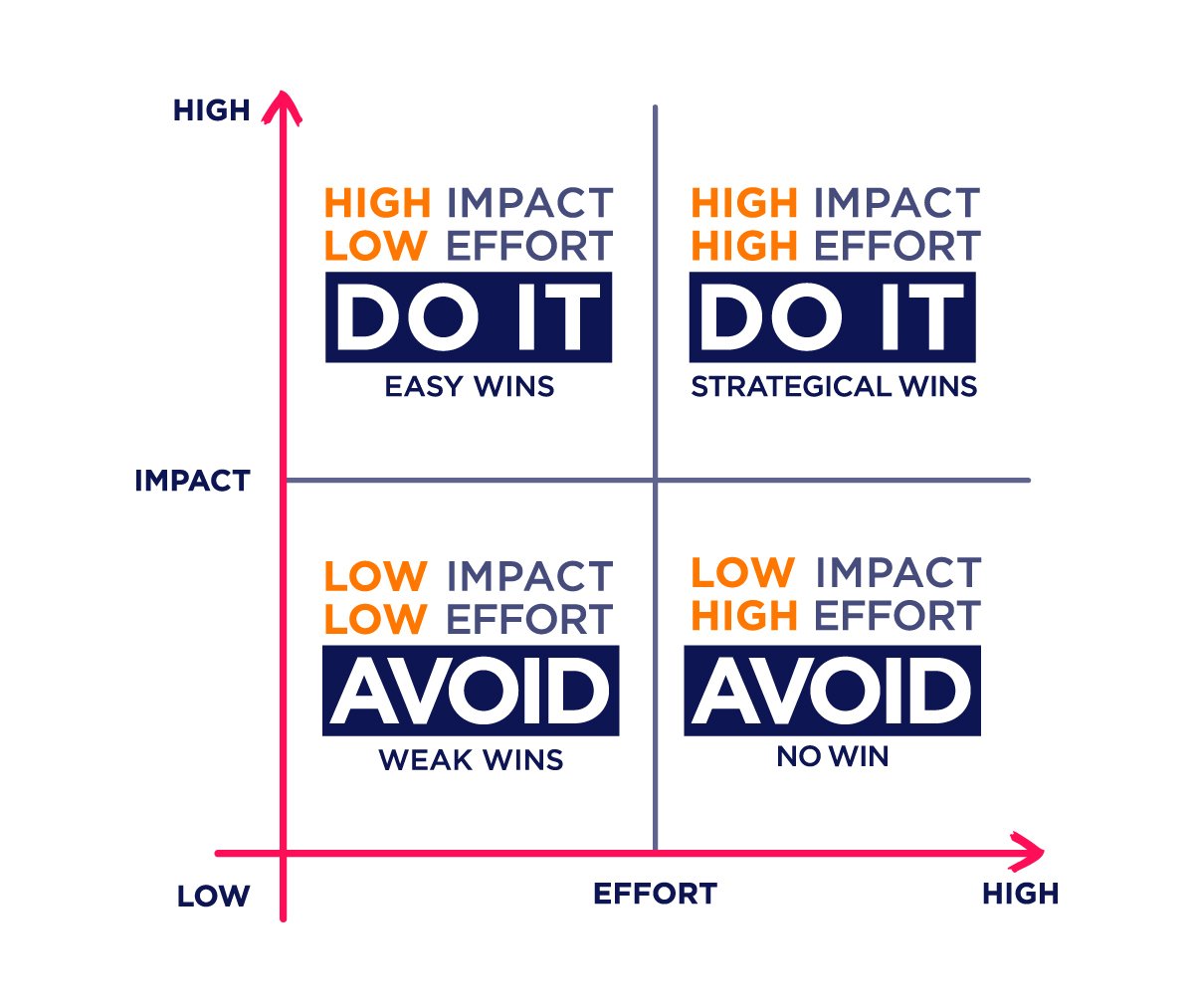
Feature Prioritization Frameworks
Use structured frameworks to decide what makes the cut:
MoSCoW Method:
- Must have: Core functionality required for MVP
- Should have: Important but not critical
- Could have: Nice-to-have enhancements
- Won’t have: Explicitly out of scope
RICE Scoring:
- Reach: How many users will this impact?
- Impact: How much will it improve their experience?
- Confidence: How sure are we about Reach and Impact?
- Effort: How much work will this require?
Score features on these dimensions to remove bias and emotion from prioritization decisions. A well-structured product roadmap keeps everyone aligned on priorities.
Avoiding Scope Creep
Scope creep is a primary cause of project failure and budget overruns. Establish a rigid “definition of done” for your MVP and treat any new feature request as a potential delay to market entry.
Create a “parking lot” for future ideas—acknowledge them without committing to build them. Every feature you add to the MVP is a bet that it’s more important than getting to market faster.
Technical and Team Considerations for SaaS Development Services

Once you know what you’re building and why, the next questions are how and who. Selecting the right SaaS development services partner or building an internal team requires understanding both technical and organizational requirements.
Choosing the Right Technology Stack
Your technology stack isn’t just a technical decision—it’s a strategic one that impacts hiring, scalability, and time-to-market.
Factors to Consider
Ecosystem and Talent Pool: Choosing popular languages (JavaScript/TypeScript, Python) ensures access to a large pool of developers. Niche languages might offer technical advantages but create hiring bottlenecks that can stall growth.
Time-to-Market: Frameworks like Ruby on Rails or Laravel are renowned for rapid MVP development. They handle authentication, database migrations, and routing out of the box, letting you focus on unique business logic.
Scalability Requirements: If you need real-time data processing (FinTech trading), consider Node.js or Go. For AI-heavy applications, Python is non-negotiable due to its dominance in machine learning libraries.
Common Stacks for 2025
SaaS/Web Applications:
- MERN stack (MongoDB, Express, React, Node.js)
- Next.js with PostgreSQL and Tailwind CSS
- Modern choice for performance and SEO
Mobile Applications:
- React Native or Flutter for cross-platform efficiency
- Up to 90% code reuse vs. native development
- Native Swift/Kotlin only for graphics-intensive apps
AI-Native Applications:
- Python backend (FastAPI/Django)
- Vector databases (Pinecone, Milvus)
- LLM orchestration tools (LangChain)
Building vs. Buying vs. Outsourcing Your Development Team
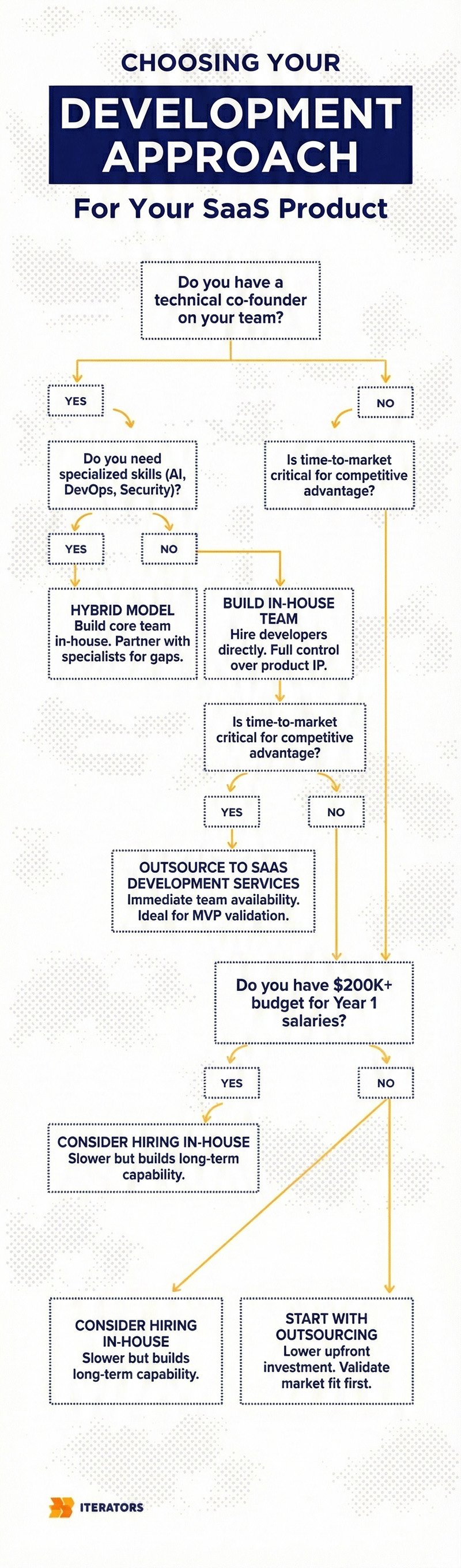
The “build vs. buy” decision extends to your team composition. Understanding when to leverage SaaS development services versus building in-house is critical.
| Feature | In-House Team | Outsourced Agency | Hybrid Model |
|---|---|---|---|
| Cost Structure | High fixed costs (salaries, benefits, overhead) | Variable costs (hourly/project based) | Medium (core salaries + agency fees) |
| Time to Start | Slow (recruiting takes 1-3 months) | Fast (immediate team availability) | Medium (depends on integration speed) |
| Flexibility | Low (fixed headcount, hard to downsize) | High (scale up/down on demand) | High (core stability + elastic capacity) |
| Quality Control | High (direct daily oversight) | Variable (depends on vendor vetting) | High (internal leads oversee external devs) |
| IP Protection | Strongest (employees under NDA) | Strong (requires robust contracts) | Strong (core IP kept in-house) |
| Best For | Core product IP, long-term scaling, post-PMF | MVP, non-core features, rapid prototyping | Scaling startups needing specialized skills |
When to Hire a Dedicated Development Team
For non-technical founders, outsourcing to SaaS development services provides immediate access to a complete “product trio” (PM, Design, Engineering) without recruitment friction. You can focus on market validation and sales while the agency handles technical execution.
However, as you scale (typically post-Series A), bringing core engineering in-house becomes critical for long-term valuation and control over your product’s destiny.
Assembling the Right Expertise
A successful product team requires balanced skills.
The Product Trio:
- Product Manager: Focused on value and viability
- Designer: Focused on usability
- Lead Engineer: Focused on feasibility
This structure prevents silos and ensures all risks are addressed simultaneously. Understanding how to split product development teams becomes crucial as you scale.
Specialized Roles: Depending on your product, you may need DevOps (infrastructure automation), QA (quality assurance), or AI Engineers (model tuning) early on. In 2025, security expertise is becoming fundamental even for early-stage teams.
The “Empowered Engineer”: Engineers should participate in discovery to understand why features are being built, not just code requirements. This empowers them to suggest technical solutions that product managers might not know are possible.
Planning for Success: Process and Operations with SaaS Development Services
Execution is where strategy meets reality. Establishing clear processes during kickoff prevents the chaos of “Zombie Scrum”—going through Agile motions without delivering value.
Creating Your Product Requirements and Documentation
Documentation serves as the “Single Source of Truth” for your development team.
User Stories: Write requirements from the user’s perspective: “As a [user], I want to [action], so that [benefit]”
This keeps focus on value delivery rather than technical implementation.
Technical Specifications:
- API documentation (Swagger/OpenAPI)
- Database schemas
- Architectural diagrams
Design Systems: Tools like Figma allow interactive prototyping that can be validated before coding begins. A well-maintained design system ensures consistency and speeds up frontend development.
PRDs (Product Requirements Documents): A living document capturing the problem, success metrics, and scope. It serves as the contract between product and engineering.
Setting Realistic Budgets and Timelines

Founders notoriously underestimate both cost and time—the “Optimism Bias” in action. Professional SaaS development services provide realistic estimates based on experience.
Cost Breakdown:
- Typical SaaS MVP: $60,000 – $150,000
- Hidden costs (hosting, APIs, legal, marketing): +20-30%
- Total realistic budget: $75,000 – $195,000
Understanding software development costs helps you plan effectively.
Timeline Estimation:
- MVP development: 3-6 months
- Influenced by team size, technical complexity, regulatory requirements
- Always add 20-30% buffer for “unknown unknowns”
Product Development Kickoff Timeline:
Weeks 1-2: Discovery & Strategy
- Market research
- User interviews
- Competitive analysis
- Hypothesis generation
Weeks 3-4: Definition & Design
- Requirements gathering
- Wireframing
- UI/UX design
- Tech stack selection
Week 5: Kickoff Meeting
- Team alignment
- Role assignment
- Roadmap finalization
- “Definition of done” establishment
Weeks 6-12+: Agile Development Sprints
- Iterative building
- Testing
- Review cycles
Choosing Your Development Methodology
Agile/Scrum: The standard for startups. Breaks work into 2-week “sprints” with regular reviews. Allows flexibility and rapid adaptation to user feedback.
Kanban: Best for continuous flow and maintenance phases. Focuses on limiting Work In Progress (WIP) and is used by teams that need to react to incoming tickets in real-time.
Waterfall: Generally discouraged for software startups due to rigidity, but elements may be necessary for hardware components or strictly regulated industries (medical devices) where requirements must be fixed upfront for compliance.
Risk Mitigation and Long-Term Thinking

A successful kickoff anticipates future challenges. Ignoring non-functional requirements like security and scalability creates technical debt and legal liability.
Security and Compliance from Day One
In 2025, security is not an add-on feature—it’s a baseline expectation that quality SaaS development services build into every project.
Regulatory Frameworks:
GDPR/CCPA: Mandatory for any product handling data of EU/California citizens. Requires:
- Data privacy policies
- “Right to be forgotten”
- Robust consent management systems
HIPAA: Essential for HealthTech applications. Requires:
- Strict encryption
- Access controls
- Signed Business Associate Agreements (BAAs) with all vendors handling Protected Health Information
SOC 2: Critical for B2B SaaS selling to enterprises. Demonstrates control over:
- Security
- Availability
- Confidentiality
Often serves as a prerequisite for closing enterprise deals.
Secure Development Lifecycle (SDLC): Implement security checks (SAST/DAST) within your CI/CD pipeline to catch vulnerabilities early rather than in production.
Planning for Scalability (Without Over-Engineering)
Your architecture must support growth without premature optimization. Experienced SaaS development services know how to balance current needs with future scalability.
Cloud-Native Architecture: Leverage managed services (AWS Lambda, Google Cloud Run) for auto-scaling and reduced operational overhead. This “serverless” approach lets you pay only for what you use.
Database Choices: Select databases that can handle growth (sharding in MongoDB or PostgreSQL) to prevent painful migrations later.
Multi-Tenancy: For SaaS, decide between:
- Single-tenant: Better security/isolation for enterprise
- Multi-tenant: Better cost/maintenance for SMBs
This foundational decision is difficult to reverse later. Understanding SaaS enterprise readiness helps you make the right choice.
Intellectual Property and Legal Considerations
Code Ownership: Ensure all contracts with outsourced agencies or freelancers explicitly state that your startup owns the code and IP upon payment. “Work for hire” clauses are essential when using external SaaS development services.
Licensing: Be careful with open-source libraries. Restrictive licenses (GPL) might force you to open-source your proprietary code.
NDAs: Use NDAs with external partners but avoid asking investors to sign them—it’s generally considered an industry red flag.
Common Pitfalls and How to Avoid Them

Learning from others’ failures is cheaper than creating your own. Professional SaaS development services have seen these mistakes countless times.
1. Building Without Validation The “Field of Dreams” approach causes 42% of failures. Solution: Sell before you build. Get letters of intent (LOIs) or pre-orders to validate demand.
2. Unclear Requirements (Scope Creep) Vague requirements lead to endless revisions. Solution: Maintain rigidly defined user stories and acceptance criteria.
3. Wrong Team Composition Hiring too many juniors to save money or lacking product leadership. Solution: Balance seniority. Hire a strong CTO or lead developer first to set technical standards.
4. Ignoring Technical Debt Rushing to launch with “quick and dirty” code. Solution: Allocate 20% of every sprint to tech debt reduction and refactoring.
5. Poor Communication Structures Siloed teams lead to “throw it over the wall” handoffs. Solution: Implement cross-functional teams and daily standups for alignment.
6. Underestimating Time and Budget Optimism Bias leads to running out of cash. Solution: Use data-driven estimation and always add contingency buffers.
Your SaaS Development Services Kickoff Checklist
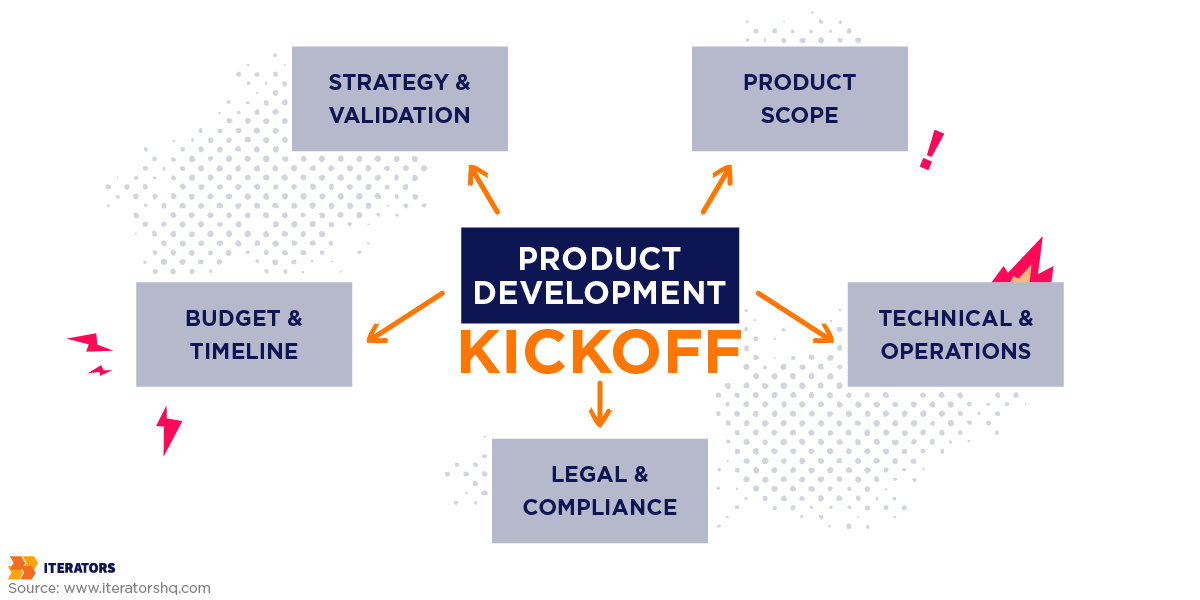
Strategy & Validation
- [ ] Market problem defined and validated with 20+ customer interviews
- [ ] Competitive landscape analyzed (direct & indirect competitors)
- [ ] Unique Value Proposition articulated and tested
- [ ] Business model and pricing strategy hypothesized
- [ ] Success metrics and “North Star” metric defined
Product Scope
- [ ] User personas created with detailed pain points
- [ ] User journey maps visualized
- [ ] Feature list prioritized (MoSCoW/RICE)
- [ ] MVP scope locked and approved by stakeholders
- [ ] Prototype validated with real users
Technical & Operations
- [ ] Tech stack selected (Frontend, Backend, DB, Cloud)
- [ ] Buy vs. Build decisions made for core components
- [ ] Development team assembled (In-house vs. Agency)
- [ ] Roles and responsibilities defined (RACI)
- [ ] Development methodology agreed upon
- [ ] Tools set up (Jira, GitHub, Figma, Slack)
Legal & Compliance
- [ ] Corporate entity structure finalized
- [ ] IP assignment agreements signed
- [ ] Privacy Policy and Terms of Service drafted
- [ ] Data protection strategy planned (GDPR/HIPAA/SOC 2)
- [ ] Vendor contracts reviewed and signed
Frequently Asked Questions About SaaS Development Services
How long should the product kickoff phase take?
A thorough kickoff, including discovery and planning, typically takes 2-4 weeks. This allows sufficient time for market research, technical architecture design, and team alignment without stalling momentum. Professional SaaS development services follow structured frameworks to maximize efficiency.
What’s the average cost to develop an MVP?
In 2025, a typical SaaS MVP ranges from $60,000 to $150,000. Simple apps may cost $25,000-$60,000, while complex enterprise solutions with AI integration can exceed $200,000. Quality SaaS development services provide detailed cost breakdowns based on your specific requirements.
Should I hire in-house or outsource for my first product?
If you have a technical co-founder, building in-house is often best for long-term IP retention. If you’re non-technical, outsourcing to reputable SaaS development services allows faster time-to-market and access to a complete team, provided you have strong contracts and oversight.
How do I know if my product idea is worth building?
Validation means currency exchanged—time, money, or reputation. If you can secure pre-orders, signed Letters of Intent, or have a waiting list of users willing to pay, your idea has merit. Verbal praise doesn’t count. Professional SaaS development services can help you run validation experiments before committing to full development.
What’s the difference between a product roadmap and a development roadmap?
A product roadmap communicates strategy and outcomes (what problems we’ll solve and when). A development roadmap details outputs (specific features, releases, and technical tasks) required to achieve those outcomes.
How much technical knowledge do I need as a non-technical founder?
You don’t need to code, but you must understand concepts like frontend vs. backend, APIs, databases, and technical debt. This knowledge empowers you to make informed business decisions and manage technical partners effectively. Quality SaaS development services educate their clients throughout the process.
Conclusion
The product development kickoff isn’t a formality—it’s the strategic crucible where your product’s future is forged.
By rigorously validating your market, defining a focused MVP, selecting the right technology and partners, and anticipating risks, you shift the odds of success dramatically in your favor. Founders who rush this phase in eagerness to “start building” often find themselves building the wrong thing with the wrong team using the wrong technology.
Those who invest time to align strategy, design, and engineering create a foundation that supports rapid scaling and market resilience. The code you write tomorrow will only be as good as the decisions you make today.
With a clear checklist, validated strategy, and trusted SaaS development services partner, you can navigate development complexities with confidence. The goal isn’t just to launch a product—it’s to build a sustainable business that solves real problems and creates genuine value.
The 10% of startups that survive don’t get there by accident. They get there by treating the kickoff phase as seriously as the code that follows. Partner with experienced SaaS development services that understand both the technical and strategic dimensions of product success, and you’ll dramatically improve your odds of joining that elite group.
Whether you’re building your first MVP or scaling an established product, the principles outlined in this guide—market validation, technical excellence, team alignment, and risk mitigation—remain constant. The difference between success and failure often comes down to how seriously you take the kickoff phase and whether you have the right SaaS development services partner to guide you through it.
Don’t let your product become another cautionary tale. At Iterators, we specialize in turning ambitious visions into market-ready products through strategic kickoff planning and expert execution. Our team has guided countless founders through the critical decisions that determine whether products succeed or fail. We don’t just write code—we help you validate assumptions, architect scalable solutions, and build products that customers actually love.
Schedule your free consultation today and let’s discuss how our SaaS development services can help you navigate your product kickoff with confidence. Because the best time to get it right is before you write your first line of code.