

You know how you can ask three people at the same company what the brand stands for and get three different answers? The founder talks about the mission. Sales talks about the price. The designer talks about the logo. Nobody is wrong, and a customer who hears all three still has no idea why they should pick you. A brand pyramid is built for exactly that problem.
It’s a one-page document that stacks everything your brand says, from the big promise at the top down to the proof at the bottom, so every layer backs up the one above it. Basically, it makes sure the story on your homepage, in a sales deck and in a support reply is the same story.
Need help implementing your brand’s pyramid? The Iterators team can help design, build, and maintain custom software solutions for both startups and enterprise businesses.
Schedule a free consultation with Iterators today. We’d be happy to help you find the right software solution to help your company.
Below are the five layers of the classic brand pyramid, Kevin Lane Keller’s brand resonance pyramid (the version from marketing textbooks), an Apple example, a brand pyramid template you can copy, and what changes when the brand is a tech product.
What is a Brand Pyramid?
A brand pyramid is a framework that describes a brand in layers, from the most emotional idea at the top to the most concrete facts at the bottom. The top answers “why should anyone care?” and the bottom answers “why should anyone believe you?”. Each layer has to follow from the one above it and be backed up by the one below it.
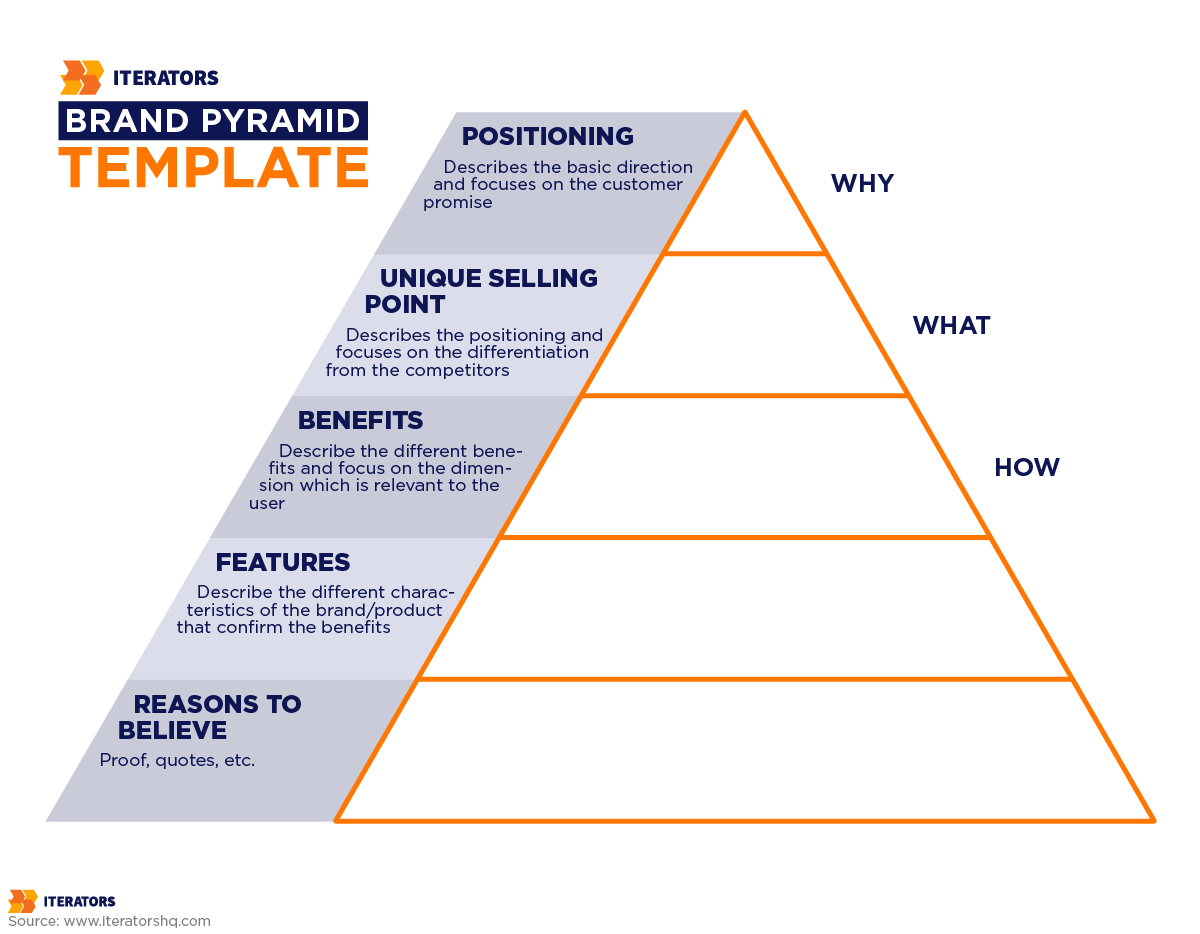
The version in the picture is the one most agencies and in-house teams work with: positioning at the top, then the unique selling point, benefits, features and reasons to believe. Some teams draw four layers, some seven, and the labels change (“brand values”, “personality”, “brand essence”). It’s the same idea with different boxes.
Three things people mean by “brand pyramid”
The name is a bit overloaded, and the search results show it. Type “brand pyramid” into Google and you get marketing frameworks next to Reddit threads ranking watch brands. So, quickly:
- The positioning pyramid, the main topic here: a tool for deciding what your own brand says and how it proves it.
- Keller’s brand resonance pyramid, also called the CBBE model (customer-based brand equity): a model of how a customer’s relationship with a brand grows, from “I’ve heard of it” to “I’d recommend it to anyone”. More on it below.
- The luxury brand pyramid: a ranking of brands by price and prestige, with mass-market labels at the bottom and haute couture at the top. Fun for fashion and watch fans, and no help when you’re writing your own messaging.
The Five Layers of a Brand Pyramid
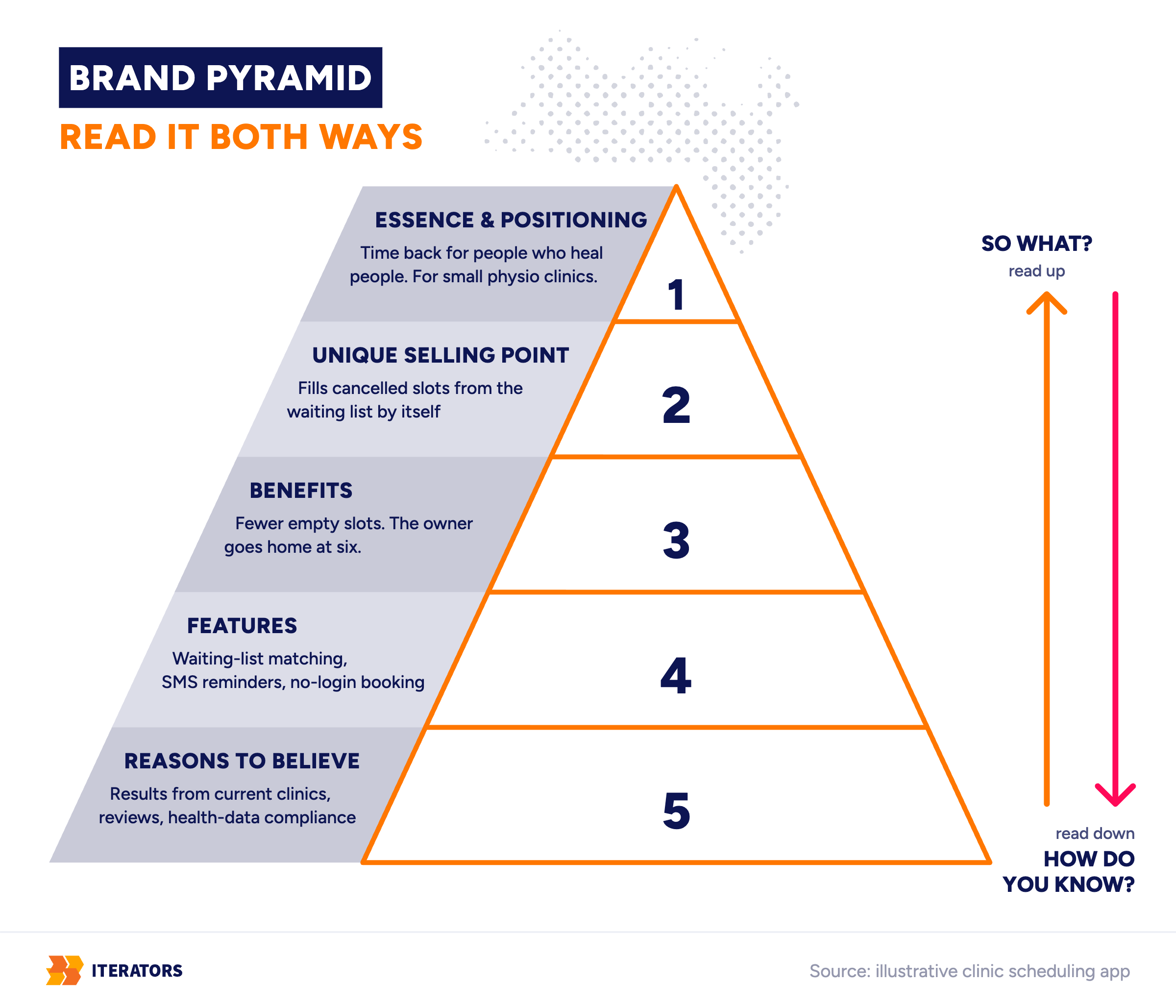
To keep this concrete, let’s follow one made-up company through every layer: a scheduling app for physiotherapy clinics. Picture the clinic owner at 7 p.m., still on the phone moving tomorrow’s appointments around because two patients cancelled.
1. Essence and Positioning
The essence is the one idea your brand stands for, in a few words. Positioning is where that idea puts you on the market: for whom, against whom, and how you’re different. Together they answer “why do we exist, and for whom?”
For the clinic app, the essence could be “time back for people who heal people”. The positioning: scheduling built for small physio clinics, as opposed to generic calendar tools made for hair salons and dentists.
Nike is the classic real-world case. Its mission is to bring inspiration and innovation to every athlete in the world, and it adds that if you have a body, you are an athlete. That one line explains why the same brand sells to marathon runners and to people who jog twice a month.
2. Unique Selling Point (USP)
The USP is the reason to pick you over the obvious alternative. It’s less about everything you do well and more about the one thing competitors can’t say with a straight face.
For the clinic app: it fills cancelled slots from the waiting list by itself, without the receptionist calling anyone. A generic calendar can’t promise that, because it doesn’t know what a waiting list is.
A quick test: put a competitor’s name into your USP. If the sentence is still true, it isn’t a USP yet.
3. Benefits
Benefits are what the customer gets out of the USP, and they come in two kinds. Functional benefits are practical: fewer empty slots, less time on the phone. Emotional benefits are about how it feels: the clinic owner goes home at six and stops dreading Monday mornings.
Most teams find functional benefits easy and get stuck on the emotional ones. It helps to listen to how customers complain. “I spend my evenings playing Tetris with the calendar” is an emotional benefit waiting to be written down.
4. Features
Features are what the product actually does: automatic waiting-list matching, SMS reminders, a booking page patients can use without creating an account. Each feature should support at least one benefit above it. A feature that supports nothing is either a benefit you haven’t named yet or a feature you shouldn’t lead with.
5. Reasons to Believe
The bottom layer is proof. Anyone can claim to save clinics time. Reasons to believe are the things that make a skeptical reader nod: numbers from real customers, reviews, certifications, awards, a well-known client. For an app that stores patient data, compliance with health-data rules belongs here too, because “is my data safe?” comes up long before “is it fast?”.
Reasons to believe only work if they’re true and checkable. If you don’t have the proof yet, leave the box half empty and write that down. The gap is useful: it tells you what to start measuring.
How the Layers Fit Together
Read the pyramid upward and every step should answer “so what?”. The app matches cancellations to the waiting list. So what? Clinics lose fewer appointments. So what? The owner stops working evenings. So what? That’s the time back, which is the essence. Read it downward and every step should answer “how do you know?”. If either direction breaks, that’s the layer to fix.
Keller’s Brand Resonance Pyramid
If you studied marketing, the brand pyramid you remember is probably this one. Kevin Lane Keller, a marketing professor at Dartmouth’s Tuck School of Business, described it in a 2001 Marketing Science Institute paper, “Building Customer-Based Brand Equity: A Blueprint for Creating Strong Brands”, and it’s still in his textbook Strategic Brand Management. That’s why you’ll also see it called the CBBE model or the brand equity pyramid.
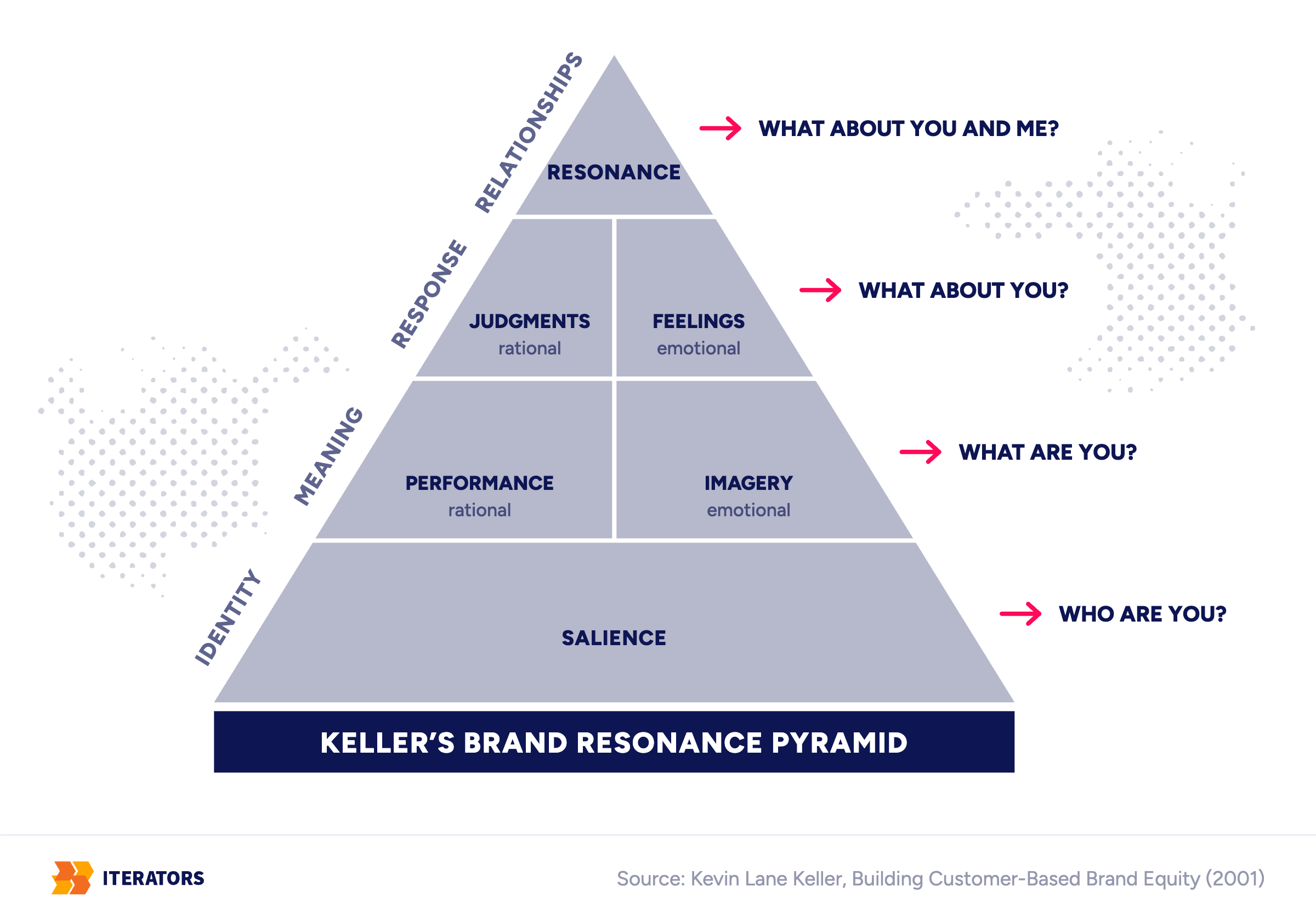
The two pyramids look alike and answer different questions. The positioning pyramid is about what you say. The brand resonance pyramid is about what happens in the customer’s head as they get to know you. It has four levels, and each one matches a question the customer asks:
| Level | The customer asks | Building block | What it looks like |
|---|---|---|---|
| 1. Identity | Who are you? | Salience | People know you exist and think of you in the right situation. |
| 2. Meaning | What are you? | Performance (rational) and imagery (emotional) | Does it work well, and what kind of people use it? |
| 3. Response | What about you? | Judgments (rational) and feelings (emotional) | Quality, credibility, worth considering; warmth, security, excitement, social approval. |
| 4. Relationships | What about you and me? | Resonance | Loyalty, attachment, a sense of community, active engagement. |
The left side of the brand resonance pyramid (performance, judgments) is the rational route and the right side (imagery, feelings) is the emotional one. Keller’s point is that a strong brand needs both, and that the levels go in order: nobody becomes a loyal fan of a product whose name they can’t remember.
How the Two Pyramids Work Together
In practice, teams use them as a pair. The positioning pyramid gives you the words, and the resonance pyramid shows where customers get stuck. If people know your name but can’t explain what you do, that’s a meaning problem, and the USP and benefits are where to work. If they like you but don’t come back, that’s a relationship problem, and a new tagline won’t fix it.
The resonance pyramid also gives you something to measure. Awareness and recall surveys tell you about salience. Reviews and ratings on comparison sites tell you about judgments. Repeat purchases, referrals and community activity tell you about resonance.
Brand Pyramid Example: Apple
Apple is the example everyone uses, and for once there’s a good reason: you can fill in every layer without guessing much. Here’s how its brand pyramid could look. It’s our reading from the outside, not an official Apple document.
- Essence and positioning: creativity made simple. A premium brand for people who care how technology feels to use as much as what it can do.
- USP: hardware, software and services designed by one company, so they work as one thing.
- Functional benefits: the devices work together with no setup. A photo taken on an iPhone shows up on the Mac, and text copied on one device pastes on another.
- Emotional benefits: the feeling of owning something well made and belonging to a group of people who care about that.
- Features: its own operating systems, its own chips, iCloud connecting it all, a minimalist design language.
- Reasons to believe: long software updates for older devices, a long run of design awards, and the experience of anyone who has moved a file between two Apple devices.
The interesting part is how the layers lean on each other. The USP (one company makes everything) is the only reason the functional benefit (it all works together) is believable. If Apple made only phones, the pyramid would fall apart at the second layer.
Steve Jobs put the top-down logic into one sentence at Apple’s Worldwide Developers Conference in 1997, answering a developer who had just criticized him:
“You’ve got to start with the customer experience and work backwards to the technology.”
Steve Jobs

That’s basically the brand pyramid read from the top: decide what the customer should feel, then decide what to build.
How to Build a Brand Pyramid
You can fill in a brand pyramid in an afternoon. Getting it right usually takes a few rounds. Here’s an order that tends to work.
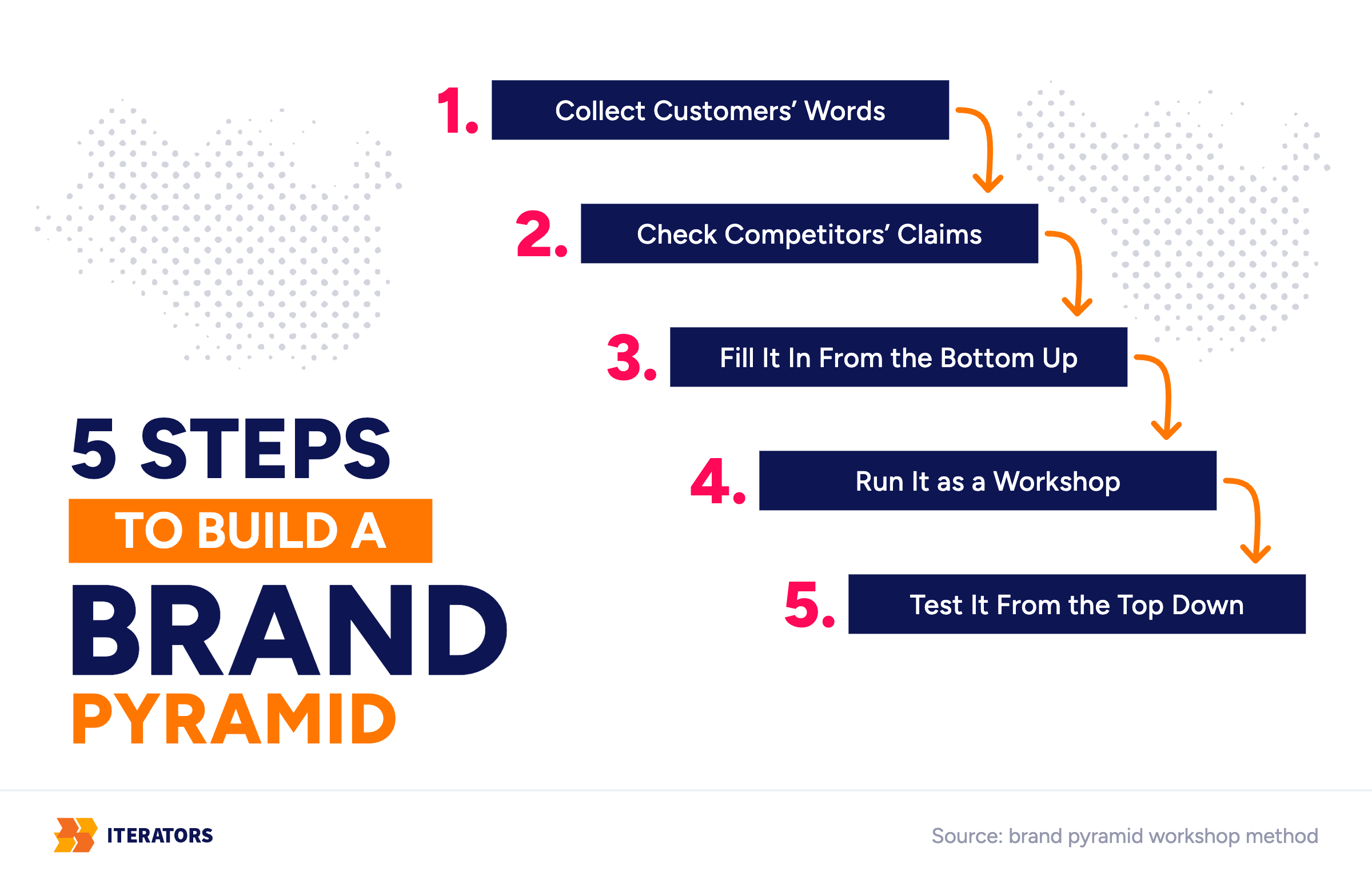
1. Start With What Customers Already Say
Before anyone opens a template, collect the words customers use: sales call notes, support tickets, reviews, interview transcripts. Your benefits are in there, in the customer’s own language, which is almost always better than what the team would write. If you don’t have much of this yet, our guides to collecting customer feedback and to UX research, from proto-personas to usability testing show how to get it without a research budget.
2. Look at What Competitors Claim
Write down the headline from the homepages of your three closest competitors. If your draft USP sounds like any of them, keep digging. Often the most useful finding is a promise everyone in your category makes: it can’t be your USP, even if it’s true.
3. Fill It In From the Bottom Up
It feels natural to start with the essence, and that’s where most pyramids go wrong. The team writes something inspiring and then can’t connect it to the product. Starting from features is less glamorous and much safer. List what the product does, then keep asking “so what?” until you reach something a customer would care about. That’s a benefit. Ask again and you’re close to the essence.
4. Run It as a Workshop
Put founders, sales, product and support in one room for two hours. Each group sees a different side of the customer, and the disagreements are the useful part: if sales and product describe the main benefit differently, you’ve found what to fix. Discovery workshops for new products run on the same idea, and the same facilitation tricks work here.
5. Test It From the Top Down
Read each layer and ask “how do we prove that?”. A claim with no answer in the layer below either goes on the reasons-to-believe to-do list or comes out of the pyramid.
Common Mistakes
- Writing the essence first and bending the rest to fit. You get a lovely sentence nobody can act on.
- Putting everything in. A pyramid with twelve benefits is a feature list with a triangle drawn around it.
- Features dressed up as benefits. “Real-time sync” is a feature. “Your team stops working from yesterday’s numbers” is the benefit.
- Proof you don’t have yet. A reason to believe that turns out to be wishful thinking costs more trust than an empty box.
Brand Pyramid Template
Here’s a brand pyramid template as a table. Copy it into a doc, one row per layer, and keep every cell short enough to read out loud in one breath. If an answer needs a paragraph, it isn’t finished.
| Layer | Question it answers | Keep it to | Clinic app example |
|---|---|---|---|
| Essence | What do we stand for? | 2–5 words | Time back for people who heal people |
| Positioning | For whom are we, and instead of what? | 1 sentence | Scheduling built for small physio clinics, instead of generic calendars |
| USP | Why us and not the obvious alternative? | 1 sentence | Fills cancelled slots from the waiting list automatically |
| Functional benefits | What problem goes away? | 2–3 points | Fewer empty slots, less time on the phone |
| Emotional benefits | How does it feel? | 1–2 points | Evenings off, no Monday-morning dread |
| Features | What does the product do to deliver that? | 3–5 points | Waiting-list matching, SMS reminders, booking without an account |
| Reasons to believe | Why should anyone believe us? | 2–4 points | Results from current clinics, reviews, health-data compliance |
When it’s filled in, read the whole thing to someone outside the company. If they can tell you back what you do and why it matters, the pyramid works. If they repeat the features and nothing else, go back to the benefits.
How Tech Companies Use a Brand Pyramid
Most brand pyramid examples online are about sneakers and soft drinks. For software companies, a few layers behave differently.
SaaS: Reasons to Believe Do the Selling
In B2B software, the buyer often isn’t the user, and a security or procurement team gets a vote too. That moves a lot of weight to the bottom layer. A SOC 2 report, uptime history and named customers are reasons to believe that decide deals, and our piece on what enterprise buyers check first shows how early those questions come up.
Fintech: Trust Comes Before Features
For anything that touches money, the main emotional benefit is feeling safe. A fintech pyramid that leads with speed and design while the trust layer is thin will struggle, however good the features are. Licenses, regulation and how you handle failures belong in reasons to believe.
Health-Tech: Two Audiences, One Pyramid
Health-tech products usually serve patients and clinicians at the same time, and the two care about different things. The essence and USP stay shared, while the benefits layer often splits into one column per audience. We wrote more about that balance in our article on healthcare software.
Where Archetypes and Brand Characters Fit
A brand pyramid says what you promise. It says much less about how you sound. That’s where brand archetypes come in: the archetype gives the essence a personality, so a caregiver-style health app and a rebel-style fintech can make similar promises in very different voices. If you want to turn that personality into a mascot or a virtual character, our article on brand character strategy picks up from there. The wider picture, from audience research to messaging, is in our guide to developing a brand strategy.
When to Revisit Your Brand Pyramid
A brand pyramid is a working document. A few moments are a good reason to open it again:
- You launch a product or enter a market that the current essence doesn’t cover.
- Sales keep winning deals for a reason that isn’t anywhere in the pyramid.
- A competitor starts making your USP claim.
- People who joined a month ago describe the company differently than the pyramid does.
The last one is the quickest check. Ask a recent hire what the company stands for and compare the answer with the top two layers. If it matches, the pyramid is being used. If it doesn’t, find out where their version came from, because that’s the story customers are hearing too.